


Where Fat Is Injected Matters in Hybrid Breast Augmentation2026.06.30
Why Injection Layer Selection Plays a Critical Role in Fat Survival
“Does fat grafting still make a difference after silicone breast implants?”
This is a question we hear frequently.
The answer is yes—but successful fat grafting is about much more than simply adding fat.
The location, volume, and technique of fat injection all influence the final outcome.
At AVAN TOKYO, we carefully select the injection planes to maximize natural contour and support long-term fat survival.
What Is Hybrid Breast Augmentation?
Hybrid Breast Augmentation combines:
● Silicone breast implants
● Autologous fat grafting
The implant provides reliable breast volume, while fat grafting enhances softness, smooths implant edges, improves cleavage, and creates a more natural upper-pole contour.
Fat grafting can also be performed after previous implant augmentation to further refine breast shape and improve overall aesthetics.
The Two Primary Injection Layers We Use
Successful fat grafting depends on placing fat into tissue with an adequate blood supply.
At AVAN TOKYO, we primarily inject fat into two anatomical layers.
- Subcutaneous Layer
Fat placed beneath the skin is used to:
● Soften visible implant edges
● Improve the décolletage
● Create a smoother breast contour
● Enhance the natural feel of the breast
This is particularly beneficial in slimmer patients where implant visibility may be more noticeable. - Intrapectoral Layer
Fat placed within the pectoralis major muscle helps:
● Increase upper-pole fullness
● Improve overall breast volume
● Create a smoother three-dimensional contour
Combining both layers allows us to achieve a balanced and natural-looking result.
Blood Supply Is Essential for Fat Survival
Transferred fat cells survive only after new blood vessels grow into the grafted tissue.
For this reason, fat should be carefully distributed into well-vascularized tissue.
Injecting excessive amounts into a single area may reduce blood supply, increasing the risk of fat resorption, fat necrosis, or palpable nodules.
At AVAN TOKYO, our goal is not to inject the largest possible volume, but rather the appropriate amount in the appropriate anatomical layer.
Recovery Is Just as Important as Surgery
Surgical technique alone does not determine fat survival.
During the first 4–6 weeks, newly transplanted fat depends on the development of new blood vessels.
We therefore strongly recommend:
● Smoking cessation
● Avoiding excessive dieting
● A high-protein, anti-inflammatory diet
● Adequate vitamin and mineral intake
● Regular postoperative follow-up
Smoking reduces blood flow and may negatively affect both fat graft survival and wound healing.
Likewise, a diet dominated by ultra-processed foods, excessive sugar, or trans fats may not provide the nutrients needed for optimal recovery.
The AVAN TOKYO Philosophy
Our goal is not simply to make the breasts larger.
Instead, we focus on:
● Evaluating each patient’s anatomy
● Selecting the optimal injection layers
● Combining the strengths of implants and fat grafting
● Supporting recovery through comprehensive postoperative care
By integrating surgical precision with personalized recovery management, we strive to achieve natural, long-lasting breast enhancement.
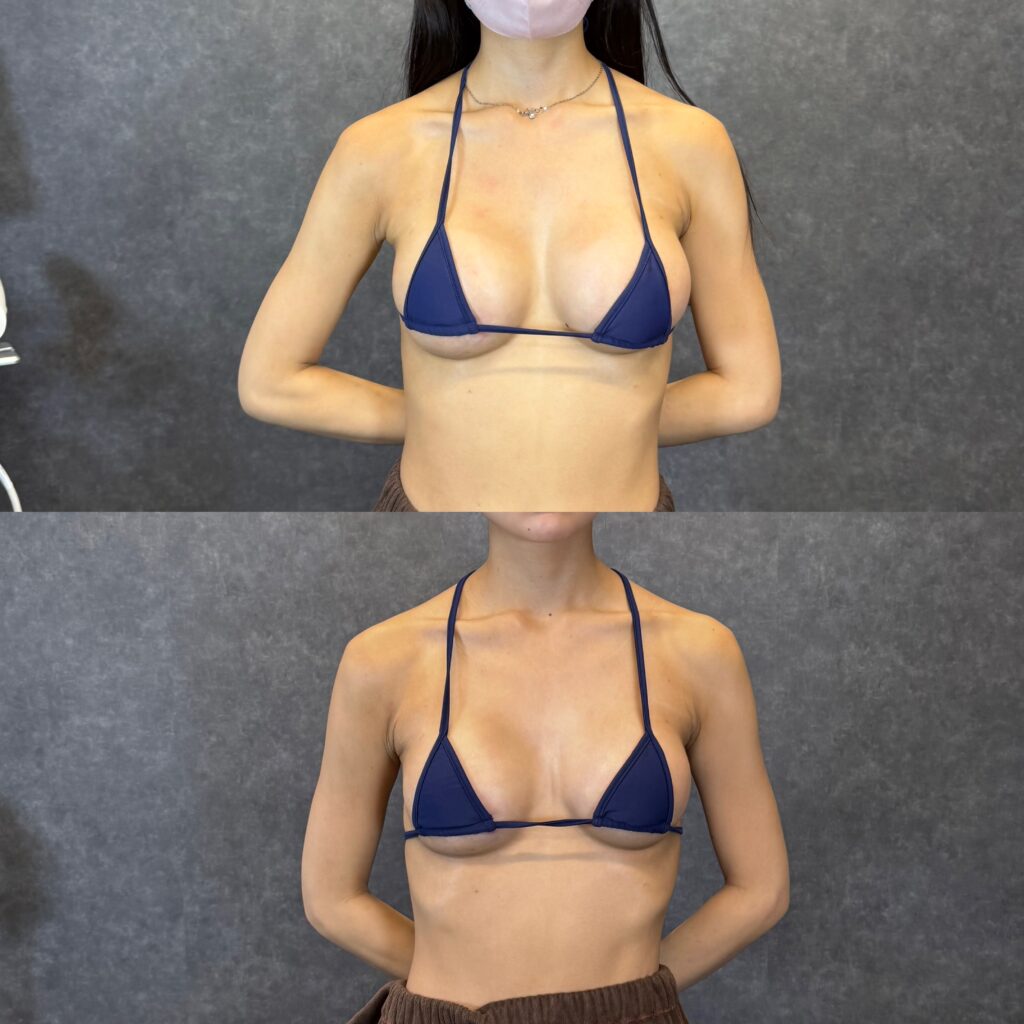
Case Information
Procedure
Secondary Hybrid Breast Augmentation (Fat Grafting After Silicone Breast Augmentation)
Injection Planes
Subcutaneous Layer and Intrapectoral Layer
Risks and Complications
Infection, fat necrosis, palpable lumps, calcification, partial fat resorption, capsular contracture, asymmetry, sensory changes, skin tethering, and scarring.
This article is intended for medical education purposes.