


Upper arm and forearm liposuction | Straight shoulder-to-wrist design explained2026.10.10
Among patients who want slimmer arms, many also say “the forearm below the elbow bothers me” or “if only the bat-wing is suctioned, won’t there be a step at the elbow?” To make the entire arm look thinner, we need to design not only the back of the upper arm but also the shoulder, anterior surface, axillary area, and forearm as a single continuous line. This article uses a case of a woman in her 30s to explain the thinking behind upper arm and forearm liposuction, performed on the same day with full-circumference upper arm, forearm, accessory breast, and bra-fat suction.
Key points
・Upper arm and forearm liposuction is designed as a single straight line from shoulder to wrist
・Suctioning only the back (bat-wing) leaves bulk on the shoulder, anterior surface, and below the elbow, so the arm does not look overall thinner
・Accessory breast and bra-fat shape the border between arm and torso; without treating them, no clear gap appears when the arms are lowered
・Where muscle bulk makes the arm look thick, Botox can be used in addition to liposuction
・Outcomes vary; contracture, asymmetry, bruising, and infection are among the risks to understand before deciding
Why upper arm and forearm liposuction should be designed as one continuous line
When patients think about slimming their arms, they usually picture the back of the upper arm — the so-called bat-wing. However, if only that area is suctioned while the shoulder, anterior surface, axillary region, and forearm are left alone, only the back of the arm narrows, and a step easily forms at the elbow and wrist. The result is an imbalance: “the suctioned part is thin, the rest looks the same.”
If we treat upper arm and forearm liposuction as one unified design, the starting point is: “What straight line does the arm draw from shoulder to wrist when viewed from the front?” We mark the shoulder bulge, the inner and outer lines of the upper arm, the elbow region, and the medial and lateral thickness of the forearm while the patient stands, then plan suction volume and layers accordingly.

Circumferential upper arm suction: shaping the bat-wing, shoulder, and anterior surface as one contour
Subcutaneous fat on the upper arm is continuous: not just the bat-wing (posterior), but the shoulder bulge, the anterior fullness, and the thickness wrapping around to the posterior axilla all flow into one another. If we suction only the bat-wing, the remaining anterior surface and shoulder become relatively prominent, and the arm often looks “thin from behind but unchanged from the front.”
In circumferential suction, we separate the superficial and deep layers and reduce each uniformly. The superficial layer heavily affects skin tightness, and over-suction here causes irregularities and fibrosis. The deep layer tolerates volume reduction with fewer surface irregularities and plays the main role in volume loss. Preserving the layer balance and prioritizing line continuity maintains a three-dimensional, natural appearance.
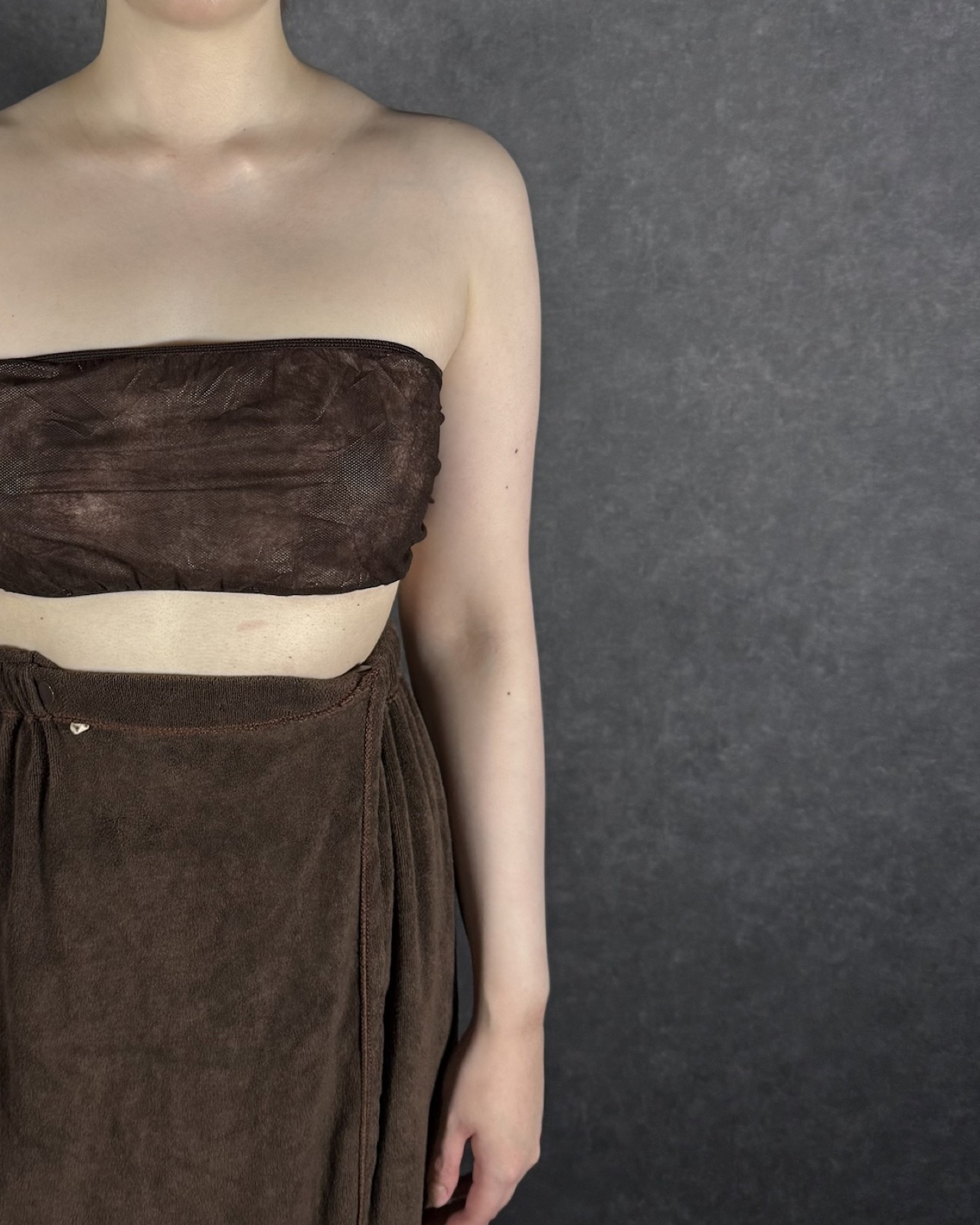
Extending to the forearm: suction design where skin and fat layers are thin
The forearm has thin skin and a thin subcutaneous fat layer, so suction technique shows directly on the surface. Wrong cannula gauge, wrong layer, or wrong motion can quickly cause over-suction or irregularities in the superficial layer. In this case we fine-tuned the balance between superficial and deep layers so that the line from the upper arm would not break at the elbow.
Bulk below the elbow is often not a matter of fat “volume,” but of the flow from the upper arm being interrupted there. Rather than aggressively increasing suction volume in the forearm alone, prioritizing continuity from the upper arm and smoothing the forearm thinly and uniformly tends to give a more natural result.
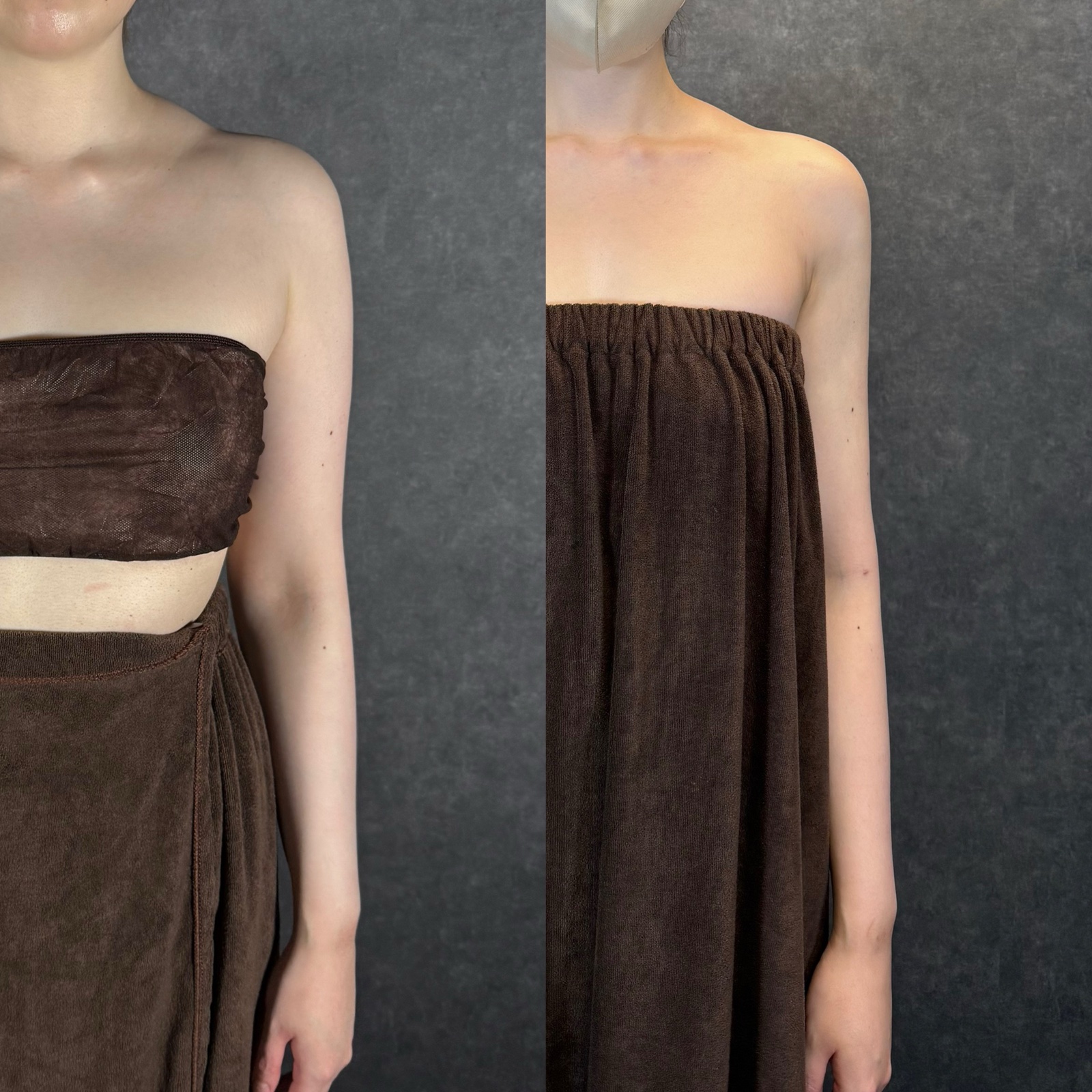
Accessory breast and bra-fat: the critical zone where arm meets torso
The accessory breast is a fatty fullness remaining at the anterior axilla; when arms are lowered, it thickens the line from the outer breast to the underarm. Bra-fat is thickness continuing from the posterior axilla to the back and is a cause of visible bra-strap steps. These two areas are not directly continuous with the upper arm, yet they are the single biggest factor determining whether a clear gap appears between the arm and the body when the arms hang down.
Even if the upper arm is slimmed, leaving the accessory breast and bra-fat untreated creates the appearance of flesh sitting on top of the arm’s root, so the arm does not read as overall thinner. In this case we approached both the anterior and posterior axilla so that a clear gap could be seen at the arm-torso border.
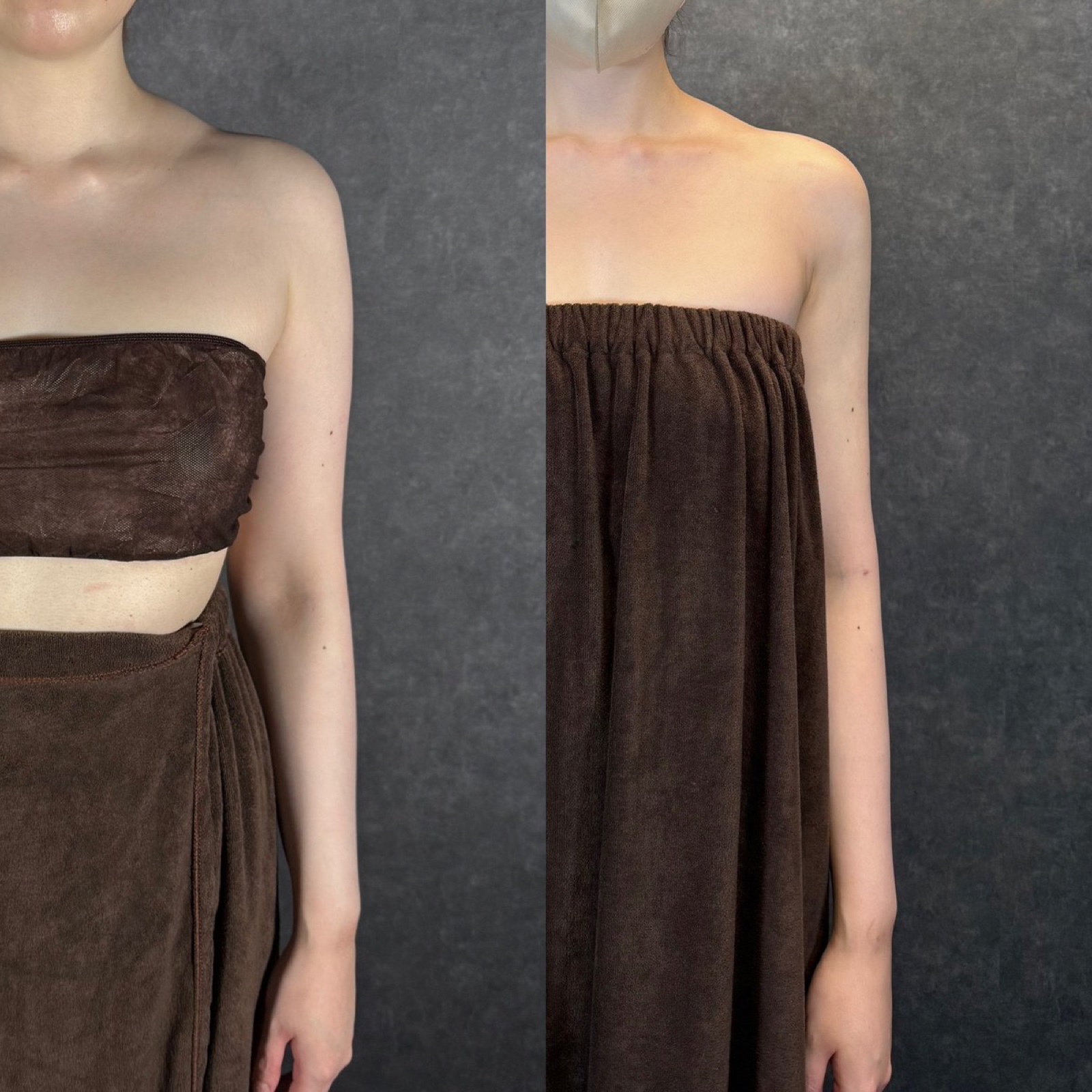
Treatment details, cost, and risks of this case
Treatment performed: For a woman in her 30s, we performed, on the same day, liposuction of the circumferential upper arm (bat-wing, shoulder, anterior), forearm, accessory breast, and bra-fat. In parallel, Botox injections were used in the shoulder, deltoid, and forearm to soften bulk arising from muscle volume, and a small dose was placed at the incision sites to help reduce scar prominence. Anesthesia combined tumescent infiltration with intravenous and inhalational anesthesia. Total aspirate was 900ml and operative time was about 1 hour 30 minutes. A bolero-type compression garment was worn postoperatively.
Cost: Please see our price page. Monitor pricing requires consent to photographs and video; the final total is confirmed at consultation.
Main risks and side effects: Bruising, swelling, contracture (firmness and irregularities), asymmetry, numbness, infection, hematoma, seroma, and — very rarely — serious complications such as deep vein thrombosis or fat embolism. Botox-treated sites may show transient muscle weakness, unusual sensation, and individual variation in effect. Response and course vary between individuals; the photographs show one example.

Contribution of muscle volume: thickness that liposuction alone cannot change
Arm and shoulder thickness depends not only on fat but also on the muscle volume of the deltoid, upper arm muscles, and forearm muscles. In patients with developed musculature, fullness may remain in the shoulder or forearm line even after fat has been fully suctioned. In this case we added small Botox doses to the shoulder, deltoid, and forearm to soften bulk arising from muscle volume.
Addressing muscle volume requires careful dosing and site selection, because excessive dosing can cause muscle weakness or asymmetry. A small dose was also placed at incision sites to help reduce scar prominence. For safety standards in aesthetic surgery, see the Japan Society of Aesthetic Surgery, which emphasizes safety management and indication judgment.
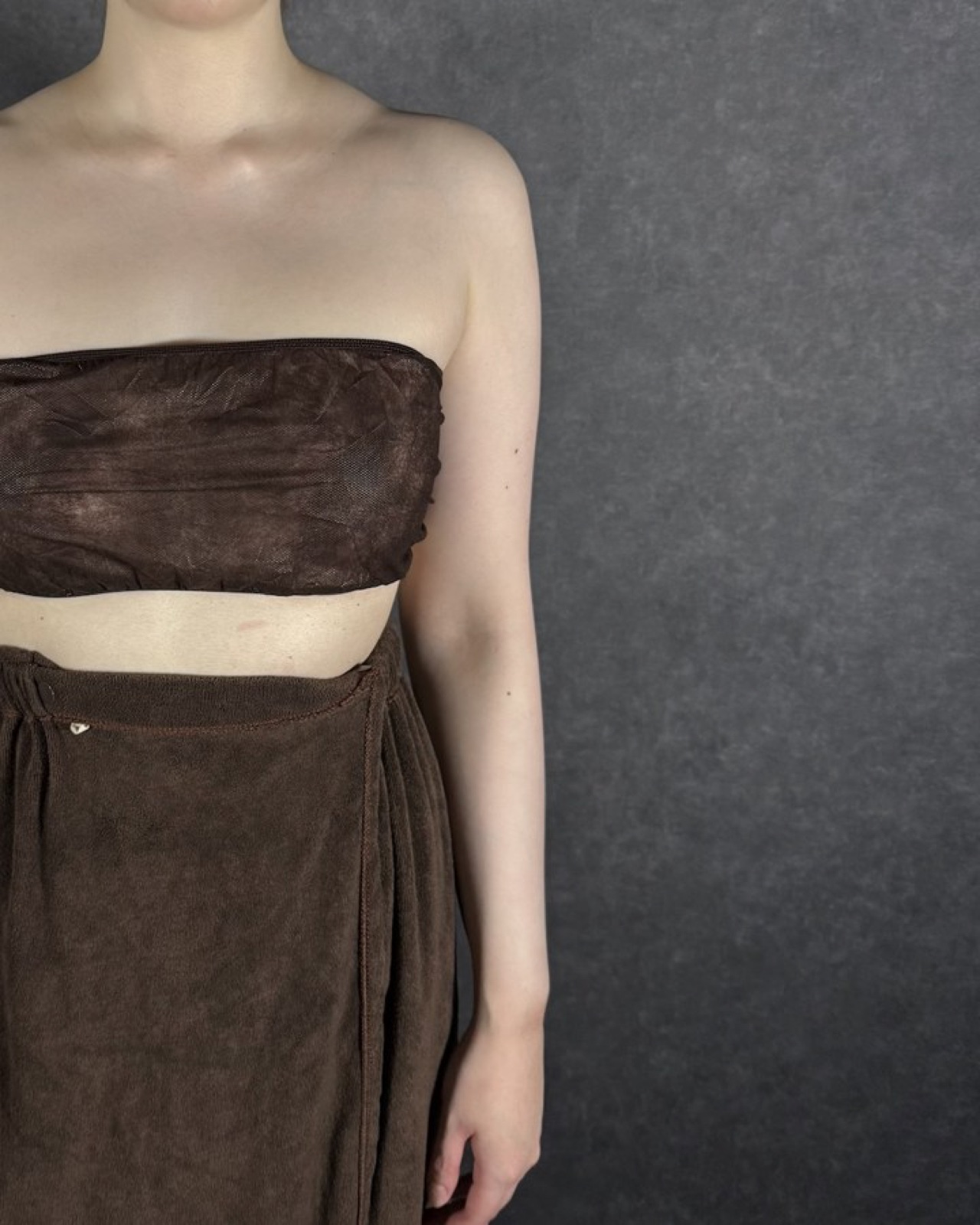
Six-month course: lines settle and skin smooths
At six months, post-liposuction contracture (fibrosis) subsides and skin smoothness returns. In this case, the width of the upper arm from root to elbow became narrower, and the front-view line from shoulder to wrist became straight. The anterior axillary fullness decreased, and a visible gap appeared between the arm and the torso when the arms were lowered.
Below the elbow, forearm bulk also decreased, and the flow from upper arm to forearm became naturally continuous. Course and response vary; how contracture settles and how much the skin tightens depends on individual subcutaneous fat distribution, skin elasticity, lifestyle, and weight fluctuation.
What this case teaches us about design judgment in upper arm and forearm liposuction
What I kept in mind for this case was not “how much to suction” but “what to make continuous.” Once upper arm and forearm liposuction is seen not as a standalone procedure but as a redesign of the single line from shoulder to wrist, the treated zone naturally expands to include the full circumference, accessory breast, and bra-fat. The forearm is positioned less as a volume-removal area and more as a zone to be thinned uniformly to secure continuity.
Such circumferential designs — including indications, risk assessment, and judgment about muscle volume — are reviewed one by one at consultation. For related liposuction thinking, see our liposuction column index.
Treating the arm as a single continuous line is a basic design principle for achieving both a natural result and a visible three-dimensional gap between arm and torso when the arms hang. Because indications, muscle volume, and skin condition differ for every patient, the exact scope is decided at consultation.
Frequently asked questions
Q. Is forearm suction really needed in addition to upper arm suction?
Yes — if the forearm shows clear bulk, or if circumferential upper arm suction is planned and a step at the elbow is anticipated, we often propose a design that includes the forearm. The forearm is not treated to extract large volume, but to keep the line from the upper arm from breaking at the elbow.
Q. Why combine Botox at the shoulder and forearm?
Arm thickness depends not only on fat but also on muscle volume of the deltoid and forearm muscle groups. In patients with strong muscle bulk, liposuction alone may not reach the ideal line, so small Botox doses may be combined to soften muscle-derived fullness.
Q. How long is postoperative compression needed?
A bolero-type compression garment was used in this case. Duration and wear time are adjusted based on the course of swelling, bruising, and contracture, but generally firm compression is maintained for several weeks after surgery and then gradually relaxed.
Q. How long until the result of upper arm and forearm liposuction is clear?
Swelling settles over several weeks, the contracture (fibrosis) peak is 1–3 months, and the result tends to look settled around six months. Course varies between individuals, and firmness or irregularities may persist, so follow-up visits are important.
Q. Is downtime heavy when the full circumference plus forearm are done at once?
Yes — a wider treatment area tends to increase swelling, bruising, and compression burden. However, splitting into separate sessions can misalign the contracture timeline between sides and layers and make matched results harder. We decide together, considering your schedule and physical reserve.
──────────────
Supervising physician: Shin Moriwaki, MD
Member, Japan Society of Aesthetic Surgery (JSAS) / Member, American Academy of Aesthetic Medicine
ECFMG Certificate
──────────────
📍AVAN TOKYO GINZA LIPOSUCTION CLINIC
English / 中文 / Tiếng Việt supported
Reservations and inquiries via DM / LINE / Website / Phone.