


How Much Fat to Inject in Hybrid Breast Augmentation? 80ml per Side from Circumferential Thigh Harvest2026.09.19
Patients considering hybrid breast augmentation (silicone implant combined with fat grafting) sometimes ask, “Can you take as much fat as possible and inject as much as possible so my breasts become larger?” In practice, we do not inject all of the harvested fat as it comes out. This article looks at one case of a woman in her thirties who underwent hybrid breast augmentation with fat harvested from the entire circumference of the thighs — of which only 80 ml per breast was actually grafted. Following the real numbers, we explain the medical logic that determines hybrid breast augmentation injection volume.
Key points
・Hybrid breast augmentation injection volume is not calculated as “inject everything harvested,” but by working backward from graft survival and complication risk.
・In this case 800 ml was aspirated from the thighs, but after processing only 270 ml of concentrated fat remained, and only 80 ml per breast (160 ml total) was actually injected.
・When an implant is placed at the same time as fat grafting, the space in the subcutaneous layer above the implant is limited, so the injection volume is designed conservatively.
・Choosing the thighs circumferentially as the donor site secures a sufficient volume of fat while also refining the lower-body silhouette.
・At 6 months, fat resorption and thigh fibrosis have largely settled, and the result is close to its final state.
Why hybrid breast augmentation injection volume was “80 ml per breast”
In this case, circumferential thigh liposuction (as far as could be reached from the anterior approach) yielded 800 ml of aspirate in total. Yet only 160 ml of fat (80 ml per breast) was actually injected into the breasts. Where did the remaining 640 ml go? Two factors are at play: the unavoidable losses during fat processing, and a safety ceiling on injection volume per breast.
From aspirate to usable fat
Fluid removed by liposuction contains not only fat cells but also tumescent anesthetic fluid, blood, damaged fat fragments, and free oil. Injecting the raw aspirate directly would provoke inflammation at the recipient site due to anesthetic and impurities, and would greatly reduce fat cell survival. So the aspirate is left to settle, allowing impurities to sediment, and then centrifuged so that the top layer (oil) and bottom layer (water and anesthetic) are removed. Only the middle layer of “pure fat” is used.
In this case, 800 ml of aspirate produced 320 ml of pure fat, which was then briefly centrifuged at a low speed to yield 270 ml of concentrated fat. Excessive centrifugation rupture fat cells mechanically and lowers survival, so we choose conditions that remove impurities while minimizing cell damage. Typically only 30–40% of the initial aspirate becomes usable fat.
Not exceeding the per-breast ceiling
Even with 270 ml of concentrated fat in hand, injecting all of it into both breasts in a single session is not advisable. The survival rate in fat grafting to the breast depends on the blood supply of the recipient bed and the distance between the injected fat and living tissue. Injecting beyond the range that circulation can reach leads to ischemic necrosis in the center, forming firm nodules or oil cysts. When an implant is placed at the same time, the implant expands the subcutaneous tissue outward from inside, further limiting the space available for safe fat placement.
In this case, a Perle 255cc implant was placed subglandularly, and 80 ml of fat was injected into the subcutaneous layer covering it on each side. The 80 ml figure was chosen as “the volume that can reasonably be expected to survive in the subcutaneous tissue over the implant.” Technically it is possible to inject 100 or 120 ml, but the risks of nodule formation, worsened resorption, and effects on the capsule rise step by step. It is safer to design conservatively at the first session and, if needed, add more at a second session after enough time has passed.
The meaning of choosing the entire thigh circumference as the donor site
When securing hybrid breast augmentation injection volume, the choice of donor site strongly affects the outcome. In this case, “circumferential thighs” were chosen — meaning the thigh is viewed 360 degrees (anterior, medial, lateral) and liposuction is performed evenly within reach from the anterior approach.
There are two advantages to treating the thighs circumferentially. First, sufficient fat volume is easier to secure — the thighs hold a lot of fat compared with the arms or abdomen, so the amount needed for augmentation can be covered in a single operation. Second, the silhouette is easier to refine — concentrating liposuction on one aspect (only the outside, only the inside) tends to create visible steps between the treated and untreated sides. Removing volume evenly around the entire circumference slims the thigh as a whole and produces a natural 360-degree contour, including the view from behind.
At the same time, thigh skin is thinner than that of the abdomen and prone to irregularity. We therefore vary the depth of cannulation across the anterior, medial and lateral aspects, layering suction lines so that no single spot is over-suctioned. Entry sites were placed small in the groin and on the inner knee, allowing the whole circumference to be approached from inconspicuous locations.
Treatment, cost and risks for this case
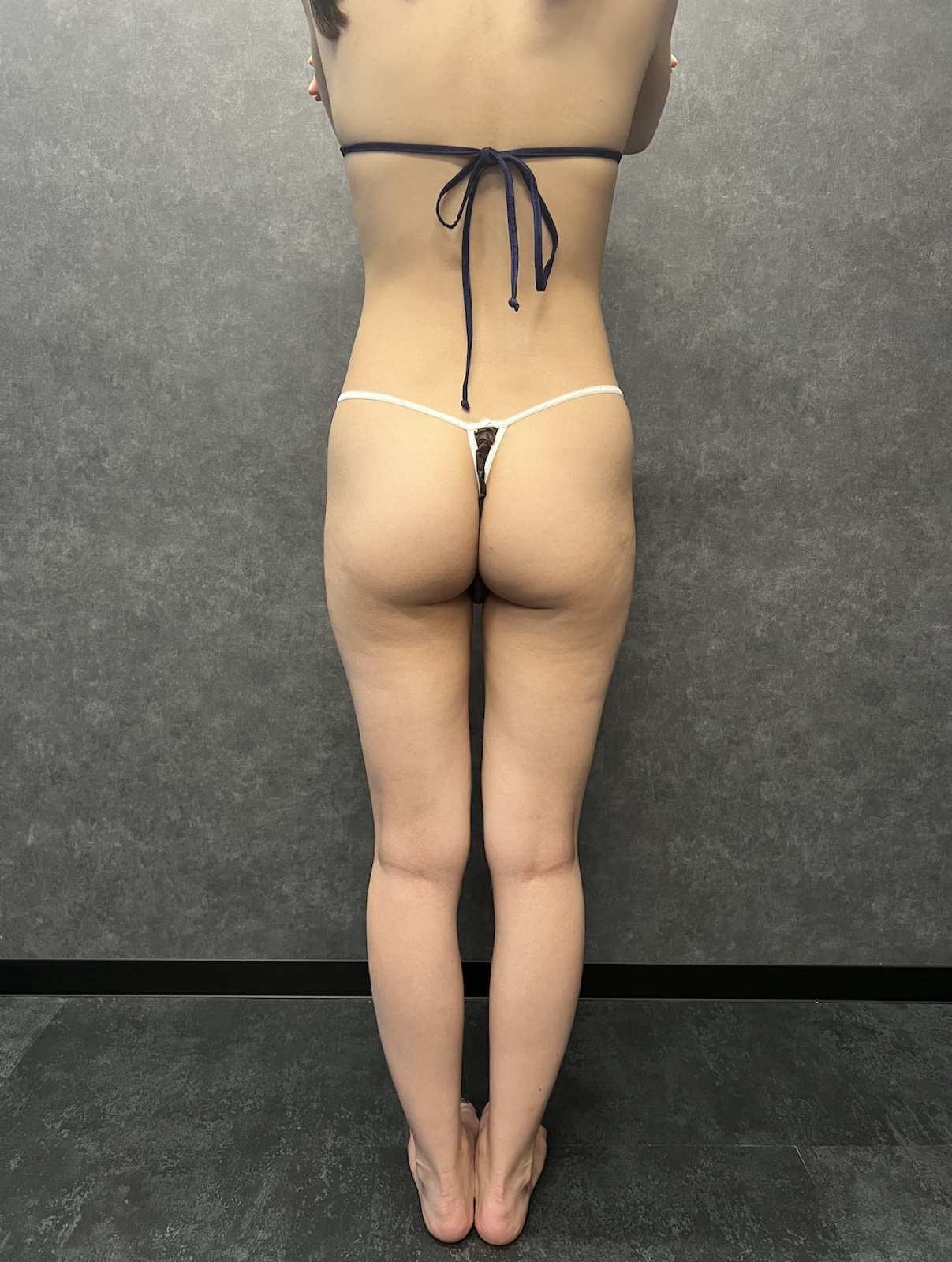
Treatment: Hybrid breast augmentation (Perle 255cc silicone implant, transaxillary incision, subglandular placement, plus fat grafting of 80 ml on the right and 80 ml on the left) combined with circumferential thigh liposuction (within reach from the anterior approach). One operation, results shown at 6 months postoperatively.
Cost: JPY 998,000 (tax included, monitor price). The JPY 998,000 for hybrid breast augmentation includes liposuction of one donor site — circumferential thighs. The monitor price is conditional on consent to photo and video documentation and may end without notice. The final total is confirmed at consultation.
Main risks and side effects: In the thighs, swelling, bruising, pain, edema, skin irregularity or tightness, asymmetry, pigmentation, small incision scars (groin and inner knee), infection, hematoma, and numbness may occur. In the breasts, graft survival varies between individuals and calcification, lumps, or oil cysts may form. Regarding the silicone implant, capsular contracture, rupture, malposition, rippling, infection, and changes in nipple or breast skin sensation may occur. The implant is not permanent and may require replacement or removal over time. Results vary between individuals; the photograph shown is one example. If you have concerning symptoms, please consult your doctor rather than self-diagnosing. For safety standards in aesthetic surgery, please also refer to the Japan Society of Aesthetic Surgery.
Progress at 6 months and reaching the final result
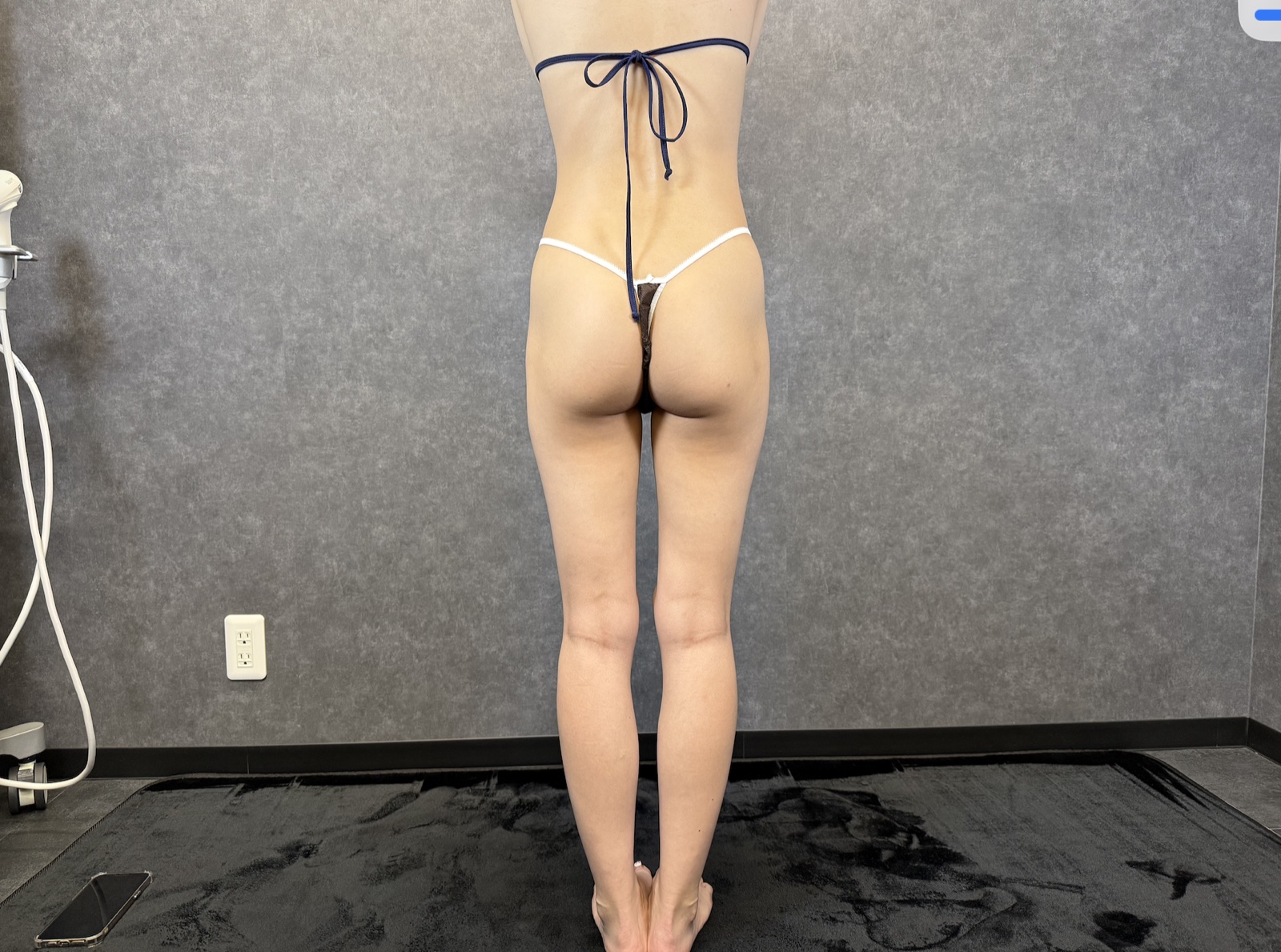
At 6 months, thigh swelling and bruising had settled, and firmness from fibrosis had softened. The fullness from beneath the buttocks to the outer thighs had reduced, and the line now tapered toward the knees. Because the whole circumference was treated, the silhouette from behind was noticeably slimmer.
As for the grafted fat, the balance of survival and resorption stabilizes between 3 and 6 months, and by 6 months the volume is close to its final state. If the result feels “a little modest” at this point, additional grafting can be planned as a second session after an appropriate interval. Conversely, if too much fat was injected greedily at the first session, the risks of nodules and capsular contracture rise, and revision surgery becomes more difficult. In designing hybrid breast augmentation injection volume, “finish safely and add if needed” is more realistic than “complete everything in one go.”
For related techniques and case courses, please also see our related column list.
Frequently Asked Questions
Q. Does a larger hybrid breast augmentation injection volume always give a better result?
No — more is not necessarily better. Injecting beyond the range that the breast blood supply can reach leads to necrosis in the center, which causes nodules and oil cysts. Especially when an implant is placed at the same time, the subcutaneous layer above the implant is limited in space, and 80–100 ml per breast is a realistic range.
Q. If 800 ml was aspirated from the thighs, why was only 160 ml injected into the breasts?
The aspirate contains anesthetic fluid and blood and cannot be injected as it is. After centrifugation to remove impurities, only about 30–40% of the aspirate remains as usable concentrated fat. Furthermore, the safe injection volume per breast has an upper limit, so any excess fat must be discarded.
Q. Which is better — circumferential thigh liposuction or partial liposuction?
If the goal is to secure fat volume for hybrid augmentation while also refining the donor-site silhouette, circumferential liposuction is well suited. Reducing volume evenly around all sides balances the 360-degree view, including the rear. However, the indication depends on subcutaneous fat thickness and skin quality, so please discuss with us at consultation.
Q. Will the thigh scars be noticeable?
Circumferential thigh liposuction uses small millimeter-scale incisions in the groin (leg crease) and inner knee. These usually become gradually less noticeable, though pigmentation or hypertrophic scarring can occur depending on skin type. The scars are placed where they can be hidden under underwear or in the natural knee crease.
Q. Can I consider the result complete at 6 months?
Thigh silhouette and injected-fat volume largely settle at 6 months and approach the final state. However, implant integration and capsule maturation continue for longer, so watching the result for around a year is a safer benchmark.
──────────────
Supervised by Dr. Shin Moriwaki
Member, Japan Society of Aesthetic Surgery (JSAS) / Member, American Academy of Aesthetic Medicine
ECFMG Certificate (US medical qualification)
──────────────
📍AVAN TOKYO GINZA LIPOSUCTION CLINIC
English / 中文 / Tiếng Việt available
Contact us via DM / LINE / Website / Phone for appointments and consultations.