


Lateral profile hybrid breast augmentation | Fat placement for a natural slope2026.10.09
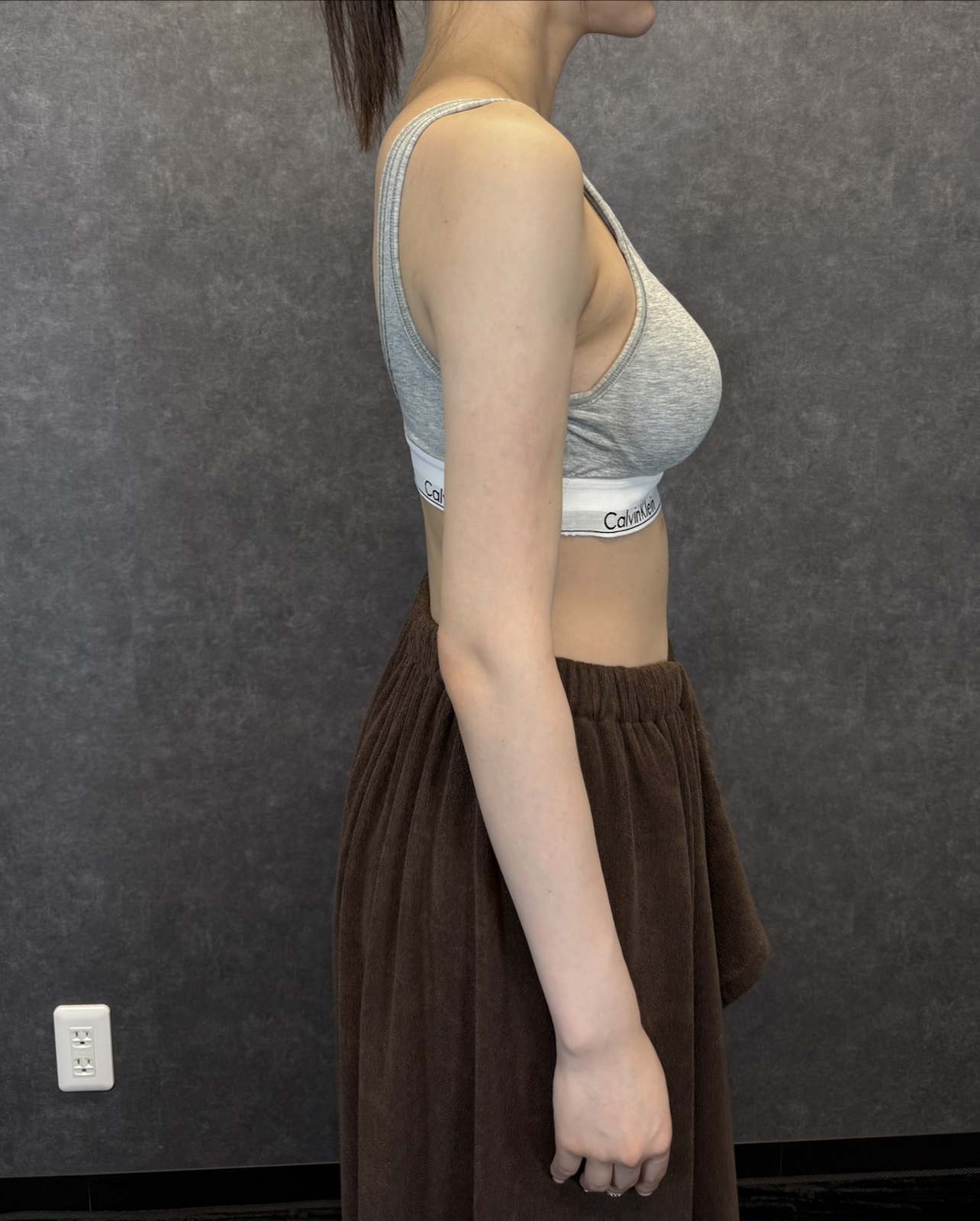
The slope of the breast as seen from the side is just as important as the cleavage or fullness seen from the front. Lateral profile hybrid breast augmentation is a technique that uses a silicone implant to establish forward projection and layers autologous fat on top, creating a smooth gradient from the décolletage to the breast top. In patients with a thin chest wall and little subcutaneous fat, the edge of the implant is more likely to be visible as a step from the side, so the design of this “upper cover fat” determines the result. In this article, we present a case of a woman in her 20s and explain how fat is placed to refine the lateral profile.
Key points
・In lateral profile hybrid breast augmentation, the most important element is fat placement that smooths the slope from the upper chest to the breast top
・In slim patients with a flat chest wall, an implant alone can show a step or rippling when viewed from the side
・Cover fat in the subcutaneous layer masks the implant edge; submuscular fat reinforces the foundation
・Harvested fat loses about 20–30% during processing, so harvest volume and injection volume must be planned separately
・When asymmetry is present, injected volumes are adjusted so the two sides look symmetric in profile
What lateral profile hybrid breast augmentation aims for
Breast beauty is often discussed in terms of cleavage or fullness seen from the front, yet many patients who feel “the result looks different from the reference photos” are reacting to the side-view slope. Three elements shape the lateral profile.
First, the slope from the sub-clavicular area down to the upper chest. A sudden rise creates an artificial appearance. Second, the position of the breast top. A natural line projects slightly forward of the chest wall, moving with — not against — gravity. Third, the lower pole curve. A smooth rise from the inframammary fold determines the beauty of the profile.
Lateral profile hybrid breast augmentation designs these three elements simultaneously: the implant establishes the breast top and base volume, while fat refines the upper, lateral, and lower contours.
Why lateral design matters most for slim and flat-chest patients
Patients with a thin chest wall and limited subcutaneous fat are more likely to show the upper edge of the implant as a visible step when viewed from the side. This is because there is no cushioning tissue over the upper chest, so the implant contour is transmitted directly to the skin.
In particular, patients with limited décolletage fat or a mildly protruding chest wall (rib flare tendency) are more prone to rippling and visible edges, because the upper rim of the implant sits closer to the dermis. To refine the lateral profile, we must decide preoperatively where and how much “upper cover fat” to place.
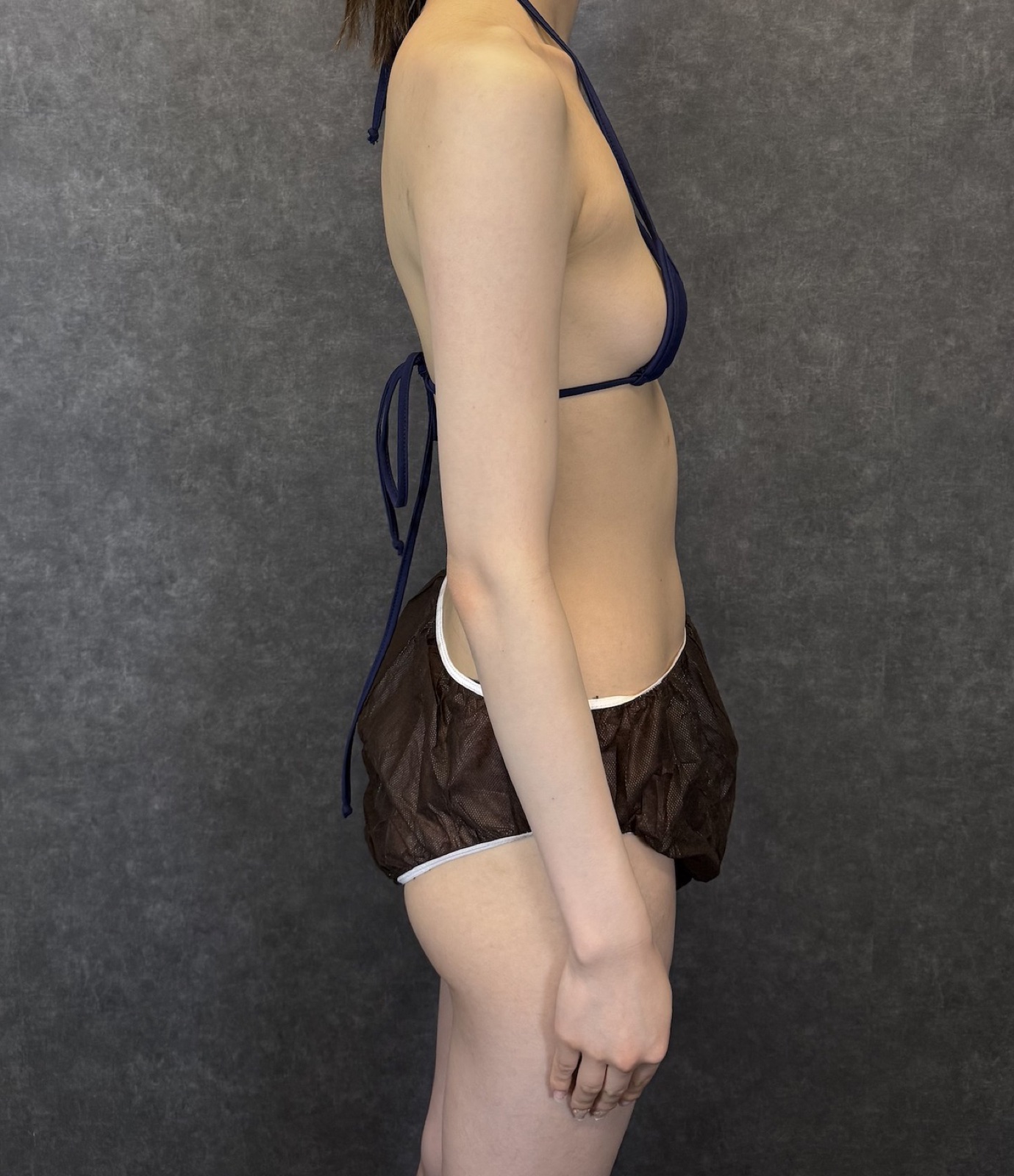
Layered fat placement that shapes the lateral slope
In hybrid breast augmentation, fat is injected into two main layers: subcutaneous and submuscular. Combining both allows a three-dimensional lateral profile design.
Fat in the subcutaneous layer functions mainly as “cover fat,” masking the implant contour and determining skin smoothness in profile view. It is placed preferentially along the décolletage, upper-outer quadrant, and lower pole curve. Fat in the submuscular layer (beneath the pectoralis major) functions as “foundation reinforcement,” thickening the platform on which the implant rests and improving forward projection and stability in profile view.
Injection ratios depend on skin and gland thickness, but in slim patients needing more cover, the subcutaneous proportion is weighted higher. Submuscular injection is kept to a “foundation-support” amount, as excessive volume there can prolong soreness and limit range of motion.
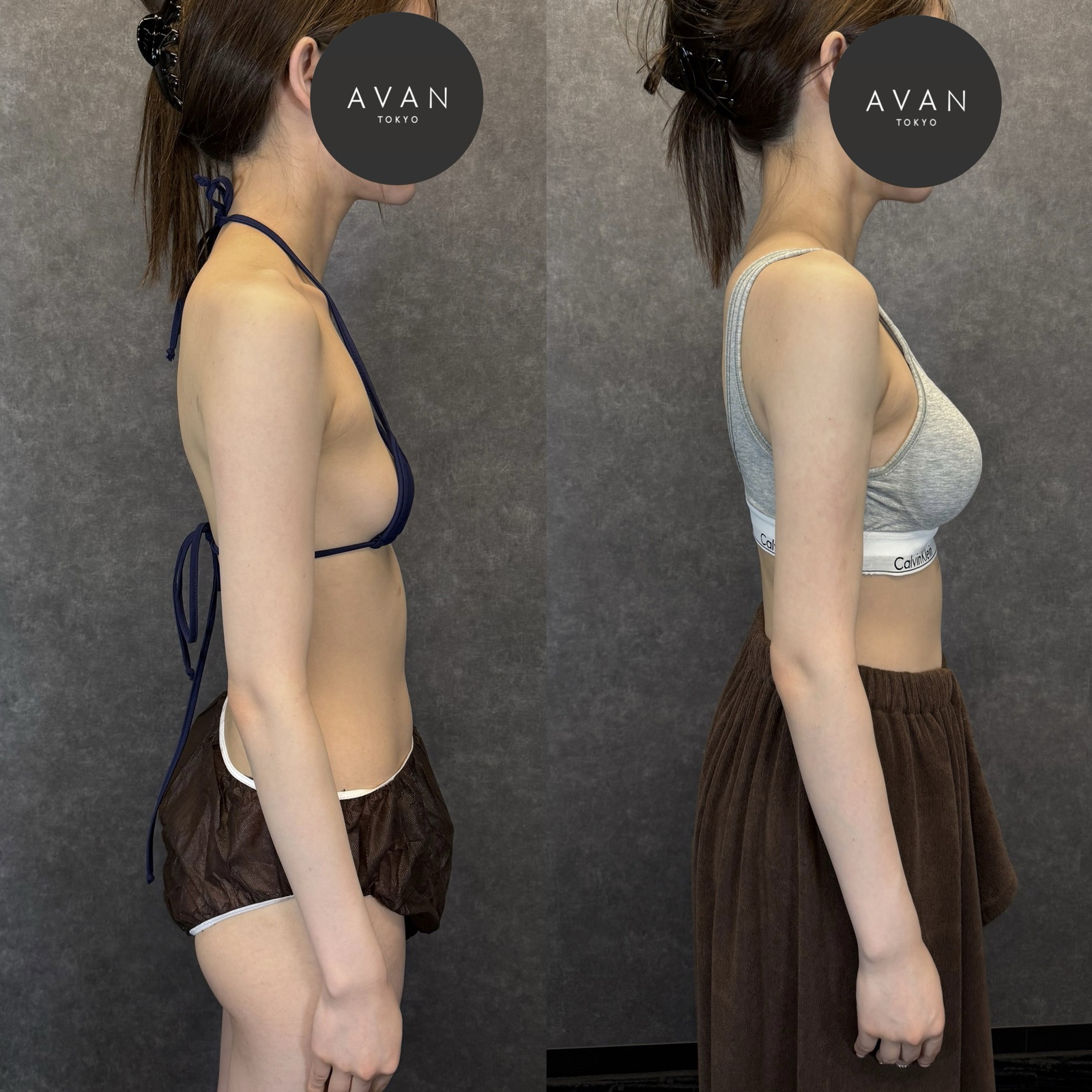
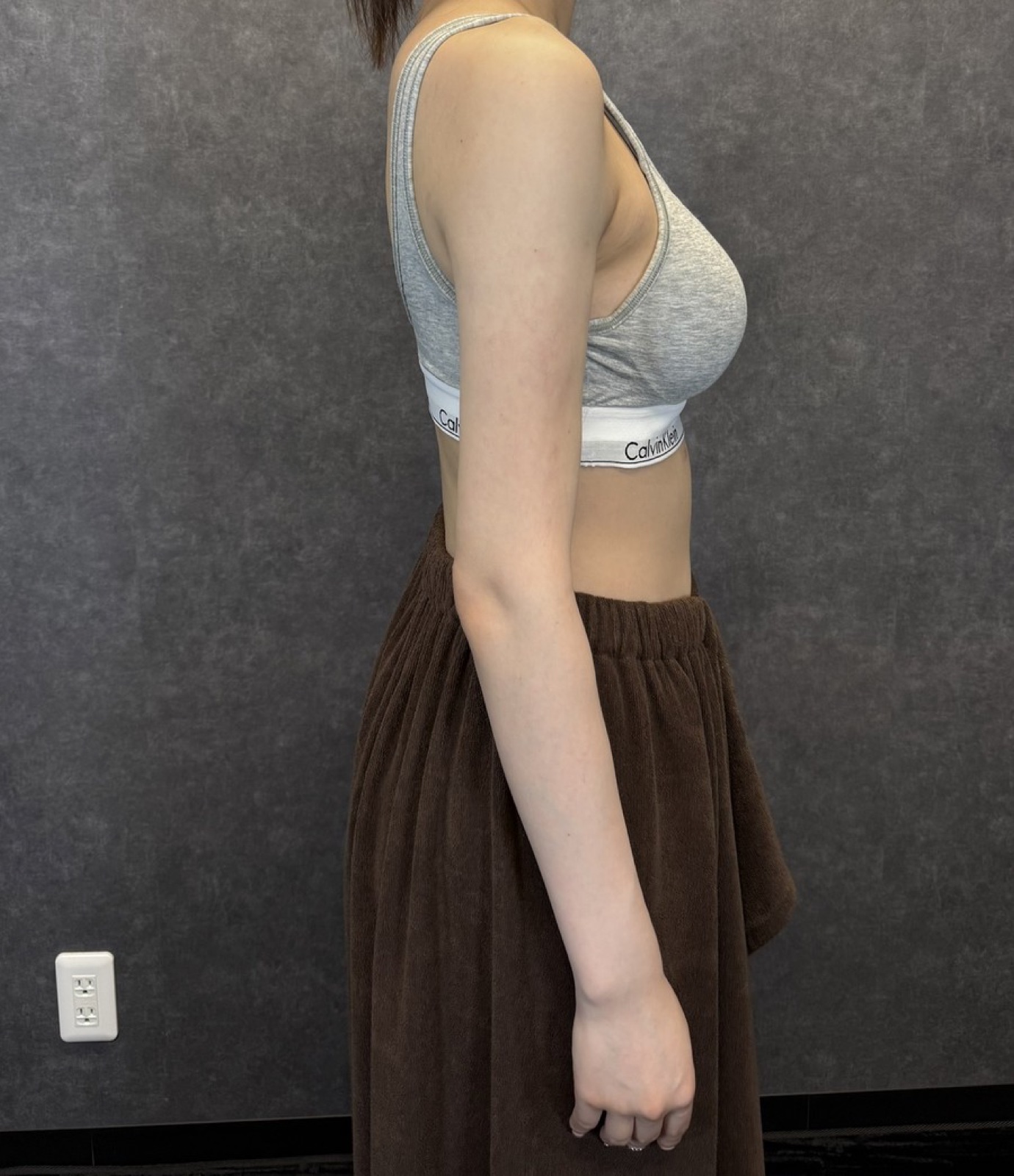
Treatment details, cost, and risks of this case
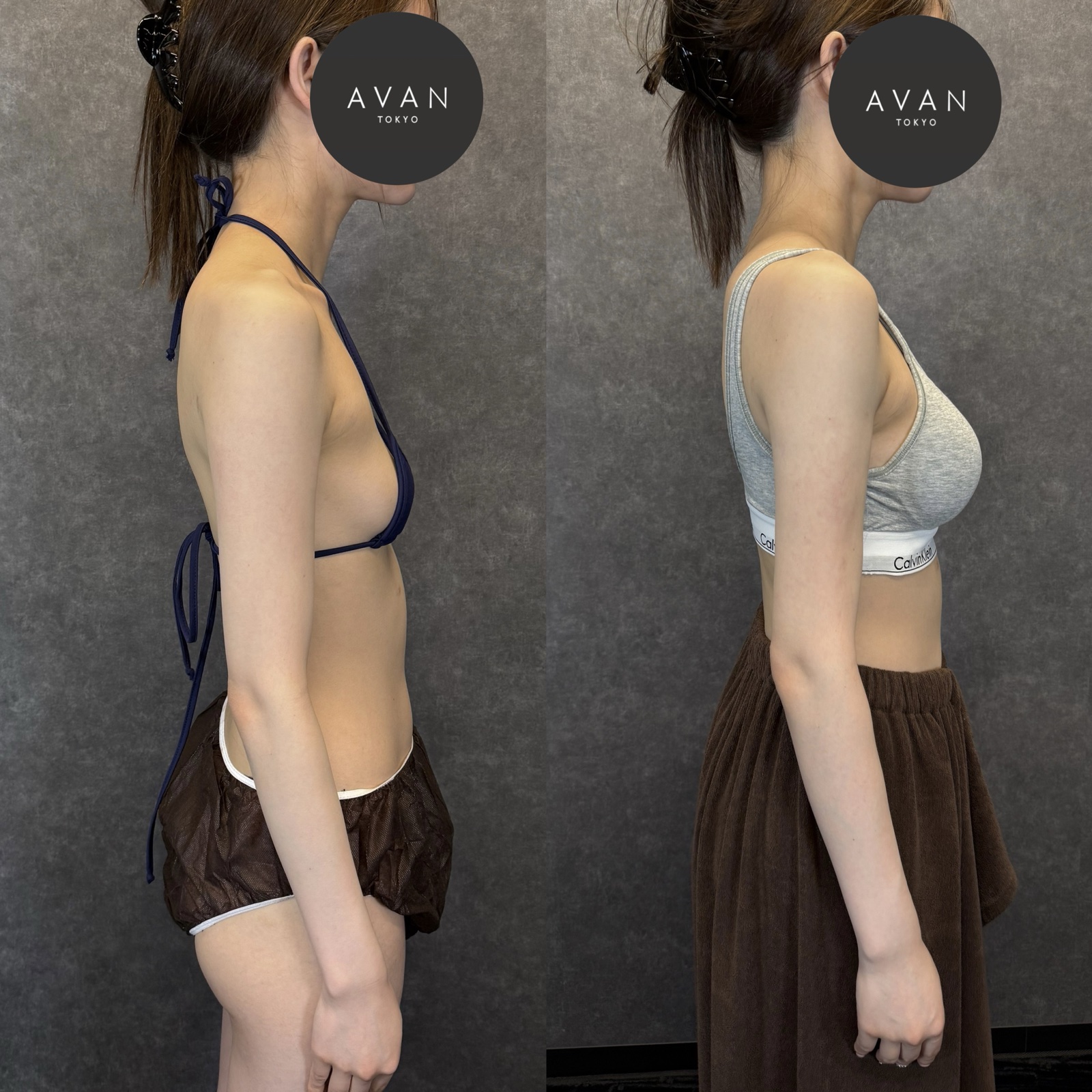
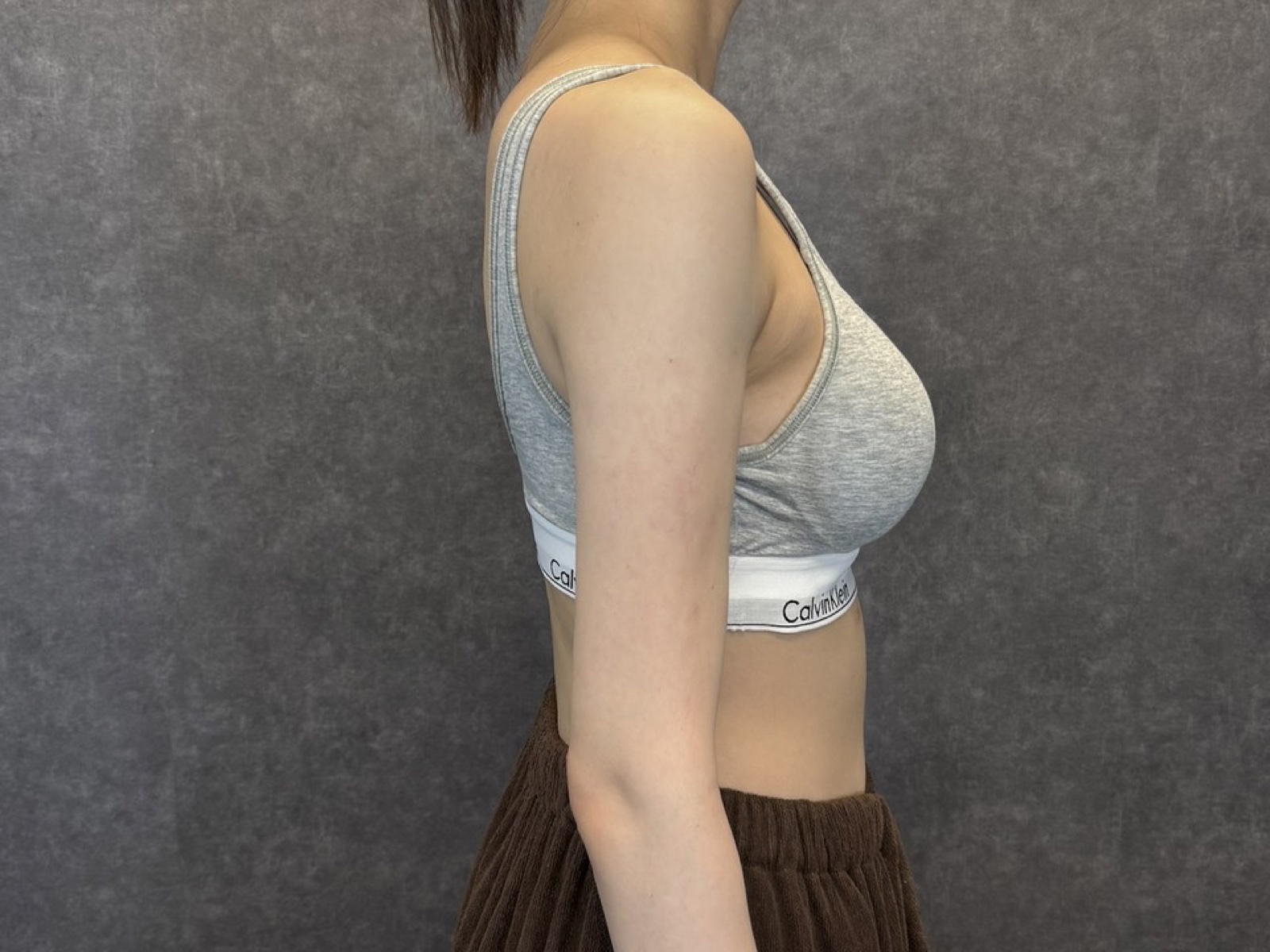
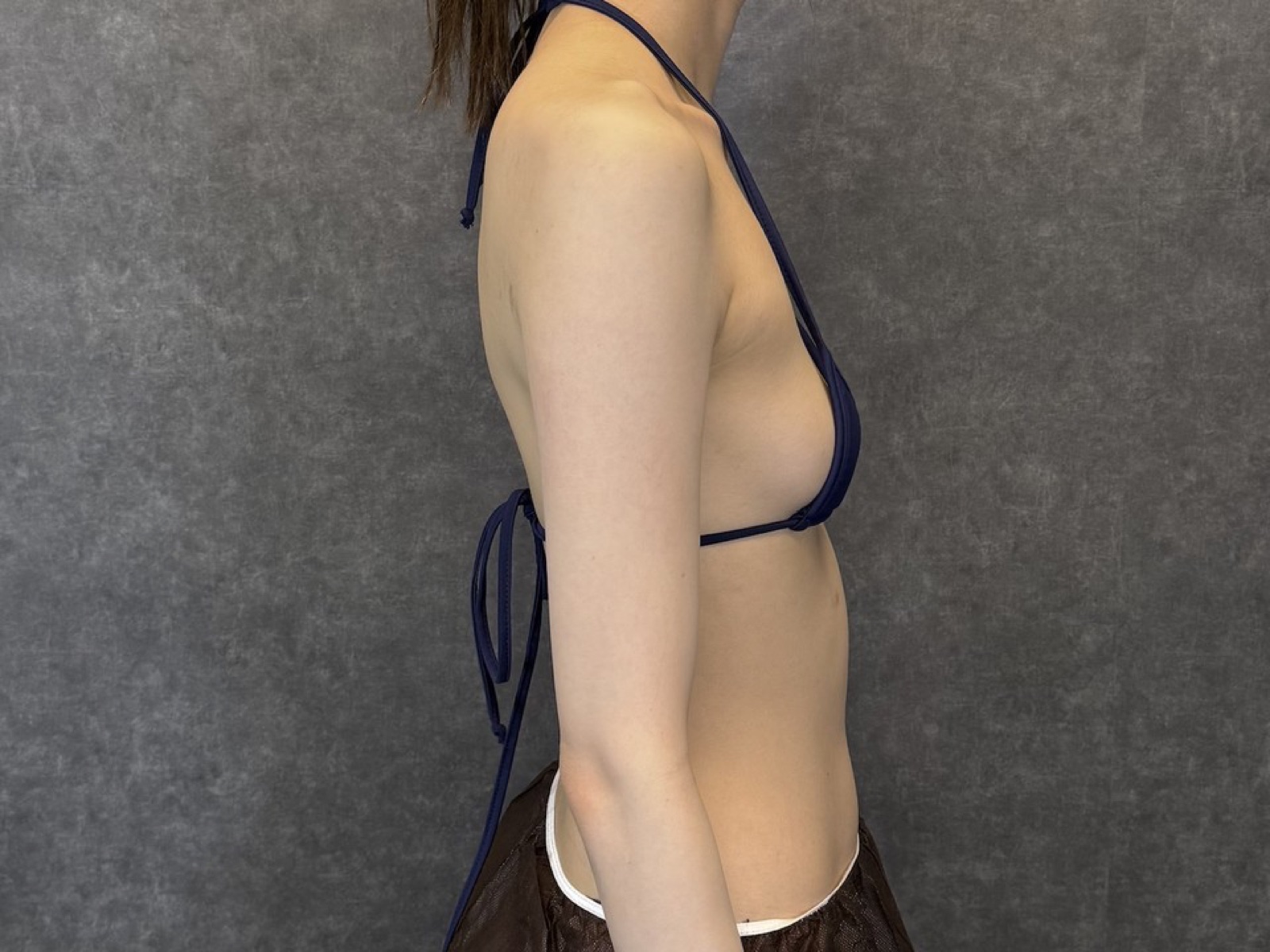
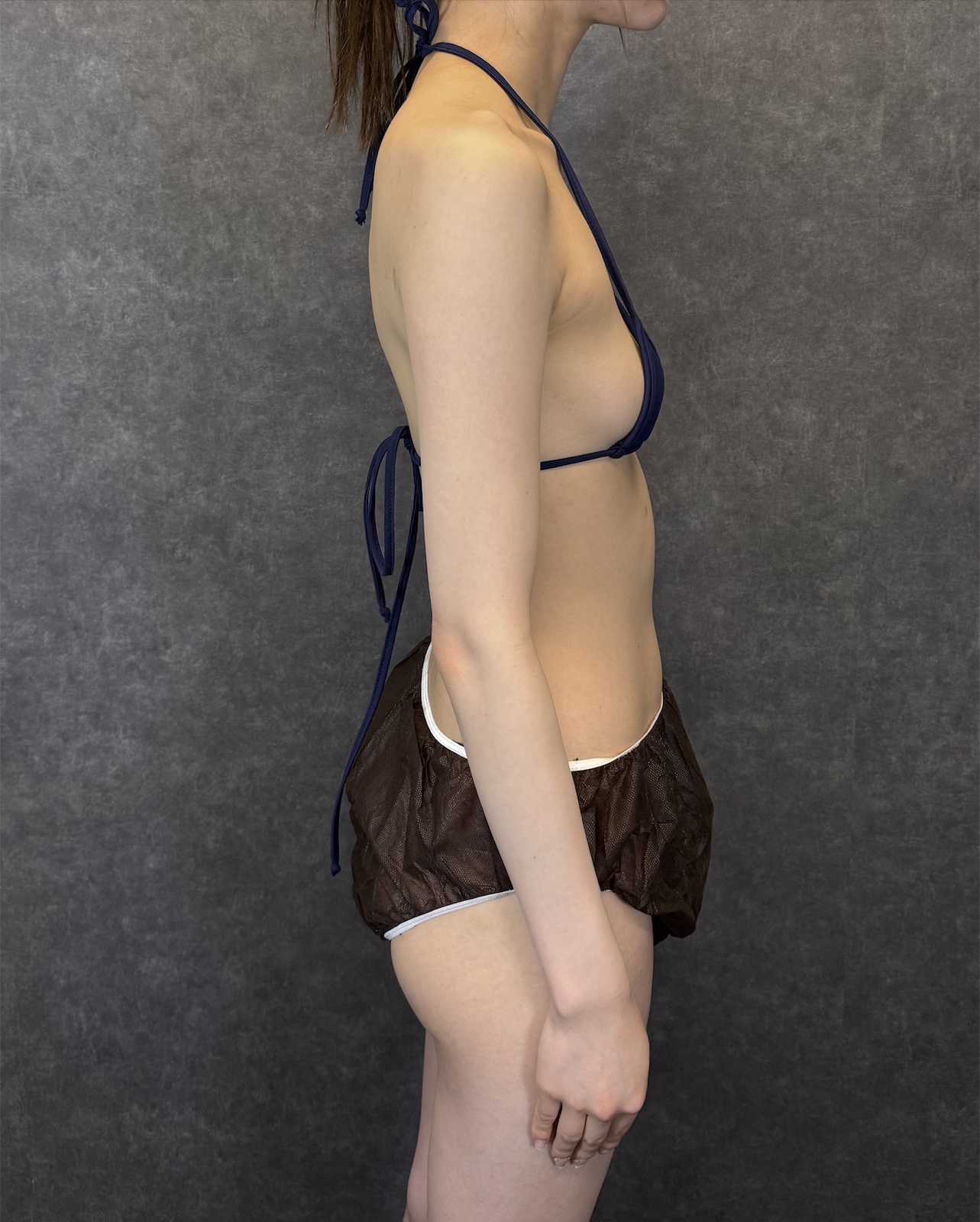
Here is an example of a lateral-profile-focused design in a woman in her 20s.
Treatment performed: On the same day, we placed a Motiva Mini 275cc implant in the subglandular plane through an axillary incision, performed circumferential upper arm and accessory breast liposuction, and injected processed fat (right 150ml / left 95ml, split between subcutaneous and submuscular layers). About 290ml of refined fat was prepared by low-speed centrifugation from 350ml of harvested fat.
Cost: Please see our price page.
Main risks and side effects: Bruising, swelling, firmness from fibrosis, asymmetry, partial fat resorption, oil cysts, lumps, capsular contracture, infection, and residual scarring may occur. The lateral profile changes over several months as fat retention stabilizes.
Results vary between individuals; the photos show one case.
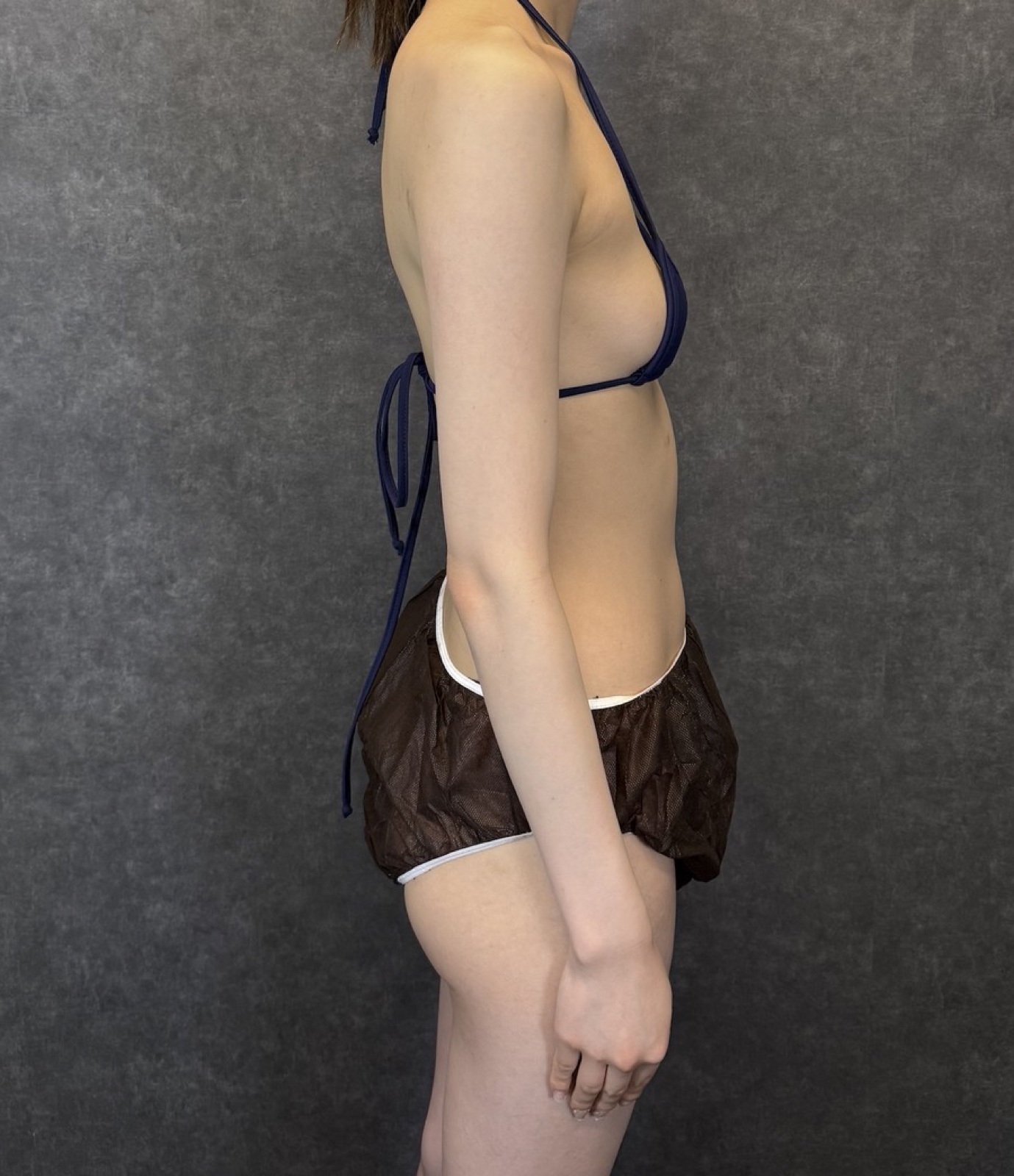
How the lateral line settles over time
For the first 1–2 weeks, swelling and bruising can make the breast appear slightly “high” in profile view. This reflects both the implant not yet fully settling into the subglandular pocket and edema around the grafted fat.
Between 1 and 3 months, partial fat resorption progresses and injected fat divides into retained and absorbed portions. The lateral profile may look slightly thinner during this phase, but by six months tissue remodeling allows the implant and surviving fat to blend, and the side-view slope approaches its final form.
What the surgeon prioritizes in lateral design
When designing the lateral profile, what I prioritize most is: where NOT to leave cover fat too thin. The upper implant rim, the subcutaneous area over the nipple, and the lateral axillary extension are places where even slight thinning of subcutaneous fat lets the contour show through. We place thicker fat in these zones from the start, calculating for post-resorption volume so that a minimum cover remains.
In patients with asymmetry, we do not simply equalize injection volumes. We inject more on the side with greater initial deficit, prioritizing matching slopes in profile view. In this case, we used right 150ml / left 95ml — a 55ml difference. For aesthetic surgery safety standards, you may also refer to the Japan Society of Aesthetic Surgery.
For related explanations, see our liposuction column index.
Frequently asked questions
Q. Is lateral profile hybrid breast augmentation suitable for slim patients?
Yes — slim patients actually benefit the most from this lateral profile design. Because the subcutaneous tissue is thin, an implant alone tends to show its edge, but actively placed cover fat produces a natural slope in profile view. That said, harvestable fat is limited, so donor site selection and implant size are decided carefully.
Q. When does the lateral profile stabilize?
Generally around six months postoperatively, the implant and surviving fat blend together and the lateral slope settles. For 1–2 weeks the breast appears larger due to swelling, and between 1–3 months partial resorption may make it look temporarily thinner. The course varies between individuals.
Q. Why also inject fat into the submuscular layer?
A small submuscular injection thickens the platform on which the implant rests, reinforcing forward projection and stability in profile view. Because excessive volume there can prolong muscle soreness and limit motion, submuscular volumes in this case were kept smaller than the subcutaneous volumes.
Q. Is upper arm and accessory breast fat enough?
Outcomes vary, but circumferential upper arm (bat wing, shoulder, anterior) and accessory breast often yield enough fat for 100–150ml per breast. Because processing loses 20–30%, harvest volume is planned accordingly. If needed, abdomen or thigh harvest can be combined.
Q. How is lateral profile design decided at consultation?
We take side-view photos and assess chest wall curvature, the positional relationships between décolletage, breast top, and lower pole, and the thickness of skin and gland by pinch test. From these we design implant size, incision site, injection layers, and left-right volume ratios three-dimensionally. Details are discussed at consultation.
──────────────
Supervising physician: Shin Moriwaki, MD
Member, Japan Society of Aesthetic Surgery (JSAS) / Member, American Academy of Aesthetic Medicine
ECFMG Certificate
──────────────
📍AVAN TOKYO GINZA LIPOSUCTION CLINIC
English / 中文 / Tiếng Việt supported
Reservations and inquiries via DM / LINE / Website / Phone.