


Scuba Diving After Liposuction: When Is It Safe? Dr. Moriwaki Explains Decompression Sickness, Pressure Changes, and Fat Graft Risks2026.08.10
Ocean lovers often ask us, “When can I safely go scuba diving after liposuction?” While we have previously covered the timing of air travel, liposuction scuba diving recovery involves an entirely different range of water and atmospheric pressure changes, requiring separate consideration of decompression sickness (DCS) and its effect on subcutaneous tissue. In this article, Dr. Shin Moriwaki of AVAN TOKYO Ginza Liposuction Clinic outlines the medical framework for resuming diving after liposuction — through the lens of post-op thrombosis risk, edema, and fat graft survival.
Key Points of This Article
・Safe liposuction scuba diving recovery guidelines are 8 to 12 weeks post-op for large-volume or trunk procedures, and at least 4 weeks even for localized areas.
・At 10 meters depth the body experiences 2 atmospheres of pressure, at 20 meters, 3 atmospheres — the impact on microcirculation is orders of magnitude greater than air travel.
・Post-op blood viscosity is elevated, creating overlap between the microbubble risk of DCS and thrombus formation.
・When combined with fat grafting to the breast, pressure fluctuations may compromise adipocyte engraftment, warranting a longer rest period.
・Snorkeling and free-diving carry lower DCS risk but still require caution regarding sunburn, hypothermia, and buddy safety.
Why Liposuction Scuba Diving Recovery Requires More Caution Than Regular Sports Return
Standard return-to-exercise timelines — walking at 1 to 2 weeks, light strength training at 4 weeks, full exercise at 6 to 8 weeks — do not translate directly to scuba diving. There are three reasons. First, the pressure environment is unique: at 10 meters, the body experiences 2 atmospheres of pressure; at 20 meters, 3 atmospheres. On ascent, dissolved nitrogen escapes as bubbles per Henry’s Law. Second, there is no rescue infrastructure: any emergency underwater cannot receive immediate medical care. Third, the post-op body is still in the middle of microthrombus formation, edema, and tissue repair — standard dive tables designed for healthy individuals cannot guarantee safety margins. Timing for liposuction scuba diving recovery must be judged not just by “can you lift your arm” or “is there pain,” but by internal healing stages.
Decompression Sickness (DCS) and Post-Liposuction Thrombosis Risk Are Additive
Decompression sickness occurs when inert gas (mainly nitrogen) dissolved in the body forms bubbles on ascent, blocking blood vessels and tissue. Risk is never zero even in healthy divers, but for liposuction scuba diving recovery, the particular concern is elevated blood viscosity and microthrombi in the 2 to 4 weeks post-op. Large-volume liposuction is known to raise deep vein thrombosis (DVT) frequency above the general population due to circulatory shifts and inflammatory cytokine release. When decompression microbubbles are added, there is a theoretical risk that bubbles nucleate around thrombi and expand, or that bubbles and clots simultaneously block pulmonary or cerebral capillaries — a “compound embolism.” While cruising altitude drops cabin pressure only to about 0.75 atmospheres, ascending from 20 meters means a change from 3 to 1 atmospheres. The scale of impact is fundamentally different.
How Pressure Changes Affect Subcutaneous Edema and Fat Graft Survival
Post-liposuction subcutaneous tissue retains an “edema pool” for several weeks while lymphatic re-drainage remains incomplete. Compression underwater and decompression on ascent can shift this interstitial fluid rapidly, causing a “temporary return of swelling” even months after surgery. For patients who also underwent fat grafting to the breast, bubble formation during the engraftment phase (up to 3 months post-op) could disrupt the reconstruction of microcirculation. Safety guidelines from cosmetic surgery organizations including the Japan Society of Aesthetic Surgery (JSAS) recommend allowing full recovery time before activities involving pressure changes — and liposuction scuba diving recovery requires an even longer rest period than air travel.
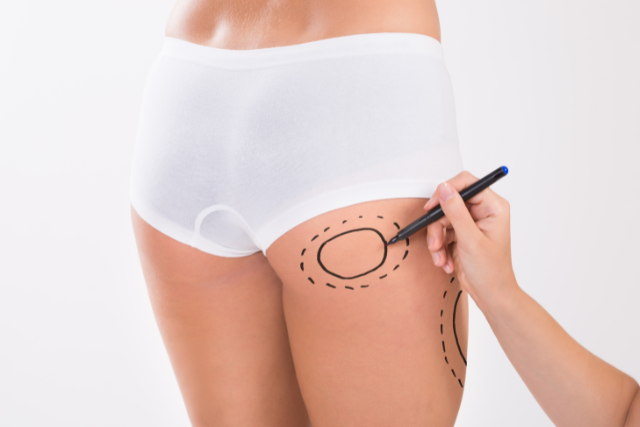
Guidelines by Treated Area and Procedure Type
Face and Submental Liposuction
Mask tightening and water pressure act directly on the incision sites and submental tissue. Avoid diving during the 4 to 6 week swelling phase; practical resumption is 2 to 3 months into the contracture phase. Mask clearing also applies repetitive negative pressure to the submental area.
Arms and Localized Liposuction
Even for small-volume cases with low DVT risk, wait at least 4 weeks. Wetsuit donning and removal creates friction on incision sites, so scars must be well healed. Also verify that shoulder range of motion is sufficient to carry a tank.
Abdomen, Thighs, and Large-Volume Liposuction
Circulatory shifts are significant, and DVT and edema risks persist for weeks, so wait 8 to 12 weeks post-op. Set the dive computer conservatively and start with shallow dives under 10 meters. Avoid consecutive-day diving until 3 months post-op.
With Concurrent Fat Grafting or Hybrid Breast Augmentation
Avoid pressure fluctuations and heavy tank loading for 3 to 6 months while fat graft engraftment stabilizes. If a silicone implant is also placed, chest wall pressure changes during capsule formation are undesirable. See our liposuction column archive for more related articles.
Are Snorkeling and Free-Diving Safe?
Snorkeling is a surface activity with essentially no DCS risk. However, the same cautions as liposuction scuba diving recovery apply: (1) prolonged sun exposure causing post-inflammatory hyperpigmentation (darkening of incision scars), (2) prolonged cold exposure causing peripheral circulation decline and delayed contracture-phase recovery, and (3) saltwater infection risk. Free-diving involves depth-related pressure changes, so descents beyond 10 meters should follow scuba-equivalent rest periods.
Pre-Dive Self-Check List
・All incision sites are closed and no drainage is present.
・No asymmetric leg swelling, no tender calf on compression.
・Post-op anticoagulation management is complete.
・Your operating surgeon has approved diving.
・For the first dive, go shallow with an experienced buddy.
These are minimum conditions. If in doubt, always consult your operating surgeon or a physician affiliated with a cosmetic surgery society before diving. For safety standards in cosmetic surgery, see the Japan Society of Aesthetic Surgery (JSAS).
Summary
Timing for liposuction scuba diving recovery must be judged not by physical stamina alone, but by three medical processes: thrombosis risk, edema resolution, and fat engraftment. Understand that the rest period must be longer than for air travel, and follow a conservative schedule based on the treated area and procedure. Since individual variation is significant, discuss your plan with your surgeon.
Frequently Asked Questions
Q. What is the earliest I can resume diving after liposuction?
For patients with small-volume localized procedures and uneventful recovery, the earliest guideline is 4 weeks post-op — but this is a lower bound, not a guarantee of safety. Large-volume liposuction or concurrent fat grafting warrants 8 to 12 weeks or more.
Q. I already have a diving trip booked at a resort. Should I cancel?
It depends on how far post-op you are, the treated area, and your condition. As a rule, depth diving within 8 weeks post-op should be avoided. Consider rescheduling or switching to snorkeling.
Q. Is DCS risk the same for air travel and diving?
No. Aircraft cabin altitude drops pressure to about 0.75 atmospheres, but ascending from 20 meters means a 3 to 1 atmosphere change — the physical risk of bubble formation is orders of magnitude greater. Diving requires a far more cautious rest period.
Q. If I only had fat grafting (no liposuction), do I still need to avoid diving?
Yes. During the engraftment phase (up to 3 months post-op), microcirculation is still reorganizing, and both pressure fluctuations and heavy tank loading should be avoided. Resume after 3 to 6 months with your surgeon’s clearance.
Q. Can wetsuit compression replace a compression garment?
No. Wetsuits apply uneven local pressure, whereas post-op compression garments provide even, controlled pressure. Uneven friction and pressure over incision sites can cause complications, so wear a wetsuit only after scars have stabilized.
──────────────
Medical Supervisor: Dr. Shin Moriwaki
Member, Japan Society of Aesthetic Surgery (JSAS) / American Academy of Aesthetic Medicine
ECFMG Certificate holder (U.S. medical license qualification)
──────────────
📍AVAN TOKYO GINZA LIPOSUCTION CLINIC
English / 中文 / Tiếng Việt supported
Bookings and consultations available via
DM / LINE / Website / Phone.