


Subglandular Hybrid Breast Augmentation: Why We Layer Fat Above and Below the Implant2026.09.07
“An implant alone might look too firm at the edges,” “Fat grafting alone will not give me enough volume” — these are common concerns we hear. For these patients, we increasingly recommend subglandular hybrid breast augmentation. In this approach, a silicone implant is placed under the mammary gland, while harvested fat is layered both above (subcutaneous layer) and below (submuscular layer) the implant. This design softens the visible edge of the implant, improves the feel of the breast, and creates a more natural silhouette. In this article, we look at one case in a woman in her thirties, where fat was harvested from both upper arms and the axillary (accessory) breast, to explain the medical rationale for splitting the fat into two anatomical layers, from the perspective of the operating surgeon.
Key points of this article
・Subglandular hybrid breast augmentation places a silicone implant under the mammary gland and grafts fat into both the subcutaneous (superficial) and submuscular (deep) layers around it.
・Fat in the subcutaneous layer softens the visible upper edge of the implant and improves the tactile feel of the breast.
・Fat in the submuscular layer smooths the lower and lateral contour of the implant and contributes to a rounded décolletage.
・Fat is harvested from multiple donor sites (arms, accessory breast) and centrifuged to concentrate viable adipocytes before injection.
・Fat survival varies by patient. Risks include bruising, swelling, capsular contracture, asymmetry, oil cysts, and infection.
Case overview — a woman in her thirties, upper-body redesign
A woman in her thirties wanted both a slimmer upper-arm silhouette and a natural, moderate breast enlargement despite her slim frame. We performed subglandular hybrid breast augmentation with full-circumference upper-arm and accessory-breast liposuction. Access was through the axillary crease. Bilateral Motiva Mini implants (275cc) were placed in the subglandular plane. The harvested fat was centrifuged and then divided between the subcutaneous and submuscular layers on each side. The goal was to slim the arms while adding volume to the décolletage — a unified upper-body design rather than two separate operations.
Treatment content, fees, and risks of this case
■ Treatment: subglandular silicone implant placement plus multilayer fat grafting (subcutaneous and submuscular), together with full-circumference upper-arm and accessory-breast liposuction. Access via the axilla.
■ Fees: please see our price page for the individual fees of hybrid augmentation and upper-arm liposuction. The final total is confirmed at consultation.
■ Main risks: bruising, swelling, pain, capsular contracture, asymmetry, partial fat resorption changing volume over time, oil cysts / fat necrosis, infection, temporary changes in skin sensation, and scarring.
■ Results vary between individuals. Photographs represent one case and do not guarantee identical outcomes.
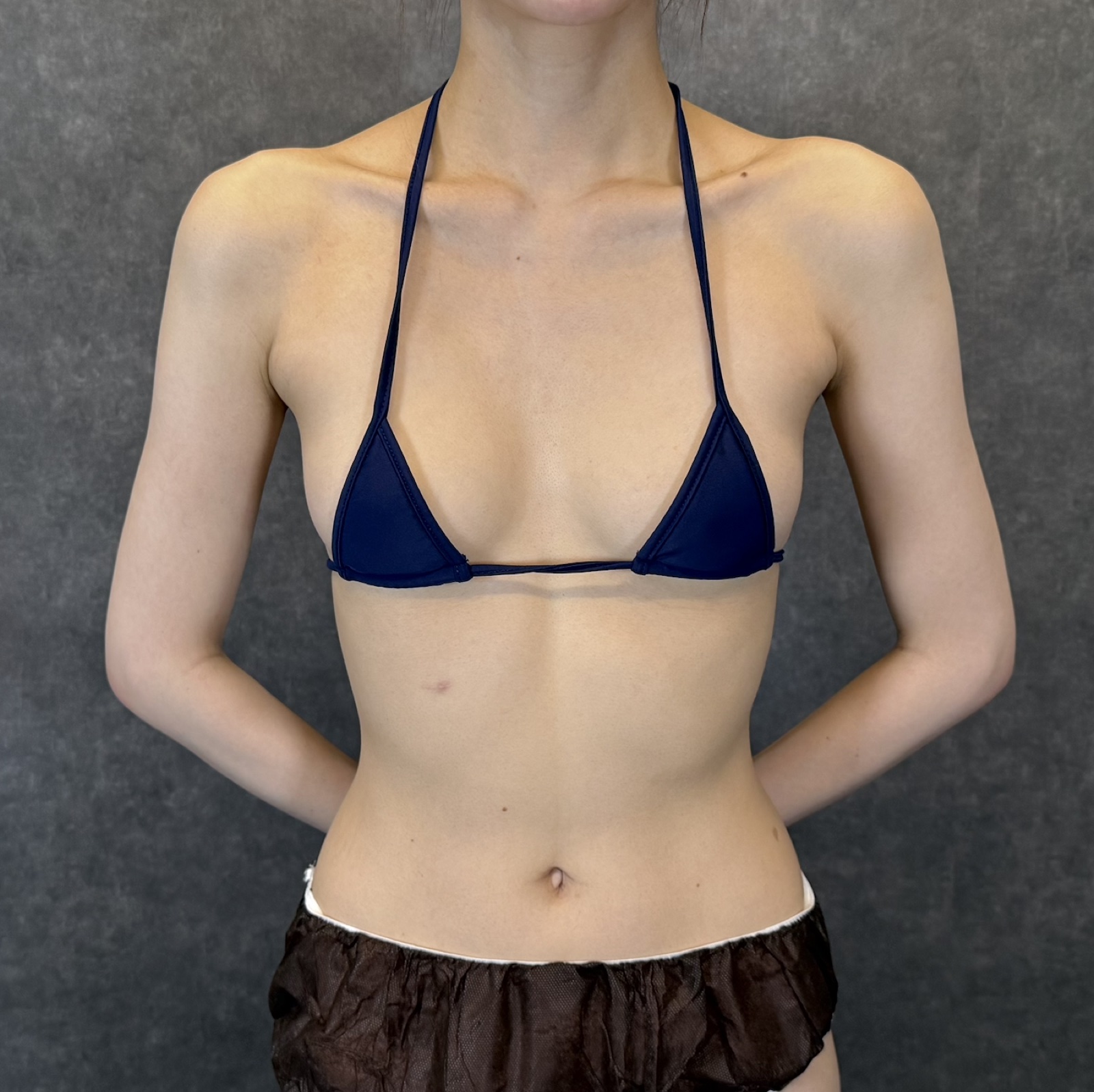
Why split the fat into subcutaneous and submuscular layers?
A silicone implant on its own provides reliable, reproducible volume, but in slim patients with little soft-tissue coverage the upper edge of the implant can look and feel visible, especially at the infraclavicular line and the lateral border. An implant alone cannot always hide these transitions.
In subglandular hybrid breast augmentation, fat is placed both above and below the implant, effectively wrapping it in soft tissue from both sides. The purpose is not simply to add more fat, but to assign a distinct role to each layer, so that the total design is more than the sum of implant plus fat.
The role of the subcutaneous layer
Subcutaneous fat grafting creates a thin “cover” of fat above the implant. This softens the infraclavicular transition and reduces the tactile firmness of the implant. In slim patients where the pinch test measures less than roughly 2cm, the edge of the implant is more likely to be palpable without a subcutaneous fat layer, so we bias the design toward a slightly thicker superficial cover.
However, injecting a large volume into the superficial layer increases the risk of oil cysts and fat necrosis, because grafted fat that fails to establish blood supply tends to consolidate. We deposit small aliquots in many passes using a fine cannula, and we deliberately keep the density below the threshold at which cyst formation becomes likely.
The role of the submuscular layer
Fat placed under the pectoralis major softens the lower pole and lateral contour of the implant. The deep layer has a relatively rich vascular supply, which supports fat survival, but excessive volume here can displace the implant. We therefore wrap the outer margins of the implant with modest amounts. The rounded upper décolletage and the smooth line from the lateral chest into the cleavage are often built from this deep layer.

How we improve fat survival
Grafted fat does not remain intact in a one-to-one volume relationship with what is injected. Rather than injecting raw lipoaspirate, we centrifuge the harvested tissue to remove excess fluid, blood, and damaged cells, leaving a purified fraction with a higher proportion of viable adipocytes. In this case, roughly 80 percent of the harvested tissue was refined for injection.
At the injection stage, we do not deposit large boluses through a thick cannula. Instead, we use fine cannulas and place small volumes across many directions and layers. This matters because grafted adipocytes must lie within a few millimetres of a functioning capillary bed to receive oxygen and nutrients. A thick bolus necroses at its centre and becomes the seed for a palpable lump. Splitting into layers also serves this purpose: it maximises the use of the surrounding recipient bed.
When left and right receive different volumes
Most patients considering hybrid augmentation have some degree of preoperative asymmetry — differences in glandular volume, sternal notch to nipple distance, or rib projection are the biological norm, not the exception. Injecting the same amount into both sides is therefore not automatically the correct answer.
In this case, we deliberately gave a slightly higher volume to the smaller side and a smaller volume to the larger side, aiming to close the visible gap after surgery. Fat survival can still differ between sides, so we reassess symmetry at three to six months post-operatively and consider touch-up grafting when appropriate. Subglandular hybrid breast augmentation is designed on the assumption that it is not always complete in a single stage.
Recovery and downtime
Strong swelling and bruising in both the arms and the chest are expected in the immediate postoperative period. We use a bolero-type compression garment to prevent implant displacement while promoting closure of the dead space at the fat-grafted sites. Sharp pain typically eases within several days to a week, though a tight, unfamiliar sensation may last several weeks. The implant begins to feel like part of the body around three months. The grafted fat undergoes partial resorption over the first one to three months, and the final result is best judged at around six months.
For general safety standards in cosmetic surgery, see the Japan Society of Aesthetic Surgery (JSAS). For related procedures see our liposuction and body-contouring column index.
Frequently asked questions
Q. How is subglandular hybrid breast augmentation different from fat grafting alone?
Fat-only augmentation has a safe upper limit per session, and some patients cannot achieve their desired size in a single procedure. Subglandular hybrid breast augmentation uses the implant to deliver the central volume and lets the fat concentrate on shaping the contour and improving tactile feel — this combination allows a more reliable size increase together with a natural silhouette.
Q. Is there a fixed ratio between subcutaneous and submuscular fat?
There is no fixed ratio. The distribution is individualised based on skin thickness, glandular volume, implant size, and native décolletage volume. Slim patients where the upper edge of the implant is likely to show tend to receive a heavier subcutaneous layer, but we always set an upper limit that respects the risk of cyst formation.
Q. How much of the injected fat survives?
This varies significantly between individuals. With centrifugation combined with layered, small-volume injection, a meaningful proportion tends to remain at six months. Smoking, large weight fluctuations, and constitutional factors all shift the survival rate, so preoperative and postoperative lifestyle also affects the outcome.
Q. Will my upper arms look slimmer because fat is harvested from them?
The volume needed for the breast usually corresponds to a meaningful arm-liposuction result, so most patients see arm slimming as a bonus. However, the priority in harvesting is the amount required for augmentation, so if arm contour is the primary goal we discuss a separate design.
Q. Are there risks or regression?
Risks include bruising, swelling, capsular contracture, infection, asymmetry, partial fat resorption, and palpable lumps. Some resorption of grafted fat is normal, which means the breast can look slightly smaller a few months after surgery than immediately post-op. The final result should be evaluated at approximately six months.
──────────────
Supervising physician: Dr. Shin Moriwaki
Member, Japan Society of Aesthetic Surgery (JSAS) / American Academy of Aesthetic Medicine
ECFMG Certificate
──────────────
📍AVAN TOKYO GINZA LIPOSUCTION CLINIC
English / 中文 / Tiếng Việt supported
Bookings and consultations: DM / LINE / Website / Phone.