



Steroid Knee Joint Injections “Work but Are Hard to Repeat” — Dr. Moriwaki on Cartilage Impact and the Alternative of Stem Cell Conditioned Media Knee Injection2026.07.14
When patients visit an orthopedic clinic for knee pain, one of the first treatment options they hear about is a “steroid knee joint injection.” Because of the strong anti-inflammatory effect, pain relief lasting several days to weeks is often clearly felt, so patients truly perceive that “it works.” At the same time, however, many are told that “there is a limit to how many times you can receive it” or that “repeated use may weaken the joint itself,” which can be confusing. In this article, Dr. Moriwaki (AVAN TOKYO Ginza) explains why steroid joint injections are described as “effective but hard to repeat,” and clarifies how they differ from a stem cell conditioned media knee joint injection as an alternative approach.
Key Points of This Article
・Intra-articular steroid injections strongly suppress inflammation, but repeated use has been associated with cartilage burden and effects on local tissue.
・A stem cell conditioned media knee joint injection is not designed to “forcibly shut down inflammation” but rather to support the joint’s internal repair environment through anti-inflammatory cytokines and growth factors.
・Because the two treatments have different goals, the point is not which is superior, but how to choose between them based on the phase of pain, KL grade, and treatment goals.
・A knee joint injection is not a cure-all; imaging assessment, accurate diagnosis, weight management, exercise therapy, and orthotic support must be in place for the injection’s effect to hold.
・Understanding efficacy, safety, indications, and limits medically — and reviewing with the physician whether repeated injections are truly meaningful each time — is essential.
Why the Steroid Knee Joint Injection Is Called “Effective but Hard to Repeat”
Steroids have a powerful anti-inflammatory effect and can produce marked pain relief in a short time for knee osteoarthritis and synovitis. In an acute phase with strong swelling and heat that severely limits daily life, this rapid quality-of-life recovery is a real benefit.
Strong for Short-Term Pain Relief, Limited for Long-Term Effect
Multiple systematic reviews report that the analgesic effect of intra-articular steroid injection peaks within a few weeks to 1–2 months and then gradually declines. In other words, they are highly effective at “temporarily calming pain,” but they are not a treatment where “the joint itself gets better while pain is absent.”
Why Frequency and Interval Limits Are Set
In clinical practice, intra-articular steroid injections are often operated within guidelines such as “no more than once every 3 months” or “no more than 3–4 times per year.” This is not only to avoid systemic effects such as adrenal suppression and glucose metabolism disturbance, but also to reduce the burden on local cartilage and soft tissue. Patients with poorly controlled diabetes or high infection risk require even more cautious planning.
Impact on Cartilage — The Reality of “The More You Inject, the Worse It Gets”
Recent attention has focused on the effect of repeated steroid injections on cartilage. A 2017 randomized controlled trial published in JAMA compared patients with knee osteoarthritis who received intra-articular steroid injections every 3 months for 2 years to a saline injection group, and reported that the steroid group had a significantly greater loss of cartilage volume.
This does not settle the debate entirely. In daily clinical practice, careful interpretation is required regarding how well these results apply to “a single injection” or “an injection limited to a clear inflammatory phase.” Still, the perspective that “just because the pain is gone does not mean it is safe” — that the appearance of symptoms and what is happening inside the joint can diverge — is indispensable when considering any knee injection.
Symptom Improvement and Joint Preservation Are Separate Issues
“Pain relief” and “joint improvement” are not the same thing. Steroid intra-articular injection is powerful for the former, but it is not the primary aim of the treatment to address the latter. For information on joint diseases including knee osteoarthritis, general explanations are available on the Japanese Orthopaedic Association website.
The Stem Cell Conditioned Media Knee Joint Injection as an Alternative Approach
By contrast, a stem cell conditioned media knee joint injection (using conditioned media from adipose-derived stem cells and similar sources) does not aim to “strongly suppress inflammation” but to work with the joint’s own repair environment. The conditioned media contains growth factors such as TGF-β, IGF-1, and FGF, along with anti-inflammatory cytokines and exosomes, which are suggested to act on the homeostasis of synovium, subchondral bone, and intra-articular tissues.
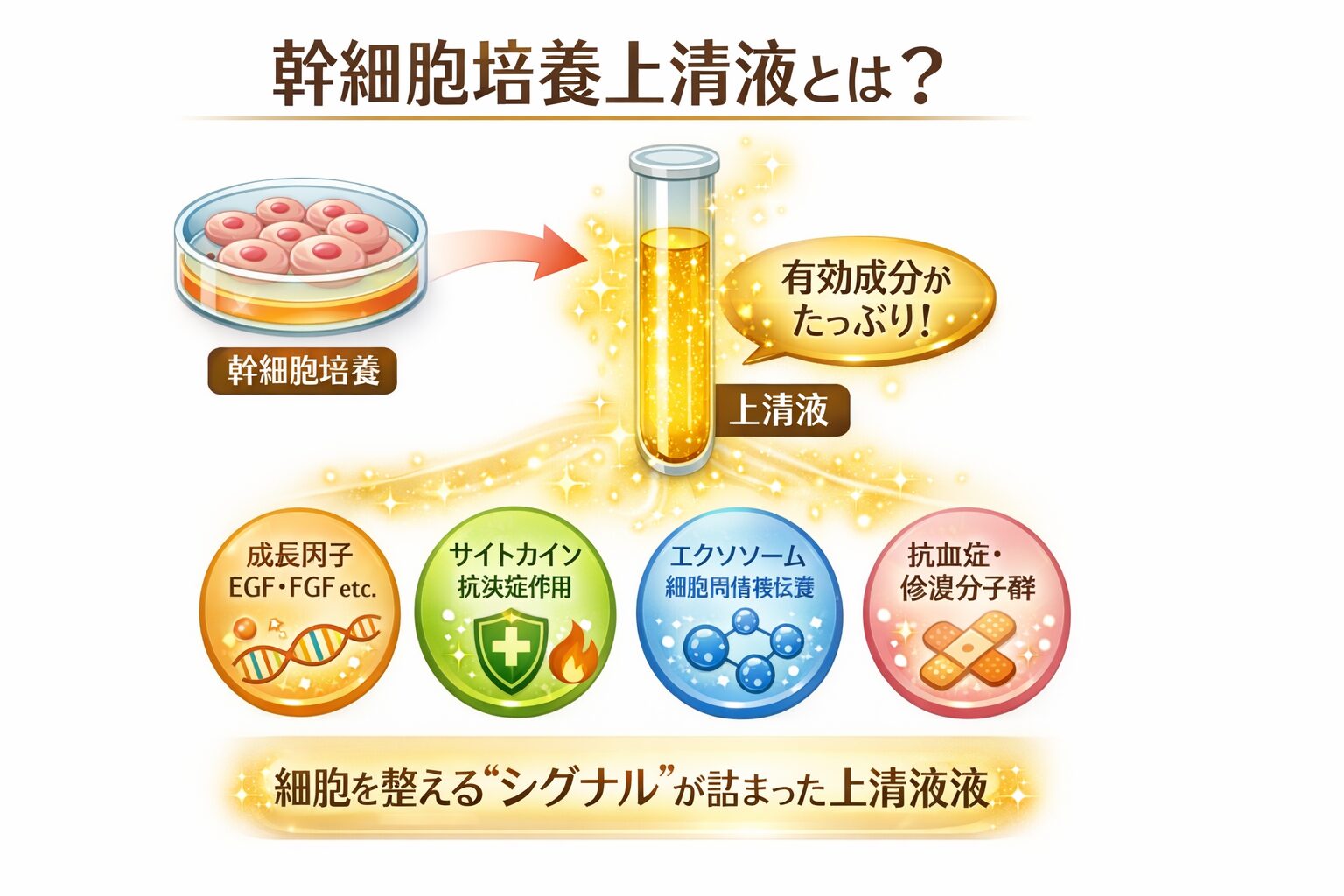
Not “Blocking Inflammation” but “Supporting the Repair Environment”
Whereas steroids are agents that “strongly block the inflammation cascade,” intra-articular administration of conditioned media works on the balance between pro-inflammatory and anti-inflammatory cytokines, aiming to calm the synovial inflammation cycle while shaping the environment of cartilage and subchondral bone. Unlike steroids, it is not a treatment where pain dramatically disappears the next day; we repeatedly explain to patients that changes are evaluated gradually over several weeks to months.
The Nature of “Hard to Repeat” Is Different
While steroids require strict awareness of frequency limits because of cartilage burden, conditioned media is not a treatment that “forcibly suppresses inflammation,” so the concept of scheduling is different. Even so, conditioned media is not a linear treatment where “more injections mean more effect”; a two-phase design of induction and maintenance, with careful effect assessment, is important.
How to Choose Between Steroid and Conditioned Media Approaches
In clinical practice, it is natural to view the two not as “competing treatments” but as “tools with different purposes.” Please also see Details on Stem Cell Conditioned Media Joint Injection.
When Strong Acute Inflammation and Short-Term Pain Relief Are the Priority
In an acute phase with pain severe enough to make walking difficult, joint effusion (fluid accumulation in the knee), and strong heat sensation, calming the inflammatory fire first with steroids or joint aspiration takes priority. There is no need to switch straight to conditioned media at this stage.
Chronic Phase, Recurring Pain, and the Long Game
On the other hand, for patients with moderate knee osteoarthritis around KL grade II–III, those who feel they have plateaued with hyaluronic acid, or those anxious about repeated steroid use, a stem cell conditioned media knee joint injection can become a new option. The goal is not to “halt inflammation at full speed,” but to “shape the intra-articular environment while combining it with rehabilitation, weight management, and orthotic support as the foundation.”
Prerequisites to Address Before Considering a Joint Injection
Whichever injection is chosen, an accurate diagnosis is essential first. Plain radiographs should be used to assess joint space, osteophytes, and subchondral bone changes; MRI is added when needed to evaluate meniscus, ligaments, and bone marrow lesions, to confirm that the main source of pain is truly intra-articular and that extra-articular conditions such as pes anserinus bursitis or iliotibial band syndrome are not confounding it. Building the foundation of conservative therapy — weight management, quadriceps strengthening, and appropriate use of orthotics or a cane — in parallel is the key to making the injection’s effect last. Individual differences in response and applicability exist, so a treatment that is dogmatically claimed to “cure” should be viewed with caution; ongoing alignment with the treating physician shapes outcomes.
Frequently Asked Questions
Q. Should I really “stop having” steroid injections in the knee?
Not necessarily. They remain a very powerful option for quickly calming strong acute inflammation. However, given the effect on cartilage with repeated use, it is important to clarify the frequency and purpose. Please decide together with your physician while sharing the current state of your joint and your injection history.
Q. Can a stem cell conditioned media injection into the knee be combined with steroid injections?
A staggered combination is clinically considered. One approach is to first calm strong inflammation with steroids and then, once things have settled, use conditioned media to shape the intra-articular environment. However, judgment must be made based on each individual’s condition.
Q. How long should I wait before judging the effect?
With conditioned media injections into the knee, changes are evaluated over several weeks to months by using objective measures such as pain intensity, range of motion, and daily activities like stair climbing. A realistic design is not to draw conclusions after a single session, but to assess over multiple visits.
Q. Is there any effect for a severely deformed, end-stage knee?
With advanced joint destruction close to KL grade IV, excessive expectations for conditioned media are unrealistic. Comparison with surgical options such as total knee arthroplasty needs to be included in the discussion.
Q. How often is it administered?
A two-phase design is common: shorter intervals of a few weeks during the induction phase, and longer intervals during maintenance. However, individual variation is large, so basic practice is to adjust with the treating physician while observing the response.
──────────────
Supervising Physician: Shin Moriwaki, MD
Member of the Japan Society of Aesthetic Surgery (JSAS) / Member of the American Academy of Aesthetic Medicine
ECFMG Certificate
──────────────
📍AVAN TOKYO Ginza Joint Regenerative Medicine
AVAN TOKYO Ginza Joint Regenerative Medicine
English / 中文 / Tiếng Việt supported
Inquiries welcome via DM / LINE / Website / Phone.