


Bouchard’s Nodes (PIP Joint Osteoarthritis) — Not to Be Confused with Heberden’s Nodes: Dr. Moriwaki Organizes the Pathology of the Chronic Middle-Finger-Joint Pain and Swelling, and Where Peri-PIP Injection of Stem Cell Conditioned Media Can and Cannot Reach — Correcting the Intra-Articular Synovial and Cartilage Metabolic Environment vs. Reversing Bony Shape Change2026.08.09
‘When I clench my little finger, the middle joint of my index finger throbs.’ ‘After knitting or opening a jar for a while, the middle joint of my finger swells and aches.’ From roughly mid-40s to 60s, women in particular increasingly complain of chronic pain and swelling at the middle finger joints. This bony enlargement and pain at the proximal interphalangeal (PIP) joint is called Bouchard’s node — osteoarthritis of the PIP joint of the hand. It is a sibling condition to Heberden’s node — degeneration of the distal interphalangeal (DIP) joint — but the impact on daily activities is often larger with Bouchard’s node. In this column, Dr. Moriwaki of AVAN TOKYO Ginza organizes, for patients, the pathology of Bouchard’s node, its differentiation from Heberden’s node, and where peri-PIP injection of stem cell conditioned media can and cannot help — correcting the intra-articular inflammatory environment vs. reversing bony shape change.
Key Points
・Bouchard’s node is osteoarthritis of the hand’s PIP (proximal interphalangeal) joint, appearing as chronic pain with bony enlargement of the middle finger joint that affects gripping, pinching, and twisting motions.
・It is a sibling of Heberden’s node (DIP), but loss of PIP flexion translates directly into grip weakness and fine-motor difficulty, so its impact on daily life is generally larger.
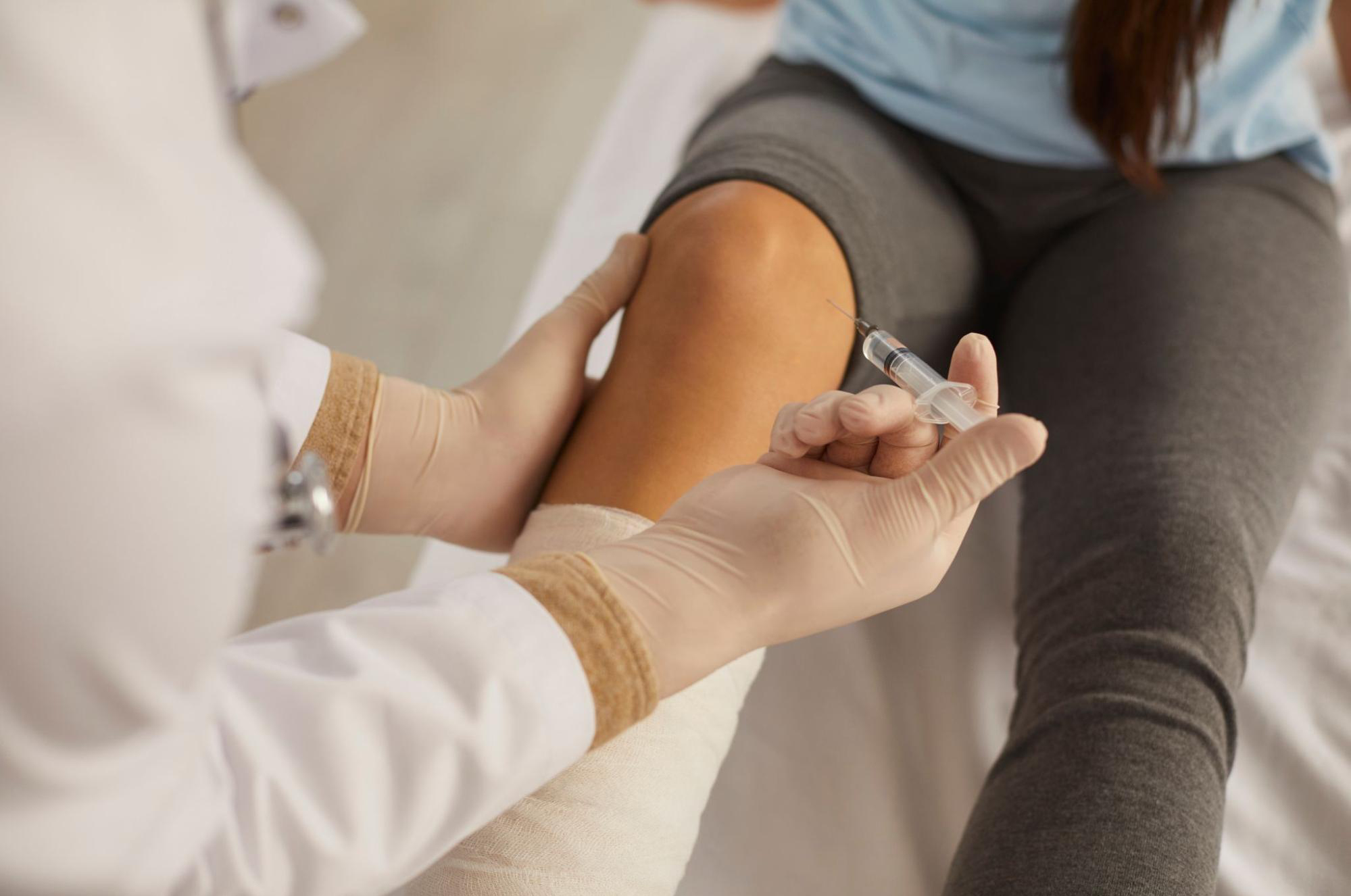
・Peri-PIP injection of stem cell conditioned media is one conservative option aimed at calming the intra-articular synovitis cycle and supporting cartilage metabolism.
・What can be targeted is ‘quieting the inflammatory cycle and lowering the pain baseline’ — this is not a treatment that reverses already-formed osteophytes or joint-space narrowing.
・The treatment plan varies with disease stage, dominant vs. non-dominant hand, and the desired functional load, and requires concurrent orthotic therapy and hand therapy.
How to Tell Bouchard’s Nodes (PIP OA) from Heberden’s Nodes (DIP OA)
Both are classified as primary osteoarthritis of the finger joints, but the site of pain and the functional impact differ.
Different location of swelling and pain
Heberden’s node is a bony prominence on the dorsal side of the joint closest to the fingertip (DIP), causing hard nodular enlargement near the nail base. Bouchard’s node is a similar degenerative change one joint proximal — at the joint in the middle of the finger (PIP) — where the middle of the finger throbs and swells. Because the thumb anatomically has no PIP joint (the thumb consists of MCP and IP joints), the target joints are the middle joints of the index, middle, ring, and little fingers.
Different magnitude of impact on daily function
At the DIP joint, even 10–15° of motion suffices for most daily tasks, but the PIP joint is required to flex 60–90° for gripping, pinching, turning a key, or opening a plastic bottle cap. When the PIP becomes stiff and painful, grip weakness and loss of fine motor function arise all at once. When patients say ‘Heberden’s is visible but the pain settled down’ while ‘Bouchard’s isn’t obvious but it aches every time I grip,’ this functional anatomy is the reason.

Pathology of Bouchard’s Node — What Is Happening Inside the Joint
In PIP osteoarthritis, aging and mechanical stress fray the collagen network of the superficial cartilage and slow proteoglycan synthesis of the cartilage matrix. As the surface wears down, micro-stimuli from exposed subchondral bone push the synovium toward inflammation. The synovium releases joint-destructive signals such as IL-1β, TNF-α, and MMPs (matrix metalloproteinases), which in turn accelerate cartilage matrix degradation — a vicious cycle of ‘cartilage degeneration → synovitis → accelerated cartilage breakdown’ that lies at the core of PIP osteoarthritis. At the joint margins, reactive bone formation produces osteophytes, which form the visible swelling of Bouchard’s nodes.
What Peri-PIP Injection of Stem Cell Conditioned Media Can ‘Target’
Stem cell conditioned media contains dozens to hundreds of growth factors, cytokines, and exosomes secreted by mesenchymal stem cells into culture — including TGF-β, IGF-1, HGF, and VEGF. Basic research suggests that the anti-inflammatory factors among these can dampen the synovitis cascade and suppress production of the inflammatory mediators driving pain. Clinically, peri-PIP injection aims at the following:
・Relief of night pain and pain at rest through calming synovitis
・Correction of the intra-articular microenvironment to support cartilage matrix metabolism
・A second card of conservative treatment that avoids the long-term concerns (cartilage/tendon/subcutaneous fragility) associated with repeated steroid injections
For more details on the treatment and the joints we address, please see this page on joint injection with stem cell conditioned media. General clinical guidance on osteoarthritis is also available from the Japanese Orthopaedic Association.
What Peri-PIP Injection of Stem Cell Conditioned Media Cannot ‘Target’
To be honest about the limits, injection of stem cell conditioned media is not designed to reverse the following:
・Osteophytes already formed (the visible swelling of Bouchard’s nodes)
・The joint space itself in end-stage joints where cartilage has largely disappeared and the space is severely narrowed
・Deformities based on bony morphology and ligamentous change, such as marked PIP flexion contracture or lateral deviation
For these, buddy taping or PIP-ring splints to distribute mechanical load, alongside hand therapy to prevent contracture progression, are indispensable. When joint destruction reaches an end-stage and night pain and functional impairment burden daily life, PIP arthroplasty or silicone implant arthroplasty should be discussed with an orthopedic surgeon as surgical options. For Bouchard’s nodes, stem cell conditioned media injection is honest to position as an option ‘when chronic pain has set in but the disease is not yet end-stage,’ aiming to calm the inflammatory cycle and preserve the quality of daily activities.
Practical Treatment Design — Running Together with Orthotics and Hand Therapy
Peri-PIP injection of stem cell conditioned media for Bouchard’s nodes is not a one-and-done treatment. It only works when combined with:
・Splints that protect the PIP joint (nighttime splints, daytime buddy taping)
・Hand therapy that balances finger flexors and extensors
・Redesign of daily motions that avoid strong gripping stress (wringing towels, opening tight jars)
・Alternating cold and heat compresses and stabilizing lifestyle rhythm
At 4–8 weeks after the initial injection, pain scores and daily-activity quality should be reassessed; when response is poor, returning to additional orthopedic imaging (joint-space and osteophyte assessment on plain X-ray, MRI as needed) is required. Individual variation is inevitable, and dramatic improvement is not guaranteed.
Frequently Asked Questions
Q. How does Bouchard’s node progress if left untreated?
Over several years to more than a decade, pain often settles after passing its peak, while enlargement and loss of flexion tend to persist. Individual variation is large, however, and in cases where grip weakness and fine-motor difficulty burden daily life, a ‘wait until pain settles’ strategy severely erodes quality of life. Starting inflammation control and orthotic therapy early is therefore meaningful.
Q. Do Heberden’s nodes (DIP) and Bouchard’s nodes (PIP) occur together?
They commonly appear in the same person — a phenomenon thought to share genetic predisposition and aging. Because each joint has different range-of-motion demands, however, treatment priorities are separated. The general strategy is to protect the PIP side first, as its impact on daily activity is larger.
Q. How many peri-PIP injections of stem cell conditioned media are needed?
A typical design is an induction phase of 2–3 sessions every 2–4 weeks, followed by a maintenance phase every 8–12 weeks depending on response. However, the actual plan is individualized to disease stage, pain flare cycle, and daily-activity load. Please understand that it is not a one-and-done treatment.
Q. How does it differ from steroid joint injection?
Steroids exert powerful anti-inflammatory effects and calm pain in the short term, but repeated use raises the risk of fragility in cartilage, ligaments, and subcutaneous tissue. Stem cell conditioned media injection addresses inflammation by ‘balancing the cytokine environment,’ and basic research suggests a relatively lower concern of tissue fragility with repeated dosing. Onset, however, is slower than steroids, so appropriate use depends on the goal.
Q. Should surgery be avoided?
It is not something that can be uniformly recommended for or against. When joint destruction reaches an end-stage and night pain and functional impairment burden life, PIP arthroplasty or implant arthroplasty is a strong option for restoring quality of life. Stem cell conditioned media injection is a card for ‘holding out before surgery’ and does not erase surgical indications. Please choose in consultation with an orthopedic surgeon on aligned assessment axes.
──────────────
Supervising Physician: Shin Moriwaki, MD
Member, Japan Society of Aesthetic Surgery (JSAS) / Member, American Academy of Aesthetic Medicine
ECFMG Certificate
──────────────
📍AVAN TOKYO 銀座 関節再生医療
AVAN TOKYO Ginza Joint Regenerative Medicine
English / 中文 / Tiếng Việt available
Inquiries via DM / LINE / Website / Phone.