


Why Untreated Knee Osteoarthritis on One Side Tends to Progress Into the Contralateral Knee Too — How a Compensatory Gait Concentrates Excess Load on the Opposite Knee, and Where Stem Cell Conditioned Media Knee Joint Injection Can and Cannot Intervene, Organized by Dr. Moriwaki2026.08.10
‘At first only my right knee hurt, but a few years later my left knee also began to ache’ — this is a story I hear surprisingly often in the outpatient clinic from patients with knee osteoarthritis (knee OA). This contralateral knee osteoarthritis is not a phenomenon we can dismiss as ‘both knees simply aging in parallel.’ It is a disease process in which the way patients favor the painful side concentrates unexpected loads on the opposite knee joint, accelerating the inflammatory cycle in the contralateral joint cavity and driving progression from one side to both. In this article, Dr. Moriwaki of AVAN TOKYO Ginza Joint Regenerative Medicine organizes the biomechanical background of why unilateral knee OA tends to spread to the contralateral knee, and how far stem cell conditioned media knee joint injection can (and cannot) intervene.
Key Points of This Article
・Contralateral knee osteoarthritis is not just ‘both knees aging together’; it progresses because a gait that favors the painful side concentrates excess load on the opposite knee joint
・An antalgic gait raises the joint contact pressure and knee adduction moment on the contralateral knee, accumulating synovitis and subchondral bone stress in the medial compartment
・Stem cell conditioned media knee joint injection can act on the intra-articular inflammatory environment of the contralateral knee, but it cannot correct the compensatory gait itself or the bone morphology changes already established
・To slow progression, a realistic design combines injection with weight management, muscle strengthening, orthotics, and exercise therapy rather than injection alone
・From the stage of one-sided onset, evaluating both knees together by X-ray and gait observation and detecting latent inflammation early is a decisive branch point
Why Does ‘Knee OA in One Knee Only’ Eventually Become ‘Knee OA in Both Knees’?
Epidemiological studies show that the proportion of patients diagnosed with unilateral knee OA at initial presentation who later develop symptoms and imaging findings in the contralateral knee over several years to a decade is by no means low. The progression speed of contralateral knee OA depends on the severity of the ‘originally worse side’ and the change in gait to a degree that cannot be explained by simple age-related parallel progression.
Antalgic Gait Raises Contact Pressure on the Contralateral Knee
When a patient unconsciously favors the painful knee, the stance phase shifts to ‘support longer on the pain-free side and shorten contact time on the painful side’ — an antalgic gait. This gait change increases the joint contact pressure and knee adduction moment on the contralateral knee, concentrating loads that would normally be distributed on the opposite medial compartment. Over months to years, this mechanical stress accumulates microdamage in the contralateral subchondral bone and drives chronic release of inflammatory cytokines from synovial cells.
Secondary Changes in Lower-Limb Alignment
When flexion contracture progresses on the painful side, compensation spreads to pelvic tilt, hip, and ankle, and the alignment of the contralateral lower limb gradually changes as well. If a varus tendency also strengthens on the opposite side, the compressive load on the contralateral medial joint space increases at an accelerating pace. The clinical experience that ‘when one knee is bad, the other catches up within a few years’ has this breakdown of the whole lower-limb kinetic chain as its background.
What Happens Inside the Joint in Contralateral Knee Osteoarthritis
In the contralateral joint cavity, excess load causes synovial cells to continuously release inflammatory cytokines (IL-1β, TNF-α, IL-6, etc.), and the expression of matrix-degrading enzymes (such as MMP-3 and MMP-13) rises. At the same time, bone marrow edema develops in the subchondral bone, and heightened sensitivity of nociceptors produces the early clinical picture of ‘strong pain even though the X-ray is still Kellgren-Lawrence grade I to II.’ It is precisely this intra-articular inflammatory environment that stem cell conditioned media knee joint injection attempts to intervene in. For general information on joint diseases, the website of the Japanese Orthopaedic Association is also a useful reference.
What Stem Cell Conditioned Media Knee Joint Injection Can and Cannot Target
What It Can Target — Correcting the Intra-articular Inflammatory Cycle
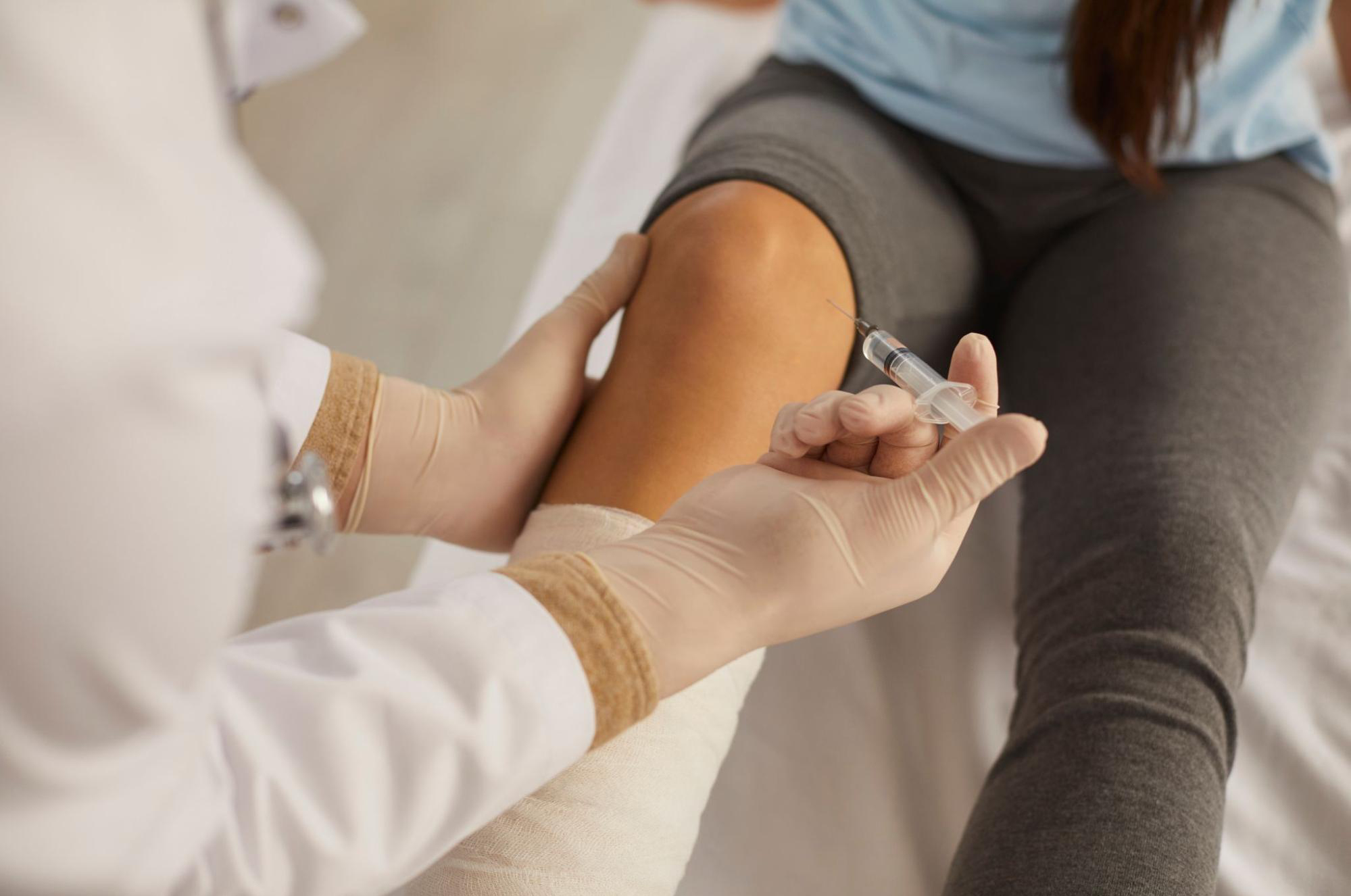
Stem cell conditioned media contains a variety of growth factors and anti-inflammatory cytokines secreted by mesenchymal stem cells during culture. When administered into the knee joint cavity, it is expected to act on the metabolic environment of synovial and cartilage cells and shift the balance with inflammatory cytokines. For early- to mid-stage intra-articular inflammatory cycles in the contralateral knee, it can serve as an adjunctive option to lower the pain baseline. That said, individual variability exists, and the quality and quantity of comparative trials are still accumulating — the reality that case reports and observational studies dominate should be honestly shared with patients. For details, please refer to this page on joint injection with stem cell conditioned media.
What It Cannot Target — The Compensatory Gait Itself and Bone Morphology
On the other hand, the compensatory gait that drives contralateral knee osteoarthritis cannot be changed by intra-articular injection alone. Osteophytes, joint space narrowing, subchondral bone sclerosis, and lower-limb alignment abnormalities already established cannot be ‘reversed’ by conditioned media. Therefore, thinking that knee joint injection alone can halt the progression of contralateral knee OA is not realistic; running exercise therapy, weight management, and orthotic therapy in parallel is a prerequisite. The message ‘injection alone protects both knees’ diverges from clinical reality, and we need to convey this honestly.
Practical Design to Prevent Contralateral Knee OA From Progressing
Evaluate Both Knees Together From the Stage of One-Sided Onset
From the stage of starting outpatient care for one-sided knee OA, we recommend performing X-ray of both knees, MRI if possible, and gait observation as a set, even if the contralateral knee is asymptomatic. Contralateral knee osteoarthritis often shows imaging findings before symptoms; catching latent bone marrow edema or early synovitis makes it much easier to design interventions that slow progression.
Running Load Management, Muscle Strength, and Orthotics in Parallel
Weight management (a 1 kg reduction is said to correspond to several kg of load reduction on the knee joint), muscle training centered on the quadriceps and gluteus medius, and the use of insoles or knee braces as needed for medial-type cases are the foundation for reducing compensatory load on the contralateral knee. Positioning stem cell conditioned media knee joint injection as an adjunct that ‘suppresses the intra-articular inflammatory cycle one notch’ on top of this foundation yields a realistic design for slowing the progression of contralateral knee osteoarthritis.
Reassessment When Response Is Poor, and Red-Flag Signs
After conditioned media injection into the contralateral knee, evaluate pain scores, range of motion, and activities of daily living objectively over weeks to months, and if the response is poor, judgment to continue, change, or switch to orthopedic reassessment is needed. When severe night pain, sudden swelling, or fever are present, prioritize differential diagnosis of other conditions such as septic arthritis or crystal-induced arthritis.
Frequently Asked Questions
Q. Only one knee hurts — should I really have the other knee examined too?
Yes. Because contralateral knee osteoarthritis often shows imaging findings before symptoms, we recommend X-ray and gait evaluation of both knees from the stage of one-sided onset. Grasping latent inflammation early makes interventions that slow progression much easier to plan.
Q. Can I receive stem cell conditioned media knee joint injection in both knees at the same time?
Simultaneous bilateral injection is a clinically considerable option, but given the observation of post-injection pain and swelling and the burden on daily life, spacing the two knees out with an interval is also common. It is safest to design this with your physician based on your condition, goals, and visit frequency.
Q. Is there anything I can do in daily life to protect the opposite knee?
Weight management, maintaining quadriceps and gluteus medius strength, adjusting your daily movement lines to reduce steps, and using insoles or knee braces as needed form the foundation. Being conscious not to unconsciously overwork the ‘pain-free side’ also reduces excess load on the contralateral knee.
Q. If I develop contralateral knee osteoarthritis, will I inevitably need total knee replacement on both knees?
Not necessarily. By suppressing the intra-articular inflammatory cycle early and adjusting load, muscle strength, and alignment, there are cases that proceed with surgery on only one side and cases that persist for a long time on conservative therapy for both sides. The branching point is grasping the state of the contralateral knee ‘early’ and ‘objectively.’
Q. About how many times do I need conditioned media joint injections in the contralateral knee?
There is a range depending on symptoms, imaging, and daily-activity goals, but a common approach is several sessions at short intervals in the induction phase, then transitioning to maintenance-phase intervals while observing the course. Effect judgment is done by pain scores, range of motion, and activities of daily living, and if response is poor, we do not force additional sessions.
──────────────
[Supervisor] Shin Moriwaki, M.D. (Supervising Physician)
Member of the Japan Society of Aesthetic Surgery (JSAS) / Member of the American Academy of Aesthetic Medicine
ECFMG Certificate
──────────────
📍AVAN TOKYO 銀座 関節再生医療
AVAN TOKYO Ginza Joint Regenerative Medicine
Available in English / 中文 / Tiếng Việt
For inquiries, please contact us via DM / LINE / Website / Phone.