


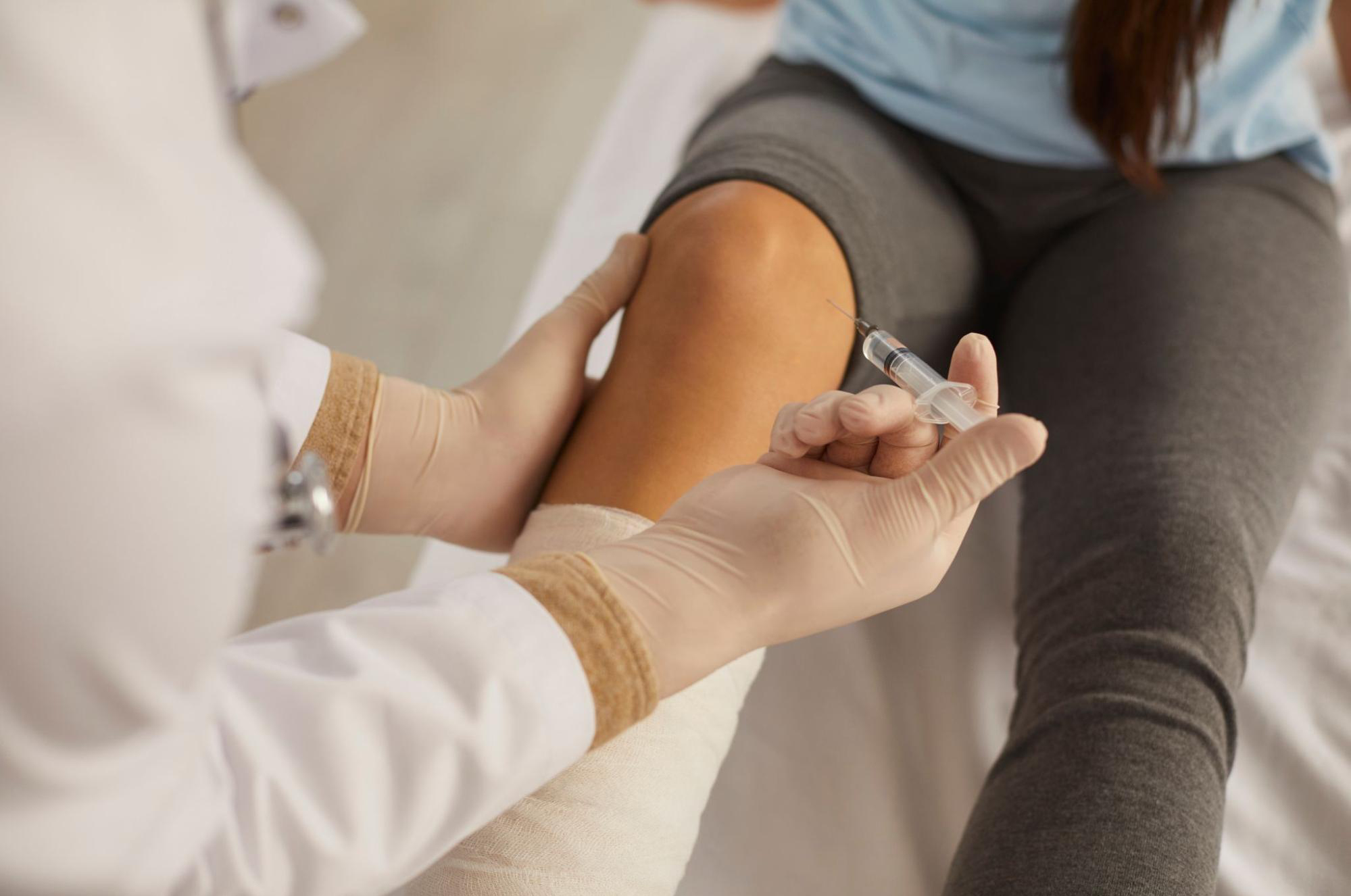
Is Aquatic Exercise Really Gentle on the Knee in Knee Osteoarthritis? — Dr. Moriwaki Organizes the Three Effects of Buoyancy, Water Temperature, and Movement Speed on the Joint, and How to Combine Them With Stem Cell Conditioned Media Knee Injection2026.08.12
“I was recommended water walking and aqua aerobics as knee-friendly exercise,” “but the day after I moved my knee in the pool, it actually hurt more” — I often hear these voices in the consultation room. Aquatic exercise for knee osteoarthritis certainly has the advantage of substantially reducing the load on the knee joint compared with land-based exercise. On the other hand, depending on water temperature, movement speed, and immersion depth, it can also stimulate intra-articular inflammation rather than calming it.
What matters is not to assume that aquatic exercise is an “unconditionally knee-friendly all-purpose exercise,” and to design how to combine it with the option of stem cell conditioned media knee injection as a means of adjusting the baseline of intra-articular inflammation. In this column, we organize the three effects that aquatic exercise has on the knee, and the way of thinking about combining it with joint injection.
Key Points of This Article
・Aquatic exercise for knee osteoarthritis can reduce the load on the knee joint to about 1/3 to 1/9 of that on land thanks to buoyancy, but depending on water temperature or movement speed, it can also worsen pain and inflammation.
・Water walking and aqua aerobics are suited to knee osteoarthritis rehabilitation in that they combine aerobic exercise with range-of-motion training.
・Stem cell conditioned media knee injection is a treatment aimed at “adjusting the intra-articular inflammatory environment” and can serve as a foundation that makes it easier to continue aquatic exercise.
・Long sessions in cold-water pools and movements involving jumping or sudden changes of direction impose heavy loads on the knee joint and are hard to recommend for people with knee osteoarthritis.
・The sequence of injection and exercise therapy should be tailored to the individual’s disease stage and symptoms; avoid intense aquatic exercise immediately after injection, and gradually build up the load while monitoring pain.
Three Effects of Aquatic Exercise for Knee Osteoarthritis on the Knee
① Load Reduction by Buoyancy
In water, the deeper the body sinks, the lighter the “apparent body weight” becomes due to buoyancy. Reports indicate that when immersed up to the navel, body weight is reduced by about 50%; up to the chest, about 70%; and up to the neck, about 90%.
In knee osteoarthritis, the load concentrated on the knee joint becomes mechanical stress on the cartilage, meniscus, and subchondral bone, sustaining the intra-articular inflammation cycle. Exercise that reduces the load to 1/3 to 1/9, such as water walking, can greatly alleviate this mechanical stimulation. That people who cannot continue walking on land often become able to walk continuously for 10 to 30 minutes in a pool is thanks to this benefit of buoyancy.
② Strength-Training Effect of Water Resistance
Water has about 800 times the density of air, and simply moving through it applies a natural resistance load. Because the quadriceps, hamstrings, and calf muscles work in balance against knee flexion and extension movements, aquatic exercise is also effective as training for the peri-knee muscles that tend to weaken in knee osteoarthritis.
Quadriceps weakness is known to correlate with the progression of knee osteoarthritis, and preserving muscle strength contributes both to pain control and to functional maintenance. However, if movements become too fast, water resistance rises sharply and the shear force on the knee joint can increase, so starting from slow movements is the rule.
③ Effects of Water Temperature on Blood Flow and Inflammation
Water temperature tends to be overlooked, but it is an extremely important factor for the joint. In a warm pool (30 to 32°C), blood vessels dilate, muscles relax, and joint range of motion widens more easily. In a cold pool (25 to 28°C), on the other hand, vasoconstriction and muscle tension occur, peri-articular flexibility drops, and pain may be triggered.
During periods of pronounced synovitis in knee osteoarthritis, a cold-water environment is considered likely to stimulate intra-articular inflammation. Conversely, mild exercise in a warm-water environment is said to promote circulation of the joint fluid and relieve stiffness.

The Role of Stem Cell Conditioned Media Knee Injection
Acting on the Intra-articular Inflammatory Environment
Stem cell conditioned media contains various growth factors, cytokines, and exosomes secreted by stem cells, and is suggested to suppress intra-articular inflammatory cytokines and promote signals in the direction of tissue repair.
This is a different axis of action from steroid joint injection, which temporarily suppresses pain and swelling, or hyaluronic acid injection, which supplements the viscoelasticity of joint fluid. By “adjusting the intra-articular inflammatory environment itself,” it may make it easier to sustain rehabilitation and aquatic exercise.
Being Honest About What It Can and Cannot Do
On the other hand, stem cell conditioned media knee injection is not a treatment that regenerates lost cartilage back to its original state. In end-stage cases such as Kellgren-Lawrence grade IV, in which the joint space has completely disappeared, the expected range is limited. Bone alignment abnormalities or severe joint contracture themselves cannot be reversed by injection either.
A realistic design is to share indications and limits with the physician and combine injection, exercise therapy, and lifestyle adjustment. From details on stem cell conditioned media joint injection here, you can review our clinic’s approach to treatment. Individual results vary, and the same outcome is not guaranteed for everyone.
How to Combine Aquatic Exercise With Knee Joint Injection
Refrain From Aquatic Exercise Right After Injection
Immediately after a knee joint injection, the drug solution injected into the joint cavity is still there. On the day and the following day, we basically ask patients to refrain from long stays in the pool or intense aquatic exercise. Pool water contains chlorine and the like, and from the standpoint of infection risk as well, patients often avoid soaking in water on the day of injection.
Generally, for about 2 to 3 days after the procedure, movements that heavily mobilize the joint are avoided, and light activities of daily living are gradually resumed. Light aerobic exercise such as water walking is realistically resumed gradually after pain and swelling have settled.
The Sequence of “Settle Pain First, Then Build Up Exercise”
When a person with knee osteoarthritis falls into a vicious cycle of “pain prevents movement → muscle strength drops → the burden on the joint increases → pain worsens further,” it can be effective first to perform stem cell conditioned media knee injection to lower the baseline of pain and inflammation, and then to gradually build up the load starting from aquatic exercise.
Even people who could not do land-based exercise due to pain often find that they can resume water walking, and by recovering muscle strength and range of motion from there, a return to land-based exercise also comes into view. For detailed information on joint diseases, the website of the Japanese Orthopaedic Association is also a helpful reference.
Movements to Avoid in Aquatic Exercise, and Notes
Jumping and Sudden-Change-of-Direction Movements
Some aqua aerobics programs include jumping in the pool or step work involving sudden changes of direction. Even with buoyancy, at the moment of landing the knee joint receives instantaneous impact and rotational stress.
People with knee osteoarthritis should avoid jumping, hopping, and twisting movements, and are advised to build the routine around linear water walking, leg swings, and slow knee flexion and extension.
Long Sessions in Cold-Water Pools
Spending long periods in an outdoor pool or a cold-water pool decreases both water temperature and body temperature, worsening blood flow around the joint, and the next day stiffness and pain may increase. It is important to combine care such as interspersing warm showers during pool sessions and warming the body in a lukewarm bath after exercise.
Frequently Asked Questions
Q. Is it okay to do aquatic exercise for knee osteoarthritis every day?
As long as swelling and pain in the knee do not remain into the next day, doing aquatic exercise about 3 to 5 times a week is often not a problem. However, it is safe to start with twice a week, 20 to 30 minutes per session, and adjust frequency and duration while watching pain and swelling. If strong stiffness or swelling appears the next day, it is safer to temporarily reduce frequency and observe.
Q. After receiving a stem cell conditioned media knee injection, when can I get into the pool?
As a general guide, we recommend refraining from bathing including the pool on the day of injection and the following day, and avoiding intense aquatic exercise for about 2 to 3 days after the procedure. This design takes into account infection risk and the reaction at the injection site. The individual timing for resumption differs depending on the state of the injection site and general condition, so please follow the instructions of your attending physician.
Q. If I continue aquatic exercise, can I avoid needing joint injections?
In mild knee osteoarthritis, many people can maintain pain and function with exercise therapy including aquatic exercise alone. On the other hand, when exercise therapy alone is insufficient for inflammation control, combining an intra-articular approach such as stem cell conditioned media knee injection can create a state in which it is easier to continue exercising. Effects and necessity vary among individuals, and design according to symptoms and disease stage is important.
Q. I get cold easily and dislike water; is it still worthwhile to continue aquatic exercise?
For those who feel the cold strongly, adjustments such as choosing a warm pool (30 to 32°C), keeping immersion time short, and warming up immediately after exercise are necessary. Pushing through long sessions in a cold pool can conversely lead to worsening blood flow around the joint and increased pain. If aquatic exercise does not suit you, please choose a method you can sustain without strain, including the judgment to switch to other low-load exercises such as a stationary bike.
Q. Should I start with aquatic exercise for knee osteoarthritis, or with joint injection first?
If pain is severe and you cannot move even in water, let alone on land, a realistic sequence is to first lower the baseline of inflammation with stem cell conditioned media knee injection and then gradually begin aquatic exercise. Conversely, if pain is mild and you can continue aquatic exercise, it is also fine to use exercise therapy as the foundation and consider the timing of injection while observing changes in pain. Please design this with your physician according to your own symptoms.
──────────────
Medical Supervision: Dr. Shin Moriwaki (Supervising Physician)
Member, Japan Society of Aesthetic Surgery (JSAS)
Member, American Academy of Aesthetic Medicine
ECFMG Certificate
──────────────
📍AVAN TOKYO Ginza Joint Regenerative Medicine
AVAN TOKYO Ginza Joint Regenerative Medicine
English / 中文 / Tiếng Việt supported
Inquiries welcome via DM / LINE / Website / Phone.