



For Knee Osteoarthritis Patients Whose Pain Is Only the First Few Steps: Dr. Moriwaki Explains the Synovitis Mechanism Behind Starting Pain After Morning Rising or Prolonged Sitting, and What Stem Cell Conditioned Media Knee Injection Aims At in Suppressing the Intra-articular Inflammation Cycle2026.08.03
“My knee hurts only for the first few steps, and then after a few minutes it feels fine” — “Only the moment I get up from bed in the morning, there is a sharp stabbing pain” — “After sitting at my desk for hours, my knee almost gives way on the first step” — these complaints are heard every day in the knee osteoarthritis outpatient clinic. Medically, this is called starting pain, and it is a typical symptom that appears from the very early to mid stages of knee osteoarthritis. In this article, Dr. Moriwaki at AVAN TOKYO Ginza organizes why starting pain in knee osteoarthritis occurs, the underlying mechanism of synovitis — the “smoldering inflammation” inside the joint — and how stem cell conditioned media knee joint injection aims to suppress the intra-articular inflammation cycle.
Key Points
・Starting pain cannot be explained by cartilage wear alone; it is a symptom of inflammation with synovitis as the main driver, and starting pain in knee osteoarthritis appears as a sign from very early in the progression.
・The reason it hurts in the morning or after prolonged sitting is that joint fluid becomes stagnant and the swollen synovium receives mechanical stimulation on the initial movement.
・Pain eases after walking a few steps because joint fluid is stirred and intra-articular pressure stabilizes — the inflammation itself has not resolved.
・Stem cell conditioned media knee joint injection aims to condition the synovial environment with anti-inflammatory and growth factors, and does not guarantee “regeneration” of bone deformity or lost cartilage.
・Weight management and quadriceps training form the foundation; injection should realistically be positioned as a supporting element.
What Starting Pain Really Is — Synovitis as “Smoldering Inflammation”
Knee osteoarthritis is often simplified as “a disease of cartilage wearing away,” but one of the actual main drivers of pain is the synovium. The synovium is a thin membrane lining the inside of the joint. It secretes joint fluid and delivers nutrition to cartilage. However, once cartilage begins to be damaged, the synovium reacts to detached cartilage fragments and damage-associated molecular patterns (DAMPs) released inside the joint. It becomes swollen and continuously releases inflammatory mediators such as IL-1β, TNF-α, IL-6, and PGE2. This chronic low-grade synovitis is thought to be the core of the “pain source” in knee osteoarthritis.
Why does it hurt in the morning or after prolonged sitting?
When the knee is kept still for a long time, joint fluid circulation stagnates, and the inflamed thickened synovium becomes congested within the joint capsule. Intra-articular pressure rises slightly at rest, and inflammatory mediators become concentrated locally. When one suddenly stands up from this state, the congested synovium and the adjacent joint structures receive mechanical stimulation at the “first movement,” strongly firing pain receptors — this is the true nature of starting pain.
Why does the pain ease after a few steps?
Once walking begins, joint fluid is stirred and synovial circulation resumes. The congested inflammatory mediators are diluted and intra-articular pressure stabilizes, so the pain temporarily lessens. However, this does not mean the inflammation has “resolved” — only that the symptom has “gotten used to movement.” The synovitis itself continues quietly, and if starting pain in knee osteoarthritis is overlooked, cartilage degeneration frequently progresses on the timeline of several years.
The Progression Signal That Starting Pain Reveals
Even when joint space is still preserved on X-ray, MRI often reveals synovial thickening, joint effusion, and bone marrow edema (increased water content inside bone). Bone marrow edema is a signal that “inflammation in the joint has reached into the bone,” and it has been reported to correlate with both the speed of progression and the intensity of pain in knee osteoarthritis. Even patients who have been told “cartilage is still there, so you are fine” may already have an inflammation cycle running inside the joint when starting pain in knee osteoarthritis is present.
What Stem Cell Conditioned Media Knee Injection Can Aim At
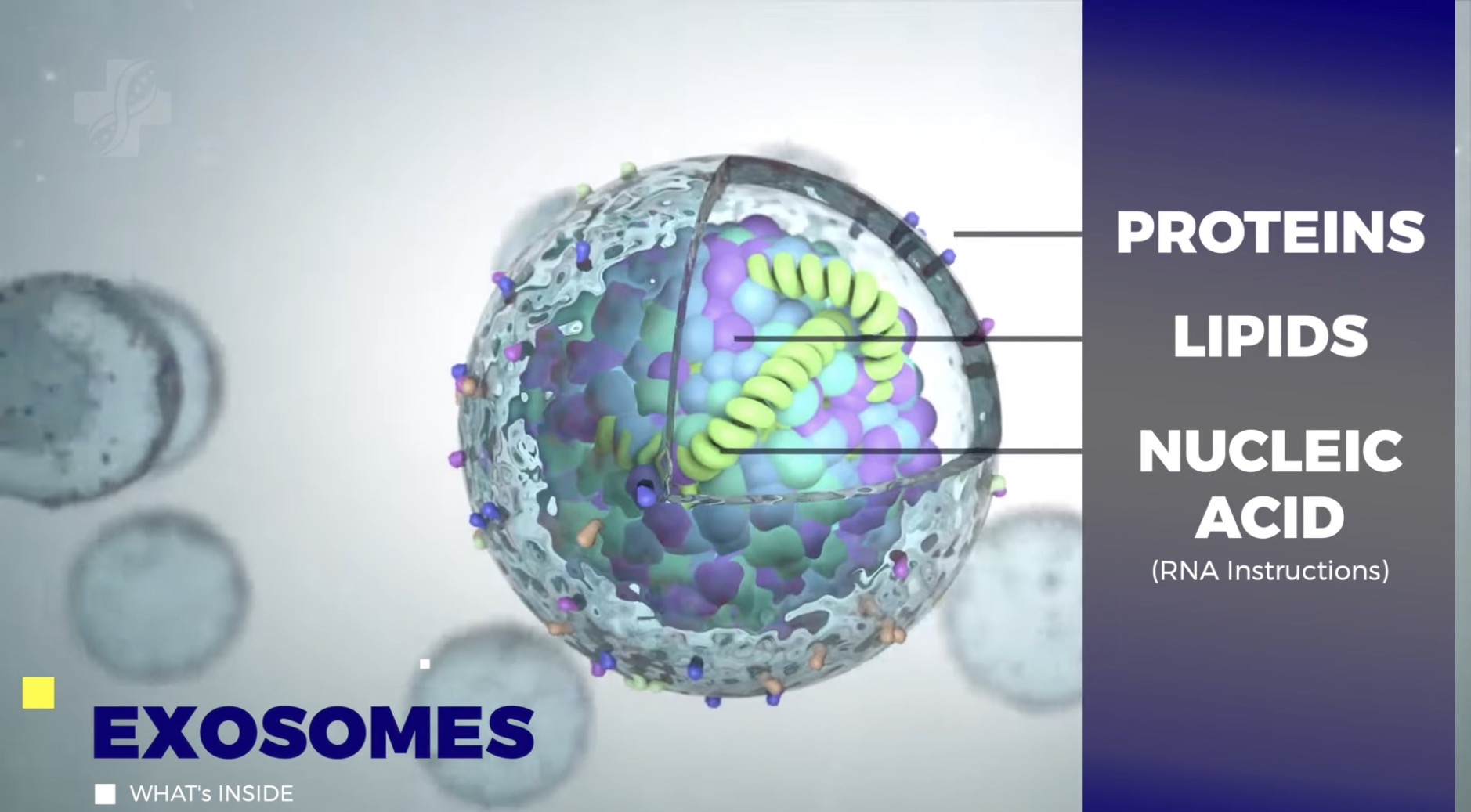
Stem cell conditioned media contains a wide range of growth factors such as TGF-β, IGF-1, HGF, and VEGF, anti-inflammatory factors including IL-1 receptor antagonist (IL-1Ra), and miRNA carried within exosomes. When delivered into the joint through knee injection, basic research has reported that these signal the microenvironment of synovial cells and chondrocytes in a direction that suppresses the production of inflammatory cytokines.
In other words, what stem cell conditioned media knee injection aims for against starting pain in knee osteoarthritis is “putting out the smoldering synovitis.” By calming the intra-articular inflammation cycle even temporarily, the approach seeks to lower the baseline of pain and lighten the burden of the “first step” in the morning or after sitting.
What it cannot aim for — “regeneration” of bone deformity and lost cartilage
On the other hand, advanced osteophytes (bone spurs) or cartilage that has already been completely lost cannot be expected to “regenerate to their original state” with the current stem cell conditioned media knee injection. The main aim is symptom relief through correction of the intra-articular inflammatory environment. When end-stage knee osteoarthritis has indications for total knee arthroplasty, an orthopedic surgical decision takes precedence. Individual variation exists, and identical change cannot be asserted for every patient.
Treatment Sequence — The Foundation Is Lifestyle and Rehabilitation
Management of starting pain does not complete with injection alone. It is a classic fact that a 1 kg increase in body weight loads the knee joint with several kilograms, and reports suggest that even a 5% weight reduction can contribute to symptom improvement. In addition, strengthening the quadriceps (particularly the vastus medialis) increases joint stability and reduces mechanical stimulation to the synovium. For the overall positioning of the treatment, see also details of stem cell conditioned media joint injection here. For general information on joint diseases, the website of the Japanese Orthopaedic Association is a useful reference.
When to See a Doctor and Red Flag Signs
If starting pain in knee osteoarthritis continues for several weeks, or if it gradually shifts from “the first few steps” to “constant pain during walking,” it is time to suspect progression. On the other hand, if the knee is clearly red, swollen and hot, if there is throbbing pain at rest at night, or if there is fever — these may indicate conditions such as septic arthritis or crystal-induced arthritis, which are different from simple knee osteoarthritis, and stem cell conditioned media knee injection may not be indicated. Confirming a diagnosis through examination and imaging must come first.
Frequently Asked Questions
Q. Will starting pain resolve if left alone?
It can improve within a few days if caused by temporary overuse or insufficient stretching, but if it lasts several weeks it may be the early symptom of knee osteoarthritis where synovitis has begun. When left untreated in the hope of natural resolution, the intra-articular inflammation cycle frequently progresses, and pain often becomes chronic and more intense. Early consultation is recommended.
Q. How many stem cell conditioned media knee injections are needed for starting pain in knee osteoarthritis?
This differs by symptom severity and progression, but the general design is multiple doses at intervals of several weeks during the induction phase, with extended intervals during maintenance once effect is achieved. It is not a one-time treatment; the number and interval are adjusted while evaluating pain, range of motion, and daily-life movement. Individual variation exists.
Q. How does it differ from hyaluronic acid injection?
Hyaluronic acid injection is an approach that replenishes the viscoelasticity of joint fluid — essentially supplementing “lubricant.” In contrast, stem cell conditioned media knee injection uses growth factors and anti-inflammatory factors and aims to act on “the environment of the synovial cells and chondrocytes themselves.” The layers of action are different. The two are not competitors; separation or combination is considered according to symptom and progression.
Q. Is it okay to exercise while starting pain is present?
Continuing high-load exercise while enduring strong pain may worsen synovitis. However, complete rest leads to quadriceps atrophy, which paradoxically reduces knee stability. Continuing low-impact exercise such as pool walking or a stationary bike while consulting a physician and physical therapist is ideal.
Q. What happens if starting pain in knee osteoarthritis progresses?
Early on it is “only painful at the first step,” but with progression it worsens in stages to “painful during walking,” “painful on stairs,” “painful at rest,” and “pain that wakes me up at night.” When night pain appears, mechanisms such as elevated intraosseous pressure may also be involved in addition to synovitis, and it is a moment to become aware of the limits of conservative therapy.
──────────────
Supervising Physician: Shin Moriwaki, MD
Member, Japan Society of Aesthetic Surgery (JSAS)
Member, American Academy of Aesthetic Medicine
ECFMG Certificate
──────────────
📍AVAN TOKYO 銀座 関節再生医療
AVAN TOKYO Ginza Joint Regenerative Medicine
English / 中文 / Tiếng Việt available
For consultations, please contact us via DM / LINE / Website / Phone.