


Painful Bipartite Patella: Do Not Confuse It with Old Patellar Fracture or Patellofemoral Osteoarthritis — Chronic Pain in the Upper Outer Patella from the Accessory Ossicle and Vastus Lateralis Traction, and Where Peri-knee Injection of Stem Cell Conditioned Media Can Address the Inflammatory Environment vs. Where It Cannot Physically Remove the Accessory Ossicle Itself, Explained by Dr. Moriwaki2026.08.16
“The upper outer part of my kneecap has been aching for years,” “An X-ray showed my kneecap is split in two” — painful bipartite patella is a condition in which the ossification centers of the patella that should have fused during adolescence never fully united, and repetitive traction from the vastus lateralis tendon perpetuates chronic anterior knee pain into adulthood. It is easily confused with the sequelae of a simple patellar fracture or with patellofemoral osteoarthritis, and injections and rehabilitation are often mismatched to the true pathology for years. From the perspective of Dr. Shin Moriwaki at AVAN TOKYO Ginza, we clarify where peri-knee injection of stem cell conditioned media can and cannot address painful bipartite patella.
Key Points of This Article
・Painful bipartite patella is a condition where the patellar ossification centers fail to fully unite and remain as an accessory ossicle, causing chronic pain at the upper outer patella through repetitive vastus lateralis tendon traction
・It can be identified relatively easily on plain AP and skyline X-ray views, but asymptomatic bipartite patella is reported in about 2–3% of Japanese adults, so imaging findings must be carefully matched with clinical symptoms
・The four main differentials are old patellar fracture, patellofemoral osteoarthritis, patellar tendinopathy (jumper’s knee), and quadriceps tendon enthesopathy
・Peri-knee injection of stem cell conditioned media can address the chronic inflammatory environment around the fibrous synchondrosis and the degenerative micro-inflammation at the vastus lateralis tendon insertion, but it cannot physically remove the accessory ossicle itself or reconstruct bony union
・When conservative therapy fails to control pain, orthopaedic surgery such as partial excision of the accessory fragment or lateral retinacular release is considered
What Is Painful Bipartite Patella?
The patella normally forms from multiple ossification centers that gradually fuse into a single bone by adolescence. When this fusion fails to complete and the fragment persists as an accessory ossicle, the condition is called bipartite patella. About 2–3% of Japanese adults show this finding on imaging, but not all become symptomatic — cases accompanied by pain are termed “painful bipartite patella.”
Saupe Classification: Three Types
Bipartite patella is divided into three Saupe types based on the location of the accessory fragment: Type I (inferior pole, ~5%), Type II (lateral margin, ~20%), and Type III (superolateral, ~75%). Type III is the most common clinically and the most likely to cause pain, because the site of the accessory fragment overlaps directly with the insertion of the vastus lateralis tendon.
Traction Stress from the Vastus Lateralis Tendon
The main mechanism sustaining pain in this condition is repetitive traction by the vastus lateralis tendon — the lateral component of the quadriceps — on the accessory fragment, causing chronic micro-injury of the fibrous synchondrosis, followed by a local synovitis and bone marrow edema cycle. Pain is easily provoked by movements in which the vastus lateralis is strongly engaged in knee extension, such as jumping, sprinting, stair climbing, and squats. Dismissing it as mere “overuse” delays recovery.
Differentiating from Old Patellar Fracture and Patellofemoral Osteoarthritis
The starting point of treatment design for painful bipartite patella is “not confusing it with other causes of anterior knee pain.” Differentiation from the following four conditions is particularly important in real-world practice.
Difference from Old Patellar Fracture
On X-ray, a divided patella can look similar whether the split is a fracture line or an accessory ossicle. However, a fracture line is irregular with sharp margins and a clear history of trauma, while the split line of a bipartite patella is smooth with sclerotic margins and is often bilateral. Comparative imaging of the contralateral knee and the presence or absence of temporal change help in differentiation.
Difference from Patellofemoral Osteoarthritis and Patellar Tendinopathy
Patellofemoral osteoarthritis is dominated by cartilage degeneration of the patellar articular surface and the femoral trochlea; pain tends to distribute from the lower to central patella and worsens with stair descent and prolonged flexion. Patellar tendinopathy (jumper’s knee) is characterized by tenderness from the inferior pole of the patella to the patellar tendon. In contrast, the pain of Type III is localized to the superolateral patella and is provoked by resisted vastus lateralis contraction — a clear clinical distinction.
Where Peri-knee Injection of Stem Cell Conditioned Media Can and Cannot Reach
Can Reach
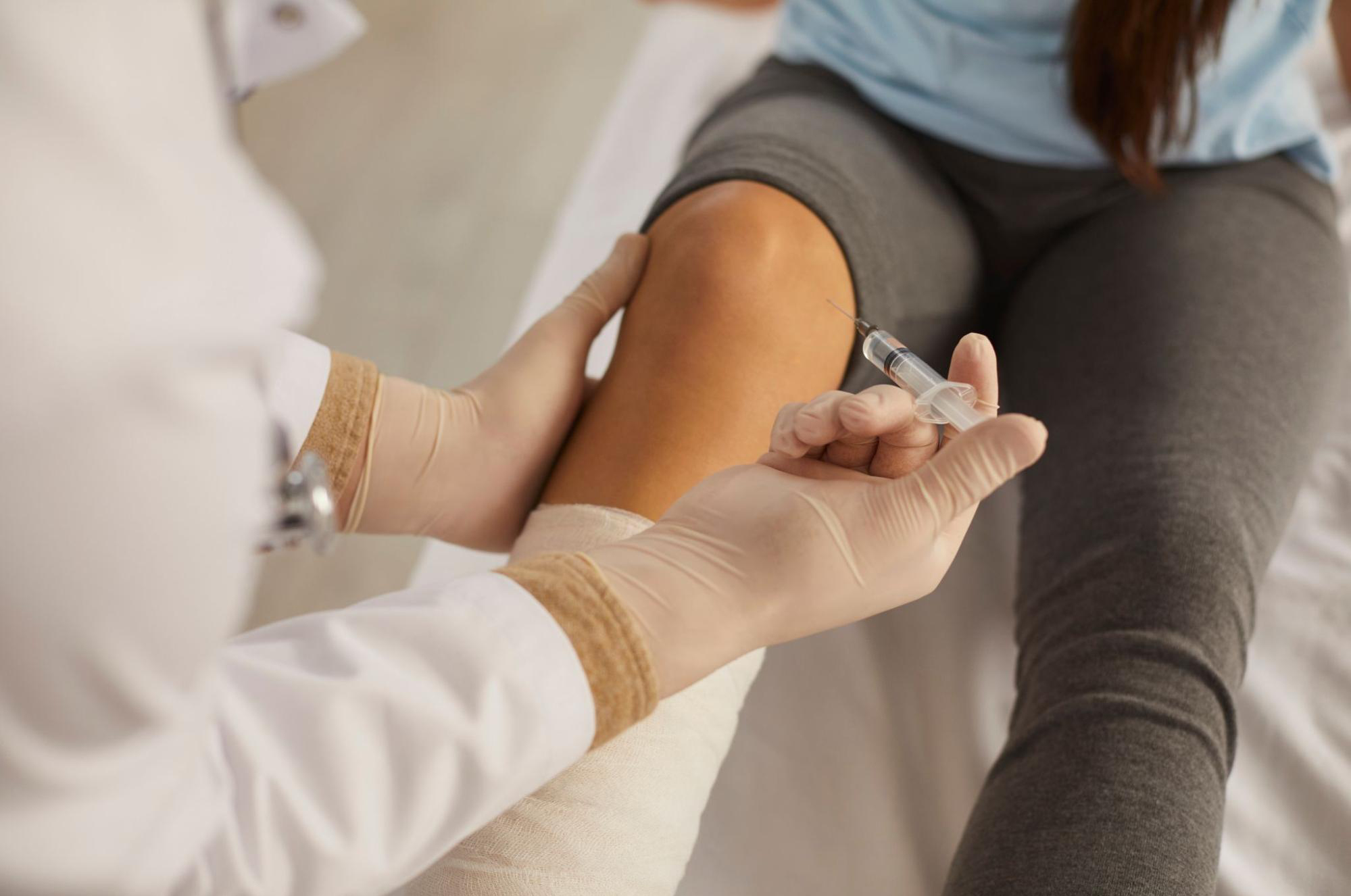
The growth factors contained in stem cell conditioned media — such as TGF-β, IGF-1, FGF, and VEGF — together with anti-inflammatory cytokines, are a promising option for calming the local inflammatory cycle and supporting the tissue-repair environment around the fibrous synchondrosis between the accessory and main patella, as well as at the degenerated vastus lateralis tendon insertion (tendinopathy). A realistic design is ultrasound-guided peri-knee injection targeting the peri-fragment region and the tendon insertion. Please also see this page for details on stem cell conditioned media joint injection.
Cannot Reach
On the other hand, we must also be clear about what “cannot be done.” Physical removal of the accessory ossicle, reconstruction of bony union, correction of quadriceps alignment (Q angle), and mechanical correction of patellar maltracking — none of these can be changed by injection alone. Long-term pain control requires combining physiotherapy such as strengthening of the vastus medialis oblique (VMO), stretching of the lateral retinaculum, and patellar taping. In progressive cases where conservative therapy cannot control pain, orthopaedic procedures such as partial excision of the accessory fragment or lateral retinacular release become options. For general information on joint diseases, please also refer to the Japanese Orthopaedic Association.
Frequently Asked Questions
Q. Does painful bipartite patella heal spontaneously?
In cases first presenting during adolescence, symptoms may resolve with activity modification and conservative care alone. However, in adults with chronic disease, repetitive vastus lateralis traction maintains the inflammatory cycle at the fibrous synchondrosis, so spontaneous resolution is unlikely with observation alone.
Q. How many peri-knee injections of stem cell conditioned media are needed to judge efficacy?
Because the effect on the inflammatory environment around the tendon insertion and the accessory fragment develops over time, we typically evaluate pain scores, range of motion, and pain with activity over several weeks to several months. If the response is poor, we decide between continuation, modification, or referral for orthopaedic re-evaluation. Individual response varies, and there are limits for structural problems such as tears or bony deformity.
Q. Between surgery (partial fragment excision) and stem cell conditioned media injection, which should be considered first?
Generally, conservative therapy — activity modification, quadriceps strengthening, and lateral retinacular stretching — is the first choice. Peri-knee injection is positioned as part of this conservative therapy, aimed at calming the inflammatory cycle. Surgery is considered when pain cannot be controlled by these measures.
Q. Is bipartite patella often bilateral?
Bilateral cases are reported in roughly half of bipartite patella findings, but pain does not necessarily occur on both sides. When repetitive stress loads only one side due to a movement pattern, only one side may become symptomatic.
Q. Can I continue sports during treatment?
It depends on the competitive level and pain severity. The general principle is to temporarily reduce movements that heavily load the vastus lateralis — jumping, sprinting, stair climbing — while combining peri-knee injection of stem cell conditioned media with physiotherapy. Forcing continued competition can prolong the inflammatory cycle at the accessory fragment and, in the end, delay return to play.
──────────────
Supervising Physician: Shin Moriwaki, M.D.
Member, Japan Society of Aesthetic Surgery (JSAS) / Member, American Academy of Aesthetic Medicine
ECFMG Certificate
──────────────
📍AVAN TOKYO Ginza Joint Regenerative Medicine
AVAN TOKYO Ginza Joint Regenerative Medicine
English / 中文 / Tiếng Việt available
Inquiries welcome via DM / LINE / Website / Phone.