


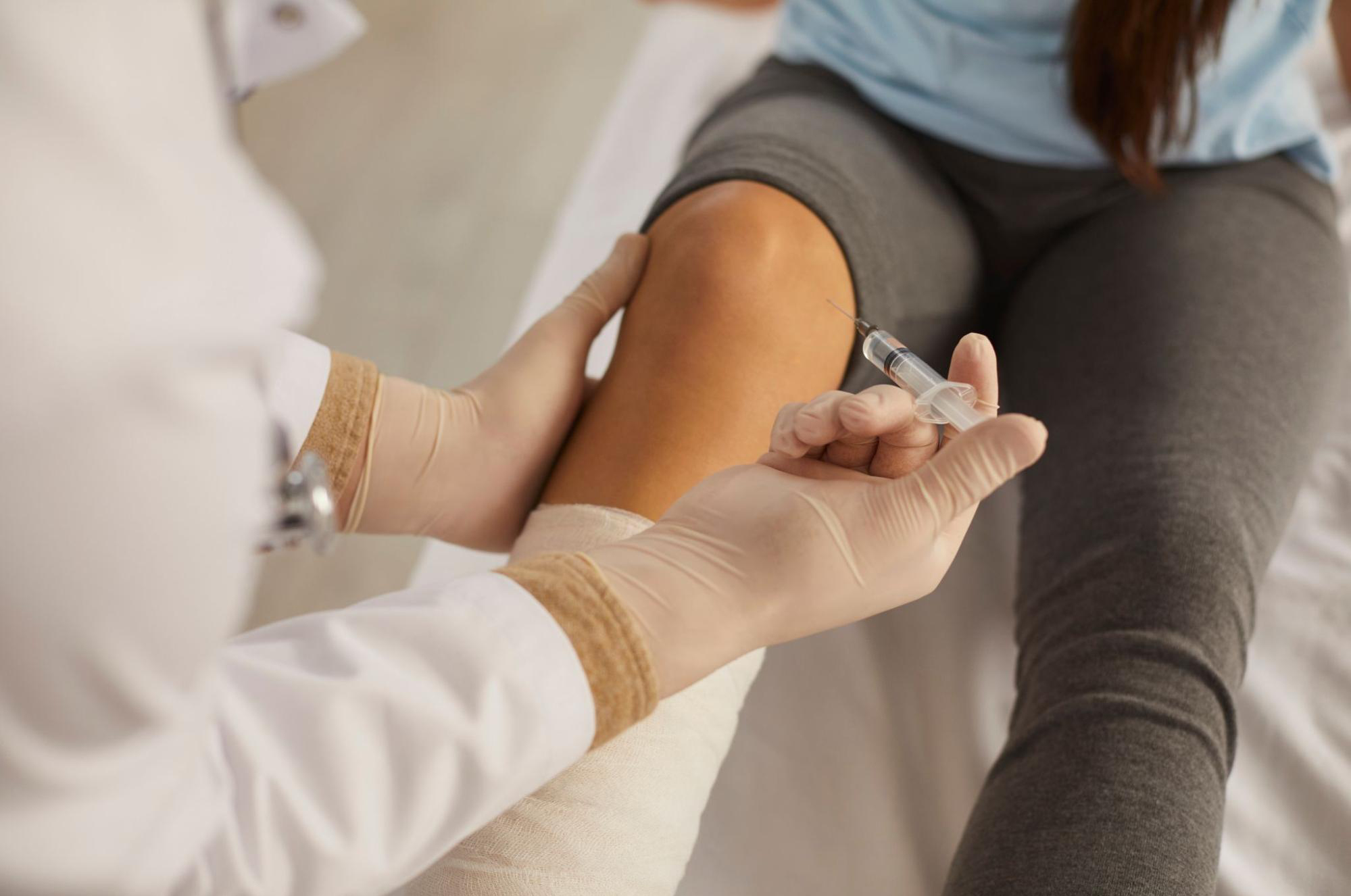
When Your Shoulder Keeps Dislocating, It May Be a Bankart Lesion, Not a Habit — Dr. Moriwaki explains anteroinferior labral tears behind recurrent anterior instability in younger patients and the conservative option of stem cell conditioned media shoulder injection to modulate intra-articular inflammation2026.07.26
“My shoulder popped out once, and now it keeps slipping.” Patients who describe this pattern are often men in their late teens to twenties, or younger people engaged in contact sports. Recurrent shoulder dislocation can happen suddenly during sports movements or even everyday actions — sometimes the patient reduces it themselves, sometimes an emergency room reduction is required. Many resign themselves to the idea that “it has just become a habit,” but behind this pattern lies, in most cases, a structural problem: an anteroinferior labral tear known as a Bankart lesion. At our clinic, we may offer stem cell conditioned media shoulder injection as a conservative complementary option positioned between surgery and simple observation, aiming to modulate the chronic intra-articular inflammatory environment. We always make clear, however, that anatomical reattachment of the detached labrum cannot be substituted by injection.
Key Points of This Article
・Repeated shoulder dislocation — recurrent shoulder dislocation — is not merely a “habit” but usually reflects a structural cause: Bankart lesion (anteroinferior labral tear)
・The younger the age at first dislocation, the higher the recurrence rate; under age 20, redislocation rates of 50–90% have been reported
・Arthroscopic Bankart repair and related surgical approaches are considered definitive treatment; stem cell conditioned media shoulder injection does not restore anatomical stability itself
・Injection can play a supportive role by addressing chronic synovitis and capsulitis that develop after repeated dislocations, easing pain and discomfort at the symptomatic level
・Coordination with orthopedic surgery, activity/position restrictions, and scapular motor relearning form the essential framework
The Relationship Between Recurrent Shoulder Dislocation and Bankart Lesion
The shoulder joint is anatomically designed to maximize range of motion, which means the glenoid (socket) is shallow. Its peripheral labrum, a fibrocartilaginous ring, expands the contact surface and contributes to stability. During anterior dislocation, the humeral head slips anteroinferiorly, often tearing the labrum off the glenoid rim — this is the Bankart lesion. The detached labrum does not readily heal back on its own, leaving a structural weakness so that similar forces easily cause the humeral head to slip again. The “habit” of recurrent shoulder dislocation is essentially the expression of this structural vulnerability.
Age at First Dislocation and Recurrence Risk
Clinical studies consistently show that recurrence rates in recurrent shoulder dislocation correlate strongly with age at the first dislocation. When the first dislocation occurs before age 20, redislocation rates of 50–90% have been reported, whereas patients whose initial event occurs after age 40 tend to have markedly lower recurrence. In younger, more active patients, relying on tissue healing alone leaves a persistent risk of the same-direction dislocation with the next trauma. Individual factors — activity level and sport type — also modify this risk.
Bony Bankart and Hill-Sachs Lesions
Repeated dislocations may cause bone loss at the anteroinferior glenoid rim (bony Bankart) and impaction damage to the posterolateral humeral head (Hill-Sachs lesion). Once bone loss exceeds a threshold, soft-tissue repair alone may not prevent redislocation, and bony reconstruction procedures such as the Latarjet may be considered. For general information on shoulder disorders, please also refer to the guidelines of the Japanese Orthopaedic Association. CT assessment of bone loss and MRI (or MR arthrography) evaluation of the labrum are essential when planning treatment.
What Stem Cell Conditioned Media Shoulder Injection Can and Cannot Address
The “anatomical instability itself” of recurrent shoulder dislocation is a problem best addressed by surgical approaches such as arthroscopic Bankart repair. Reattaching the detached labrum to the glenoid is not something an injection can substitute for. We always draw this line honestly at the first consultation.
The Layer of Intra-Articular Inflammation
At the same time, a shoulder that has undergone repeated dislocations accumulates changes such as chronic synovitis, capsular thickening, synovial pannus formation, and articular cartilage wear. Symptoms like “a lingering catching sensation or dull ache without an obvious dislocation” or “persistent subluxation-level discomfort” often reflect this chronic inflammatory environment. Growth factors and anti-inflammatory cytokines in stem cell conditioned media have shown, in basic research, the potential to intervene in intra-articular inflammatory cycles, and we position injection as a complementary option aimed at raising the symptom baseline. Results vary by individual and no guarantees can be made.
Bridging Surgical Waiting Periods and Post-Operative Rehabilitation
For patients who cannot schedule surgery immediately due to school, work, or in-season sports commitments, or for those wanting to control intra-articular inflammation and pain during post-op rehab, we may combine stem cell conditioned media shoulder injection with their broader plan. It is not a treatment to “avoid surgery,” but a supportive layer for functional recovery. For details, please see our page on stem cell conditioned media joint injection.
Treatment Sequencing and Dr. Moriwaki’s Perspective
For a patient with suspected recurrent shoulder dislocation, we consider MRI (or MR arthrography), CT-based bone loss assessment, and a detailed history of dislocation direction and injury posture with orthopedic surgery to be indispensable. From there we integrate age at first dislocation, number of recurrences, extent of bone loss, activity/sport level, and patient preference. In a young contact-sport athlete with significant bone loss, surgical decision-making (Bankart repair versus Latarjet) in collaboration with an orthopedic surgeon is the priority. Stem cell conditioned media shoulder injection becomes a candidate when chronic inflammation and pain need to be controlled during that decision window, or when a patient — for whatever reason — chooses a conservative course and wants to maintain function.
Frequently Asked Questions
Q. What happens if recurrent shoulder dislocation is left untreated?
With each additional dislocation, bony Bankart and Hill-Sachs lesions may progress and the anteroinferior glenoid bone loss can expand. Once bone loss passes a threshold, soft-tissue repair alone may no longer suffice. If you are young and prone to recurrent dislocation, structural evaluation by an orthopedic surgeon as early as possible is recommended.
Q. Will stem cell conditioned media shoulder injection stop the dislocations?
No. Reattaching the detached labrum to the glenoid cannot be achieved by injection. What the injection aims for is modulation of the chronic intra-articular inflammatory environment created by repeated dislocations — a way to raise the symptomatic baseline of pain and discomfort. Restoration of anatomical stability itself is the role of arthroscopic surgery.
Q. I’m unsure whether to undergo surgery. What are the decision factors?
We weigh age at first dislocation, number of recurrences, degree of bone loss, daily and sporting activity level, and the patient’s own wishes. Young contact-sport athletes with clear bone loss tend to favor surgery, while older, less active patients often lean toward conservative care — but decisions are highly individual, so please consult with an orthopedic surgeon.
Q. When and how are the effects of the injection evaluated?
We evaluate on a scale of weeks to months, using pain scores, range of motion, and the felt burden of daily activities as objective indicators. If response is poor, we share from the first consultation a clear framework for switching to continuation, modification, or orthopedic re-evaluation.
Q. Are there activity restrictions after the injection?
On the day of the procedure, avoid vigorous shoulder motion, heavy loading, throwing, and contact play. From the following day, gradual return is guided by pain level, but sudden loading in high-risk abduction–external rotation positions should be avoided, ideally alongside scapular motor relearning.
──────────────
Medical Supervisor: Shin Moriwaki, M.D. (Supervising Physician)
Member, Japan Society of Aesthetic Surgery (JSAS) / Member, American Academy of Aesthetic Medicine
ECFMG Certificate
──────────────
📍AVAN TOKYO Ginza Joint Regenerative Medicine
AVAN TOKYO Ginza Joint Regenerative Medicine
English / 中文 / Tiếng Việt available
Inquiries welcome via DM / LINE / Website / Phone.