


Abdominal Liposuction: How Much Improvement Can You Expect at 3 Months? A 1,100 cc Case and What to Know About Fibrosis and Downtime2026.09.07
If you are considering abdominal liposuction, you may be wondering:
“How soon will my abdomen look slimmer?”
“How long does the hardness or lumpiness last after liposuction?”
“Is the result complete by 3 months?”
At AVAN TOKYO GINZA LIPOSUCTION CLINIC, we do not view abdominal liposuction as simply removing fat. Our goal is to refine the overall contour of the abdomen and waist while allowing the tissues to heal properly throughout the recovery period.
In this case, approximately 1,100 cc of pure fat was removed from the abdomen, and the patient is now 3 months post-procedure.
At 3 months, the postoperative firmness and fibrosis have already improved significantly.
However, the abdomen tends to develop a stronger fibrotic healing response than areas such as the arms or face.
For this reason, it is important to understand that the final result usually develops gradually over approximately 6 months.
1,100 cc of Pure Fat Removed from the Abdomen
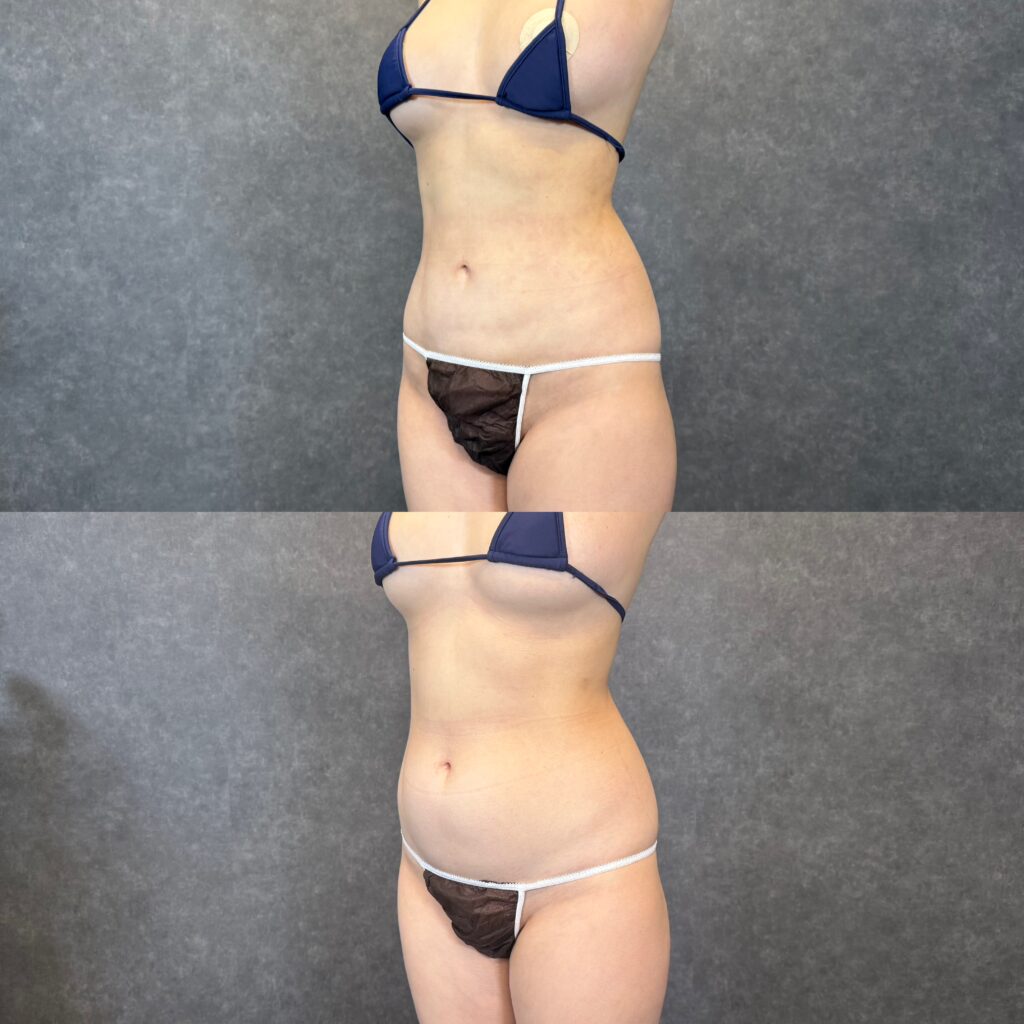
In this case, approximately 1,100 cc of pure fat was removed during abdominal liposuction.
However, successful liposuction should not be judged simply by how many cubic centimeters of fat are removed.
Overaggressive fat removal can increase the risk of irregularities, contour deformities, asymmetry, or an unnatural appearance.
At AVAN TOKYO, we carefully evaluate the entire three-dimensional contour, including:
● Upper abdomen
● Lower abdomen
● Waist
● Flanks
● Rib area
● Pelvic contour
● Transition between the abdomen and surrounding areas
Our goal is not simply to create an abdomen with less fat.
We aim to create a body contour that looks balanced and attractive from the front, side, and oblique views, including when wearing fitted clothing.
What Is Fibrosis After Abdominal Liposuction?
One of the most common concerns after liposuction is postoperative firmness.
Patients often tell us:
“My abdomen feels hard.”
“The skin feels lumpy.”
“I can feel tight areas under the skin.”
In many cases, this is part of the normal healing process known as post-liposuction fibrosis or tissue contracture.
After liposuction, the body begins repairing the treated tissues. During this healing process, fibrosis and scar-like tissue formation can temporarily occur beneath the skin.
As a result, patients may notice:
● Firmness under the skin
● Temporary lumpiness or unevenness
● Tightness
● Swelling
● Areas that feel harder when pressed
These findings do not necessarily indicate a poor liposuction result.
The abdomen in particular tends to develop more noticeable fibrosis because the treatment area is relatively large.
Abdominal Liposuction Often Causes More Noticeable Fibrosis
One important point to understand before abdominal liposuction is that the appearance can continue changing significantly during recovery.
Even when fat has already been removed, swelling and fibrosis may temporarily make the abdomen appear thicker, firmer, or less smooth.
For this reason, patients should not evaluate the final result too early.
At 1 or 2 months after surgery, it is common to feel that:
“My abdomen is still hard.”
“The contour looks uneven.”
“It does not look as slim as I expected yet.”
This does not necessarily mean that the procedure has failed.
In many patients, the abdominal tissues gradually soften and become smoother over approximately 6 months.
The patient in this case has already shown significant improvement by 3 months and is recovering relatively quickly.
Abdominal Liposuction Recovery: What to Expect
Recovery varies from person to person, but abdominal liposuction commonly follows the timeline below.
1 Week After Surgery
Swelling, bruising, and tenderness are usually most noticeable during the early postoperative period.
The abdomen may feel tight, swollen, or sore, similar to muscle pain.
1 Month After Surgery
Major swelling begins to improve, but fibrosis may become more noticeable.
Some patients experience firmness, lumpiness, or tightness beneath the skin.
3 Months After Surgery
Swelling and fibrosis usually begin to improve further, and the abdominal contour becomes easier to appreciate.
In this 1,100 cc case, the postoperative firmness had already improved significantly by 3 months.

6 Months After Surgery
The tissues usually continue to soften, and residual fibrosis and unevenness become less noticeable.
The final body contour is generally easier to evaluate around this stage.
Recovery speed depends on many factors, including the treatment area, amount of fat removed, skin quality, individual healing characteristics, and postoperative care.
Postoperative Care Is Important After Abdominal Liposuction
Liposuction does not end when the surgery is finished.
How you manage the recovery period can also affect how smoothly the tissues heal.
At AVAN TOKYO, postoperative care is tailored to each patient’s condition.
1. Wear a Proper Compression Garment
Compression garments can help control swelling and stabilize the treated tissues during the early recovery period.
However, stronger compression is not always better.
The garment should provide appropriate pressure without causing excessive discomfort or circulation problems.
2. Warm the Body After the Appropriate Recovery Period
Once your surgeon confirms that healing is progressing appropriately, activities such as:
● Warm baths
● Hot springs
● Sauna
may be considered as part of your recovery routine.
Warming the body can support circulation and may make firm tissues easier to mobilize.
3. Massage
Depending on your postoperative condition, massage may be helpful once it is safe to begin.
There is no need to apply excessive force.
Massage should be performed gradually and according to your healing stage.
4. Resume Exercise Gradually
Walking and light exercise can be restarted as recovery progresses.
Appropriate movement can help improve circulation and reduce swelling.
The key point is that liposuction is not simply:
“Have surgery and wait.”
The best recovery often comes from combining appropriate postoperative care with patience while the body heals.
In Abdominal Liposuction, Contour Matters More Than the Amount Removed
We are often asked:
“How many cc can you remove?”
The amount of fat removed can be one useful reference point, but it should never be the main goal of liposuction.
Even if two patients both have 1,100 cc removed, their results can be completely different depending on:
● Where the fat is removed
● How deep the liposuction is performed
● How much subcutaneous fat is intentionally left behind
● How the treated areas transition into surrounding tissues
Abdominal liposuction especially requires careful attention to the waistline from the front, side, and oblique angles.
At AVAN TOKYO, we evaluate each patient’s bone structure, muscle anatomy, skin quality, and fat distribution to create a balanced and natural body contour.
Can Slim Patients Have Abdominal Liposuction?
Yes.
Liposuction is not only for patients who are overweight.
Even slim patients may have concerns such as:
● Persistent lower abdominal fat
● Lack of waist definition
● Fat around the ribs
● A protruding appearance from the side
● Localized fat that does not respond well to weight loss
In slimmer patients, the goal is usually not to remove a large volume of fat.
Instead, careful adjustment of which areas to reduce and which areas to preserve becomes even more important.
Considering Abdominal Liposuction?
Abdominal liposuction can create a significant improvement in body contour, but the abdomen is also one of the areas where postoperative fibrosis can be more noticeable.
It is important not to judge the final result based only on the first 1 to 3 months.
In this case, approximately 1,100 cc of pure fat was removed, and the fibrosis had already improved considerably by 3 months.
However, in general, abdominal liposuction should be viewed as a procedure that continues to improve gradually over approximately 6 months.
Appropriate compression, massage, warming, and exercise may help support recovery when performed at the correct stage and under medical guidance.
At AVAN TOKYO, our goal is not simply to remove as much fat as possible.
We focus on:
where fat should be removed, where it should be preserved, and how the overall body can look more balanced and refined.
If you are concerned about abdominal fat, waist definition, or your overall body contour, please feel free to discuss your goals with us during your consultation.
Frequently Asked Questions About Abdominal Liposuction
How long does fibrosis last after abdominal liposuction?
The recovery period varies, but firmness is often more noticeable during the first 1 to 3 months and gradually improves over approximately 6 months.
Is the result complete at 3 months?
The overall contour is often much easier to see by 3 months, but the abdomen may still have residual fibrosis or firmness.
The final result is generally evaluated closer to 6 months.
How many cc of fat can be removed from the abdomen?
The amount varies depending on BMI, fat thickness, treatment area, body structure, and safety considerations.
At AVAN TOKYO, we prioritize body contour and safety rather than simply maximizing the volume removed.
Will the lumpiness after liposuction go away?
Temporary firmness and unevenness can occur due to swelling and fibrosis and may gradually improve over time.
However, not all contour irregularities have the same cause, so persistent or concerning changes should be evaluated by your surgeon.
Is massage necessary after abdominal liposuction?
It depends on the individual recovery process.
Massage, exercise, and other postoperative care may support improvement in swelling and fibrosis once it is medically appropriate to begin.
Your surgeon should advise you regarding timing and intensity.
AVAN TOKYO GINZA LIPOSUCTION CLINIC
AVAN TOKYO specializes in body contouring procedures, including liposuction of the abdomen, waist, arms, thighs, and other areas.
Our philosophy is not to compete over how many cubic centimeters of fat can be removed.
Instead, we focus on:
removing fat where it improves the silhouette, preserving volume where it supports natural contours, and creating a balanced overall body line.
If you are considering abdominal liposuction, save the case photos you like and bring them to your consultation so we can discuss the body contour you would like to achieve.
Results, recovery time, and the amount of fat that can be removed vary between individuals.
Potential risks of liposuction include swelling, bruising, pain, edema, fibrosis, contour irregularities, asymmetry, pigmentation changes, scarring, infection, hematoma, and other complications.