


Back Liposuction in Tokyo, GinzaBack liposuction
Thickness around the shoulder blades and the bulge along the bra line. We design the upper and lower back separately and shape your back view in one continuous line with the upper arms and accessory breast area.
Back liposuction at a glance
| Areas treated | Upper back (around the shoulder blades) and lower back (bra-line to just above the waist); both can be treated together as “upper back + lower back”. The back is often combined with the upper arms, accessory breast tissue and the area beside the armpits on the same day |
|---|---|
| Your doctor | The same doctor (Director Dr. Susumu Moriwaki) handles your counseling, surgery and post-op check-ups. For his background and qualifications, see Our Doctor |
| Operating time | Varies with the treatment area (about 2 hours in a case where the full upper arms, accessory breast tissue, upper and lower back and other areas were treated on the same day) |
| Anesthesia | Local anesthesia, or IV sedation / general anesthesia administered by a board-certified anesthesiologist (a pre-operative blood test is required for IV sedation and general anesthesia) |
| Downtime | The back is prone to contracture (firmness under the skin), which may last 1 to 3 months after surgery. The result is typically settled at 3 to 6 months |
| Follow-up visits | Check-ups at 1 week (suture removal), 1 month, 3 months and 6 months after surgery |
| Prices (tax included) | Upper back (above shoulder blades): from ¥248,000 (monitor price ¥198,000). For prices by area, see the price table |
| Not included | Anesthesia fee (see “Anesthesia” in the price table) |
– LINE –Free LINE Booking– MAIL –Book by Email– WhatsApp –Consult on WhatsApp
Why fat builds up on the back and is hard to lose
Rolls that sit over the bra, or thickness around the shoulder blades. The back is hard to see for yourself, yet it strongly shapes how your silhouette looks from behind and from the side.
Many people feel that “even when I diet, my back is the only part that doesn’t change.” Here is why fat builds up on the back and is hard to lose.
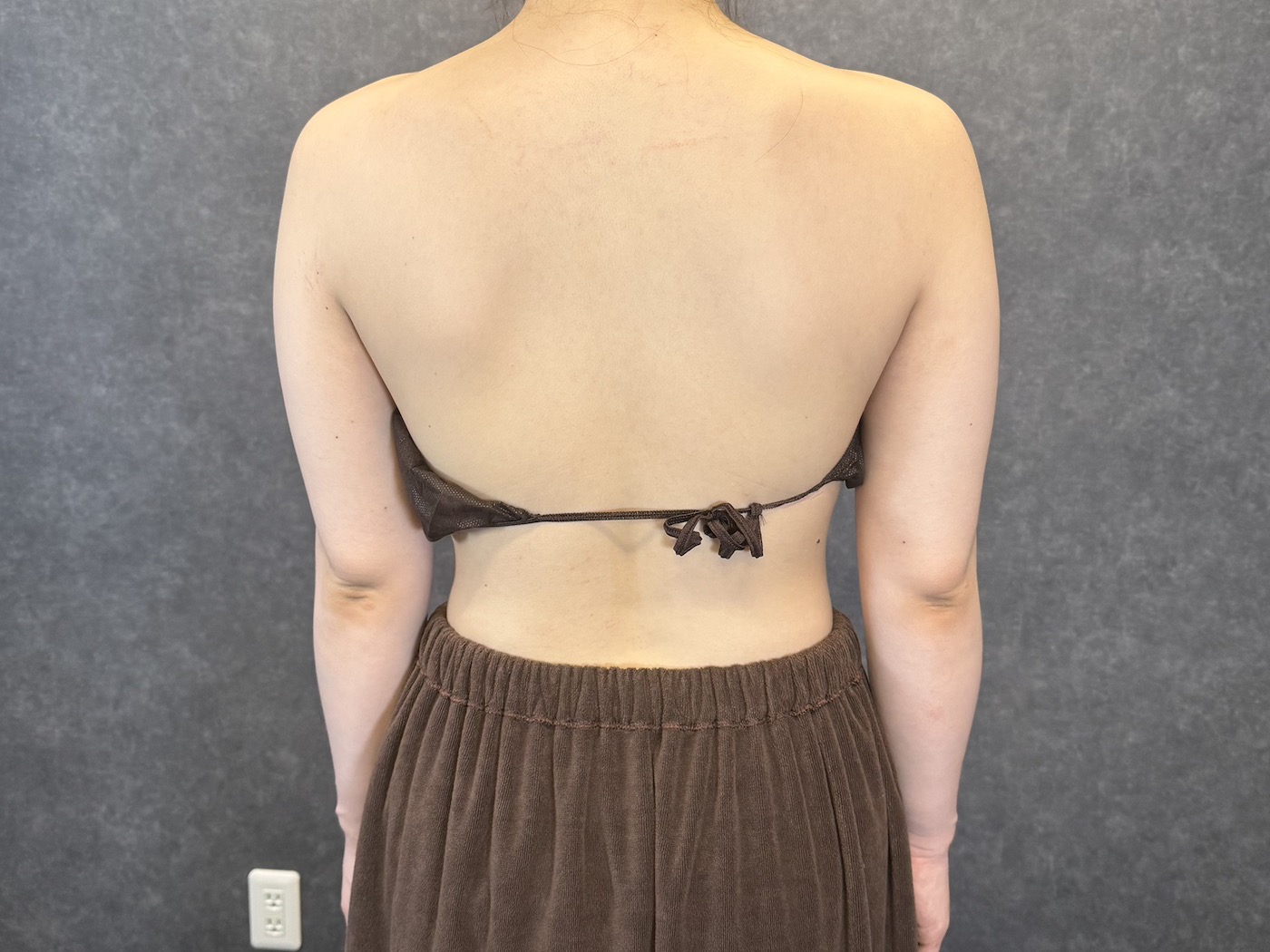
Bra-line rolls caused by tight underwear
The horizontal “bra-line roll” just below the bra band is something many people are concerned about. The fat here is thick, and repeated pressure from underwear makes this a zone where rolls form easily. The fat often contains firm fibrous tissue, so diet and exercise alone may not change its shape.
Posture and limited movement around the shoulder blades
When you spend long hours looking at a smartphone or computer and keep a hunched or rounded-shoulder posture, the shoulders move forward and the trapezius muscle stays tense, making the shoulder area look raised. Because the shoulders, neck, arms and back are connected as one line, improving your posture is also an important factor in changing how you look from behind (column: “Beautiful Upper Arm, Neck and Shoulder Lines Depend Greatly on Posture“).
Thick skin and fibrous fat
The back has some of the thickest skin on the body, and its fat contains a lot of fibrous tissue. This makes it difficult to lose fat from this area alone, and even in liposuction, experience is needed in handling the shallow and deep layers and in choosing instruments. At our clinic, we think of the back as an “upper” and a “lower” zone and design each with a different goal.
Back liposuction treatment areas
The area to be treated depends on how fat is distributed on your back and the back view you would like. At our clinic, the following areas can be treated.

Upper back (around the shoulder blades)
Here, a thin layer of fat spreads widely over the muscles. When fat and fibrous tissue build up here, the outline of the shoulder blades blurs and the back looks flat. The goal is not to remove volume but to create shading so the contour of the shoulder blades appears naturally. Removing too much lets the contours of the muscles show through the skin, so we carefully refine the shallow layer.
Lower back (bra-line to just above the waist)
The fat here is thick and bra-line rolls form easily. Because it is often firm tissue containing fibers, we smooth out the rolls while creating a line that flows smoothly into the waist. Designing it as one continuous area with the lower back and waist helps bring out a curve when seen from behind.
Upper back + lower back
This option refines the upper and lower back together. We look at the area from the shoulders down to just above the waist as one continuous line and change the depth and amount of suction by location: shading on the upper back, and smoothing out rolls on the lower back.
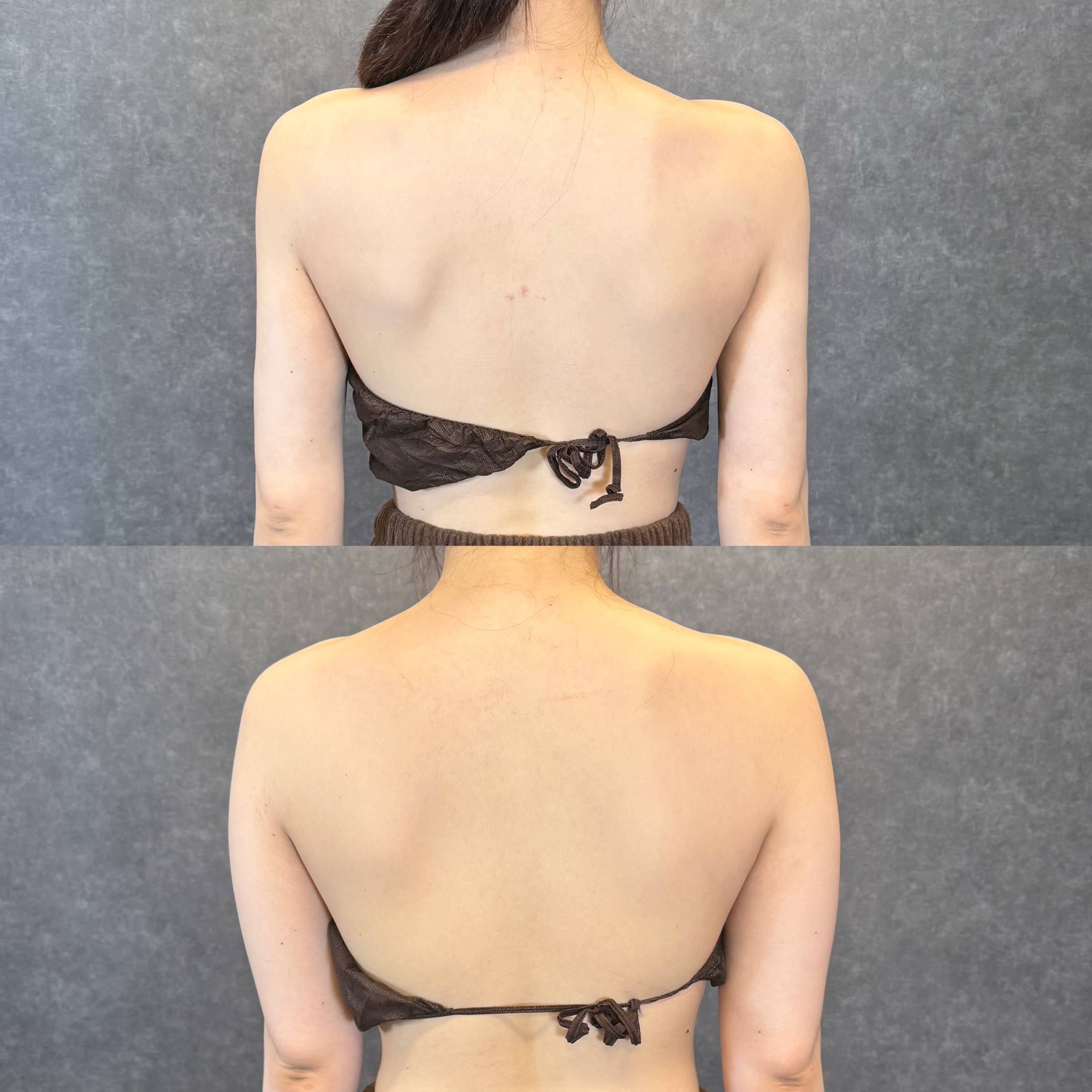
Back view before and 6 months after surgery of a 26-year-old woman who had liposuction of the full upper arms, forearms, accessory breast tissue, upper and lower back and lower neck (combined with shoulder and arm Botox). A total of 900 ml was removed under IV sedation, and the operating time was about 2 hours (case details).
Combining with the upper arms, accessory breast tissue and armpit area

Before

8 months after surgery
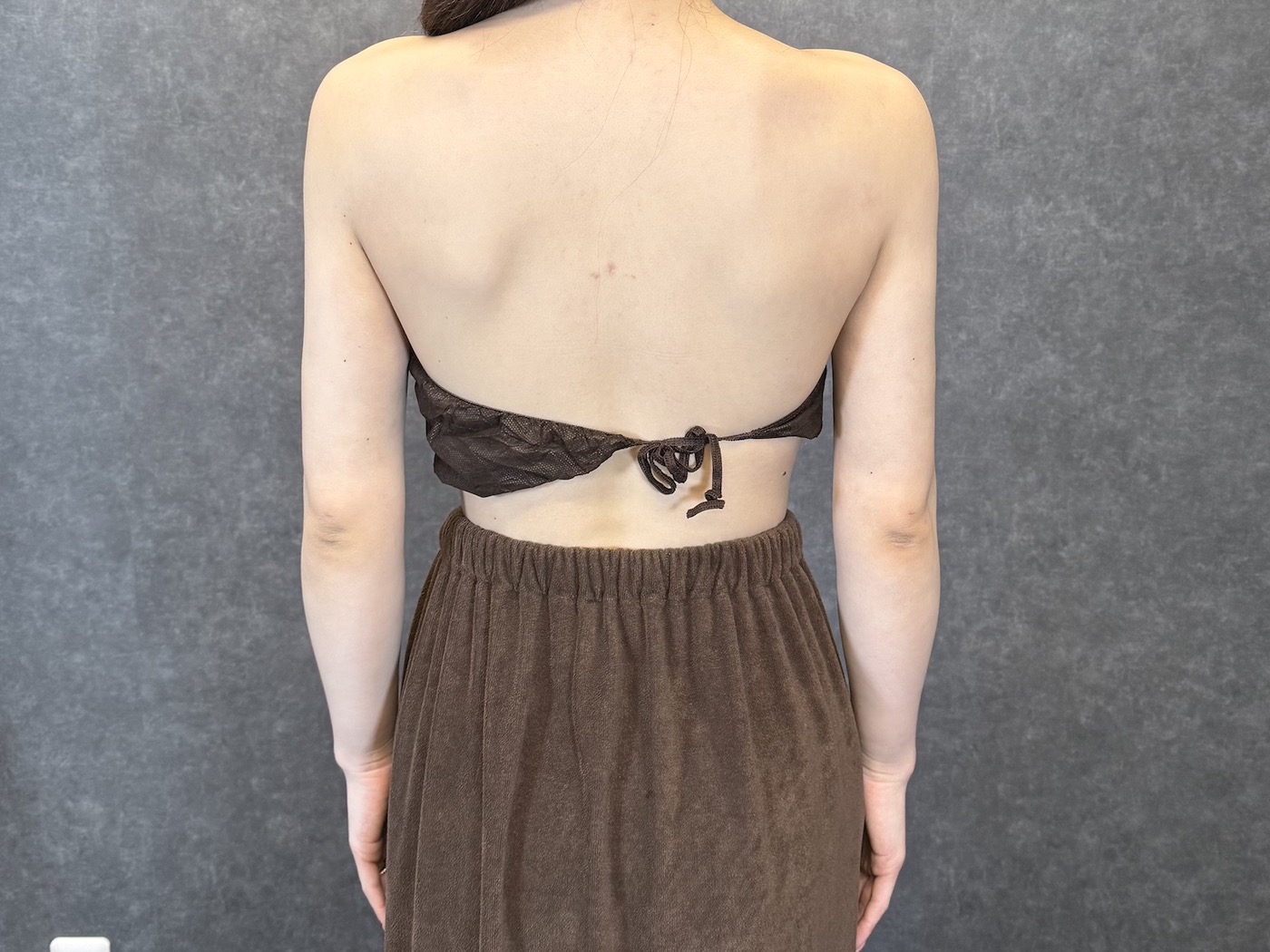
Before and 8 months after surgery of a 32-year-old woman who had liposuction of the upper arms and back (case details).
The shoulder blades and upper arms form one continuous line, so if only the back is slimmed while volume remains on the arms or beside the armpits, steps become noticeable. Many of our back cases are performed on the same day as the upper arms, accessory breast tissue and armpit area. The removed fat can also be used for fat-transfer breast augmentation or hybrid breast augmentation.
How to decide how much of the upper body to include is explained in “Upper Body Liposuction Design | How to Decide How Far to Include the Arms, Shoulders and Back“.
Downtime after back liposuction

The most characteristic feature of downtime after back liposuction is that contracture (a feeling of firmness under the skin) tends to be relatively strong. This is because the back has thick skin and a lot of fibrous tissue.
Swelling and bruising settle over several days to several weeks, while contracture may last about 1 to 3 months after surgery. The back view, with the shoulder-blade line appearing naturally and flowing into the waist, is typically complete 3 to 6 months after surgery. Recovery varies from person to person.
Common symptoms during downtime are as follows.
- Pain
-
Because the tissue around the area where fat was removed is affected, you will feel pain similar to muscle soreness after surgery. The degree varies from person to person.
The pain can be controlled with the prescribed painkillers.
- Swelling and puffiness
-
These are caused by inflammation of the tissue around the removed fat and by blood and lymphatic fluid that collect during and after surgery.
Holding the treated area in place with a compression garment reduces swelling and puffiness and keeps the skin in close contact with the underlying tissue.
- Bruising
-
Blood from small vessels injured during surgery collects under the skin and looks like a bruise. It fades naturally over time.
- Contracture
-
Contracture is a condition in which the skin and the tissue beneath it adhere and become firm where fat was removed. The skin may feel stiff or tight, but this is a natural healing response seen in most people who have liposuction, not a failure.
Contracture tends to be relatively strong on the back and may last about 1 to 3 months after surgery. If it lasts longer or concerns you, please contact the clinic.
Back liposuction scars, risks and side effects

Back liposuction can change your back view considerably, but it is important to understand not only the benefits but also the possible risks and precautions.
- You may not reach your ideal slimness
-
Based on the doctor’s judgment, not all fat is removed. The amount may be adjusted for overall balance, the burden on your body and to prevent sagging skin.
It is important to discuss thoroughly with the doctor at counseling and share a clear image of the expected result.
- Unevenness and steps
-
On the upper back the fat over the muscles is thin, so if too much is removed, the contours of the muscles may show through the skin. The lower back contains a lot of fibrous tissue, and uneven suction can leave steps.
At our clinic, we change the depth and amount of suction between the upper and lower back, aiming for a smooth result.
- Sagging skin
-
If too much fat is removed from the shallow layer, the skin may not contract fully and may sag. How likely this is depends on age, skin elasticity and the amount of fat.
- Scars
-
Small scars remain where the cannula was inserted. They are usually not noticeable, but in rare cases the incision may become raised (keloid), in which case an examination is needed.
- Pigmentation
-
The skin at the incisions or treated area may darken or turn brown. If you are concerned, please ask at your follow-up visit.
- Infection and complications
-
There is a slight risk that bacteria enter through the incision and cause an infection. After surgery, keep the incisions clean and take the prescribed medication as instructed.
Other complications, such as a hematoma or nerve problems including numbness, may also occur. If you notice any worrying symptoms, do not judge for yourself; please consult your doctor.
Back liposuction procedure

Here is how back liposuction proceeds.
STEP1Counseling
Please tell us in detail about your concerns with your back view and the figure you would like. We check the firmness of your skin and the thickness of the fat, and decide together how much of the upper and lower back to treat and whether to combine it with the upper arms, armpit area or other areas. We also explain the risks and precautions clearly.
STEP2Pre-operative tests
If the procedure is performed under IV sedation or general anesthesia, a blood test is done beforehand. It checks items we need to confirm before surgery, such as your response to anesthesia, anemia and allergies. The results are available in 2 to 3 days, so the surgery is scheduled after that.
We also explain carefully how to use the compression garment worn on the day of surgery and what to keep in mind.
STEP3Measurements and photos
On the day of surgery, a nurse first checks your physical condition and you change into a surgical gown. Then, to accurately record your pre-operative condition, we measure the areas to be treated and take photos.
STEP4Design and anesthesia
The doctor marks the design agreed on in advance. Because the goals of suction differ between the upper and lower back, the areas and depths are designed separately. You then move to the operating table and anesthesia is administered.
STEP5Liposuction
Small incisions are made in inconspicuous places, such as the center of the upper back or below the shoulder blades, and tumescent solution is injected to reduce pain, soften the fat and minimize bleeding.
A thin cannula with a rounded tip is then inserted and the fat is removed. In areas with a lot of fibrous tissue, a device that softens fat with ultrasound (Elsa) may be used as an option. The operating time varies with the treatment area.
STEP6Compression
Immediately after surgery, the area is compressed to reduce swelling. Wearing an upper-body compression garment (such as a bolero type) reduces swelling and puffiness and helps the skin settle into its new shape.
STEP7Recovery room and going home
After surgery, you rest in a private room until you have recovered. We measure your blood pressure and heart rate and check for any pain or discomfort.
After a post-operative talk with the doctor, you can go home. Because the effects of anesthesia may remain, please do not drive; use public transportation instead.
Aftercare for back liposuction (how to spend the recovery period)

Here is how to spend the period after back liposuction.
The day of surgery
You go home wearing the compression garment. Please keep wearing it to reduce swelling and puffiness. Because bacteria could enter the incisions, please do not shower on the day of surgery.

From the next day
You do not need to wear the compression garment all day, but for a clean result and to keep downtime down, we recommend continuing compression for about 1 week, such as while at home and while sleeping.
The pain can be controlled with the prescribed painkillers.
1 week after surgery
You visit the clinic to have your stitches removed. After suture removal, there are no more restrictions on bathing, alcohol or exercise, but if swelling or pain remains, do not push yourself; return to your daily routine gradually while watching how your body feels.
1 to 3 months after surgery
You visit the clinic for a post-operative check-up. Visible swelling and bruising settle, and contracture appears during this period. Contracture tends to be relatively strong on the back, so the skin may feel firm or tight, but this is part of the process of the skin adapting to its new shape.
Where there was a bra-line roll, tight underwear can easily create a roll again, so we recommend reviewing the position of the hooks or switching to looser underwear.
3 to 6 months after surgery
Contracture softens, and the shoulder-blade line and the transition into the waist settle naturally. We also hold check-ups at 3 and 6 months to confirm the result.
Recovery after surgery varies from person to person. If pain increases or swelling becomes severe, another problem may be developing, so please do not hesitate to contact our clinic if anything worries you.
Back liposuction prices
All prices include tax (Japanese yen). Prices are synchronized with our Japanese price list.
| Area | Regular price | Monitor price |
|---|---|---|
| Upper back (above shoulder blades) | ¥248,000 | ¥198,000 |
| Mid back (below shoulder blades) | ¥248,000 | ¥198,000 |
| Upper + mid back | ¥448,000 | ¥368,000 |
| Armpit / bra-line fat | ¥220,000 | ¥150,000 |
Anesthesia
| IV sedation | ¥55,000 (¥110,000 when administered by a board-certified anesthesiologist) |
|---|---|
| General anesthesia (by a board-certified anesthesiologist) | ¥220,000 |
BMI surcharge: BMI 25–29 → ×1.5, BMI 30 or above → ×2 (multiplier applied to the procedure fee).
The final total is confirmed at counseling. Prices for all treatments are listed on the price list (Japanese).
Back liposuction FAQ
- QHow long does back liposuction take?
- AIt depends on the area treated and whether it is combined with other areas such as the upper arms. In a case where the full upper arms, forearms, accessory breast tissue, upper and lower back and lower neck were treated on the same day, it took about 2 hours. With general anesthesia, please allow about half a day, including pre-operative preparation and post-operative observation.
- QHow much fat can be removed from the back?
- AIt varies greatly depending on the thickness of the fat and the condition of the skin. Among our cases, there is one in which 800 ml was removed from the back in a patient treated on the same day as the upper arms and thighs. Aiming only to remove volume can cause unevenness or sagging, so we decide the amount while considering the balance of the result.
- QCan the rolls that sit over the bra strap (bra-line rolls) be removed?
- AThe lower back, where bra-line rolls form, is treated under the “lower back (bra-line to just above the waist)” option in the price table. The fat there is thick and often firm with fibrous tissue, so we design it to smooth out the rolls while flowing smoothly into the waist. After surgery, tight underwear can easily create a roll again, so we recommend reviewing the position of the hooks or wearing looser underwear.
- QWhich areas of the back can be treated?
- AThe price table divides the back into two areas, “upper back (around the shoulder blades)” and “lower back (bra-line to just above the waist)”, and there is also “upper back + lower back” to treat both at the same time. Thickness around the shoulder blades and rolls around the bra strap call for different goals, so how much to treat is decided after examining your figure at consultation.
- QHow long is the downtime?
- AThe back has thick skin and a lot of fibrous tissue, so contracture, which feels like firmness under the skin, tends to occur and may last about 1 to 3 months after surgery. The result is typically settled 3 to 6 months after surgery. How swelling and bruising appear and how long recovery takes vary from person to person.
- QWhat type of anesthesia is used?
- AYou can choose local anesthesia, or IV sedation or general anesthesia administered by a board-certified anesthesiologist. For IV sedation or general anesthesia, we confirm safety with a pre-operative blood test before the procedure.
- QWill there be scars?
- AThe incisions are small, about 2 to 4 mm, made to insert the thin tube (cannula) used to remove fat. On the back, they are planned in places easily hidden by underwear or clothing, such as the center of the upper back or below the shoulder blades. How scars heal varies from person to person.
- QHow long do I wear the compression garment?
- AYou go home wearing it on the day of surgery. From the next day you do not need to wear it all day, but we recommend continuing compression for about 1 week, such as while at home and while sleeping.
- QCan it be combined with the upper arms or accessory breast tissue?
- AYes. Many of our back cases are performed on the same day as the upper arms, accessory breast tissue, armpit area and other areas. Designing the shoulders, back and armpit area as one continuous line makes it less likely that steps remain in the silhouette from behind or from the side. Please discuss which areas to combine at counseling.
- QAre there costs other than the procedure fee?
- AAnesthesia is charged separately. IV sedation and general anesthesia fees are listed in the “Anesthesia” table above. If a device that softens fat with ultrasound (Elsa) is used, an option fee applies (“LSSA” in the price table). Any other costs are itemized in the written estimate you receive at your counseling.
- QWhat is the “monitor price”?
- AThe monitor price is the price listed as “Monitor” alongside the regular price in the price table. It requires your agreement to photo and video documentation; detailed conditions are explained at counseling. Monitor prices may end without notice.
Learn more about back liposuction (doctor’s columns)
Results and design
- Upper and Lower Back Liposuction Are Completely Different | Suction Design Around the Shoulder Blades and the Bra-Line Zone
- Upper Body Liposuction Design | How to Decide How Far to Include the Arms, Shoulders and Back
Treating fibrous and firm fat
Combining with other areas


Book a Free Counseling
Counseling is free. Choose the way that suits you.