


Calf Liposuction in Tokyo, GinzaCalf liposuction
An asymmetric design that removes different amounts on the inner and outer sides to refine the line from the ankle to the calf. Before surgery, we check whether fat is really what makes your calves look thick.
Calf liposuction at a glance
| Areas treated | Calves, ankles, or calves + ankles. These can also be combined with the thighs or knees on the same day |
|---|---|
| Your doctor | The same doctor (Director Dr. Susumu Moriwaki) handles your counseling, surgery and post-op check-ups. For his background and qualifications, see Our Doctor |
| Operating time | Varies with the treatment area (longer when combined with other areas) |
| Anesthesia | Local anesthesia, or IV sedation / general anesthesia administered by a board-certified anesthesiologist (a pre-operative blood test is required for IV sedation and general anesthesia) |
| Downtime | You can walk from the next day. Avoid strenuous exercise and long hours of standing work for 1 week. Swelling peaks on days 3 to 7, and the result gradually approaches its final shape over 2 to 3 months |
| Post-op compression | Compression with medical compression stockings |
| Follow-up visits | Check-ups at 1 week (suture removal), 1 month, 3 months and 6 months after surgery |
| Prices (tax included) | Calves: from ¥398,000 (monitor price ¥270,000). For prices by area, see the price table |
| Not included | Anesthesia fee (see “Anesthesia” in the price table) |
– LINE –Free LINE Booking– MAIL –Book by Email– WhatsApp –Consult on WhatsApp
Why calves look thick
Calves stand out when you wear a skirt or shorts. Fat is not always the only reason calves look thick; muscle, swelling and bone structure often overlap.
Liposuction works when fat is the cause. Identifying the cause first is the first step toward a result you are happy with.
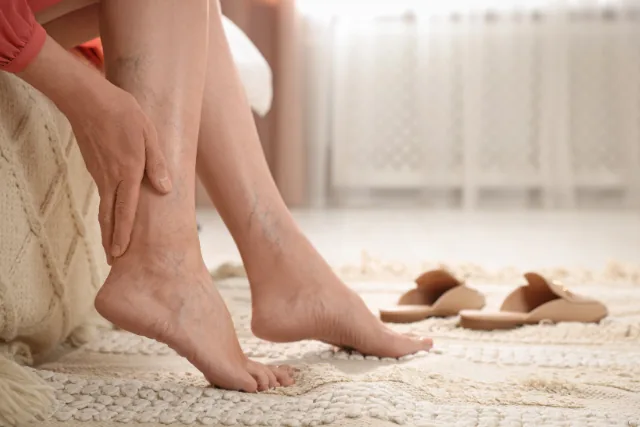
Subcutaneous fat
If you have subcutaneous fat you can pinch with your fingers (roughly 1.5 cm or more on a pinch test), liposuction tends to give a clearly visible change. In women, the subcutaneous fat on the inner calf tends to be thicker than on the outer calf.
Muscle bulk
On the inner calf, the inner head of the gastrocnemius muscle bulges out quite far down the leg, so the muscle contour remains even after fat is removed. When muscle bulk is the main cause, reducing muscle volume with calf Botox may be the preferred approach.
Swelling and bone structure
Standing work, sitting for long periods, feeling cold and too much salt all make the calves and ankles prone to swelling. When swelling or bone structure (such as bow legs or knock knees) is the main cause, liposuction alone will not make the legs slimmer. At our clinic, we use a pinch test and ultrasound before surgery to determine whether fat is the main cause (column: “Calf Liposuction: Why the Inner and Outer Sides Slim Differently | The Anatomy of the Gastrocnemius and Soleus Explained by a Doctor“).
Calf liposuction treatment areas
Because the calves have pronounced muscle contours and only a limited fat layer, they are one of the areas where planning how to remove fat is particularly difficult. At our clinic, we treat the following areas listed in our price table.
Calves
As a rule, we use an “asymmetric design” that intentionally removes different amounts from the inner and outer sides. On the inner side, where the fat is thicker, we carefully remove fat layer by layer in a vertical direction; on the outer side, where the fat is thinner, we only refine the shallow layer as little as necessary. Removing fat evenly leaves the inner side not slim enough and removes too much from the outer side, causing unevenness.
Ankles
Both sides of the Achilles tendon are a delicate area where the skin is thin and nerves and blood vessels run close to the surface. Using a thin cannula, we remove fat thinly and evenly, limited to the shallow-to-middle layers, aiming for a result in which the lines of the tendon and bone appear naturally (column: “Thick Ankles Are Not Just Fat | Swelling Around the Achilles Tendon and Who Is Suited to Ankle Liposuction, Explained by a Doctor“).
Calves + ankles
This option refines the calves and ankles as one continuous area. It suits people who want a cleaner line from the ankles up through the calves.
Combining with the thighs and knees
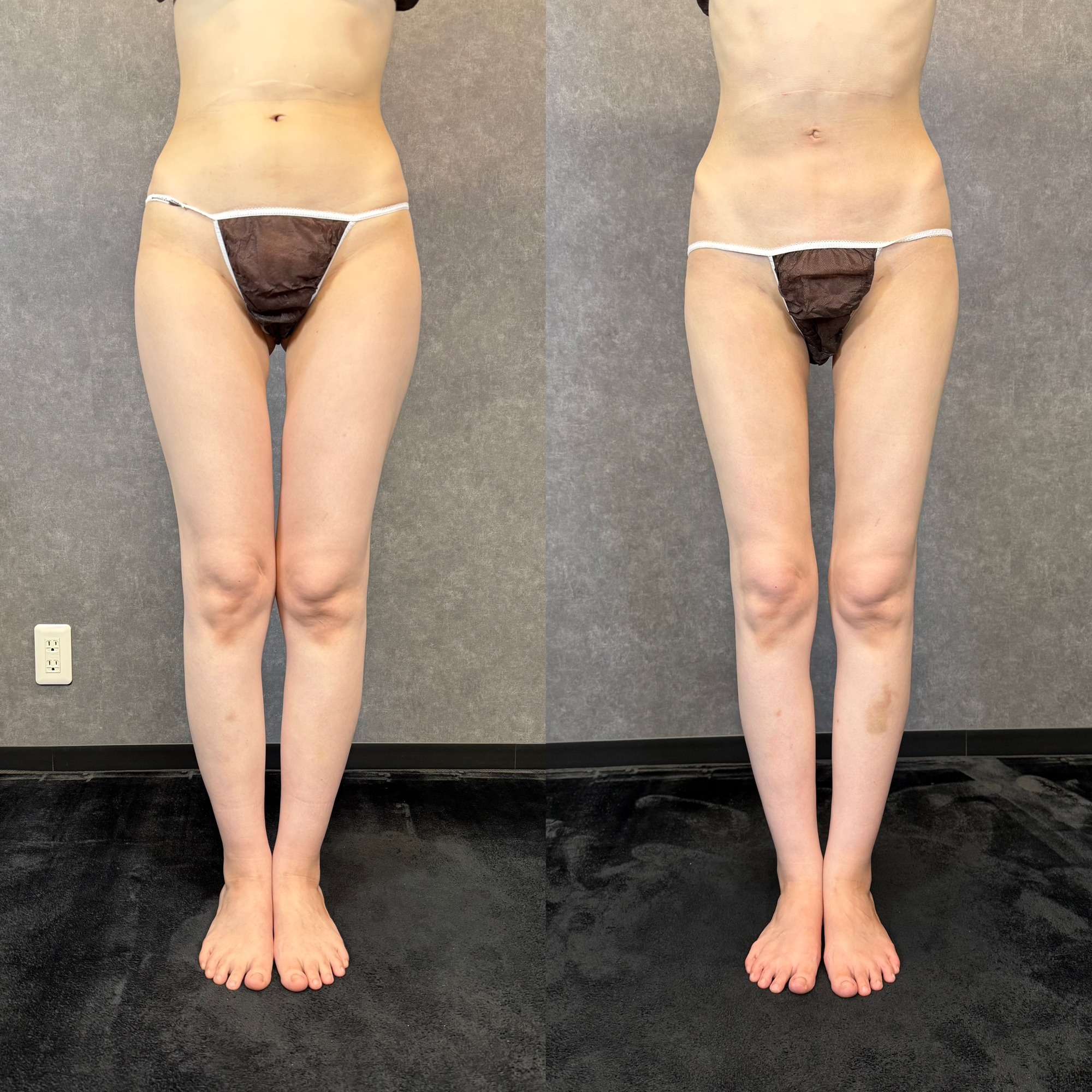
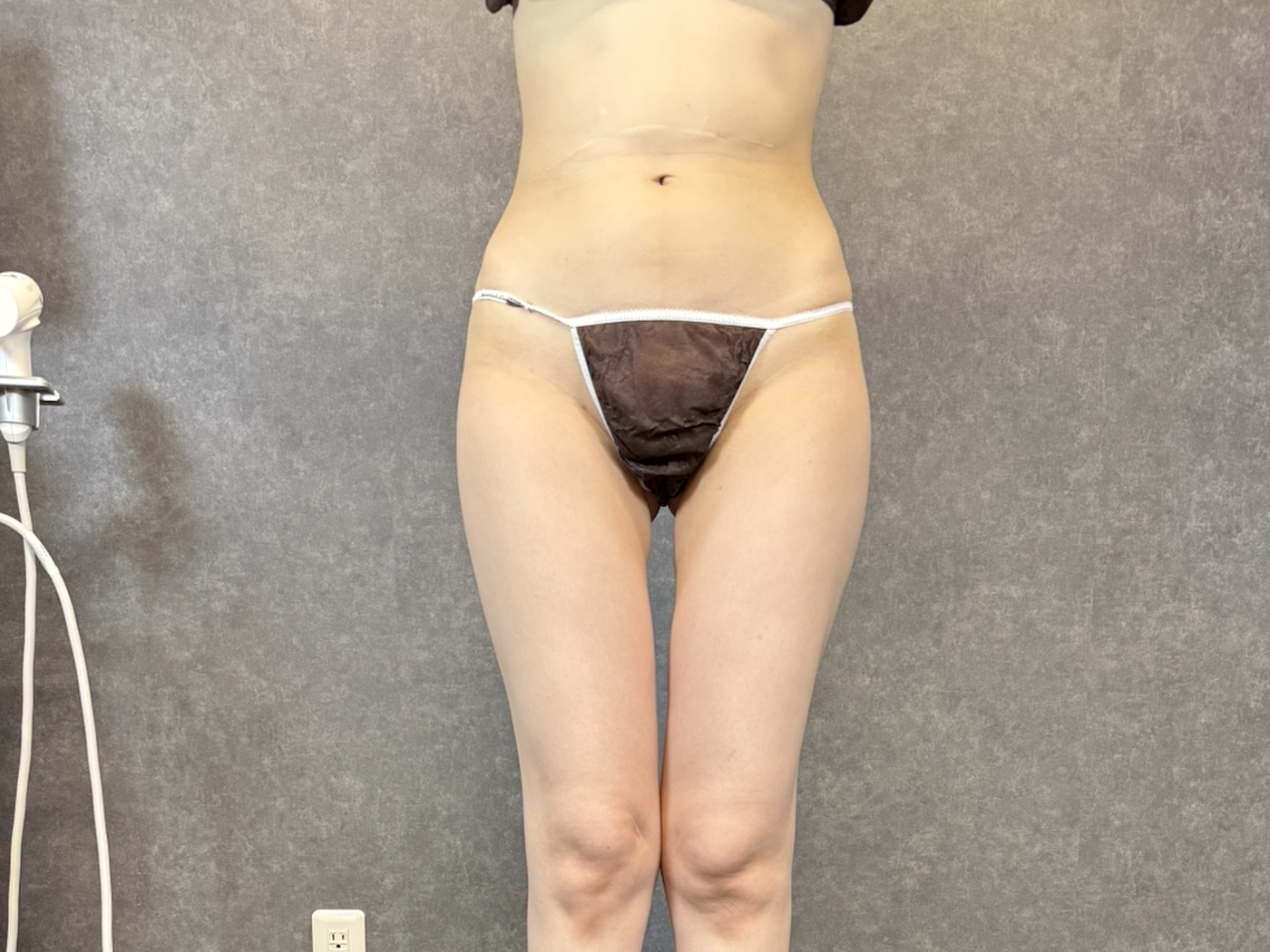
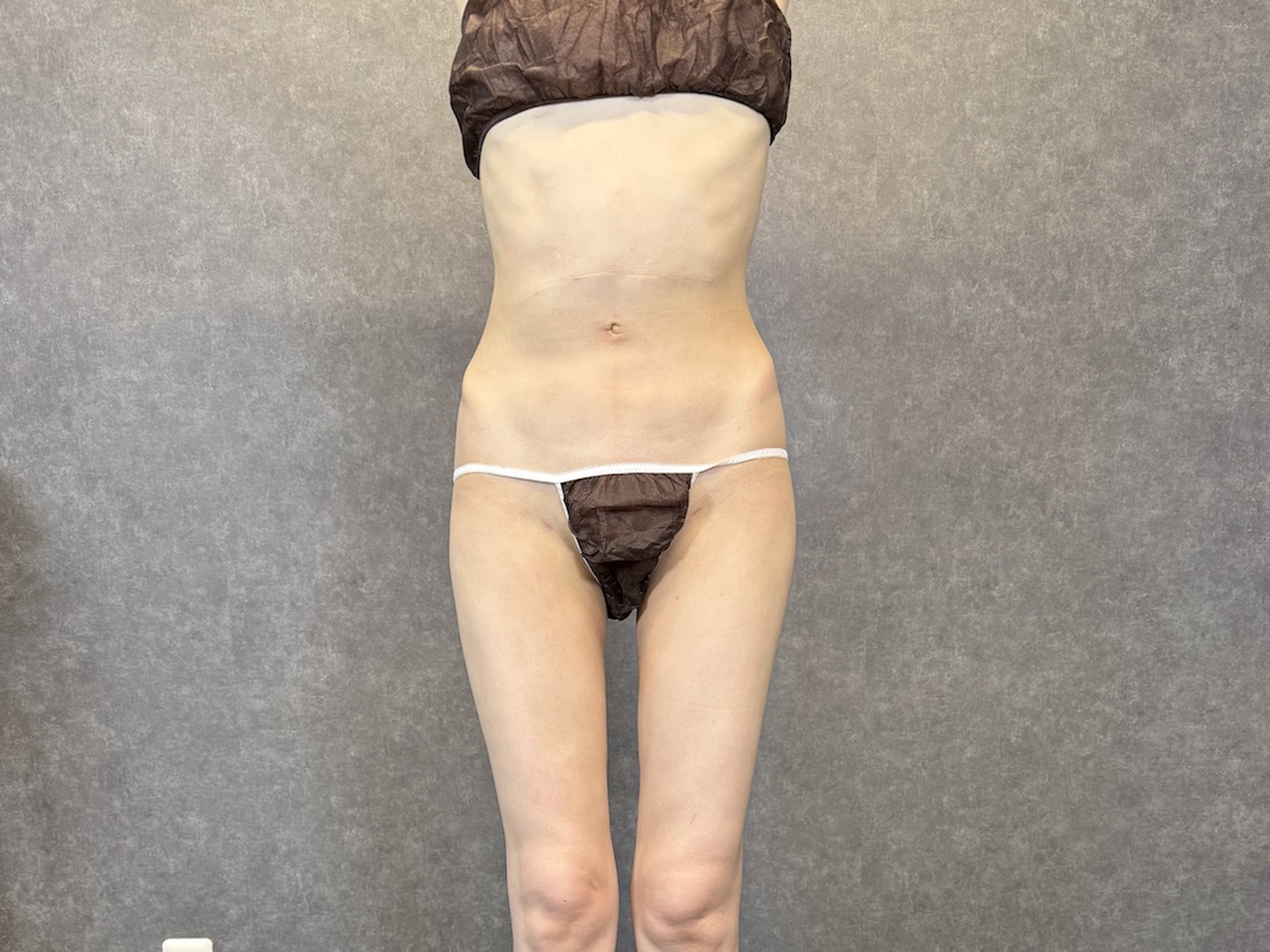
This is the case of a 28-year-old woman who had liposuction of the whole abdomen, waist, full-circumference thighs, knees, calves and other areas in a single operation. The surgery was performed under general anesthesia, and an ultrasound device (Elsa) was used on the lower legs including the calves, the back of the thighs and other areas. At 6 months after surgery, the bulge above the knees and the fullness of the calves have settled, giving a silhouette in which the whole leg looks longer (case details).
If only the calves are slimmed while volume remains on the thighs or knees, a step can easily form partway down the leg. When combined with thigh liposuction, we design the area from the abdomen down to the calves as one continuous line (column: “Continuous Lower-Body Liposuction Without Steps | A Doctor Explains How to Connect the Abdomen to the Calves“).
Downtime after calf liposuction

Because the calves are on the lower part of the leg, they are prone to swelling due to gravity. You can walk from the next day, but swelling and tightness are strong, so please avoid strenuous exercise and long hours of standing work for 1 week.
Swelling peaks on days 3 to 7 after surgery; after that, the result goes through a contracture period and approaches its final shape over 2 to 3 months. Recovery varies from person to person.
Common symptoms during downtime are as follows.
- Pain and tightness
-
Because the tissue around the area where fat was removed is affected, you will feel pain similar to muscle soreness and a sense of tightness after surgery. You may feel it strongly when walking.
The pain can be controlled with the prescribed painkillers.
- Swelling and puffiness
-
Fluid tends to collect in the calves and ankles due to gravity, and swelling peaks on days 3 to 7 after surgery.
Swelling is reduced by compression with medical compression stockings and by avoiding standing or sitting for long periods.
- Bruising
-
Blood from small vessels injured during surgery collects under the skin and looks like a bruise. It fades naturally over time.
- Contracture
-
Contracture is a condition in which the skin and the tissue beneath it adhere and become firm where fat was removed. The skin may feel stiff or tight, but this is a natural healing response seen in most people who have liposuction, not a failure.
It settles over 2 to 3 months. If it lasts longer or concerns you, please contact the clinic.
Calf liposuction scars, risks and side effects
The calves are an area densely packed with muscles, bones, nerves and blood vessels, and the greatest risk is removing too much fat in an attempt to force them slimmer. It is important to understand not only the benefits but also the possible risks and precautions.
- Modest change
-
Compared with the thighs or abdomen, the calves hold less fat, so dramatic changes are less likely. Thickness caused by muscle bulk or bone structure cannot be changed by liposuction.
It is important to agree with the doctor at counseling on what can and cannot be changed.
- Unevenness
-
The calves have pronounced muscle contours (gastrocnemius and soleus) and only a limited fat layer, so unevenness can easily appear if the amount or layer of suction is misjudged. The fat on the outer side is especially thin, and removing too much makes unevenness noticeable.
- Prolonged swelling
-
Veins run through the shallow layer beneath the skin. If they are injured, the flow of blood and lymph can be impaired and swelling may last longer.
When necessary, we check the course of the veins with ultrasound (echo) before surgery (column: “Preoperative Ultrasound Before Liposuction: How AVAN TOKYO Works Toward Safety and a Beautiful Result“).
- Numbness and reduced sensation
-
Nerves run close to the surface on the outer calf and around the ankles, so numbness or reduced sensation may occur. At our clinic, we prioritize protecting the nerves by moving the cannula only within the shallow layer.
- Scars and pigmentation
-
Small scars remain where the cannula was inserted. They are usually not noticeable, but in rare cases the incision may become raised (keloid), or the incision or treated area may darken. If you are concerned, please ask at your follow-up visit.
- Infection and complications
-
There is a slight risk that bacteria enter through the incision and cause an infection. After surgery, keep the incisions clean and take the prescribed medication as instructed.
Other complications, such as a hematoma, may also occur. If you notice any worrying symptoms, do not judge for yourself; please consult your doctor.
Calf liposuction procedure

Here is how calf liposuction proceeds.
STEP1Counseling
Please tell us in detail about your concerns with your calves and ankles and the leg line you would like. Using a pinch test and ultrasound, we check whether the cause of the thickness is fat or muscle, swelling or bone structure, and decide together which areas to treat. We also explain the risks and precautions clearly.
STEP2Pre-operative tests
If the procedure is performed under IV sedation or general anesthesia, a blood test is done beforehand. It checks items we need to confirm before surgery, such as your response to anesthesia, anemia and allergies. The results are available in 2 to 3 days, so the surgery is scheduled after that.
We also explain carefully how to use the medical compression stockings worn on the day of surgery and what to keep in mind.
STEP3Measurements and photos
On the day of surgery, a nurse first checks your physical condition and you change into a surgical gown. Then, to accurately record your pre-operative condition, we measure the areas to be treated and take photos.
STEP4Design and anesthesia
The doctor marks the design agreed on in advance. Because different amounts are removed from the inner and outer calf, the areas and depths are designed separately. You then move to the operating table and anesthesia is administered.
STEP5Liposuction
Small incisions are made in inconspicuous places, and tumescent solution is injected to reduce pain, soften the fat and minimize bleeding.
A thin cannula with a rounded tip is then inserted, and fat is removed layer by layer while changing the position of the leg. When needed, a device that softens fat with ultrasound (Elsa) is used as well. The operating time varies with the treatment area.
STEP6Compression
Immediately after surgery, the legs are compressed with medical compression stockings to reduce swelling. Compression keeps the skin and underlying tissue in close contact so they settle into the new shape.
STEP7Recovery room and going home
After surgery, you rest in a private room until you have recovered. We measure your blood pressure and heart rate and check for any pain or discomfort.
After a post-operative talk with the doctor, you can go home. Because the effects of anesthesia may remain, please do not drive; use public transportation instead.
Aftercare for calf liposuction (how to spend the recovery period)

Here is how to spend the period after calf liposuction.
The day of surgery
You go home wearing the medical compression stockings. Please keep wearing them to reduce swelling. Because bacteria could enter the incisions, please do not shower on the day of surgery.

From the next day to 1 week
You can walk from the next day, but avoid strenuous exercise and long hours of standing work. Swelling peaks on days 3 to 7. Continue compression with the stockings as instructed, and avoid standing or sitting for long periods.
Drink plenty of fluids, get enough protein, and be careful not to take too much salt while the swelling is strong. The pain can be controlled with the prescribed painkillers.
1 week after surgery
You visit the clinic to have your stitches removed. If swelling or pain remains, do not push yourself; return to your daily routine gradually while watching how your body feels.
1 to 3 months after surgery
You visit the clinic for a post-operative check-up. Visible swelling and bruising settle, and contracture appears during this period. The skin may feel firm or tight, but this is part of the process of the skin adapting to its new shape.
3 to 6 months after surgery
Contracture softens and the line from the ankles to the calves becomes more defined. We also hold check-ups at 3 and 6 months to confirm the result.
Recovery after surgery varies from person to person. If pain increases or swelling becomes severe, another problem may be developing, so please do not hesitate to contact our clinic if anything worries you.
Calf liposuction prices
All prices include tax (Japanese yen). Prices are synchronized with our Japanese price list.
| Area | Regular price | Monitor price |
|---|---|---|
| Calves | ¥398,000 | ¥270,000 |
| Calves + ankles | ¥428,000 | ¥328,000 |
| Ankles | ¥220,000 | ¥198,000 |
Anesthesia
| IV sedation | ¥55,000 (¥110,000 when administered by a board-certified anesthesiologist) |
|---|---|
| General anesthesia (by a board-certified anesthesiologist) | ¥220,000 |
BMI surcharge: BMI 25–29 → ×1.5, BMI 30 or above → ×2 (multiplier applied to the procedure fee).
The final total is confirmed at counseling. Prices for all treatments are listed on the price list (Japanese).
Calf liposuction FAQ
- QWill calf liposuction alone make my calves slimmer?
- AIf fat is the reason your calves look thick, a clear change can be expected. However, if muscle bulk, swelling or bone structure (such as bow legs or knock knees) is the main cause, liposuction alone will not make them slimmer. For people with pronounced muscle bulk, we may suggest combining it with calf Botox. The cause is checked at counseling with a pinch test and ultrasound.
- QHow much fat can be removed?
- AIt depends on your body type, but from the calves it is sometimes possible to remove about 300 to 600 cc of pure fat. The calves hold less fat than the thighs or abdomen, so the change is modest, but careful suction in the right layers gives a cleaner line from the ankles up through the calves.
- QCan you treat only the inner calves?
- AYes. The subcutaneous fat tends to be thicker on the inner calf and thinner on the outer calf, so for people mainly concerned about the inner bulge, a design focused on the inner side often gives a natural result. It is safer to keep treatment of the outer side to the minimum necessary.
- QCan the ankles be treated at the same time?
- AYes. The price table includes “Ankles” and “Calves + ankles” options. The skin around the ankles is thin, and nerves and blood vessels run close to the surface, so we remove fat thinly and evenly from the shallow layer with a thin cannula. If the ankles look thick because of swelling or bone structure, liposuction may not make them slimmer.
- QHow soon can I walk after surgery?
- AYou can walk from the next day. However, swelling and tightness are strong, so please avoid strenuous exercise and long hours of standing work for 1 week. Swelling peaks on days 3 to 7 after surgery; after that, the result goes through a contracture period and approaches its final shape over 2 to 3 months.
- QI am worried about nerve or blood vessel damage.
- AThe outer calf (around the area over the fibula) and along the veins on the inner side are places that require care. At our clinic, we check the course of nerves and blood vessels with ultrasound and prioritize protecting them by moving the cannula only within the shallow layer.
- QWhat type of anesthesia is used?
- AYou can choose local anesthesia, or IV sedation or general anesthesia administered by a board-certified anesthesiologist. For IV sedation or general anesthesia, we confirm safety with a pre-operative blood test before the procedure.
- QWhat should I be careful about during downtime?
- AContinuing compression with medical compression stockings as instructed, avoiding standing or sitting for long periods, and getting enough fluids and protein all help your recovery. While the swelling is strong, also be careful not to take too much salt.
- QAre there costs other than the procedure fee?
- AAnesthesia is charged separately. IV sedation and general anesthesia fees are listed in the “Anesthesia” table above. Any other costs are itemized in the written estimate you receive at your counseling.
- QWhat is the “monitor price”?
- AThe monitor price is the price listed as “Monitor” alongside the regular price in the price table. It requires your agreement to photo and video documentation; detailed conditions are explained at counseling. Monitor prices may end without notice.
Learn more about calf liposuction (doctor’s columns)
Design and suitability
- Calf Liposuction: Why the Inner and Outer Sides Slim Differently | The Anatomy of the Gastrocnemius and Soleus Explained by a Doctor
- Calf Liposuction: Benefits and Key Considerations
Ankles
Combining with other areas and safety
- Continuous Lower-Body Liposuction Without Steps | A Doctor Explains How to Connect the Abdomen to the Calves
- Preoperative Ultrasound Before Liposuction: How AVAN TOKYO Works Toward Safety and a Beautiful Result
If you are also concerned about your thighs, see “Thigh liposuction“; if muscle bulk concerns you, see “Botox for arms and legs“.
Book a Free Counseling
Counseling is free. Choose the way that suits you.