


Why Accessory Breast and Axillary Fat Matter in Arm Liposuction and Breast Augmentation2026.09.08
When considering upper arm liposuction or hybrid breast augmentation, there is one area that we strongly recommend evaluating at the same time:
the accessory breast and axillary area.
Even if the upper arms are made slimmer and breast volume is enhanced, residual fullness under the armpit can interrupt the smooth transition from the arm to the chest.
By appropriately contouring the accessory breast and underarm area, it is often possible to create a more seamless line from the upper arm to the shoulder, axilla, and breast.
At AVAN TOKYO, we do not evaluate each body area in isolation.
Our goal is to design the entire upper-body silhouette as one continuous line.
What Is an Accessory Breast?
The fullness commonly referred to as an “accessory breast” may contain not only subcutaneous fat, but also breast tissue.
For this reason,
“There is a bulge under the armpit, so it should simply be removed with liposuction”
is not always the correct approach.
The optimal treatment depends on whether the fullness is mainly caused by fat, breast tissue, skin laxity, or a combination of these factors.
Careful examination of the entire area from the armpit to the breast is therefore important before surgery.
Upper Arm Liposuction Alone May Leave Fullness Under the Armpit
When people think about upper arm liposuction, they often focus only on reducing the circumference of the arms.
However, when the arms are resting naturally beside the body, several surrounding areas also affect how the upper body looks.
These include:
● the upper arm near the axilla
● the front of the armpit
● the area directly beneath the armpit
● the outer side of the breast
These areas can significantly influence the overall silhouette.
If there is noticeable fullness under the armpit when the arms are closed, slimming only the upper arms may actually make that remaining bulge appear more prominent.
For this reason, AVAN TOKYO may recommend including the accessory breast and axillary region in the treatment plan when appropriate.
The Key Is to Contour the Area All the Way to the Axilla
The goal of accessory breast or axillary liposuction is not simply to remove as much fat as possible.
What matters more is deciding:
where volume should be reduced and where volume should be preserved.
When designing the transition from the arm to the breast, appropriate contouring of the underarm area can help create a smoother, more refined upper-body line.
However, this area requires careful surgical judgment.
Over-Removal Can Make the Breast Look Hollow
The accessory breast and outer breast region should not be aggressively liposuctioned without careful planning.
If too much tissue is removed from the lateral breast area, the breast may appear hollow or “scooped out.”
This is especially important when upper arm liposuction is combined with breast augmentation.
Even if the breast itself is enhanced, excessive removal of surrounding volume can create an unnatural transition between the breast and the chest wall.
The key is to:
reduce unwanted axillary fullness while preserving the tissue that contributes to a natural breast contour.
Upper Arm Liposuction + Accessory Breast Contouring + Breast Augmentation
Upper arm liposuction and breast augmentation can complement each other very well.
By reducing unnecessary volume around the arms and axilla while adding volume to the breasts, it is possible to create a clearer contrast between areas that should look slimmer and areas that should look fuller.
When the accessory breast and underarm area are also addressed, the following line can become smoother:
Upper arm
↓
Shoulder
↓
Axilla
↓
Breast
At AVAN TOKYO, our goal is not simply to “make the arms thinner” or “make the breasts larger.”
We also consider how the upper body looks:
● when wearing clothes
● when the arms are lowered naturally
● from the front
● from an oblique angle
● from the back
The entire upper-body balance matters.
Case Example: Circumferential Upper Arm Liposuction + Accessory Breast Liposuction + Hybrid Breast Augmentation, 11 Months After Surgery
In this case, the patient underwent:
circumferential upper arm liposuction, accessory breast liposuction, and hybrid breast augmentation.
At 11 months after surgery, the contour from the upper arms through the axillary region and into the breasts appears more naturally connected and refined.
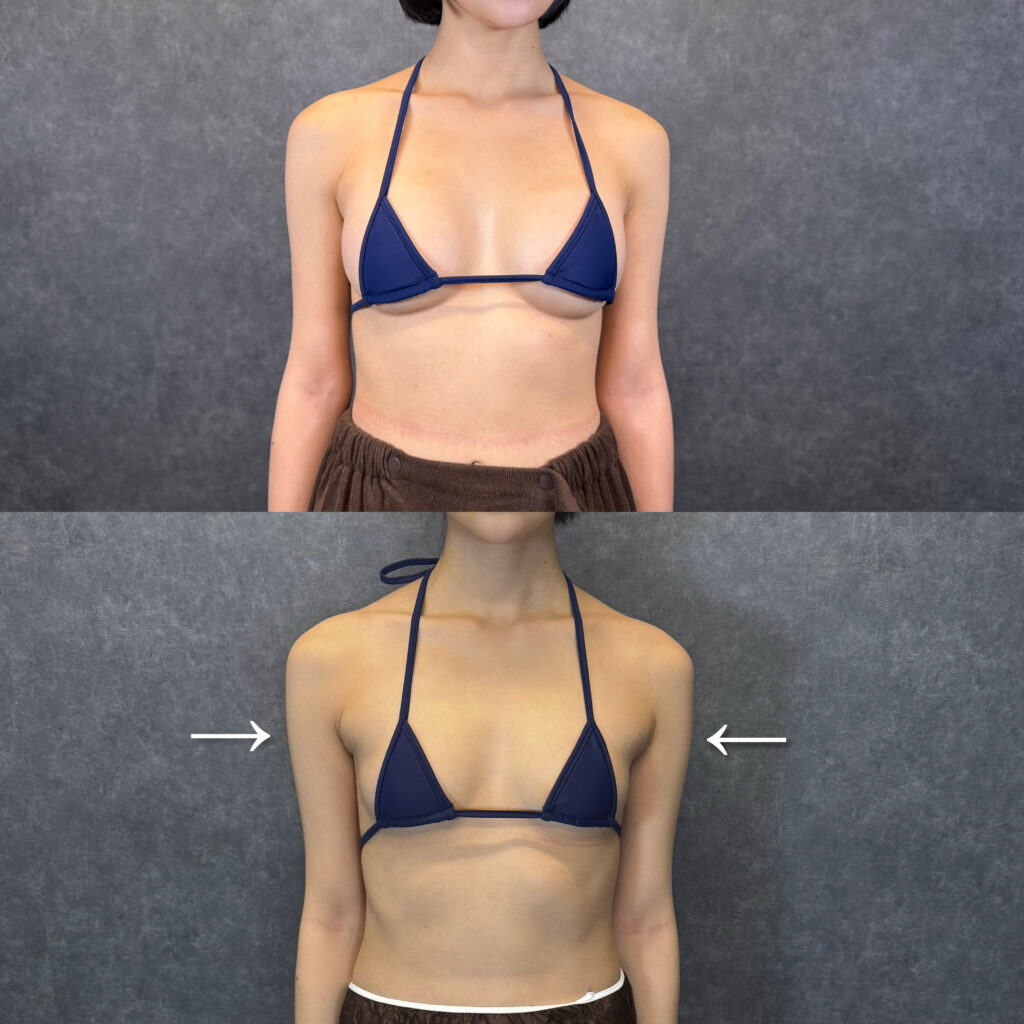
One of the key points in this case is that the accessory breast area was treated at the same time.
Instead of only slimming the arms, the underarm fullness was also reduced, allowing both the slimmer arms and enhanced breasts to stand out more effectively.
What Is Hybrid Breast Augmentation?
Hybrid breast augmentation generally refers to a combination of:
breast implants + fat grafting.
The implant provides the main volume, while fat grafting can be used to refine the contour around the implant and create a smoother transition depending on the patient’s anatomy.
In slimmer patients, combining breast augmentation with contouring of the upper arms and axillary area can create a more defined upper-body silhouette.
However, the ideal procedure and the amount of fat available for grafting vary depending on body type.
Frequently Asked Questions About Accessory Breast Liposuction
Q. If I am having upper arm liposuction, should I always have the accessory breast treated too?
Not necessarily.
The decision depends on the amount of axillary fullness, the presence of breast tissue, the relationship between the underarm and breast contour, and your desired result.
Some patients achieve a natural result with upper arm liposuction alone, while others benefit from including the accessory breast and axillary region.
Q. Can an accessory breast always be treated with liposuction?
No.
If the fullness is mainly caused by subcutaneous fat, liposuction may be effective.
However, if there is a significant amount of breast tissue, liposuction alone may not provide sufficient improvement.
The treatment should be selected after examining the actual structure of the area.
Q. Can accessory breast liposuction make my breasts smaller?
Depending on the treatment area, reducing too much tissue from the outer breast can make the breast appear smaller or hollow.
For this reason, AVAN TOKYO emphasizes distinguishing between:
tissue that should be preserved as part of the breast contour, and tissue that should be reduced as unwanted axillary fullness.
Q. Can upper arm liposuction and breast augmentation be performed at the same time?
In selected patients, yes.
The treatment plan depends on body type, the extent of liposuction, anesthesia, the amount of available fat, and the overall surgical plan.
When combining upper arm liposuction, accessory breast treatment, and breast augmentation, it is especially important to design the entire upper body rather than treating each area separately.
Upper Arm Liposuction Should Be About More Than Making the Arms Thinner
The quality of upper arm liposuction is not determined only by how much fat is removed.
Likewise, breast augmentation is not simply about increasing breast size.
The goal is to:
reduce volume where it is unwanted, preserve tissue where it is needed, and add volume where it improves overall balance.
This is why the combination of:
upper arm liposuction + accessory breast contouring + breast augmentation
can be so effective in selected patients.
For those who want slimmer arms while also improving the shape and volume of the breasts, this approach may help create a more harmonious upper-body silhouette.
At AVAN TOKYO, we evaluate the shoulders, upper arms, axillary region, and breasts as one continuous body line and create an individualized surgical plan for each patient.
If you are considering upper arm liposuction or hybrid breast augmentation and are unsure whether your accessory breast or axillary area should also be treated, please discuss it with us during your consultation.
Risks and Possible Complications
Possible risks of liposuction include swelling, bruising, pain, edema, fibrosis or postoperative firmness, contour irregularities, asymmetry, pigmentation changes, scarring, and infection.
Possible risks of breast augmentation vary depending on the procedure and may include infection, hematoma, asymmetry, scarring, fat necrosis, lumps, capsular contracture, and implant malposition.
The accessory breast region may contain breast tissue in addition to fat, and not all axillary fullness can be corrected with liposuction alone. The appropriate treatment and surgical area should be determined after an in-person medical evaluation.