


Diet After Fat Transfer Breast Augmentation: Soy Milk, Protein and a 6-Month Case2026.11.06
“What should I eat after breast fat transfer?” “Will soy milk or a protein supplement help the fat stay?” When considering fat transfer breast augmentation, both the amount injected and the shape that remains over time deserve attention.
At AVAN TOKYO, we consider both the injection plan—particularly upper-pole hollowness and breast contours—and everyday care during recovery. This article presents the 6-month progress of a 22-year-old woman who underwent upper-body liposuction and breast fat transfer, alongside what research can and cannot tell us about diet.

Operating surgeon and case contributor
Dr. Shin Moriwaki
Director, AVAN TOKYO Ginza Liposuction Clinic Doctor profile (Japanese)
Key points
After fat transfer breast augmentation, the dietary priorities are avoiding inadequate energy and protein intake and avoiding rapid weight loss. Soy milk or protein supplements can help fill dietary gaps, but they cannot be said to improve fat retention on their own. Injection planning, tissue blood supply and weight changes also matter, so follow-up examinations remain important.
Breast fat transfer: planning the shape, not just the volume
Fat transfer breast augmentation uses fat harvested from your own body. The same injected volume can look different depending on the original breast shape, skin elasticity, tissue thickness and asymmetry. Some transferred fat is absorbed, so the injected amount is not the same as the final increase in breast volume. [4]
Considering the décolletage, upper-pole hollowness and breast contour together
As the treating surgeon, I (Dr. Moriwaki) plan not only for size but also for the transition from the upper chest to the breasts and areas that appear to lack volume. When upper-body liposuction is combined with breast fat transfer, I also assess the balance between the upper arms, underarm area and breasts.
There is a limit to how much fat the tissues can safely accommodate. The amount and distribution must be planned around the recipient tissues, with safety taking priority over a target size.
A 22-year-old patient: 6-month photos and treatment details
This patient underwent circumferential upper-arm, back and accessory-breast-area liposuction, an upper-arm thread lift and fat transfer breast augmentation. In the two oblique comparisons, before is on the left and 6 months after is on the right. In the frontal comparison, 6 months after is at the top and before is at the bottom.
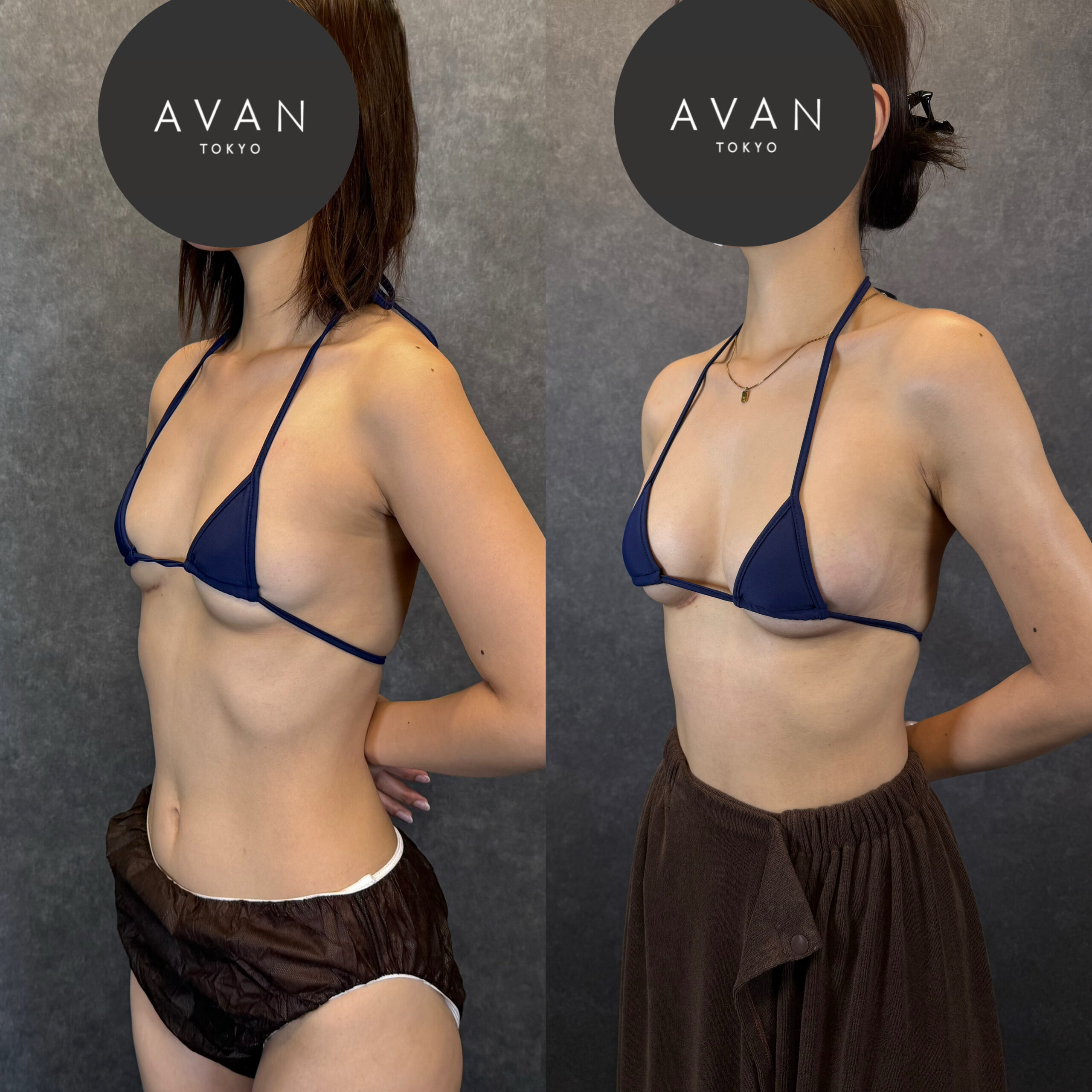
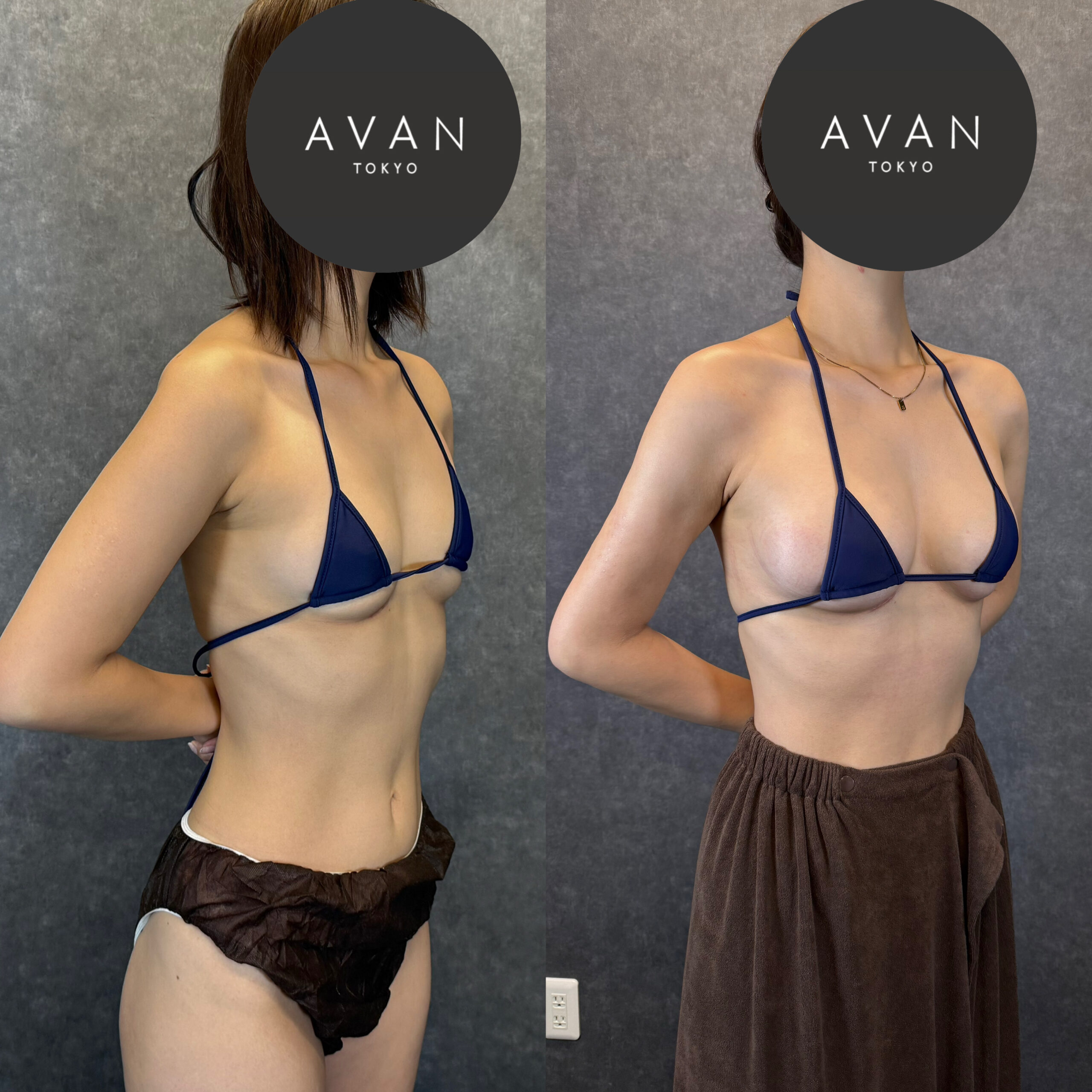
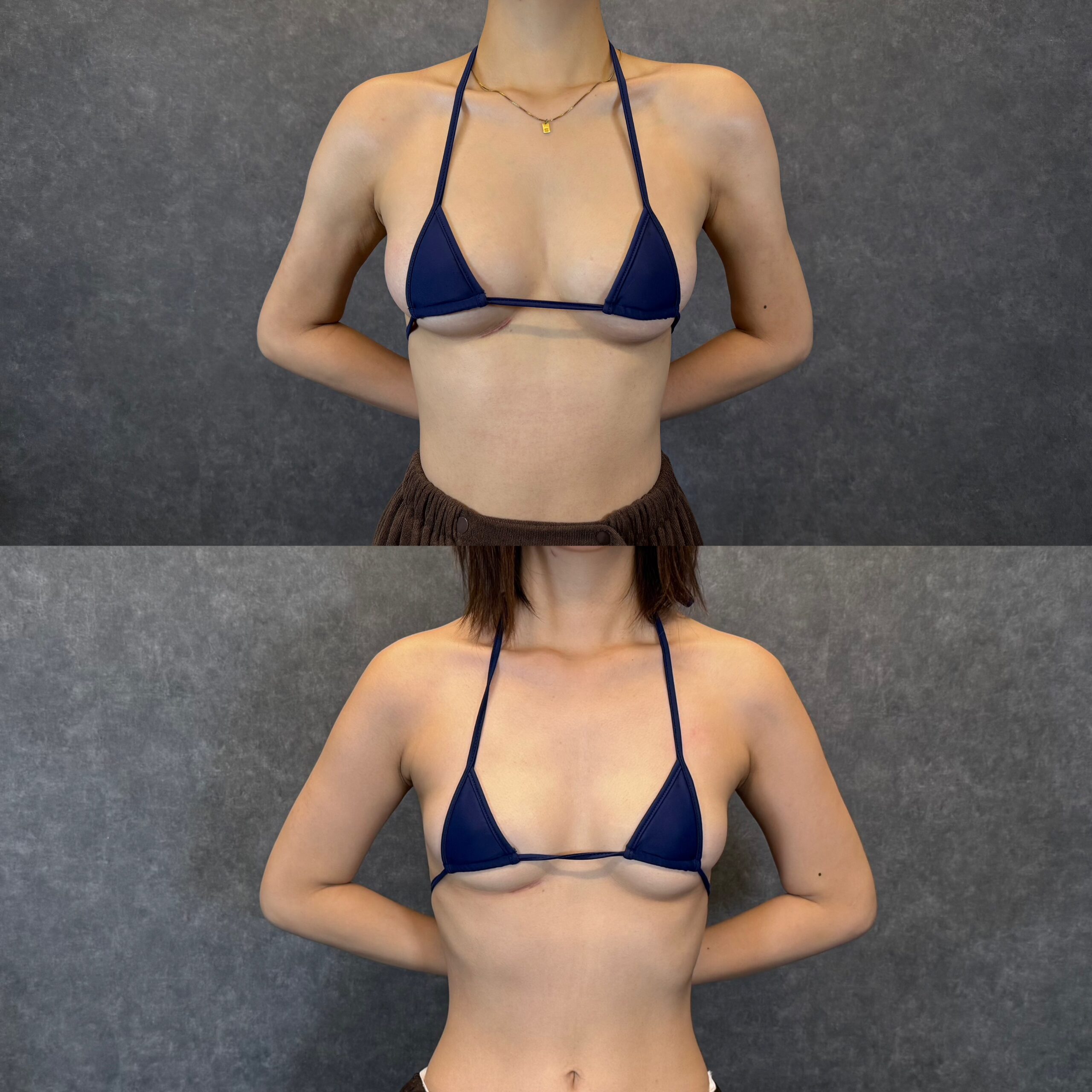
How to interpret these photographs
The photographs compare the décolletage, breast contours and upper-arm-to-underarm region at 6 months. This patient also paid attention to her diet, but photographs cannot establish the percentage of injected fat retained or prove that diet caused the outcome.
Posture, garment position and lighting can change the appearance. These are results of several combined procedures in one patient. Outcomes and recovery vary; the same result is not guaranteed.
Case video: from preoperative marking to 6 months
Our YouTube video follows the same patient from preoperative marking and surgery through recovery and the 6-month visit. It contains surgical footage and Japanese-language narration.
Watch the case video on YouTube (22 min 28 sec; Japanese)
The short clip in the X post was recorded on postoperative day 26; the comparison photos in this article are from 6 months. These time points should not be confused. Individual dietary habits or comments in the video do not establish the effects of a food or a recommended intake.
Primary research on graft survival and weight changes
Blood supply and tissue responses influence fat-graft survival
Fat “retention” refers to transferred fat surviving and being maintained as tissue at the recipient site. In basic research by Eto and colleagues, cell survival, regeneration and necrosis varied by location within the graft. This work involved experiments using human adipose tissue and animal experiments; it did not directly measure fat-retention rates after breast augmentation in patients. [1]
The research helps explain why simply injecting more fat is not enough: the transplanted tissue needs an environment in which it can survive. Diet alone cannot compensate for all factors related to injection technique or blood supply.
A prospective MRI study linked weight changes with retained volume
Ørholt and colleagues prospectively followed 28 patients and 46 breasts using MRI. They estimated that breast-volume changes stabilized at about 8 months and reported an association between postoperative weight changes and retained volume. This was a small observational study; it does not mean that everyone stabilizes at the same time or retains the same proportion of fat. [2]
A 6-month photograph should therefore not be treated as a permanent, unchanging endpoint. Follow-up should consider weight changes too. This is not a recommendation to deliberately gain weight: discuss avoiding rapid weight loss and maintaining a suitable, stable weight with your surgeon.
Recovery diet, soy milk and protein supplements
Start by preventing inadequate overall intake
Recovery requires energy as well as protein. The ESPEN surgical nutrition guideline emphasizes nutritional assessment and individualized support when intake is insufficient. However, it mainly addresses general and major surgery; it does not test breast-fat retention or the effects of soy milk. [3]
Avoid severely restricting staple foods or replacing meals with drinks because you are worried about gaining fat elsewhere. As tolerated, combine a source of carbohydrates, a protein-containing main dish and vegetables. If nausea or other symptoms prevent adequate eating for a sustained period, contact your treating clinician.
| Meal component | Examples | Purpose |
|---|---|---|
| Staple foods | Rice, bread or noodles | Help meet energy needs; avoid extreme carbohydrate restriction. |
| Protein foods | Fish, meat, eggs, tofu or natto | Include a protein source across meals. |
| Vegetables and fruit | A variety of vegetables, mushrooms and fruit | Support a varied diet instead of relying on one food. |
| Optional additions | Soy milk, dairy foods or a protein supplement when needed | Fill dietary gaps; taking more does not necessarily increase fat retention. |
Soy milk is one convenient protein source
In my X post, I introduced soy milk as an accessible way to become more mindful of food intake. That does not mean drinking it daily guarantees fat retention or that larger quantities work better. The studies cited here did not test those claims.
Use soy milk as part of a balanced diet, not as a replacement for all meals. Check the nutrition label and choose an amount that fits your normal intake. Avoid it if you have a soy allergy, and follow your clinician’s advice if you have a medical condition or dietary restrictions.
Protein and amino-acid supplements are optional support
A protein supplement may be considered when appetite is reduced or adequate intake is difficult through food alone. Our clinic can discuss soy protein, amino acids and related supplements, but they are not necessary for everyone and do not guarantee graft retention.
There is no single appropriate amount for every patient, especially for people with kidney disease or other medical conditions. Tell your clinician about your usual diet, medications and supplements before combining multiple products.
Aftercare and when to seek medical attention
Ask your surgeon about smoking and nicotine, breast compression, exercise and when to resume particular bras. Compression garments for liposuction areas are not equivalent to compression of the breasts receiving fat. Do not apply strong pressure or massage a lump without medical guidance.
Lumps, oil cysts and calcification can occur after breast fat transfer. Always tell the breast-screening or imaging team about your fat-transfer history. [4][5]
Contact the treating clinic promptly for increasing pain, redness or warmth, fever, or sudden swelling on one side. Sudden shortness of breath, chest pain or other acute systemic symptoms require emergency medical assessment. A lump needs clinical evaluation, not assessment from photographs alone.
Frequently asked questions
- Does drinking soy milk improve breast-fat retention?
-
Soy milk can contribute protein. The research cited here did not test whether it improves retention after breast fat transfer. Prioritize adequate overall nutrition with staple foods, protein foods and vegetables.
- Are protein powders or amino-acid supplements essential?
-
No. They may be used to fill gaps when food alone does not provide adequate nutrition. Discuss the product and amount with your clinician based on your health, medical conditions and usual diet.
- Can I diet after fat transfer breast augmentation?
-
Avoid extreme food restriction and rapid weight loss during recovery. Weight changes may affect postoperative breast volume. Discuss maintaining a suitable, stable weight rather than deliberately gaining weight.
- Can a 6-month photograph show the percentage of fat retained?
-
No. Photographs can show changes in shape but cannot calculate how much injected fat remains. Swelling, weight, posture and photography conditions also affect appearance. Six months is one follow-up time point, with further clinical review as needed.
- If 1,000 cc is removed, is 1,000 cc injected into the breasts?
-
No. Liposuction volume and injection volume are different. This case involved 1,000 cc of fat removed and 260 cc injected on the right plus 250 cc on the left, totaling 510 cc. The harvested fat and the breast tissues’ thickness and capacity guide the injection plan.
References and related articles
The case information comes from the treating surgeon and the photographs and video shown here. References [1] and [2] are basic and clinical primary research, respectively; [3] is a surgical nutrition guideline; [4] and [5] are patient information from professional societies. These sources serve different purposes.
- Eto H, et al. The fate of adipocytes after nonvascularized fat grafting: evidence of early death and replacement of adipocytes. Plast Reconstr Surg. 2012;129(5):1081–1092. PubMed. DOI: 10.1097/PRS.0b013e31824a2b19.
- Ørholt M, et al. Long-Term Volume Retention of Breast Augmentation with Fat Grafting Depends on Weight Changes: A 3-Year Prospective Magnetic Resonance Imaging Study. Plast Reconstr Surg. 2025. PubMed. DOI: 10.1097/PRS.0000000000011841.
- Weimann A, et al. ESPEN guideline on clinical nutrition in surgery – Update 2025. Clin Nutr. 2025;53:222–261. ESPEN (PDF).
- American Society of Plastic Surgeons (ASPS). Fat Transfer Breast Augmentation: Risks and Safety.
- International Society of Aesthetic Plastic Surgery (ISAPS). Fat Transfer / Body Fat Grafting.
Dr. Moriwaki’s X post (6 November 2026; Japanese) / Clinic case video (Japanese)
- Fat transfer breast augmentation (Japanese)
- Upper-arm liposuction (Japanese)
- Upper-arm liposuction and breast contours (Japanese)
- Post-liposuction tightness of the upper arms (Japanese)
Discuss breast-fat-transfer planning and recovery
We consider your desired contour, available donor fat, usual diet and weight changes when discussing a treatment plan.
The surgeon who treated this patient

Dr. Shin Moriwaki
Director, AVAN TOKYO Ginza Liposuction Clinic
Graduate of Tokushima University School of Medicine. Previously worked at Tokushima University Hospital, Tokyo Central Beauty Clinic and Gracia Clinic. His practice focuses on liposuction and breast augmentation.
VASER Lipo certified physician / ECFMG Certificate
AVAN TOKYO Ginza Liposuction Clinic
DEAR GINZA 3F, 1-6-8 Ginza, Chuo-ku, Tokyo, Japan
Clinic hours: 10:00–19:00