


Replacing Silicone Implants from Another Clinic | Why Breast Reduction and Lift Are Often Needed Together2026.09.22
Patients who had silicone implant augmentation at another clinic sometimes come to us saying that their breasts feel heavy or that the nipple has moved lower. The cause is rarely the implant alone — native glandular volume, skin stretch and the degree of ptosis usually overlap, and implant exchange alone may not restore the shape. This article discusses when to combine breast implant replacement with reduction and lift, based on a case in a woman in her twenties and the first-hand perspective of our supervising physician, Dr. Moriwaki.
Key points
・Breast implant replacement with reduction is considered for cases in which simply exchanging the implant will not resolve ptosis or heaviness.
・Removing both the anterior and posterior capsule tends to stabilize the shape of the new pocket.
・After glandular reduction, the previous implant volume is usually too large, so implant volume must be reconsidered.
・At two months post-op, swelling has mostly subsided, but scar maturation and final shape take six to twelve months.
・Outcomes and recovery vary; the photograph shown is one example. Suitability is judged individually at consultation.
When “just replacing the implant” is not enough
Over time after silicone implant augmentation, the weight of the implant combines with progressive stretching of the skin and support tissues to pull the whole breast downward. At consultation we assess ptosis (whether the nipple sits below the inframammary fold), skin excess, glandular volume, and the implant position relative to the chest wall. When the original implant was too large for the native gland, simply swapping the old implant for a new one leaves the stretched skin and support tissue as they are, so neither shape nor nipple position tends to improve.
In such cases, breast implant replacement with reduction and lift performed together — reducing excess skin and gland, restoring the nipple-areola complex to its natural position, and re-evaluating implant volume — becomes a candidate design. It addresses size, weight, ptosis and nipple position in a single operation. The physical burden is greater than a single procedure, but the result tends to be more stable than repeating isolated operations.
A case: implant replacement with reduction and lift in a woman in her twenties
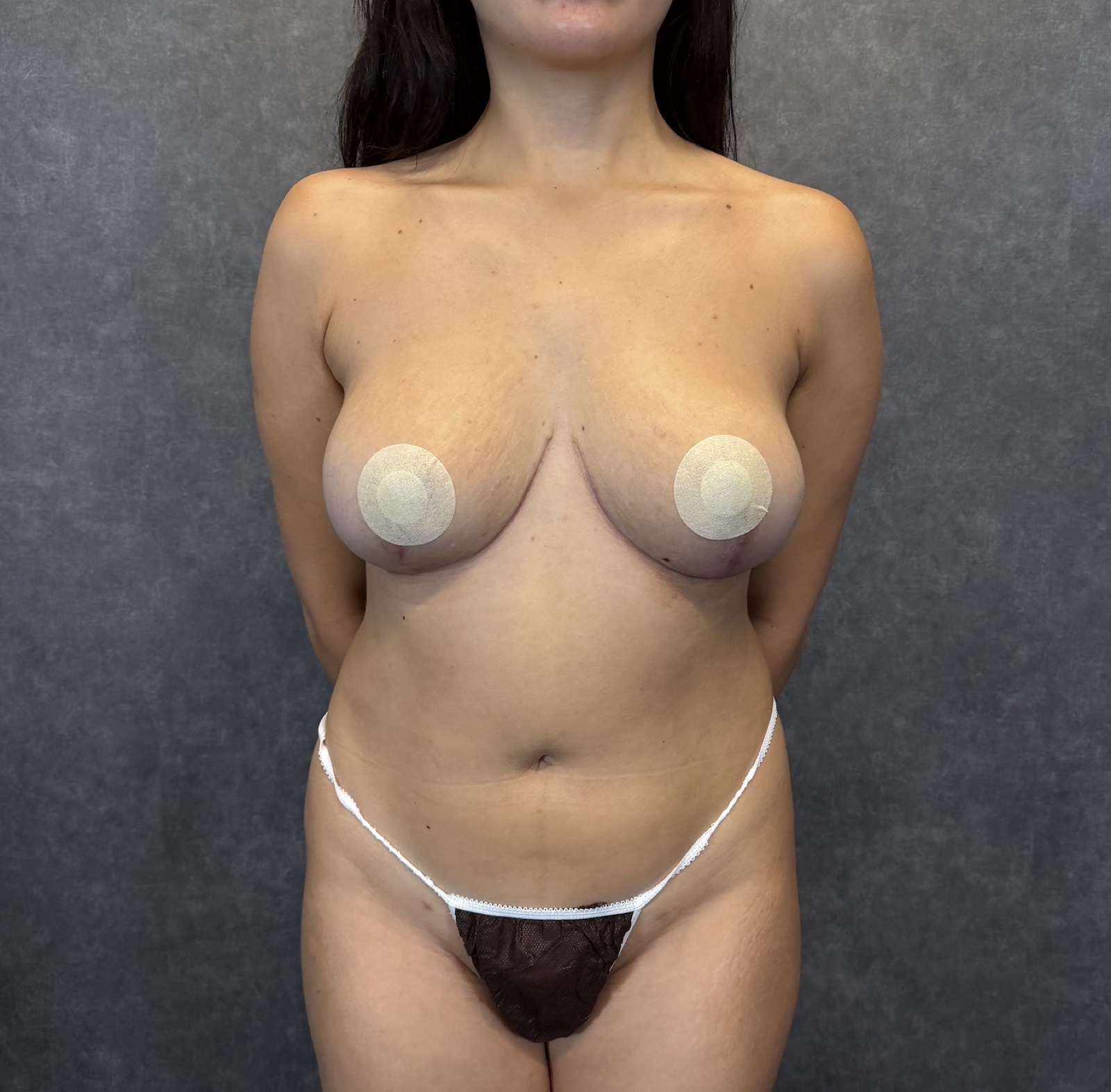
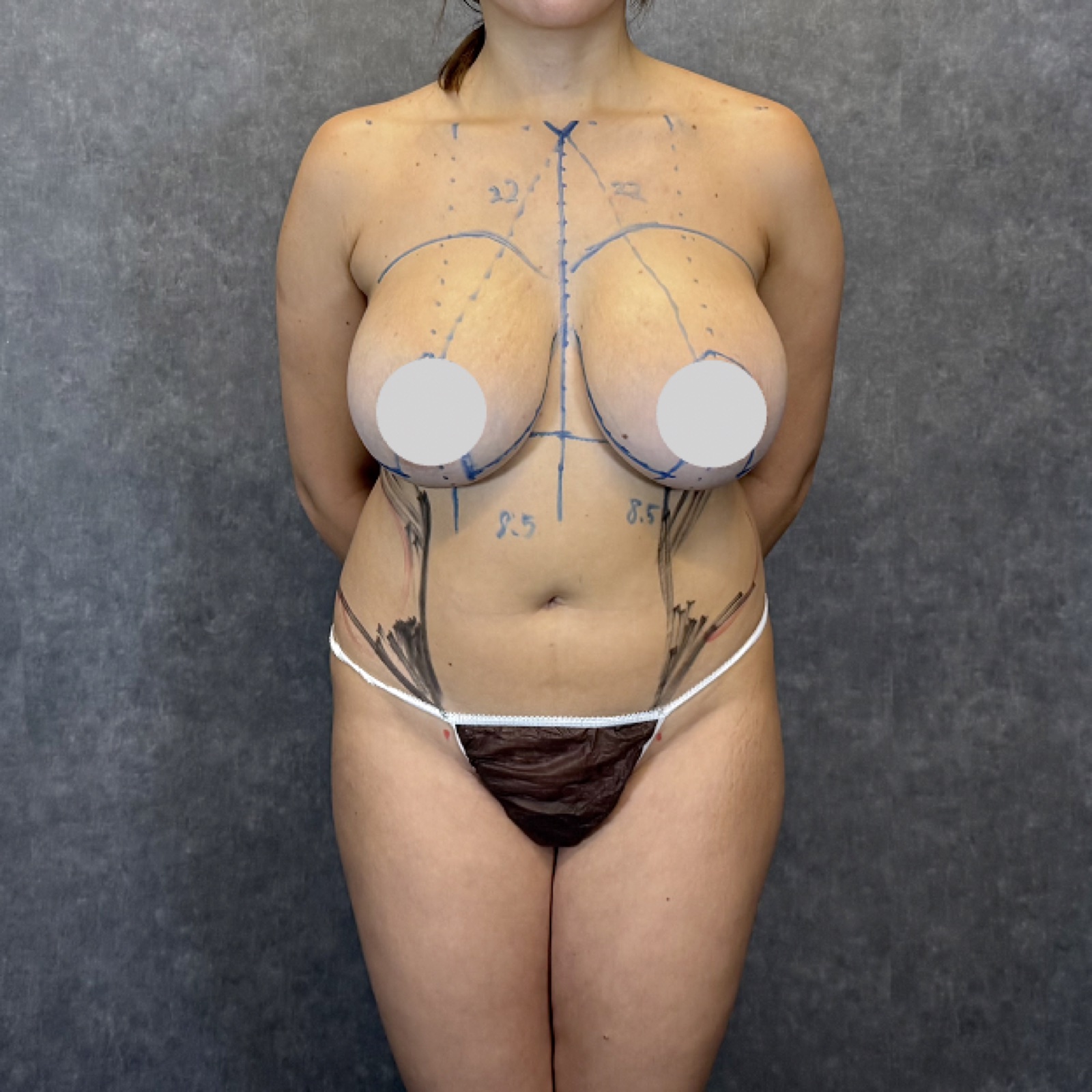
This is one example of a woman in her twenties after silicone implant augmentation at another clinic. Her concerns — heavy breasts, lowered nipple position, and dissatisfaction with implant size and shape — led to a combined operation: breast reduction and lift, replacement of the implants placed elsewhere, and flank liposuction, all in one session. Resection was designed with a Wise pattern (inverted-T). The point where the inframammary fold projects onto the breast meridian was used as the new nipple position, and a 40 mm areola was designed.
Blood supply to the nipple-areola complex was secured on a superomedial pedicle. Because the pedicle was elevated in full thickness without thinning the gland, the nipple-areola complex could be moved upward while preserving vascularity. After the gland and skin were reduced, a new silicone implant (Motiva Demi 210cc) was placed in the subglandular plane, and a lateral drain was inserted. On the flanks, tumescent solution was infiltrated and 220 ml of fat was aspirated to refine the waistline.
Why we remove both the anterior and posterior capsule
Any silicone implant placed in the body forms a thin membrane around it, called the capsule. In breast implant replacement with reduction, whether and how much of this capsule to remove influences the outcome. If the capsule is left in place while a new implant is inserted, the shape of the old pocket persists, and the new implant may not sit stably. In this case we removed the implants from the subglandular plane and excised both the anterior and posterior capsule. The caudal edge of the resected glandular tissue was then fixed to the inframammary fold and to the pectoralis fascia to re-create the pocket.
Capsulectomy carries risks of bleeding, skin injury and transient firmness or irregularity after surgery. How far to remove the capsule is judged from capsule thickness, degree of contracture, skin margin and blood supply, both preoperatively and during surgery. For safety standards in aesthetic surgery, information from the Japan Society of Aesthetic Surgery is also a useful reference.
Reconsidering implant volume after replacement
Once the gland and skin have been reduced through breast reduction and lift, the same implant volume looks very different from before. Choosing the same volume as before tends to be excessive for the reduced gland and raises the risk of recurrent ptosis. In planning breast implant replacement with reduction, we reselect a volume that looks natural and is less prone to sagging, based on the reduced gland, chest wall width, skin margin and tendency to ptosis.
In this case, we chose a relatively compact Motiva Demi 210cc. Implant shell surface, shape and volume are chosen individually according to body type and surgical history.
Treatment content, cost and risks for this case
Treatment performed: Breast reduction and lift (Wise pattern, superomedial pedicle); removal of silicone implants from another clinic (with anterior and posterior capsulectomy); silicone implant augmentation (Motiva Demi 210cc, inframammary incision, subglandular); and flank liposuction — all in one session under general anesthesia, with a lateral drain.
Cost: JPY 2,994,000 (tax included, monitor price). This is the total for the breast reduction and lift, implant removal, silicone implant augmentation, and flank liposuction. The monitor price is conditional on consent to photo and video documentation and may end without notice. The final amount is confirmed at consultation. Please also see the price page.
Main risks and side effects: Swelling, bruising, pain, edema, asymmetry, pigmentation, infection, hematoma, numbness or reduced sensation. For breast reduction and lift: inverted-T scars around the areola, along the vertical line and along the inframammary fold, with possible hypertrophic scar or keloid, altered sensation of the nipple or breast skin, possible impact on future breastfeeding, impaired blood supply to the nipple-areola complex, and recurrence of ptosis. For silicone implants: capsular contracture, implant rupture, malposition, rippling, infection, and future need for replacement or removal. For flank liposuction: skin irregularity or tightness, induration, skin laxity, and small incision scars. Outcomes and recovery vary; the photograph shown is one example.
Postoperative course and points to check
At two months post-op, swelling has mostly subsided and the position of the nipple-areola complex and the breast shape are settling. The inverted-T scars still show redness and firmness at this stage and will gradually mature to a paler line over six to twelve months. The implant continues to integrate with surrounding tissue over three to six months, as fullness settles into the lower pole and the shape becomes more natural. Posture, distance, lighting and weight change at the time of photography also affect how the result looks.
At this stage we monitor scar color and firmness, blood supply and sensation of the nipple-areola complex, implant position and feel, signs of capsular contracture, asymmetry, and any pain or tightness with daily activities. If you notice any concerning symptoms, please consult your surgeon rather than self-judging. For related topics, please also see our liposuction and breast augmentation column list.
Frequently Asked Questions
Q. Does breast implant replacement with reduction always have to be done in one session?
No, not always. If ptosis is mild and skin excess is limited, an implant exchange alone may be sufficient. If the nipple sits below the inframammary fold and the skin has significant excess, replacement alone will struggle to restore shape, and combining with reduction and lift becomes appropriate. This is judged individually at consultation.
Q. Does the capsule always have to be removed completely?
Not always. Whether to remove the capsule and how far to do so is judged intraoperatively based on capsule thickness, degree of contracture, skin margin and blood supply. Leaving the capsule may make the new implant less stable, while removing it carries risks of bleeding, skin injury, and transient firmness or irregularity. The safer approach for that individual is chosen after weighing both.
Q. Can I keep the same implant volume as before?
When reduction and lift are combined, using the same volume tends to be excessive for the reduced gland and predisposes to recurrent ptosis, so implant volume is usually revised. A volume less prone to sagging is chosen based on reduced gland, chest wall width and skin margin. In this case we selected 210cc.
Q. How long until scars become inconspicuous?
The Wise pattern leaves inverted-T scars around the areola, along the vertical line and along the inframammary fold. Redness and firmness peak at two to three months post-op and gradually mature into a paler line over six to twelve months. Depending on constitution, hypertrophic scars or keloids may leave prolonged redness or elevation, and scar care such as topical treatment or injections may be added as needed.
Q. What is the benefit of combining flank liposuction in the same session?
Refining breast size and creating a waist indentation at once makes it easier to balance the whole upper body. However, anesthesia time and postoperative burden are greater, so we decide whether to combine or stage based on general condition, comorbidities and preoperative test results.
──────────────
Supervised by Dr. Shin Moriwaki
Member, Japan Society of Aesthetic Surgery (JSAS) / Member, American Academy of Aesthetic Medicine
ECFMG Certificate (US medical qualification)
──────────────
📍AVAN TOKYO GINZA LIPOSUCTION CLINIC
English / 中文 / Tiếng Việt available
Contact us via DM / LINE / Website / Phone for appointments and consultations.