


Lipedema (Lipoedema) Liposuction: How Effective Is It? Differences from Lymphedema and Treatment Strategy | Dr. Moriwaki Explains2026.08.09
When the legs are noticeably larger than the upper body and neither diet nor exercise seems to slim them down, a chronic condition called “lipedema (lipoedema)” may be hiding behind the complaint. This condition occurs almost exclusively in women and should be distinguished from lymphedema and simple obesity as an independent pathology. In recent years, specialized lymphatic-sparing lipedema liposuction has drawn attention as an effective option for cases that do not respond to conservative therapy alone. In this column, Dr. Shin Moriwaki, supervising physician at AVAN TOKYO GINZA LIPOSUCTION CLINIC, explains how to identify the condition and what the actual surgical treatment involves.
Key Points of This Article
・Lipedema is a chronic abnormal accumulation of subcutaneous fat that affects mainly women and tends to appear or worsen during hormonal transitions (puberty, pregnancy, menopause).
・It resembles obesity or lymphedema but is characterized by tenderness, easy bruising, and symmetrical fat that does not shrink with weight loss – accurate differentiation is essential.
・First-line management is conservative therapy (compression garments, manual lymphatic drainage, low-impact aerobic exercise, dietary control), yet existing hypertrophic fat cells cannot be reduced by these measures alone.
・When conservative therapy fails, specialized liposuction with the highest priority placed on lymphatic preservation becomes a valid treatment option.
・Long-term postoperative compression therapy and lifestyle management are essential to control volume and prevent recurrence.
What Is Lipedema (Lipoedema)?
This condition was first described in the 1940s by Allen and Hines as a chronic disorder characterized by symmetrical subcutaneous fat accumulation, primarily in the lower limbs. It occurs almost exclusively in women and tends to emerge or worsen during hormonal transitions such as puberty, pregnancy, and menopause. Unlike ordinary obesity, it involves a complex interplay of adipocyte hyperplasia, extracellular matrix changes, microvascular fragility, and chronic low-grade inflammation.
Typical findings include bilateral lower limbs that are markedly larger than the upper body, sparing of the feet (the so-called “cuff sign”), tenderness on pressure, and a tendency to bruise easily from minor trauma. A variant involving the upper limbs also exists. Because the condition is progressive, early differential diagnosis is crucial.
Distinguishing It from Lymphedema
This condition is often confused with lymphedema in clinical practice, but the distinguishing points are clear.
・Distribution: bilateral and symmetrical in lipedema; often unilateral in lymphedema.
・Foot involvement: feet are of normal size in lipedema; the dorsum of the foot and toes swell in lymphedema.
・Stemmer sign: positive (skin at the base of the 2nd toe is hard to pinch) in lymphedema; negative in lipedema.
・Tenderness: prominent in lipedema; usually absent in lymphedema.
・Subcutaneous tissue: nodules are palpable in lipedema; the tissue becomes progressively firm and fibrotic in lymphedema.
Note, however, that long-standing lipedema can secondarily impair lymphatic flow, resulting in a mixed state called lipo-lymphedema. Differential diagnosis is based on detailed history-taking and physical examination, supplemented as needed by lymphoscintigraphy or ultrasound.
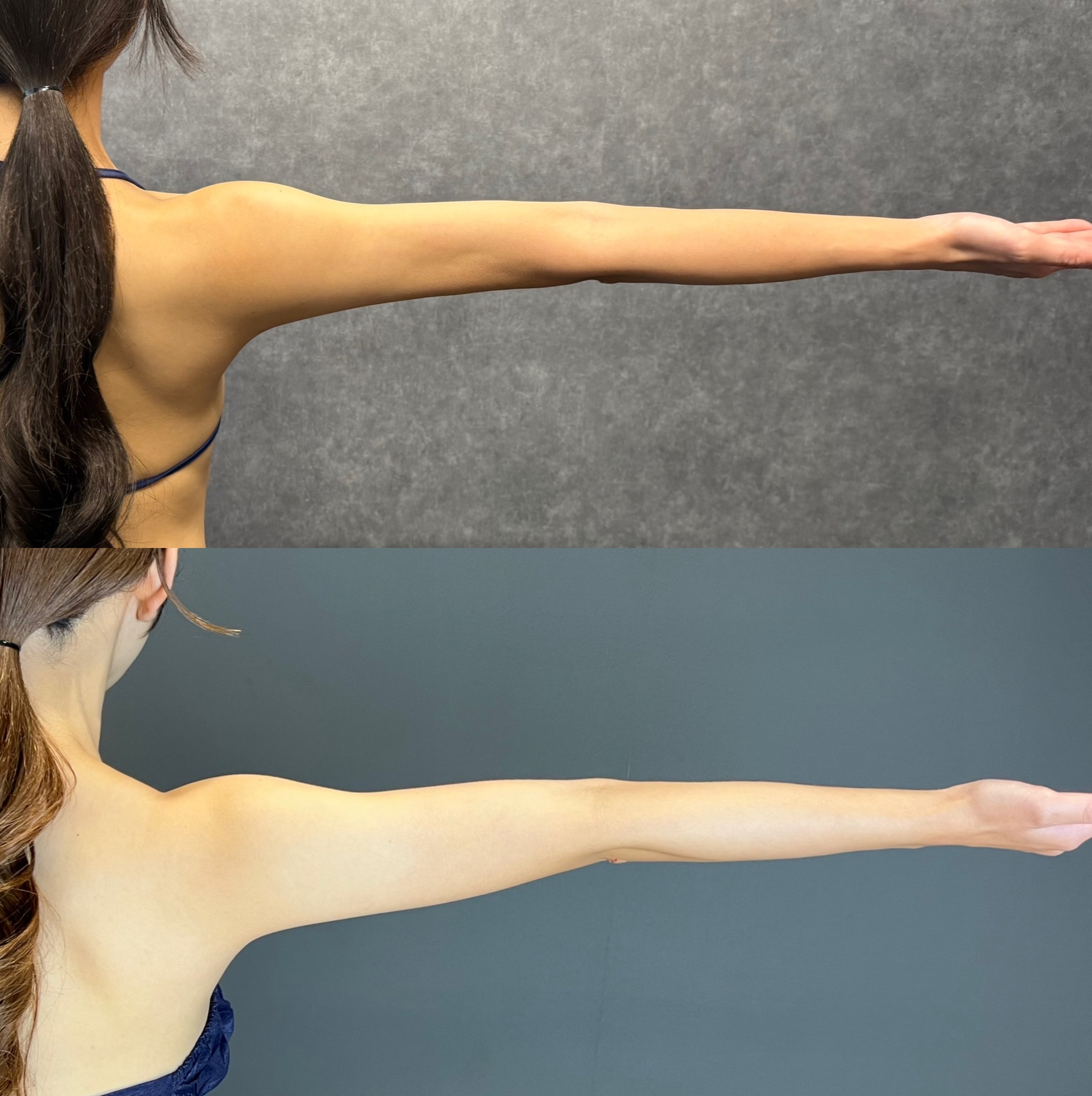
Limits of Conservative Therapy and Indications for Surgery
First-line treatment for this condition is conservative therapy: medical-grade compression garments (20–40 mmHg), manual lymphatic drainage (MLD), low-impact aerobic exercise such as aquatic exercise, weight management, and an anti-inflammatory diet. However, these measures suppress progression and relieve symptoms – they cannot reduce the already-hypertrophic fat itself, which is the medical limit.
When symptoms do not improve after 6–12 months of conservative therapy, when pain or gait disturbance interferes with daily life, or when progressive volume increase is documented, specialized liposuction is considered as a treatment option.
Technical Principles of Lipedema Liposuction
Lipedema liposuction differs significantly from ordinary aesthetic liposuction. The two most important differences are that lymphatic preservation is the top priority, and planned, staged suction is the rule. The technical principles that Dr. Moriwaki emphasizes at our clinic are as follows.
1. Device selection: selective fragmentation devices such as VASER or Acu-Sculpt (Aculysis) are used to preferentially break down adipocytes while preserving lymphatic vessels and connective tissue as much as possible.
2. Cannula direction: suction is oriented along the course of lymphatic vessels, avoiding perpendicular crossings.
3. Tumescent fluid: dilution ratios and local anesthetic doses are strictly controlled to limit the systemic risk of large-volume surgery.
4. Staged surgery: rather than treating the entire leg in one session, thighs and lower legs are addressed safely in multiple procedures.
5. Layered suction: superficial-layer suction is kept to a minimum to reduce the risk of skin laxity and contracture.
Postoperative Management: Long-Term Compression Determines Prognosis
After surgery, sustained compression therapy determines long-term outcome. Medical-grade compression garments (20–30 mmHg) are typically worn for 24–52 weeks – far longer than for ordinary aesthetic liposuction – and MLD or exercise therapy is continued afterward. The suctioned fat cells do not regenerate, but without ongoing control of inflammation in the remaining adipose tissue and tissue pressure, symptoms may recur. For safety standards in cosmetic surgery, please also refer to the Japan Society of Aesthetic Surgery (JSAS).
Not Everyone Is a Candidate: Indications and Limits
Surgical treatment for this condition requires careful judgment in the following situations.
・Extremely high BMI (40 or above) – often outside the indication for liposuction.
・Severe concomitant lymphedema – lymphatic-vessel anastomosis or other treatment may be needed first.
・Cardiovascular or coagulation disorders – general anesthesia and extensive suction carry high risk.
・Inability to continue postoperative compression and lifestyle management – high risk of recurrence.
Please also understand that lipedema surgery is not a procedure for “creating beautiful legs” but a treatment aimed at “controlling the disease.” You may also find the liposuction column archive helpful for related articles.
Frequently Asked Questions
Q. Is lipedema liposuction covered by health insurance?
At present it is not covered by public insurance in Japan and is performed as a self-pay procedure. Some overseas jurisdictions (e.g., Germany and the UK) do provide public coverage under certain conditions.
Q. Will surgery cure the disease completely?
The removed fat cells do not regrow, but surgery does not stop the progression of the remaining adipose tissue or newly proliferating adipocytes. Continued lifestyle management and compression therapy determine long-term prognosis.
Q. How does the operative time compare with ordinary aesthetic liposuction?
For this condition, lymphatic-sparing technique and a wide treatment area extend the operative time, and treatment is often divided into multiple sessions. A per-session suction volume limit is set for safety.
Q. How long is the downtime?
As with ordinary liposuction, swelling, bruising, and a contracture phase occur; return to daily activities typically takes 1–2 weeks and full resolution of contracture takes 3–6 months. Compression therapy itself, however, is continued for 6 months to 1 year.
──────────────
【Supervising Physician】Shin Moriwaki, MD (Supervisor)
Member, Japan Society of Aesthetic Surgery (JSAS) / Member, American Academy of Aesthetic Medicine
ECFMG Certificate (US Medical Licensing Qualification)
──────────────
📍AVAN TOKYO GINZA LIPOSUCTION CLINIC
English / 中文 / Tiếng Việt supported
Reservations and consultations are accepted via
DM / LINE / Website / Phone.