


Second Fat Grafting for Breast Symmetry: Asymmetric Layering and Inframammary Touch-Up2026.09.24
“I had a fat grafting session, but the upper-pole roundness and lower contour still feel incomplete.” — A second fat grafting procedure is not simply a repeat of the first. It is a finishing phase in which the surgeon reads, by palpation and visual assessment, exactly which layers and locations retained fat from the previous injection, and adds volume only to the specific layers and positions that fell short. This article draws on a single case of a woman in her 20s who underwent a second fat grafting procedure, using the abdomen as a donor site and combining asymmetric multi-layer injection with an inframammary subcutaneous top-up, to explain intraoperative decision-making and design thinking from the perspective of Dr. Moriwaki, the operating surgeon.
Key Points of This Article
・A second fat grafting outcome is driven less by volume than by which layer and which position receives the added fat.
・The take map from the first session, read by palpation, may lead the surgeon to choose an asymmetric design with different layers and volumes for each side.
・A small subcutaneous (SC) top-up in the inframammary region smooths the lower-pole step and rounds the contour.
・Abdominal donor fat allows predictable pure-fat yield after low-speed centrifugation, making it well suited to second-session augmentation.
・Additional injection still carries risks such as infection, nodules and residual asymmetry, so post-op compression and graft-take environment must be carefully managed.
Why a Second Fat Grafting Is Sometimes Needed
Fat grafting resorbs anything injected beyond the recipient tissue’s “physiological capacity,” so few patients reach their target size in a single session. Especially in slim patients, or those with dense subglandular tissue that limits how much can safely be added at once, the rational strategy is to prioritize “the volume that can safely engraft” in session one and add the remaining target volume in session two. In this case, after the first session had placed fat in the subglandular, intramuscular and subcutaneous layers, palpation of the healed graft showed “upper-outer roundness achieved, but a residual step in the lower contour” and “a small side-to-side thickness difference.” These unresolved issues drove the design of the touch-up.
Treatment Content, Cost and Risks for This Case
[Treatment performed] Woman in her 20s, second fat grafting to the breast. The whole abdomen was first emulsified with a VASER-type ultrasound handpiece and then aspirated under tumescent anesthesia. The harvested fat was condensed and low-speed centrifuged to secure pure fat, and approximately 200 ml per breast — around 400 ml total — was injected across four layers (subglandular, intramuscular within the pectoralis major, subfascial and subcutaneous). During surgery, based on intraoperative findings, a subcutaneous top-up was added to the inframammary region.
[Cost] Specific fees vary with area, injected volume, device choice and anesthesia plan. Please refer to our price page.
[Main risks and side effects] Abdominal donor side: bruising, swelling, fibrosis, asymmetry, skin numbness, and rarely surface irregularity or seroma. Breast side: nodules (oil cysts, fat necrosis), calcification, infection, residual asymmetry, and potential need for further surgery if graft take is insufficient. Photographs are one example only and results vary between individuals.
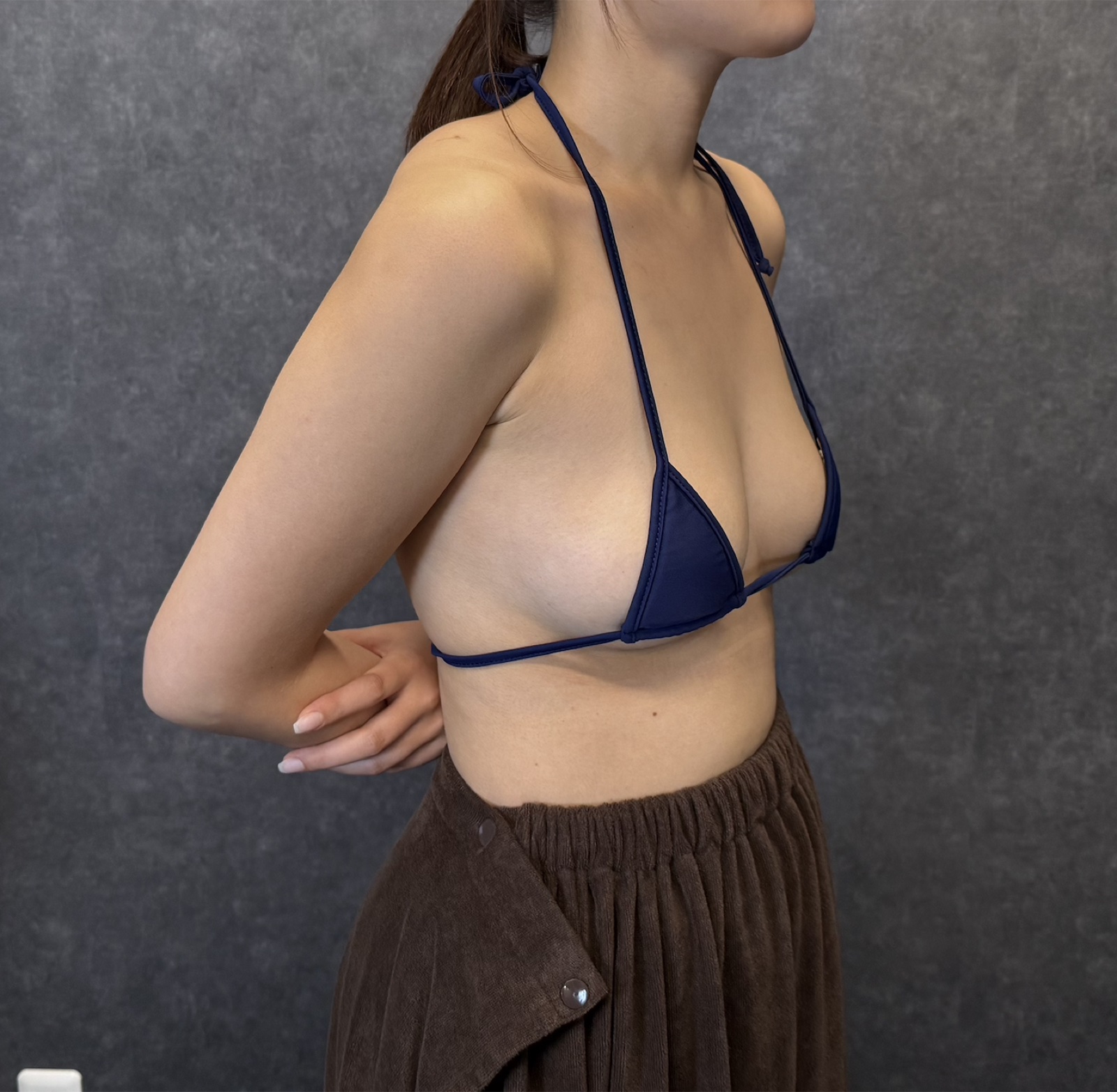
Design of the Touch-Up | Why Injection Layers Differed Between the Two Sides
The most difficult idea in a second fat grafting is that “to make the two sides look symmetric, they must sometimes be injected asymmetrically.” In this case, the right breast received 60 ml subglandular, 60 ml intramuscular, 0 ml subfascial and 80 ml subcutaneous — 200 ml total. The left breast received 60 ml subglandular, 60 ml intramuscular, 20 ml subfascial and 60 ml subcutaneous — also 200 ml total. The right side had thinner lower-lateral subcutaneous coverage after the first session and a residual contour step, so a higher subcutaneous ratio was chosen. The left side had weaker lower-pole projection, so 20 ml was placed subfascially to reinforce the base. The 20 ml difference looks small on paper, but it shifts upper-pole roundness and cleavage lift-off.
“More Volume Equals a Bigger Breast” Is a Misconception
Injecting a large amount at once creates central ischemia; adipocytes outside the three-zone oxygen-diffusion range are prone to necrosis and oil-cyst formation. The goal of a top-up is to “add to the places that fell short” within physiological capacity. Roughly 200 ml per side is a volume made possible only by the existing fat bed of a second session. Only because the first session’s take is already palpable can this volume and layer distribution be judged safely.
Inframammary SC Top-Up | Smoothing the Lower Step and Contour
After completing the planned subglandular and intramuscular injections, intraoperative findings led to the decision to add subcutaneous fat (SC) to the inframammary region. When the lower breast has thin subcutaneous tissue, no matter how much is placed subglandularly or submuscularly, a step tends to appear at the inframammary fold and casts an unnatural shadow or depression when the breasts are pushed together. A small amount of subcutaneous fat placed here restores a smooth lower contour and produces a natural silhouette under a T-shirt or bra. SC top-up is not about making the breast larger; it is a corrective layer that “connects contours smoothly.” This is best judged intraoperatively based on side-to-side differences and skin extensibility, rather than being locked in preoperatively.
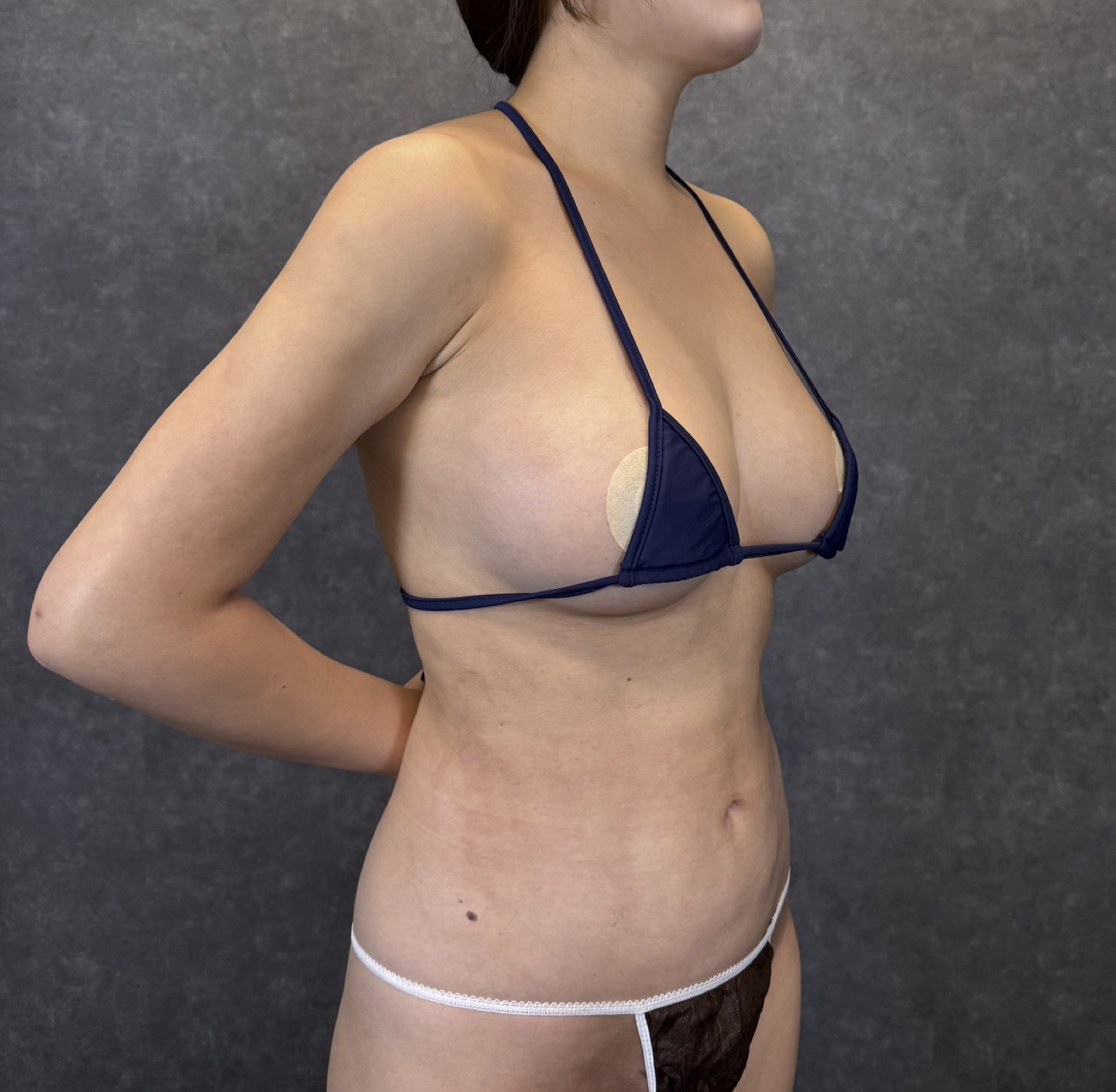
Why the Abdomen Is Chosen as Donor and the Role of Low-Speed Centrifugation
The whole abdomen (upper abdomen, lower abdomen and periumbilical area) was chosen as the donor site. Abdominal fat has a relatively uniform fibrous architecture in the deep subcutaneous plane and can be harvested with limited damage even after ultrasound emulsification. Securing pure fat by low-speed centrifugation and condense processing lets us predict the actually engraftable volume. Excessive centrifuge speed fractures the adipocytes themselves and reduces the viability of the adipose-derived stem cell (ADSC) fraction, so our policy is to deliberately use a low speed that separates only oil, blood components and water. The abdomen also contributes to waist contouring, so a touch-up augmentation and a subtle body-line refinement can be achieved within a single downtime.
Post-Op Compression and Graft Environment | The Role of Wardell-Type Fixation
Fat-graft take begins with neovascularization at post-op days 3–7 and stabilizes over roughly three months. Strong compression over the whole breast during this period can push out injected fat or restrict blood supply and lower take. We therefore use a Wardell-type upper fixation that “does not crush the breast itself but prevents displacement from upper to lower pole.” Patients are asked to wear a wire-free sports bra for three to four weeks; return to underwire or push-up styles is decided by the attending physician. On the abdominal donor side, a body suit provides uniform compression to help prevent bruising, seroma and surface irregularity. Because both excessive and insufficient pressure impair the final result, wear time and tightness are adjusted at each follow-up.
Indications and Limitations of a Second Fat Grafting
A second fat grafting is considered at least three months after the first session, once graft take and fibrosis have settled. Patients whose donor fat is depleted, who have a history of infection or dense scarring, or who present with severe asymmetry or ptosis may not be candidates for simple additional injection and may require conditional indications or a combined technique. If additional injection still cannot reach the goal, a switch to hybrid augmentation (implant plus fat) can be discussed. For safety standards and thinking on procedure selection in aesthetic surgery, refer to the Japan Society of Aesthetic Surgery. Related cases and recovery experiences can be found on our liposuction column archive.
Frequently Asked Questions
Q. When can a second fat grafting be performed?
A rough guideline is three months or more after the first session, once swelling and fibrosis have settled and graft take is stable. If palpable nodules or strong induration remain, waiting longer may improve the graft-take environment. Please discuss the timing with your physician based on your individual recovery.
Q. Will the second session enlarge me by the same amount as the first?
A second session is primarily aimed at finishing “the places and layers that fell short” within physiological capacity, because a fat bed already exists. It focuses more on shape, symmetry and lower contour than on major cup-size change. It is important to share your goal with the attending physician before surgery.
Q. Does a top-up increase the risk of nodules (oil cysts)?
Over-injection or single-point injection can still cause nodules in a second session. We inject in small volumes across multiple layers and directions, palpating existing induration and steering the cannula around it. Risk cannot be reduced to zero, so post-op self-check and regular follow-ups remain important.
Q. Should the donor site differ from the previous session?
Using the same donor site again is possible as long as depth and superficial balance are maintained symmetrically. If the abdomen was not fully harvested the first time, taking additional fat from the abdomen again is an option. Patients with contour irregularities from previous over-harvest may need to consider alternative donor sites such as the thighs or flanks.
Q. Is an inframammary subcutaneous top-up always performed?
Not always. Patients who already have adequate lower subcutaneous thickness or no tendency toward ptosis may not receive a top-up. During surgery, we evaluate subcutaneous thickness, step-off and skin extensibility between the fingers and add a small volume only when judged necessary.
──────────────
Medical Supervisor: Shin Moriwaki, MD (Shin Moriwaki)
Member, Japan Society of Aesthetic Surgery (JSAS) / Member, American Academy of Aesthetic Medicine
ECFMG Certificate (U.S. medical license qualification)
──────────────
📍AVAN TOKYO GINZA LIPOSUCTION CLINIC
English / 中文 / Tiếng Việt available
Bookings and consultations accepted
via DM / LINE / Website / Phone.