


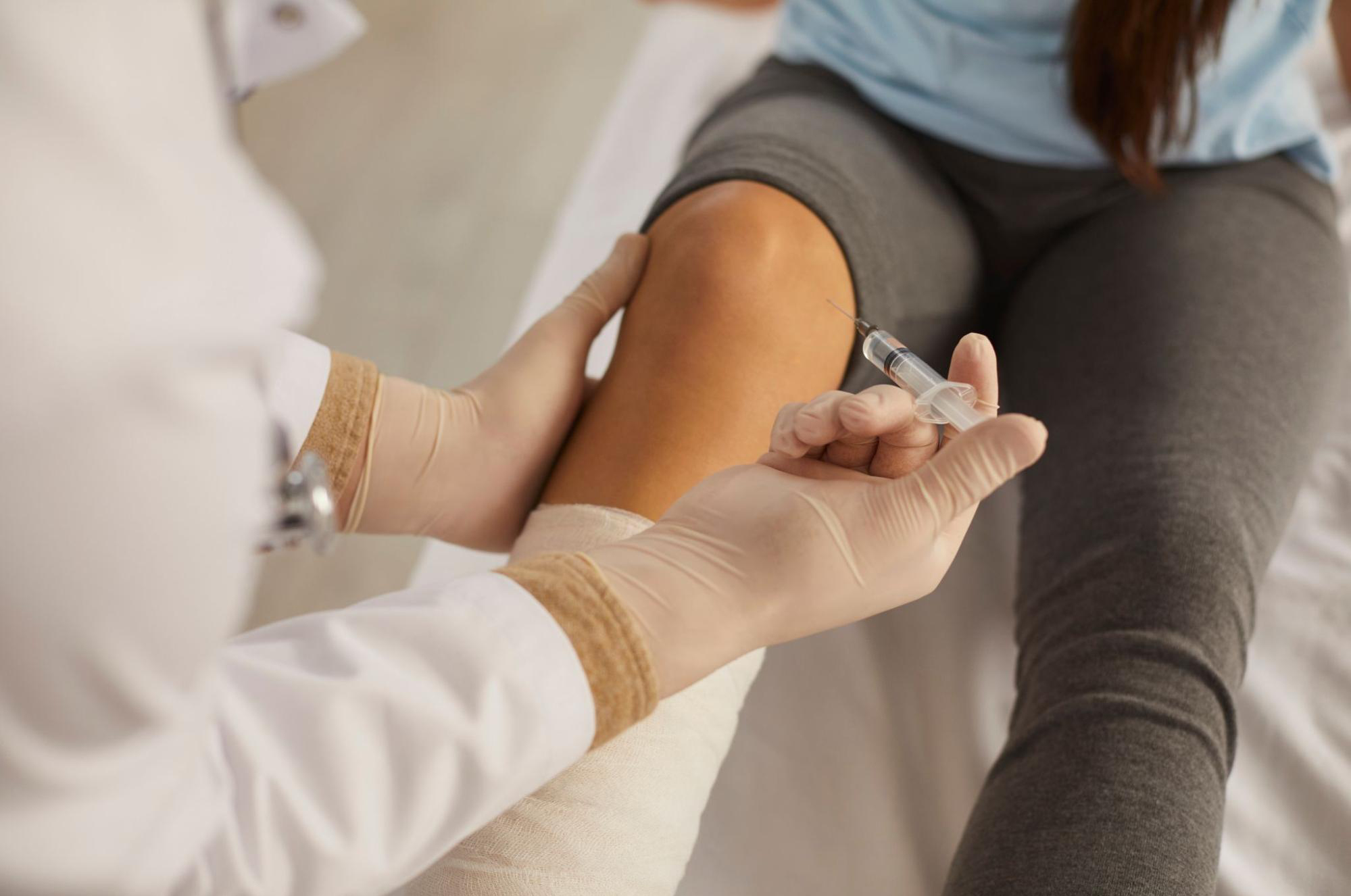
An Elbow That Will Not Straighten or Bend Fully Is the Aftermath of an Overused Joint — The Mechanism of Range-of-Motion Loss and Osteophytes, and What Stem Cell Conditioned Media Elbow Injection Can (and Cannot) Do, Organized by Dr. Moriwaki2026.07.23
“My elbow will not straighten out.” “When I bend my elbow, it feels blocked.” “It hurts whenever I put force through my elbow.” — Some patients who have lived with these complaints for a long time are actually harboring elbow osteoarthritis, a condition entirely different from tennis elbow or baseball elbow.
Caused by overuse or previous trauma, the joint cartilage wears down and osteophytes (bony spurs) form; as the disease progresses, it is accompanied by loss of range of motion and ulnar nerve dysfunction.
In this article, Dr. Shin Moriwaki, the supervising physician of our clinic, organizes the mechanism of this pathology and what stem cell conditioned media elbow injection can and cannot target.
Key Points of This Article
・Elbow osteoarthritis is a disease in which the cartilage of the elbow wears down and osteophytes form — a completely different pathology from tennis elbow (a tendon insertion disorder).
・Loss of range of motion (inability to fully extend or flex the elbow) and ulnar nerve dysfunction (numbness in the little finger) caused by osteophytes are the characteristic symptoms.
・Stem cell conditioned media elbow injection is positioned as one conservative option that aims to calm intra-articular inflammation and reduce pain and synovitis.
・It is not a treatment that dissolves existing osteophytes or restores lost cartilage to its original state, so in advanced or end-stage disease, surgery (osteophyte excision, total elbow arthroplasty) takes priority.
・The order of workup is to first assess the extent of joint destruction with X-ray and MRI, differentiate from other diseases, and only then judge indications for injection.
What Is Elbow Osteoarthritis — The Aftermath of an Overused Joint
This disease refers to progressive wear of the articular cartilage of the elbow joint (humeroulnar, humeroradial, and proximal radioulnar joints) due to years of use or trauma, with osteophytes (thorn-like bony overgrowths) forming where bone rubs against bone.
It is broadly divided into primary (progressing with age from unknown causes) and secondary (caused by trauma, intra-articular fracture, or sequelae of baseball elbow).
Particularly among those with a history of heavy manual labor (carpentry, construction), throwing sports (baseball, softball), or combat sports (judo, wrestling), secondary elbow osteoarthritis tends to become clinically apparent from middle age onward.
Bony and Cartilaginous Changes Within the Elbow Joint
In the early stage, wear of the articular cartilage and sclerosis of the subchondral bone begin; as it advances, osteophyte formation around the joint, narrowing of the joint space, and the development of loose bodies (so-called joint mice) follow.
These changes are irreversible; once osteophytes have formed or cartilage has been lost, they do not naturally return to their original state.
Differences from Tennis Elbow, Golfer’s Elbow, and Baseball Elbow
Tennis elbow (lateral epicondylitis) and golfer’s elbow (medial epicondylitis) are, at their core, tendon insertion degeneration (tendinosis) on the outer or inner side of the elbow, not diseases of the joint itself.
By contrast, the present disease is a disorder of the “contents” of the joint — the articular cartilage, bone, and synovium.
Symptomatically, tendon insertion disorders provoke localized pain with specific movements (wrist extension or flexion), whereas degeneration of the elbow joint produces motion pain and range-of-motion restriction across the whole arc of flexion and extension.
Range-of-Motion Loss and Ulnar Nerve Dysfunction — How Symptoms Spread With Progression
Why Elbow Extension and Flexion Become Restricted
In advanced cases, range-of-motion restriction occurs in both extension (straightening) and flexion (bending) of the elbow.
This is because osteophytes formed in the olecranon fossa and coronoid fossa physically block the joint, and because synovitis causes thickening and contracture of the joint capsule.
It is perceived as difficulty with activities of daily living such as “I can’t get my arm through a shirt sleeve,” “I can’t reach my hand up to my shoulder,” or “I have to lean forward to wash my face.”
Ulnar Nerve Dysfunction Caused by Osteophytes
On the posteromedial side of the elbow lies the cubital tunnel, through which the ulnar nerve (supplying part of the little and ring fingers) runs; when osteophytes protrude into this tunnel and compress the nerve, cubital tunnel syndrome may develop as a complication.
Symptoms include numbness of the little and ring fingers, weakness of the intrinsic hand muscles, and fine-motor difficulties such as “chopsticks are hard to use” or “I can’t fasten buttons.”
Elbow osteoarthritis accompanied by neuropathy is difficult to manage with injection alone, and is treated as a sign that consideration of surgery (osteophyte excision, ulnar nerve transposition) is approaching.
What Stem Cell Conditioned Media Elbow Injection Can and Cannot Target
Expected Actions and Mechanisms
Stem cell conditioned media is reported to contain growth factors such as TGF-β, IGF-1, FGF, and HGF, along with miRNA carried by exosomes and anti-inflammatory cytokines.
Within the joint, these are thought to act in the direction of calming the inflammatory environment itself — suppressing synovitis, modulating the metabolic environment of chondrocytes, and inhibiting pain-related mediators.
In cases where cartilage wear is present but osteophytes and range-of-motion restriction remain mild to moderate, it is positioned as one option within conservative therapy, aimed at controlling intra-articular inflammation, easing pain, and preserving activities of daily living.
For general information on joint diseases, please also refer to the website of the Japanese Orthopaedic Association.
Limits in Cases Where Deformity Has Advanced
On the other hand, stem cell conditioned media elbow injection is not a treatment that “dissolves” already-formed osteophytes, nor one that “regenerates lost articular cartilage to its original state.”
In end-stage joint destruction, joint locking caused by large loose bodies, or cases with advanced ulnar neuropathy, conditioned media alone has limits in improving pain and function; orthopedic surgical intervention such as osteophyte excision, arthroplasty, or total elbow arthroplasty takes priority.
Effects vary between individuals, and response differs depending on symptoms and the degree of joint destruction — a point patients should understand in advance.
The Treatment Sequence — Judging Indications for Injection After Imaging and Differential Diagnosis
When elbow osteoarthritis is suspected, we first confirm joint-space narrowing, osteophytes, and loose bodies with anteroposterior and lateral X-rays.
When needed, MRI is used to evaluate cartilage, synovium, and the ulnar nerve, and blood tests (CRP, rheumatoid factor, anti-CCP antibody) are added to differentiate from rheumatoid arthritis.
Once we have confirmed that other diseases such as tennis elbow, baseball elbow, or rheumatoid arthritis are not the primary problem, the basic approach is to combine conservative therapy (rest, bracing, oral NSAIDs, exercise therapy, hyaluronic acid or corticosteroid joint injection, and stem cell conditioned media elbow injection) according to the degree of deformity.
Please also see our detailed page on stem cell conditioned media joint injection.
Frequently Asked Questions
Q. Does elbow osteoarthritis heal on its own?
Once articular cartilage has worn down or osteophytes have formed, they do not naturally return to their original state. However, by combining lifestyle guidance to reduce loading, exercise therapy, pharmacotherapy, and injection therapy, it is possible to slow the progression of symptoms and reduce interference with daily life. Treatment is designed in parallel with regular orthopedic evaluation.
Q. How many stem cell conditioned media elbow injections are needed to see an effect?
The way effects appear varies between individuals and depends on the degree of joint destruction, intensity of inflammation, age, and activity level. Generally, we evaluate over the course of several weeks to several months, judging by pain score, range of motion, and improvement of daily activities. When response is poor, we consider continuation, change, or shifting to orthopedic re-evaluation.
Q. Could a case diagnosed as tennis elbow actually be elbow osteoarthritis?
The two can coexist, and there are cases in which patients treated conservatively as tennis elbow turned out to have intra-articular degeneration as the main driver. When symptoms have not resolved for a long time, when range of motion is restricted, or when little-finger numbness is present, we recommend reviewing the diagnosis including imaging studies.
Q. Between surgery and injection, which should be chosen first?
In the early to mid stages, when range-of-motion restriction is mild and there is no neuropathy, conservative therapy (including injection) is generally prioritized. When range-of-motion restriction is severe, joint locking from loose bodies recurs, or ulnar neuropathy is clearly progressing, orthopedic surgical consideration takes priority.
Q. Is it safe to move the elbow after injection?
On the day of and the day after the injection, avoid intense exercise and heavy labor and perform daily activities within a range that does not place large loads on the joint. If strong swelling, warmth, or persistent pain appears within a few days, there is a possibility of infection or a strong inflammatory reaction, so please contact us promptly.
──────────────
【Supervisor】Shin Moriwaki, MD (Supervising Physician)
Member, Japan Society of Aesthetic Surgery (JSAS) / Member, American Academy of Aesthetic Medicine
ECFMG Certificate
──────────────
📍AVAN TOKYO Ginza Joint Regenerative Medicine
AVAN TOKYO Ginza Joint Regenerative Medicine
English / 中文 / Tiếng Việt supported
Inquiries welcome via DM / LINE / Website / Phone.