


Don’t Mistake Peroneal Tendinopathy for Post-Sprain Ankle Pain: Chronic Retromalleolar Pain and Stem Cell Culture Supernatant Peritendinous Injection as an Option, Explained by Dr. Moriwaki2026.07.27
“A dull throbbing behind the outer ankle,” “a catching sensation behind the lateral malleolus when starting to walk or coming down stairs” — many people with a history of repeated ankle sprains continue to suffer from these symptoms. They are often dismissed as an old injury or a chronic sprain, but the true source of the pain may be peroneal tendinopathy, a disorder of the tendon itself. In this article, Dr. Moriwaki explains the chronic pain caused by peritendinitis, tendon subluxation, and split tears of the peroneal tendons behind the lateral malleolus, and outlines peritendinous injection of stem cell culture supernatant as one option.
Key Points
・Peroneal tendinopathy is easily confused with post-sprain sequelae and chronic lateral ligament insufficiency, but the primary site of pain is not the ligament — it is the peroneal tendon itself.
・The peroneus longus and peroneus brevis tendons pass through the retromalleolar groove, where inflammation, subluxation, and split tears can occur, causing chronic pain behind and along the lateral side of the ankle.
・Options range from conservative treatment (rest, orthoses, NSAIDs, ultrasound-guided injections) to surgery (groove-deepening procedures, tendon repair). Peritendinous injection of stem cell culture supernatant is one conservative option that aims to modulate the tissue repair environment.
・Because tendon tissue has poor vascular supply and heals slowly, treatment should be designed in combination with orthoses and physical therapy — not injection alone.
What Is Peroneal Tendinopathy? — An Overlooked Cause of Retromalleolar Pain
The peroneal tendons pass behind the lateral malleolus and serve to evert the ankle while supporting the arch of the foot. The peroneus longus inserts on the base of the first metatarsal after crossing the sole, while the peroneus brevis inserts on the base of the fifth metatarsal. Both tendons run within the retromalleolar groove, held in place by the superior peroneal retinaculum. Repeated eversion or inversion trauma and laxity of the retinaculum can cause a range of disorders including peritendinitis, tendon subluxation, and split tears. Peroneal tendinopathy is an important differential diagnosis of retromalleolar pain, not only in athletes but also in middle-aged and older adults with chronic ankle instability, flatfoot, or supinated foot alignment.
Confusion Between Sprain and Tendon Disorder Fuels Chronicity
Patients with a history of ankle sprain sometimes complain months to years later that “the deep part of the outer ankle still hurts” or “there’s a catch when I start walking.” Peroneal tendinopathy may be lurking behind these symptoms. When the superior peroneal retinaculum loosens during the acute sprain phase, the tendons repeatedly sublux anteriorly out of the groove, and the tendon surface abrades against the bony edge, progressing to a split tear. What is dismissed as “post-sprain sequelae” often turns out to be structural tendon degeneration.
What Peritendinous Injection of Stem Cell Culture Supernatant Can Address
Like ligaments and cartilage, tendon tissue has poor vascular supply and heals slowly. Chronic tendon disorders should be understood not as simple “inflammation (-itis)” but as “tendon degeneration (tendinosis).” Repeated corticosteroid injections have been noted to increase the risk of tendon weakening, so chronic-phase strategies must balance anti-inflammatory action with support for tissue repair. The same principle applies to peroneal tendinopathy.
The Role of Growth Factors and Anti-Inflammatory Cytokines
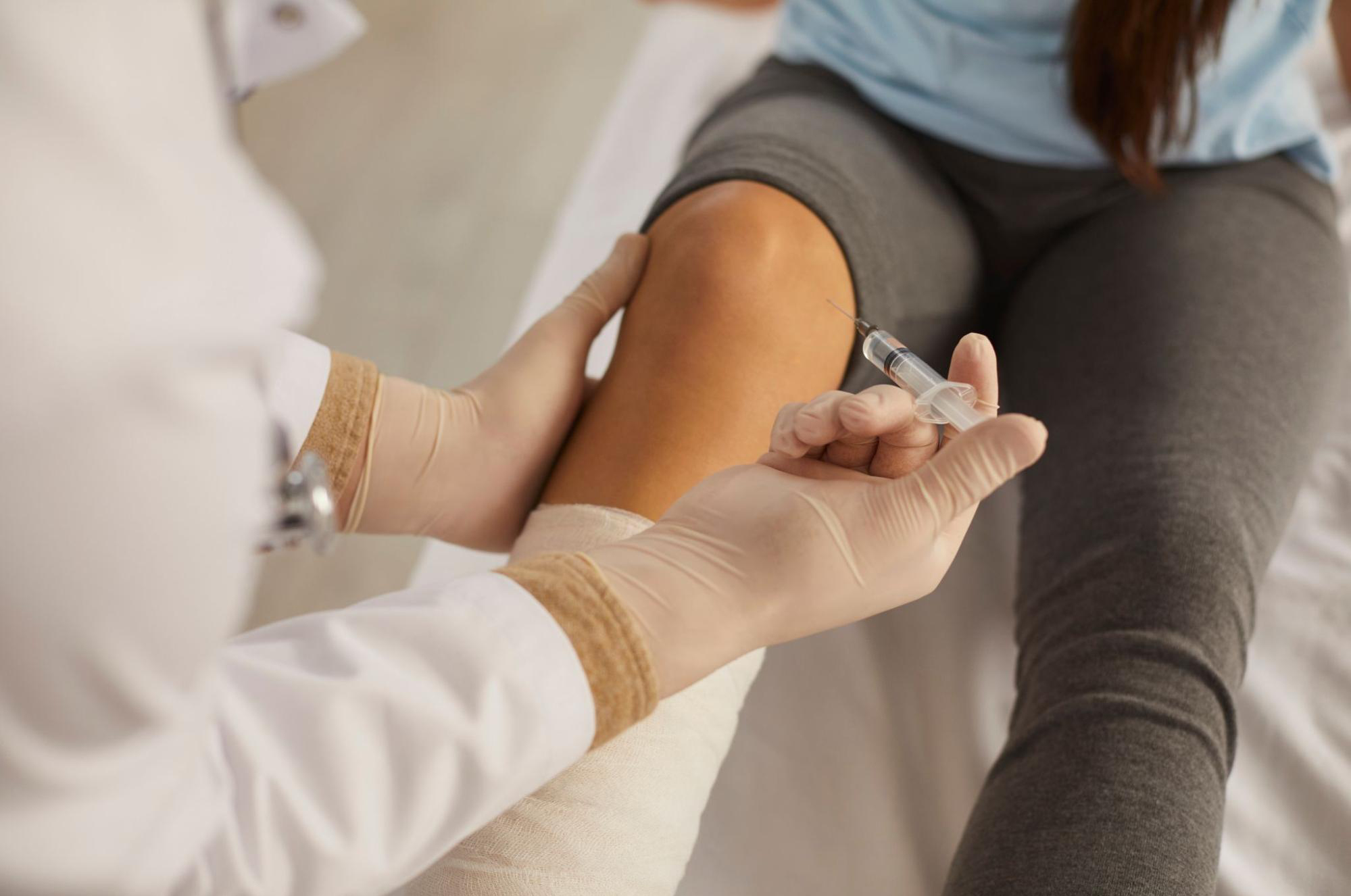
Stem cell culture supernatant has been reported to contain growth factors such as TGF-β, IGF-1, FGF, and VEGF, along with anti-inflammatory cytokines. Ultrasound-guided peritendinous or entheseal delivery is considered an option that may calm the inflammatory environment around the tendon and tendon sheath while supporting the repair environment of degenerated tendon tissue. However, in advanced peroneal tendinopathy with complete tears, severe subluxation, or bony changes, injection alone is often insufficient for functional recovery, and orthopedic surgical evaluation takes priority. For general information on tendon and joint disorders, please also refer to the guidelines of the Japanese Orthopaedic Association.
Orthoses and Exercise Therapy Are Prerequisites
For peroneal tendinopathy, conservative treatment centers on lateral longitudinal arch support insoles and lateral heel wedges to reduce inversion stress, along with strengthening of the peroneal muscle group (isometric eversion exercises and resistance band training). Peritendinous injection of stem cell culture supernatant should be designed in combination with these orthoses and exercises. Relying on injection alone leaves the mechanical load unchanged and invites recurrence.
The Order of Diagnosis and Treatment Design
The Imaging Ladder
Plain X-ray first evaluates the bony morphology behind the lateral malleolus (flattening of the peroneal groove, pseudo-malleolus, chronic avulsion at the fifth metatarsal base). MRI or ultrasound then assesses tendon course, presence of split tears, tenosynovial effusion, and integrity of the superior peroneal retinaculum. Ultrasound is especially useful for real-time dynamic evaluation (visualizing tendon subluxation during dorsiflexion-eversion) and serves both diagnostic and needle-guidance roles for peritendinous injection.
A Gradient From Conservative Care to Surgery
Acute and mild cases are managed conservatively with rest, orthoses, NSAIDs, and physical therapy. For chronic cases with persistent symptoms, tissue-repair–oriented approaches such as peritendinous injection of stem cell culture supernatant become options. In contrast, cases with repeated overt subluxation, severe split tears, or significant impairment of activities of daily living may require orthopedic surgery — groove-deepening procedures, retinaculum reconstruction, or tendon repair. For approaches to local injection of stem cell culture supernatant in other joints and tendons, please see our page on joint injection with stem cell culture supernatant. Treatment planning for peroneal tendinopathy must be individualized based on disease stage, presence of subluxation, and the patient’s activity level.
Frequently Asked Questions
Q. My outer ankle still hurts months after a sprain. Could it be peroneal tendinopathy?
Not necessarily. Chronic lateral ligament insufficiency, osteochondral lesion of the talus, and peroneal tendinopathy often coexist. Objective evaluation by ultrasound and MRI is the starting point. Ultrasound assessment of tendon subluxation during dorsiflexion-eversion is particularly useful in differentiating peroneal tendinopathy.
Q. Can peritendinous injection of stem cell culture supernatant heal a complete tendon tear?
Functional recovery from a complete tear or severe split tear is not realistic with injection alone. It becomes an option at the stage of tendon degeneration, incomplete tears, or peritendinitis where tendon continuity is preserved, aiming to support the repair environment. Surgical indications should be determined in cooperation with an orthopedic surgeon.
Q. How many injections are typically needed to see results?
Because tendon tissue has poor blood supply and heals slowly, response assessment takes several weeks to months. Typically, several injections combined with orthoses and exercise therapy are followed by objective evaluation of pain scores, range of motion, and movement-related pain. If the response is poor, the treatment plan should be reconsidered.
Q. How does it differ from a local corticosteroid injection?
Corticosteroid injections have strong anti-inflammatory effects, but repeated tendon injections may increase the risk of tendon weakening and rupture, so caution is required for chronic tendon degeneration. Stem cell culture supernatant simultaneously targets “anti-inflammatory” action and “support of tissue repair,” representing a different mechanism.
Q. Is it covered by insurance?
Peritendinous injection using stem cell culture supernatant is not covered by insurance and is provided as private-pay treatment. We will explain the distinction from insured treatments (corticosteroid injections, hyaluronic acid, physical therapy) and cost-effectiveness on an individual basis at consultation.
──────────────
Supervising Physician: Shin Moriwaki, MD
Member, Japan Society of Aesthetic Surgery (JSAS) / Member, American Academy of Aesthetic Medicine
ECFMG Certificate
──────────────
📍AVAN TOKYO 銀座 関節再生医療
AVAN TOKYO Ginza Joint Regenerative Medicine
English / 中文 / Tiếng Việt available
Inquiries welcome via DM / LINE / Website / Phone.