


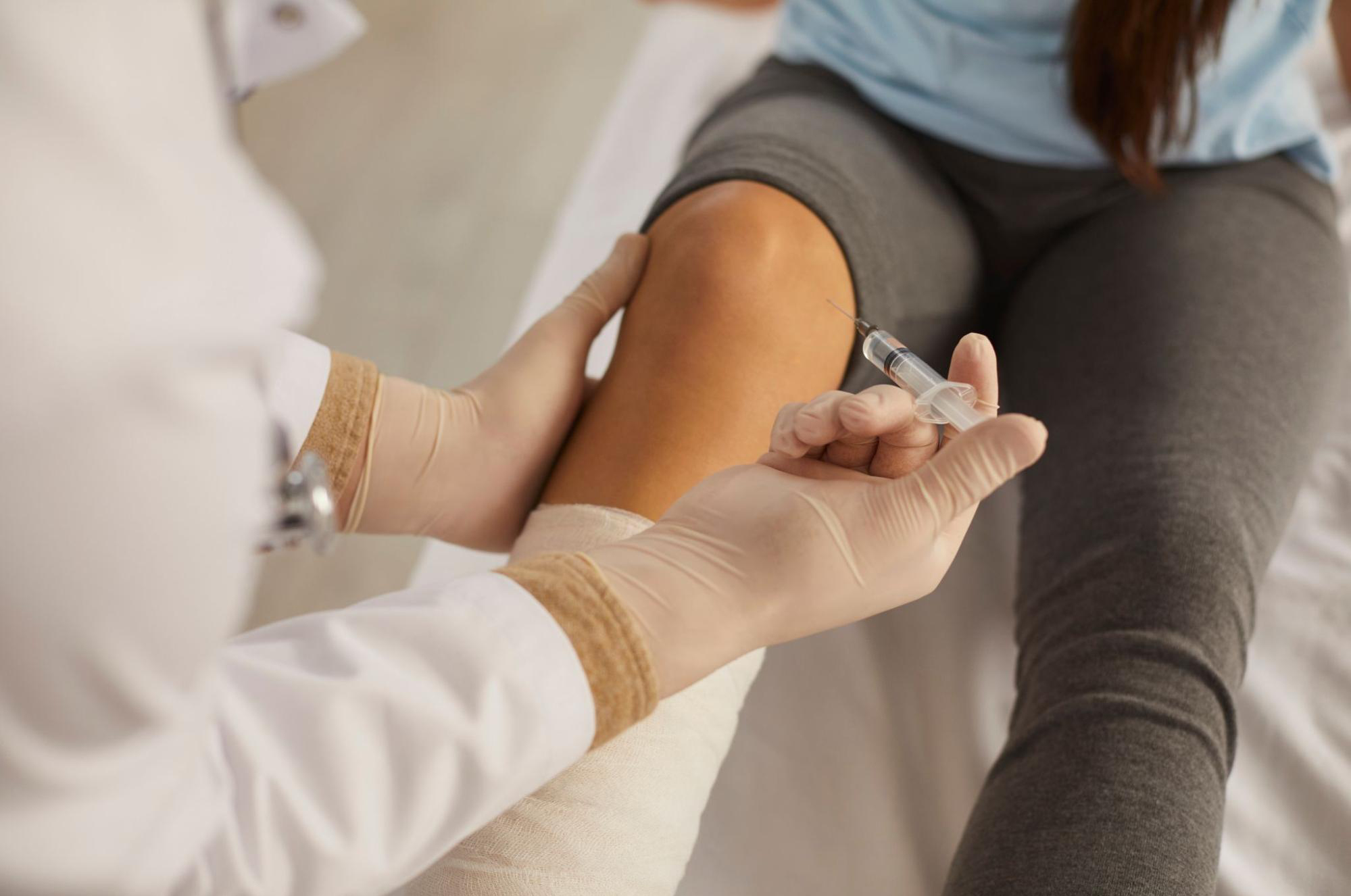
Don’t Dismiss a PCL Injury (Posterior Cruciate Ligament) as “Just Leftover Bruising” — Dr. Moriwaki Organizes the Pathology of Chronic Knee Instability and the Synovitis Cycle After Dashboard and Sports Trauma, and Where Stem Cell Conditioned Media Knee Injection Can Aim (Intra-Articular Inflammatory Environment) Versus Cannot Aim (Anatomical Ligament Reconstruction)2026.08.12
After striking the knee hard, some patients return to daily life yet keep noticing that “the knee feels loose when standing up or walking downhill” or “a deep ache flares from time to time” for months to years. When acute fractures and meniscal injury are ruled out, this is often dismissed as “just leftover bruising.” Yet among these cases, posterior cruciate ligament (PCL) injury frequently leaves chronic knee instability and a persistent synovitis cycle behind. In this column, Dr. Shin Moriwaki of AVAN TOKYO Ginza Joint Regenerative Medicine organizes the pathology of posterior cruciate ligament injury and the line between what stem cell conditioned media knee injection can and cannot aim at, from an orthopedic viewpoint.
Key Points of This Article
・Posterior cruciate ligament (PCL) injury occurs from dashboard trauma or sports impact, but is easily missed acutely because symptoms are relatively mild.
・In the chronic phase, posterior instability (posterior tibial sagging) remains, altering contact pressure distribution across the tibiofemoral and patellofemoral joints and driving secondary cartilage degeneration and a synovitis cycle.
・What stem cell conditioned media knee injection can aim at is correction of the intra-articular inflammatory environment, not anatomical reconstruction of the torn ligament itself.
・For isolated Grade I–II PCL injury, conservative treatment centered on quadriceps strengthening and bracing is often first-line; combined ligament injuries or severe instability call for consideration of ligament reconstruction surgery.
・Treatment design should be built alongside orthopedic assessment based on MRI, stress radiographs, and clinical findings.
What Is Posterior Cruciate Ligament (PCL) Injury?
The posterior cruciate ligament sits at the center of the knee and is the principal restraint against posterior displacement of the tibia relative to the femur. It is thicker and stronger than the anterior cruciate ligament (ACL), but once damaged it heals poorly on its own and becomes a source of chronic knee instability.
Mechanism of Injury — Dashboard Trauma and Sports Impact
The classic mechanism is the “dashboard injury” — during a motor vehicle collision, the flexed knee strikes the dashboard and a posteriorly directed force is applied to the anterior tibia, stretching or rupturing the PCL. In sports, PCL rupture arises in rugby, soccer, judo, and American football when the flexed knee absorbs a frontal impact. A hard fall directly onto the front of the knee can produce the same injury.
How PCL Injury Differs From ACL Injury — and Why It Gets Missed
ACL injury typically presents with an audible “pop,” a sensation of giving way, and prominent hemarthrosis within the following day. Posterior cruciate ligament injury, by contrast, tends to cause milder symptoms at the moment of injury with only mild to moderate swelling. This is precisely why patients and physicians alike are prone to dismiss it as “just a bruise” at the first visit. Abrasions or bruising over the anterior knee — especially the tibial tubercle — can be an important clue to the true mechanism.

Why Posterior Cruciate Ligament Injury Gets Dismissed as “Leftover Bruising”
The Acute-Phase Miss
Acute PCL injury tends to produce relatively mild pain, and walking often remains possible even with a limp. This makes it easy to conclude that “it isn’t a major injury.” Plain radiographs without bony injury are read as “unremarkable,” and the diagnosis is not settled unless the workup progresses to MRI and stress radiographs. Missing the diagnosis at this stage becomes the seedbed for chronic knee instability and the synovitis cycle later on.
Chronic Posterior Instability and the Synovitis Cycle
Left untreated, the injury leaves the tibia perpetually a few millimeters posterior relative to the femur (posterior sagging). This shifts the contact pressure distribution across the tibiofemoral and patellofemoral joints, applying chronic stress to the cartilage of the medial tibiofemoral compartment and the patellofemoral joint. Sustained synovitis, joint effusion, restricted range of motion, and unease going down stairs or slopes then progress gradually over months to years. Long-term follow-up has reported progression to secondary osteoarthritis of the knee, which is why this posterior cruciate ligament injury cannot be dismissed as mere residual bruising.
Stem Cell Conditioned Media Knee Injection — What It Can and Cannot Aim At
Correcting the Intra-Articular Inflammatory Environment (Can Aim At)
Stem cell conditioned media contains growth factors such as TGF-β, IGF-1, HGF, and VEGF along with exosomes (extracellular vesicles that carry miRNA), and may aim to correct the anti-inflammatory and tissue-repair environment inside the joint by acting on the synovitis cycle. For persistent synovitis, joint effusion, and mild cartilage degeneration seen in the chronic phase of this injury, stem cell conditioned media knee injection can be positioned as one conservative-treatment option that “turns down the intra-articular flame.” Because its mechanism differs from hyaluronic acid injection (lubricant supplementation) and steroid injection (anti-inflammatory), it also warrants consideration when those options have plateaued.
Anatomical Ligament Reconstruction (Cannot Aim At)
At the same time, stem cell conditioned media knee injection is a treatment that acts on the intra-articular environment; it is not a treatment that anatomically reconstructs the torn posterior cruciate ligament itself. This line must be drawn honestly. When Grade III complete rupture, combined ligament injury (with ACL, MCL, LCL, or the posterolateral corner), or severe residual posterior instability that impairs daily life is present, ligament reconstruction surgery takes priority. Responses vary between individuals, and it is not possible to assert that stem cell conditioned media knee injection is effective in every case of PCL rupture.
Where Conservative Treatment and Surgery Diverge — A Framework for Treatment Design
For isolated Grade I–II posterior cruciate ligament injury, conservative treatment built around quadriceps-focused strengthening, bracing, and activity-level adjustment is often first-line. Within that conservative framework, adding stem cell conditioned media knee injection for chronic intra-articular inflammation and synovitis is a medically coherent positioning. On the other hand, combined ligament injuries and cases with persistent, disabling posterior instability call for consideration of ligament reconstruction surgery. Sound treatment design is inseparable from orthopedic assessment based on MRI, stress radiographs, and clinical findings. For further reading on conservative approaches and indications, see our page on stem cell conditioned media joint injection. General medical information on joint disorders is also available through the Japanese Orthopaedic Association.
Frequently Asked Questions
Q. Does stem cell conditioned media knee injection make sense for a posterior cruciate ligament injury sustained many years ago?
When chronic intra-articular synovitis or mild cartilage degeneration underlies the symptoms, it can be considered from the standpoint of correcting the inflammatory environment. Because it does not treat posterior instability itself, however, it is important to first assess the degree of instability with MRI and stress radiographs, and to place the injection within a comprehensive plan that includes bracing and strengthening.
Q. Surgery has been recommended for my PCL injury — can I first try to hold on with stem cell conditioned media joint injection?
It depends on the grade, whether there is combined injury, and how much daily life or sports are affected. In cases with severe residual instability or combined ligament injury, injection cannot anatomically reconstruct the ligament. The decision between surgery and conservative treatment should be made carefully, drawing on both orthopedic and regenerative-medicine perspectives.
Q. How many stem cell conditioned media knee injections are needed before effects appear?
Onset and duration of response vary between individuals, so it is not possible to state a universal number. A common approach is to administer several sessions at fixed intervals during an induction phase, then design maintenance intervals while evaluating pain, range of motion, and daily activities objectively. If response is poor, options include continuation, modification, or transition back to orthopedic re-evaluation.
Q. My knee is swollen at the back after a PCL injury. Can I still receive a joint injection?
Swelling at the popliteal region can reflect a Baker’s cyst or joint effusion. Joint injection is contraindicated when septic arthritis or acute hemarthrosis is suspected, so joint aspiration, evaluation of synovial fluid quality, and imaging come first, and treatment is designed only after confirming that red flags such as fever, severe pain, and marked warmth are absent.
Q. When can we say a PCL injury has been “treated” through conservative and regenerative approaches?
“Healing” in this context does not mean anatomical reconstruction of the ligament. It is evaluated comprehensively by intra-articular inflammation control, range of motion, muscle strength, and recovery of daily activities. Long-term monitoring for progression to secondary osteoarthritis through periodic examination and imaging is an important stance.
──────────────
Medical Supervision: Dr. Shin Moriwaki (Supervising Physician)
Member, Japan Society of Aesthetic Surgery (JSAS)
Member, American Academy of Aesthetic Medicine
ECFMG Certificate
──────────────
📍AVAN TOKYO Ginza Joint Regenerative Medicine
AVAN TOKYO Ginza Joint Regenerative Medicine
English / 中文 / Tiếng Việt supported
Inquiries welcome via DM / LINE / Website / Phone.