


This is a 28-year-old woman, 6 months after upper arm and thigh liposuction followed by fat-graft breast augmentation.

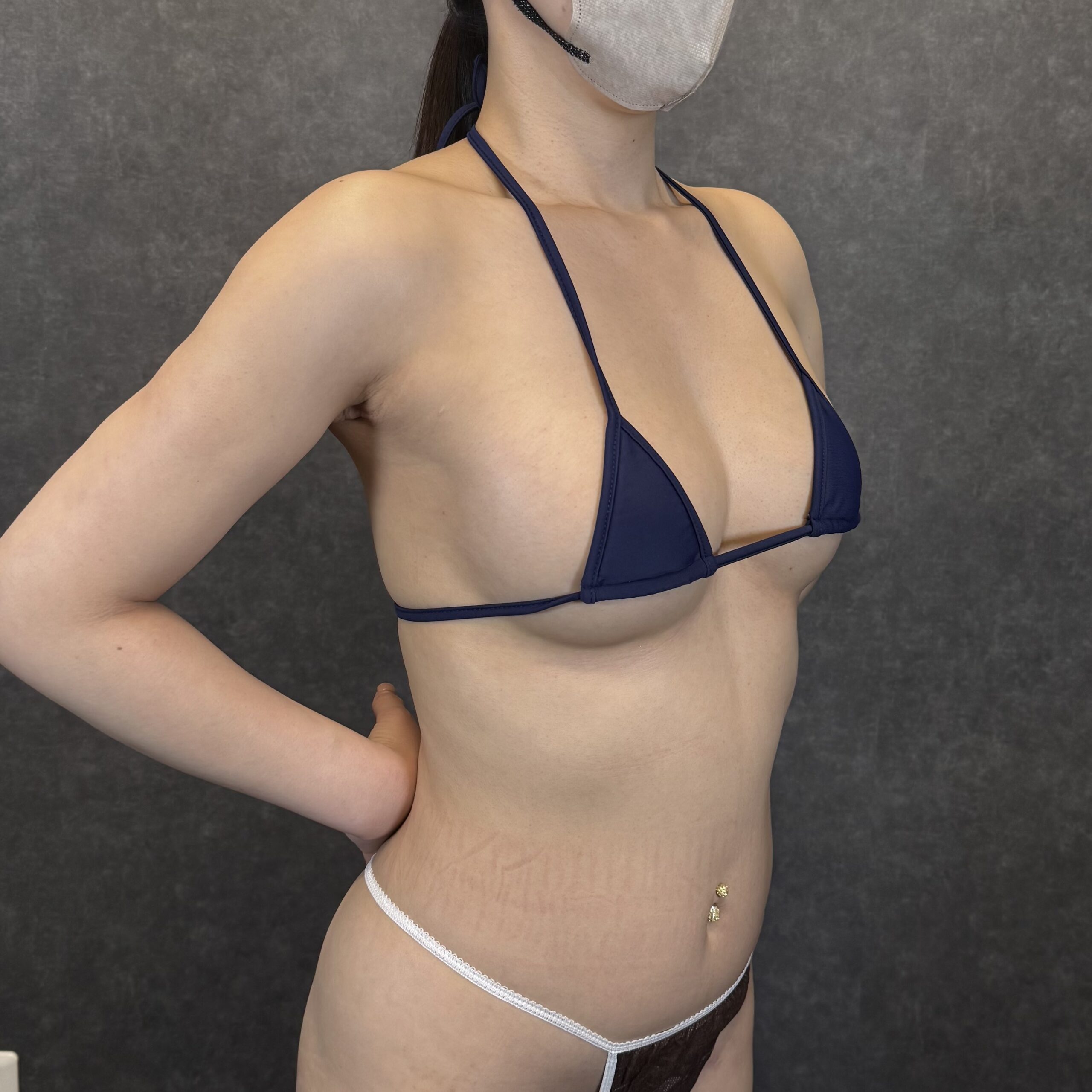
She mentioned that she gained about 2–3 kg, but noticed that the weight gain tended to go more to her breasts than to other areas.
Case overview
| Procedure | Fat grafting breast augmentation |
|---|---|
| Sessions | 1 session |
| Cost | ¥1,500,000 (price at the time of treatment, monitor price) Price list |
| Main risks | swelling, bruising, pain, edema, skin irregularities, asymmetry, scars, prolonged swelling, lumps, calcification, etc. (see details below) |
| Doctor | Dr. Shin Moriwaki (Director) |
We injected 270 cc on the right and 310 cc on the left.
At 6 months, ultrasound examination shows no lumps, and her progress is excellent.
One of the advantages of fat-graft breast augmentation is that when weight increases, fat may preferentially accumulate in the treated breast area compared to other body parts.
Risks: infection, lumps (fat necrosis), and variability in fat survival.
Surgeon: Dr. Shin Moriwaki (Director, AVAN TOKYO Ginza Liposuction Clinic)
Risks and side effects
Liposuction may cause swelling, bruising, pain, edema, skin irregularities or tightness, asymmetry, pigmentation, and scars at the small incision sites. Rarely, complications such as infection, hematoma, numbness, or reduced sensation may occur. On the upper arms, shoulders, and back, skin laxity, rippling, or a pulling sensation may occur. On the thighs, calves, and other lower-body areas, prolonged swelling, asymmetry, and reduced sensation may occur; the ankles and calves are particularly prone to swelling and pigmentation.
Fat grafting may cause calcification, lumps or cysts, individual variation in fat survival, asymmetry, and irregularities at the donor site.
These symptoms may occur during recovery and most improve over time, but their severity and the recovery period vary from person to person. If you have any concerns, please consult your doctor rather than judging for yourself.