


Hybrid Breast Augmentation Success Depends on Both Surgery and Recovery2026.06.20
Why Surgical Technique and Postoperative Care Matter Equally
Hybrid Breast Augmentation combines silicone implants and fat grafting to achieve both volume enhancement and a natural appearance.
More patients are choosing this procedure because they want:
● Noticeable breast enlargement
● Natural cleavage and upper pole fullness
● Softer breast contours
● Reduced implant visibility
However, the final result is not determined by surgery alone.
At AVAN TOKYO, we believe that the best outcomes come from the combination of:
Excellent surgical technique + Proper postoperative care
What We Focus on During Surgery
Every patient has different anatomy, including:
● Chest wall shape
● Existing breast tissue volume
● Skin thickness
● Body proportions
● Desired breast shape
For this reason, treatment plans are customized individually.
Choosing the Right Implant Size
Larger is not always better.
An implant that is too large may appear unnatural, while one that is too small may not achieve the desired enhancement.
The ideal implant size depends on each patient’s body frame and goals.
Strategic Fat Grafting
Fat grafting is not simply about adding volume.
The placement of the fat is equally important.
Common target areas include:
● Décolletage
● Cleavage
● Outer breast contour
● Lower breast pole
At AVAN TOKYO, fat is distributed into multiple tissue layers to maximize survival and create a natural shape.
Fat Survival Is More Important Than Fat Volume
In fat transfer breast augmentation, not all transferred fat survives.
Newly grafted fat cells require the formation of new blood vessels.
Without adequate blood supply, some of the fat will be absorbed by the body.
Therefore, the key question is not:
“How much fat was injected?”
but rather:
“How much fat survived?”
Recovery Plays a Major Role
Many patients underestimate the importance of postoperative care.
The first 4–6 weeks after surgery are critical.
During this period, transplanted fat cells are attempting to establish a new blood supply.
Proper nutrition and recovery habits can significantly influence fat retention.
Case Study
The patient featured here is a 19-year-old woman who underwent Hybrid Breast Augmentation.
She was highly committed to her recovery process.
Whenever she felt her breast volume had slightly decreased, she adjusted her nutrition accordingly and increased her soy milk and protein intake.
Her dedication to postoperative care contributed significantly to her recovery.
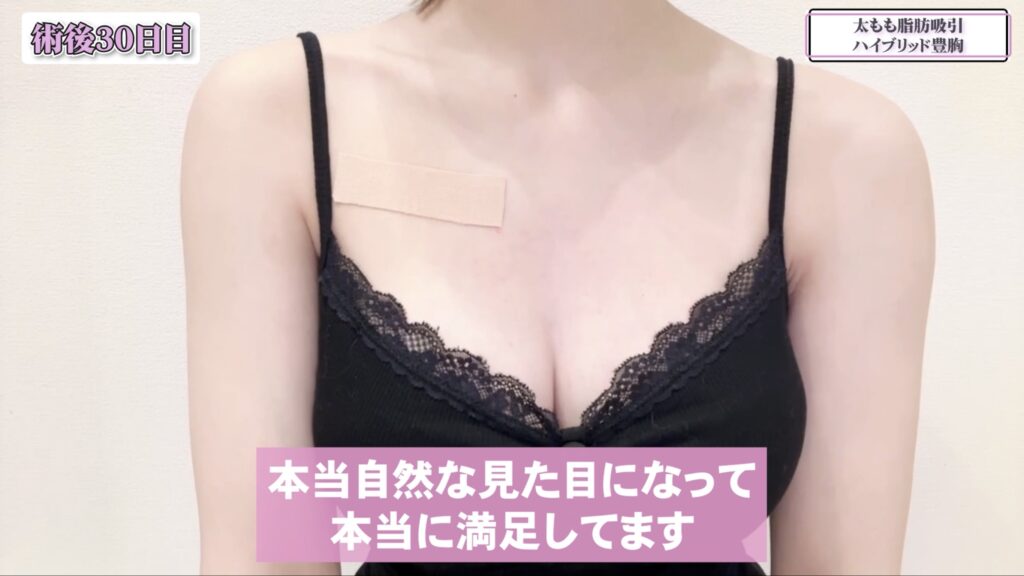
Natural Changes Are Already Visible at One Month
At one month, some firmness and swelling are still expected.
However, the breast contour is already becoming more natural.
As the fat graft integrates and the tissues soften, the breasts continue to improve over the following months.
Most patients notice further refinement between 3 and 6 months after surgery.
The AVAN TOKYO Philosophy
We do not view breast augmentation as simply making breasts larger.
Our goal is to create:
● Long-term fat retention
● Natural cleavage
● Smooth décolletage contours
● Soft breast texture
● Balanced body proportions
For this reason, we emphasize both surgical precision and recovery support.
The Most Important Message
Success in Hybrid Breast Augmentation requires more than a successful operation.
It requires commitment during recovery as well.
Great surgery and great postoperative care together create the best results.
Risks and Complications
Silicone Implants:
Infection, capsular contracture, asymmetry, implant malposition, scarring.
Fat Grafting:
Infection, lumps, fat necrosis, calcification, asymmetry, fat absorption, and scarring.