


Can Upper Arms Be Slimmed Down Even with a BMI Under 18? The Importance of Indications and Design in “Ultra-Slim Liposuction”2026.08.04
For Those Who Were Told “You Can’t Get Any Slimmer” Due to a BMI Under 18
“I was told that because I’m naturally lean, liposuction wouldn’t make much of a difference.”
We frequently hear this concern from our patients.
It is true that for patients with a BMI under 18, the amount of subcutaneous fat is minimal, making it difficult to achieve dramatic changes using conventional liposuction techniques. However, being lean does not mean liposuction is impossible.
The key lies in evaluating the anatomically necessary layer of fat to leave behind while precisely designing the ideal silhouette.
Case Presentation
Secondary Revision Upper Arm Liposuction & Hybrid Breast Augmentation
Postoperative Recovery: 6 Months
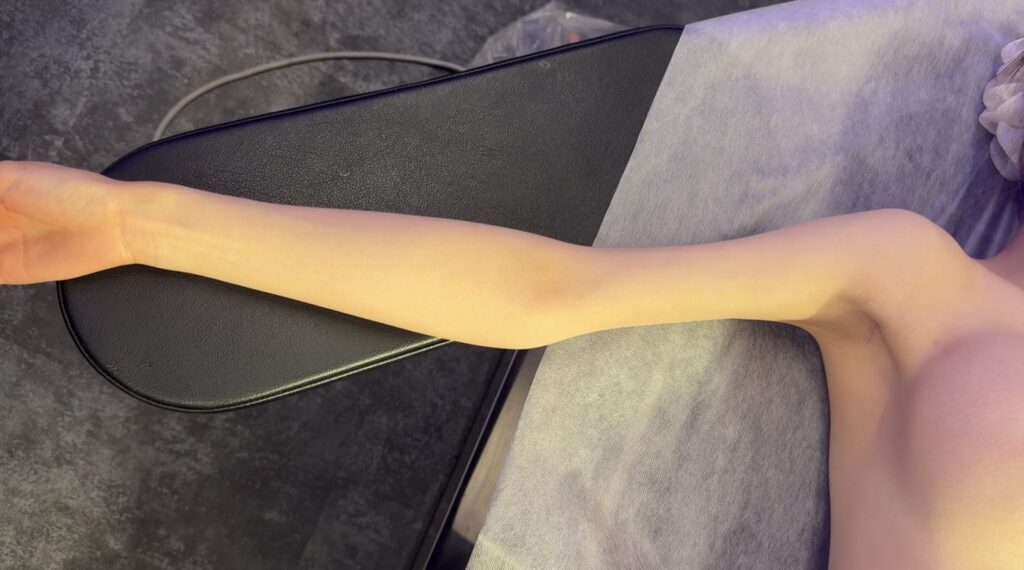
Although the patient was naturally slim, we executed a meticulous design focusing on:
The contour from the upper arm to the shoulder
The lateral profile thickness
The natural silhouette when arms are resting at the side
The objective was not simply to aspirate maximum fat, but to prioritize “where to leave fat and where to reduce it.”
Is “Ultra-Slim Liposuction” Really Dangerous?
Opinions often circulate claiming:
“Ultra-slim liposuction is dangerous.”
“It is better to leave more fat behind.”
However, this debate lacks an essential perspective: “Who is the patient?”
For instance, in patients who:
Are slender with a BMI under 18
Maintain good skin elasticity and turgor
Present good muscular and skeletal harmony
The appropriate design strategy differs fundamentally from that of average candidates.
Rather than applying a single uniform protocol to every patient, it is critical to evaluate individual body composition, skin quality, and layer thickness before deciding on surgical indications.
Why “Leaving Fat Behind” Is Critical
In liposuction, aspirating the maximum possible volume does not equate to achieving the best aesthetic outcome.
Directly beneath the skin lies the superficial subcutaneous fat layer, which plays a vital role in:
Maintaining a smooth skin surface
Ensuring a soft, natural tactile feel
Preserving superficial tissue vascularity
Preventing surface irregularities and contour deformities
Excessive aspiration of this superficial layer can result in:
Contour irregularities and dimpling
Dermal-fascial adhesions
Surface asymmetry
An unnatural, rigid texture
Therefore, at AVAN TOKYO, determining “how much to safely preserve” is considered just as crucial as “how much to aspirate.”
Utilizing Real-Time Ultrasound for Fat Thickness Verification
In recent years, ultrasound-assisted liposuction has gained popularity internationally.
By utilizing high-resolution ultrasound during the procedure, we can monitor:
Subcutaneous fat layer thickness
Precise cannula positioning
The status of the remaining fat layer in real time
At AVAN TOKYO, we incorporate ultrasound imaging according to case requirements to map and design while constantly verifying fat layer thickness.
Particularly in slender patients, maintaining precise awareness of the residual fat thickness ensures long-term natural softness and a smooth aesthetic result.
Designing Beyond the Arms: Integrating Shoulders, Decolletage, and Bust
At AVAN TOKYO, our objective extends beyond simply slimming the upper arms.
A truly elegant arm requires a continuous, harmonious flow across the:
Shoulders
Delta area (perideltoid region)
Decolletage
Bust
Upper back
For this reason, combining the procedure with Hybrid Breast Augmentation when requested allows us to create a natural, attractive contrast with the refined arms. We design from the perspective of “balancing the entire upper body silhouette,” not just treating an isolated area.
The AVAN TOKYO Philosophy
We do not measure success by “how many ccs of fat were aspirated.”
What truly matters is:
What overall body line we are aiming to create
Whether that contour can be safely and reproducibly achieved
Whether a soft, natural skin texture can be maintained over the long term
Because every patient’s ideal silhouette is unique, we perform a thorough evaluation of body type, skin elasticity, and fat thickness to propose a tailored design for each individual.
Surgeon’s Note
The slimmest patients require the highest degree of design precision—even the slightest variation significantly impacts the final outcome.
Thus, the core principle is not “aspirating to the absolute limit,” but determining “how slim we can safely refine the contour.”
By incorporating global clinical insights, detailed anatomy, and ultrasound evaluation, I continuously pursue surgical protocols with maximum consistency and safety.
Every patient has a different vision of their ideal body line. Bringing that vision to life while balancing it with strict surgical safety is the true responsibility of an aesthetic surgeon.
Risks and Side Effects
Liposuction carries potential risks and side effects, including:
Swelling
Ecchymosis (bruising)
Edema
Tissue Induration (firmness during healing)
Asymmetry
Surface irregularities or dimpling
Hyperpigmentation
Sensory changes (such as transient numbness)
Infection
Hematoma
Seroma
Skin laxity
Potential need for revision procedures
Indications vary depending on individual body composition and skin condition.
Postoperative Guidelines
Final results mature over several months following surgery. To achieve optimal results, it is important to:
Wear compression garments strictly as instructed
Introduce light stretching and mild mobility exercises at the appropriate time
Attend all scheduled postoperative follow-up appointments
Maintain stable weight management
Long-term satisfaction in upper arm liposuction depends not on “how much fat was removed,” but on “how beautifully the line was designed.”
Achieving your ideal silhouette requires a precise assessment of your skeletal frame, skin quality, and fat distribution to execute a personalized surgical plan.