


Hybrid Breast Augmentation: Why the Fat Injection Layer Matters2026.09.10
In breast augmentation, the final result is not determined simply by how many cc of fat or what size implant is used.
One of the key factors is where and how the fat is injected.
At AVAN TOKYO, we carefully consider the anatomical layer, tissue thickness, breast shape, and desired volume when performing fat grafting or hybrid breast augmentation.
By strategically combining a silicone implant with fat grafting into appropriate tissue layers, we aim to achieve both predictable volume and a naturally refined breast shape.
Where Does Fat Tend to Survive Best After Fat Grafting?
For successful fat grafting, transplanted fat cells need to receive an adequate blood supply from the surrounding tissue.
This is why fat should not simply be injected as a large volume into one area. Instead, it is generally distributed in small amounts across multiple planes and locations.
At AVAN TOKYO, we commonly utilize the subcutaneous layer and areas around or within the pectoralis major muscle, depending on each patient’s anatomy.
These layers can provide an appropriate environment for fat graft survival when fat is carefully and evenly distributed.
Different anatomical layers can also be used for different purposes:
Subcutaneous tissue and pectoralis major region:
Useful for distributing fat and refining breast contours while providing additional soft-tissue coverage.
Subglandular region:
Useful when creating or refining the overall roundness and shape of the breast.
The exact injection planes and volumes are individually determined based on anatomy, tissue thickness, and safety.
What Is Hybrid Breast Augmentation?
Hybrid breast augmentation combines silicone breast implants with autologous fat grafting.
Silicone implants are highly effective for creating a relatively predictable increase in breast volume.
Fat grafting, on the other hand, allows the surgeon to make more subtle adjustments to areas that may be difficult to refine with an implant alone.
In simple terms:
The implant creates the main breast volume, while fat grafting fine-tunes the shape and contour.
This approach can be particularly useful for slim patients.
When a patient has very little subcutaneous tissue, the edges or contour of an implant may sometimes become more noticeable. Strategically placed fat grafting can provide additional soft-tissue coverage and help create a smoother transition between the implant and surrounding tissues.
Case Study: 6 Months After 360° Arm and Accessory Breast Liposuction + Hybrid Breast Augmentation
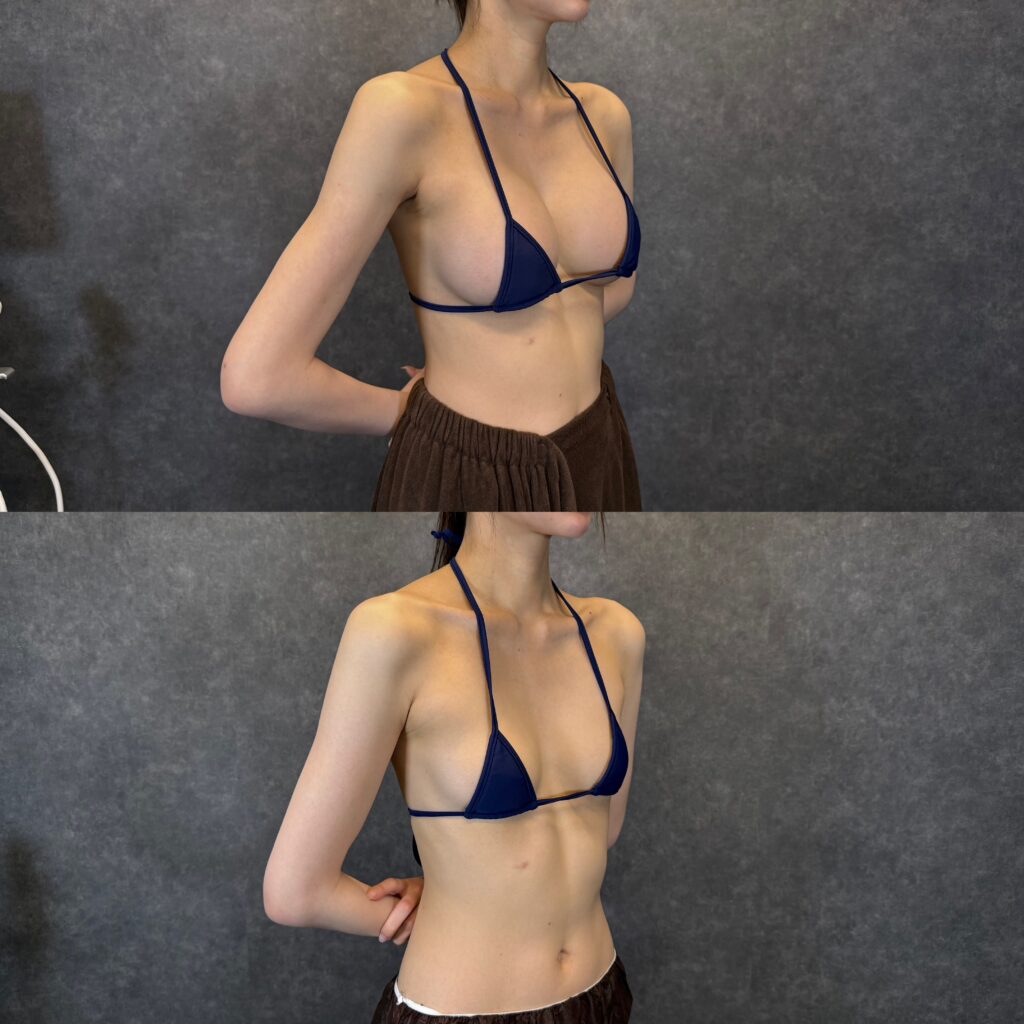
This patient underwent:
360° upper-arm liposuction
● accessory breast/axillary fat liposuction
● hybrid breast augmentation
The postoperative follow-up shown is at 6 months.
For breast augmentation, we used:
Motiva Ergonomix2 Mini 275cc implants
placed in the subglandular plane.
Fat grafting was also performed:
Right breast: 150cc
Left breast: 95cc
with the fat primarily distributed within the subcutaneous and pectoralis major regions, according to the patient’s anatomy and breast shape.
At 6 months, some reduction in the volume of the grafted subcutaneous fat can be observed, as not all transferred fat permanently survives.
However, the overall breast volume and shape remain well maintained.
This illustrates one of the advantages of hybrid breast augmentation: the implant provides the foundation for breast volume, while carefully planned fat grafting helps refine the surrounding contours.
Why Combine Upper-Arm and Accessory Breast Liposuction With Breast Augmentation?
At AVAN TOKYO, we do not evaluate the breasts in isolation.
We consider the entire upper-body silhouette.
Even when breast volume is increased, excess fullness around the upper arms, axilla, or accessory breast area can sometimes make the upper body appear heavier.
By combining:
360° upper-arm liposuction
● accessory breast liposuction
● hybrid breast augmentation
we can approach the body from two directions:
Remove volume where it is unnecessary and add volume where it enhances the silhouette.
Reducing excess fat around the upper arms and underarm area can also create a smoother transition from the arms to the chest and make the breast contour appear more defined.
When appropriate, fat obtained during liposuction can also be processed and used for breast fat grafting.
Is Hybrid Breast Augmentation Suitable for Slim Patients?
In many cases, yes.
For very slim patients, however, the amount of fat available for harvesting may be limited.
Fat grafting alone may therefore not provide enough volume for patients seeking a significant increase in breast size.
In these cases, hybrid breast augmentation can be particularly useful.
A silicone implant can provide the primary breast volume, while the available fat can be strategically used to refine the breast contour and improve soft-tissue coverage.
At AVAN TOKYO, we assess potential donor areas such as the:
● Upper arms
● Accessory breast/axillary area
● Abdomen
● Waist
● Back
● Thighs
to determine how much usable fat can safely be harvested.
Hybrid Breast Augmentation Is About More Than Implant Size
We are often asked:
“What implant size will give me my ideal breasts?”
However, the same 275cc implant can produce very different results depending on the patient’s anatomy.
Important factors include:
● Chest width
● Existing breast volume
● Subcutaneous tissue thickness
● Position of the inframammary fold
● Upper-pole and décolletage thickness
● Breast asymmetry
● Implant profile and projection
● Implant placement
● Fat injection volume
● Fat injection location
For this reason, AVAN TOKYO does not design breast augmentation based solely on implant volume.
We consider how the implant and transplanted fat should be positioned together to create the most balanced result for each patient’s body.
Frequently Asked Questions
What is the difference between fat transfer breast augmentation and hybrid breast augmentation?
Fat transfer breast augmentation primarily uses the patient’s own harvested fat to increase breast volume.
Hybrid breast augmentation combines a silicone implant with fat grafting.
The implant provides predictable volume, while fat grafting can be used to refine the contour, improve soft-tissue coverage, address asymmetry, and create smoother transitions around the breast.
Does all injected fat survive permanently?
No.
Not all transplanted fat will permanently survive.
Some of the injected fat is naturally absorbed during the postoperative healing process, and the final breast volume gradually stabilizes over time.
This is why AVAN TOKYO emphasizes careful distribution of fat according to the condition of the surrounding tissues rather than simply injecting the largest possible volume.
Can liposuction and breast augmentation be performed at the same time?
Depending on the patient’s general condition, treatment areas, amount of fat to be harvested, and surgical plan, simultaneous treatment may be possible.
Combining upper-arm or accessory breast liposuction with breast augmentation allows us to design not only the breasts themselves but also the overall upper-body silhouette.
How long does it take for hybrid breast augmentation to look natural?
Initial swelling and firmness gradually improve after surgery.
Over the following months, the implant position, breast shape, and tissue softness continue to settle.
The exact recovery process varies between patients, which is why regular postoperative follow-up is important.
AVAN TOKYO’s Approach: Breast Augmentation Is Not Simply About Making the Breasts Larger
Successful breast augmentation is not simply about maximizing breast size.
We consider:
the upper arms, shoulders, axillary area, chest wall, breasts, and waist together as one continuous body contour.
At AVAN TOKYO, we specialize in combining liposuction and breast augmentation to create a more balanced upper-body silhouette.
With hybrid breast augmentation, we utilize the different advantages of:
Silicone implants for predictable volume
+
Fat grafting for detailed contour refinement
to pursue both breast size and breast shape with greater reproducibility.
For patients considering liposuction and breast augmentation together, slim patients concerned about whether fat transfer alone can provide sufficient volume, or patients worried that implants alone may look unnatural, we provide individualized surgical planning based on their anatomy and desired result.
Implant type, implant size, fat donor areas, fat graft volume, and injection planes are all carefully planned for each patient.
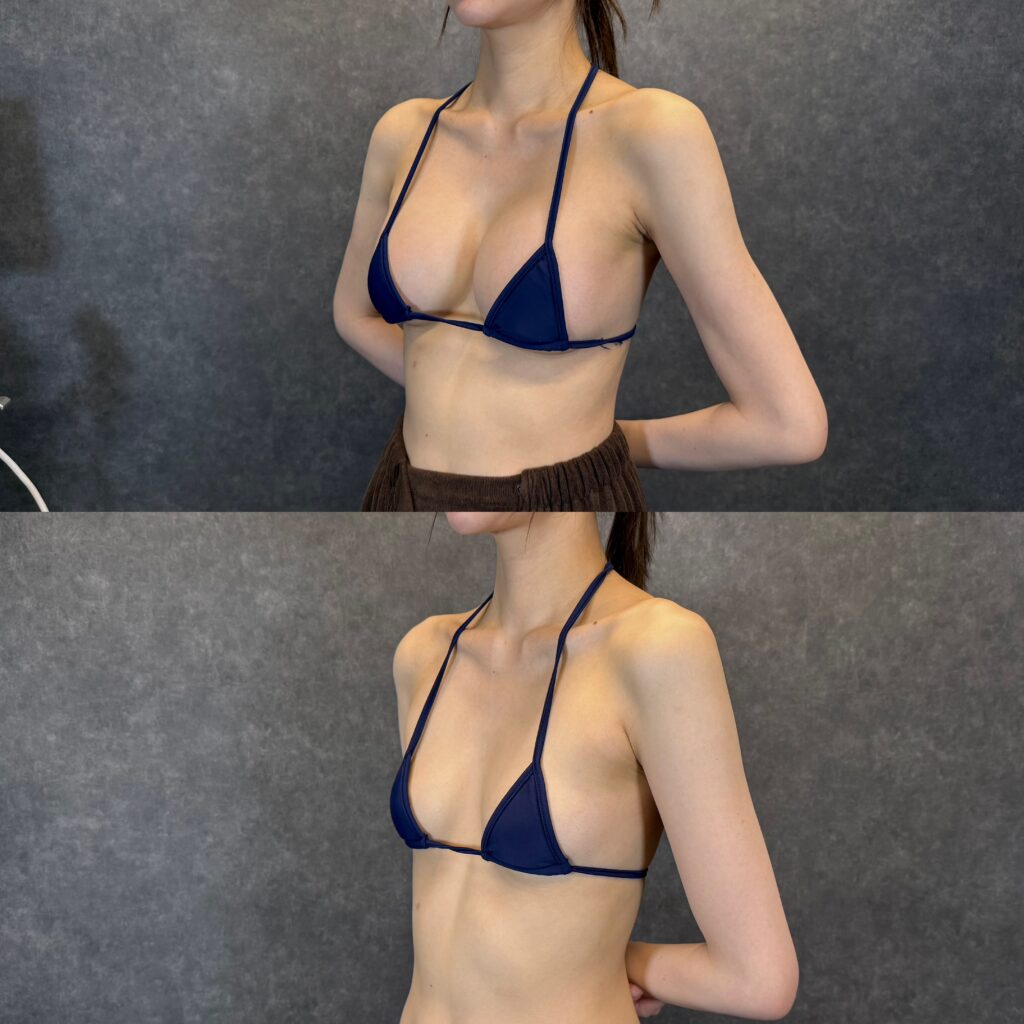
Procedures: 360° Upper-Arm Liposuction, Accessory Breast Liposuction, Hybrid Breast Augmentation
Implant: Motiva Ergonomix2 Mini 275cc
Implant Placement: Subglandular
Fat Grafting: Right 150cc / Left 95cc
Follow-up: 6 Months
Potential Risks and Complications
Liposuction may involve swelling, bruising, pain, contour irregularities, asymmetry, postoperative fibrosis/induration, pigmentation changes, and scarring.
Fat grafting to the breasts may involve fat absorption, fat necrosis, lumps, calcification, infection, asymmetry, and other complications.
Silicone breast implants may involve infection, hematoma, seroma, asymmetry, capsular contracture, implant malposition, rupture, rippling, and scarring.
Results, fat graft survival, and recovery periods vary between individuals.