


Thigh Contour Irregularities After Liposuction Elsewhere | Why Too-Shallow Suction Damages the Subdermal Layer — Explained by a Doctor2026.07.16
Patients often come to us worried about lingering step-offs, wavy grooves, or line-shaped depressions on the outer or front thigh after undergoing liposuction at another clinic. Unlike temporary firmness during the healing period, irregularities that persist beyond six to twelve months are usually not caused by leftover fat. In most cases they stem from damage to the subdermal layer caused by suction performed too superficially. In this column, Dr. Shin Moriwaki of AVAN TOKYO Ginza Liposuction Clinic explains, from the perspective of thigh liposuction revision, what happens just beneath the dermis, why revision surgery is so difficult, and how remaining contour irregularities should be approached.
Key Points of This Article
– The biggest reason thigh liposuction revision is difficult is that irreversible scarring and adhesions have already formed in the superficial subcutaneous layer
– Contour irregularities are usually caused not by leftover fat, but by aggressive suction 1–3 mm beneath the dermis, which destroys the vascular network and gliding space
– Revision focuses less on removing more fat and more on smoothing the surface using the healthy fat that remains
– Line-shaped depressions visible under angled light are often due to skin tethering by scar tissue
– Device choice and layered design during the first surgery greatly influence how manageable a future thigh liposuction revision will be
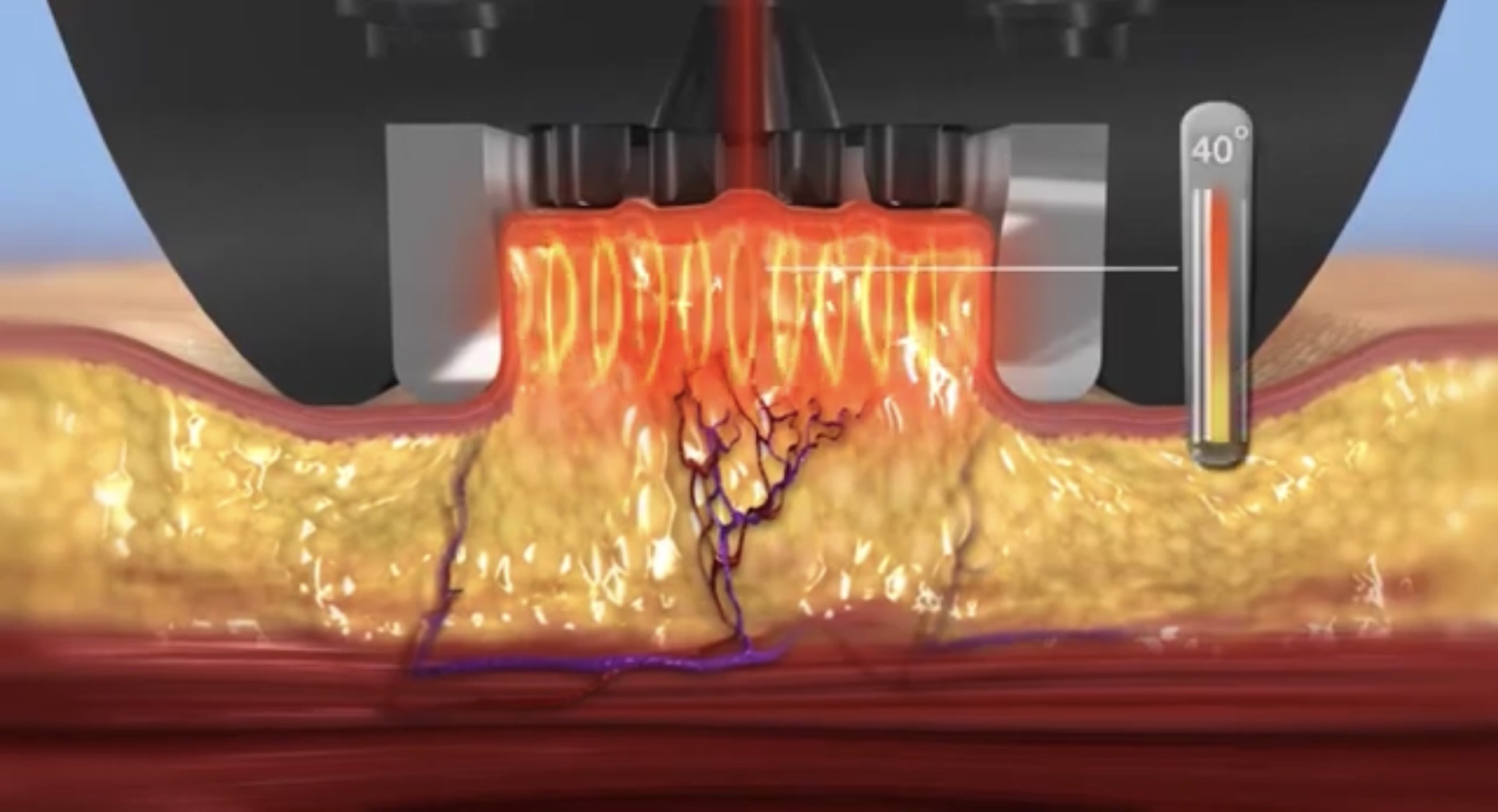
The True Nature of “Persistent Step-Offs” — The Most Common Revision Consultation
The thigh is one of the largest curved convex surfaces on the body. The front (over the quadriceps), outer side (greater trochanter to above the knee), inner side (over the adductors), and back (over the hamstrings) each have different subcutaneous fat thickness and fibrous architecture. When uniform shallow suction is applied across all zones, angled light exposes step-offs, linear shadows, and rippling.
Many patients believe the cause is leftover fat and request more suction. However, ultrasound often shows very little remaining fat and clear scar tissue with adhesion bands just beneath the dermis. Adding more suction in this state causes the skin to sink further into the damaged layer and makes the irregularity worse. Thigh liposuction revision therefore begins with correcting this common misconception.
Three Types of Damage Caused by Too-Shallow Suction
1. Disruption of the Subdermal Plexus
The subdermal vascular plexus that nourishes the skin runs densely 1–3 mm beneath the dermis. Repeated cannula passes in this layer rupture the fine vessels, causing local ischemia and excessive scar formation. Because scar tissue naturally contracts, it pulls the skin inward, appearing on the surface as linear grooves.
2. Loss of the Gliding Plane
Normally, a loose connective-tissue layer between the skin and subcutaneous fat allows the skin to slide smoothly. When this layer is destroyed, the skin adheres to underlying scar tissue and gets pulled in one direction during movement, producing visible irregularity. This tethering phenomenon is the most stubborn issue we treat in thigh liposuction revision.
3. Damage to the Retinacula Cutis
The fibrous septa connecting skin to fascia normally support the skin structurally. Excessive superficial suction ruptures these fibers, and the skin sags locally under gravity, creating drooping irregularities frequently seen on the outer and back of the thigh.
Why Thigh Liposuction Revision Is Harder Than Other Areas
The thigh is a large area constantly subjected to gravity and muscular movement from walking. On the front and inner thigh, where skin is thin and highly mobile, initial damage tends to translate directly into the final result. In addition,
– When scarring covers a wide area, there is little fat left to remove with additional suction
– Fat grafting to fill defects is limited by poor blood supply within scar tissue, which lowers graft survival
– Revision requiring skin undermining carries risks of visible scars and re-scarring
These factors combine to make thigh liposuction revision considerably more complex than the primary surgery. That is why the revision strategy should not be “suction again” but rather “use the healthy fat that remains to smooth the surface.”
Our Approach to Thigh Liposuction Revision at AVAN TOKYO
At the first consultation we carefully evaluate the subcutaneous layer with ultrasound. We map the extent of scarring, the distribution of remaining fat, and the areas of reduced skin mobility, and then combine the following three techniques.
1. Layered Re-Suction to Smooth the Surface
Fine-diameter cannulas are used in the middle and deep layers of the “elevated side” of the step-off to gently level the surrounding surface. We do not touch the subdermal layer.
2. Subcision to Release Tethering
If a depression is judged to be caused by skin tethering, a dedicated blunt needle is used to mechanically release only the subcutaneous adhesion bands. This restores skin glide and softens the linear shadows.
3. Micro Fat Grafting to Fill Depressions
Where needed, fat harvested from well-vascularized donor sites such as the abdomen or waist is injected in tiny amounts across multiple layers. Because graft survival is lower in scar tissue, we plan on multiple sessions from the outset.
Timing: Wait for Scar Maturation Before Revision
As a rule, thigh liposuction revision should be performed at least 6 to 12 months after the initial surgery, once scar tissue has matured. During the immature scar phase (3–6 months postoperatively) tissues are still firm and unstable, and any revision will tend to re-adhere. Physiologically, immature Type III collagen must be replaced by mature Type I collagen and the fiber alignment must stabilize, which takes time. Waiting patiently is the shortest route to a good final result.
How to Prevent Too-Shallow Suction in the First Surgery
The single most important factor for avoiding contour irregularity is not revision technique, but layered design during the first surgery. Preserve roughly 1 cm just beneath the dermis, remove volume in the middle and deep layers using layered technique, choose cannula diameter by anatomical zone, and avoid the overly “crisp” over-suction that some patients request. Following these fundamentals dramatically reduces the future risk of needing thigh liposuction revision. For guidance on aesthetic surgery safety standards, please refer to the Japan Society of Aesthetic Surgery (JSAS). See our column archive on liposuction here for related topics.
Frequently Asked Questions
Q. Will revision surgery always eliminate step-offs left by another clinic?
We cannot guarantee a completely flat result. When irreversible scarring exists beneath the dermis, the goal of thigh liposuction revision is to make step-offs less noticeable, not necessarily invisible. Individual differences in this area are significant.
Q. When can I undergo thigh liposuction revision?
Ideally at least 6 months after the initial surgery, and preferably after 12 months. Operating on immature scar tissue risks re-adhesion and worsened irregularity.
Q. My revision plan includes fat grafting. Will it take?
Blood supply within scar tissue is limited, so graft survival is lower than in healthy tissue. Planning multiple sessions of small-volume grafting yields more reliable, stable volume improvement over time.
Q. Will scars from revision surgery be visible?
Suction ports are only a few millimeters and, on the thigh, are placed inside the bikini line, behind the knee, or in other hidden locations. Revision may require additional ports different from the original.
Q. Is there anything I can do myself to prevent irregularities?
After the initial surgery, wearing your compression garment as instructed and performing self-massage and warming care during the contracture phase can help prevent uneven fibrosis. However, once mature scarring has caused a step-off, self-care alone cannot correct it.
──────────────
[Medical Supervision] Shin Moriwaki, MD (Supervising Physician)
Member, Japan Society of Aesthetic Surgery (JSAS) / Member, American Academy of Aesthetic Medicine
ECFMG Certificate
──────────────
📍AVAN TOKYO GINZA LIPOSUCTION CLINIC
English / 中文 / Tiếng Việt available
Appointments and consultations are accepted via
DM / LINE / Website / Phone.