


Are Slim Smokers Suitable for Fat Grafting Breast Augmentation?2026.05.11
Why fat retention matters and how AVAN TOKYO determines the right indication
Fat grafting breast augmentation is a procedure that uses your own fat to enhance breast volume.
Fat is harvested from areas such as the thighs, arms, abdomen, or waist, and then injected into the breasts.
It is an attractive procedure because it can reduce unwanted fat while creating a natural breast enhancement.
It can offer:
- A soft and natural breast texture
- A subtle and less obvious result
- Body contouring and breast enhancement at the same time
- Breast volume using your own tissue
However, fat grafting breast augmentation is not a procedure that works equally well for everyone.
In particular, patients who are very slim and smoke need to be especially careful when considering this procedure.
At AVAN TOKYO, we do not recommend fat grafting breast augmentation based only on its appealing image.
We carefully evaluate whether the procedure is truly suitable for each patient.
The Most Important Factor in Fat Grafting Is Fat Retention
In fat grafting breast augmentation, the most important question is:
How much of the injected fat will remain?
Not all injected fat survives permanently.
Some fat is absorbed by the body, while some becomes retained in the breast tissue.
Therefore, the result is not determined only by how much fat is injected.
It is determined by how much fat survives and remains after healing.
Patients Who Tend to Have Lower Fat Retention
Fat retention varies significantly from person to person.
Patients with the following characteristics may have lower fat retention:
- BMI below 17
- Very slim body type
- Limited skin stretch
- Thin soft tissue
- Limited available fat for harvesting
- Smoking
- Frequent exposure to secondhand smoke
- Poor diet
- Frequent junk food intake
- Low food intake
- Tendency to lose weight after surgery
- Excessive dieting
When several of these factors are present, the result of fat grafting breast augmentation can become less predictable.
In particular, the combination of being very slim, smoking, and poor nutrition can make it difficult to achieve sufficient breast enlargement with fat grafting alone.
Smoking Is Highly Incompatible with Fat Grafting
Smoking is one of the biggest negative factors for fat grafting breast augmentation.
For grafted fat to survive, new blood flow must develop into the injected fat and connect with the surrounding tissue.
Smoking worsens blood circulation and reduces oxygen delivery to the tissue.
This can make it more difficult for the injected fat to survive.
In other words, smoking creates an unfavorable environment for a procedure that depends heavily on blood supply.
Smoking may also increase the risk of:
- Infection
- Delayed wound healing
- Poor scars
- Skin problems
- Lower fat retention
For this reason, AVAN TOKYO strongly recommends smoking cessation for patients considering fat grafting or hybrid breast augmentation.
Why Fat Grafting Can Be Difficult in Very Slim Patients
Very slim patients can face several challenges with fat grafting breast augmentation.
First, the amount of fat available for harvesting may be limited.
Because the procedure uses the patient’s own fat, patients with low BMI and minimal subcutaneous fat may not have enough donor fat.
Second, slim patients often have thinner skin and soft tissue, and the skin may not stretch easily.
If too much fat is forced into a tight space, the injected fat may not receive enough blood supply.
This can increase the risk of:
- Lump formation
- Fat necrosis
- Poor fat retention
- Unnatural firmness
Fat grafting is not about injecting as much fat as possible.
It is about injecting the appropriate amount into the right layers under the right conditions.
Diet and Nutrition Also Affect Fat Retention
After fat grafting breast augmentation, nutrition is extremely important.
The body needs adequate nutrients to recover and to support the formation of new blood supply around the grafted fat.
Patients who eat too little, frequently consume junk food, follow extreme diets, or lose weight after surgery may have lower fat retention.
After fat grafting, the following should be avoided:
- Medical weight-loss drugs soon after surgery
- Excessive dieting
- Significant weight loss
- Poor nutritional intake
- Excessive exercise too early
If body weight decreases after fat grafting, the fat transferred to the breasts may also decrease.
Fat grafting breast augmentation should not be followed by aggressive dieting.
To maintain the result, weight stability and proper nutrition are essential.
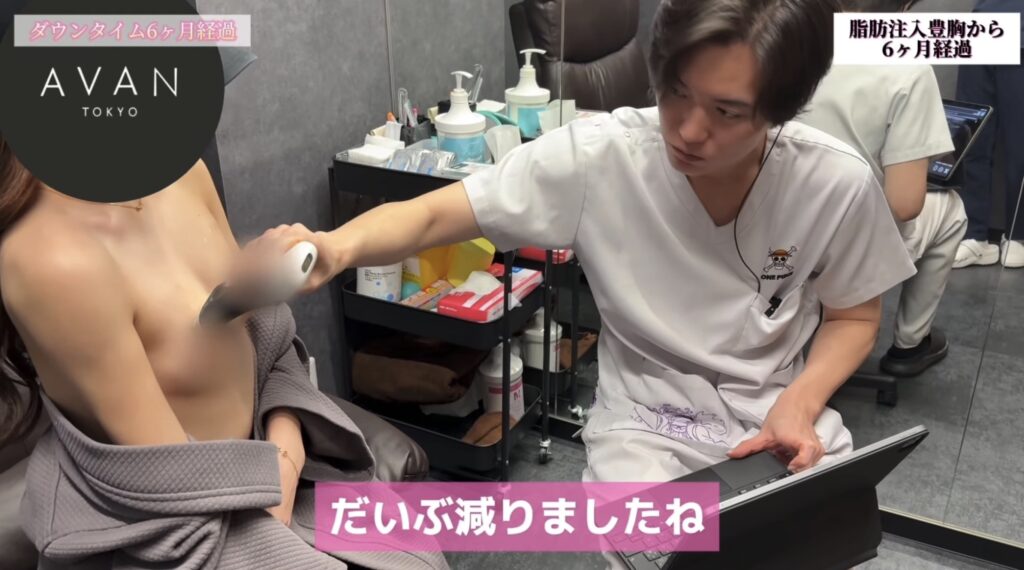
Case Example: 19-Year-Old Female, Arm Liposuction and First Fat Grafting Breast Augmentation
This case involved a 19-year-old female patient who underwent arm liposuction and her first fat grafting breast augmentation.
At 6 months post-operatively, ultrasound examination showed no obvious lumps.
This is a favorable finding from a safety perspective.
However, a significant amount of the injected fat had been absorbed.
This demonstrates one of the main difficulties of fat grafting breast augmentation.
Even when the recovery is safe and there are no lumps, the injected fat may not remain as much as expected.
This is why fat grafting requires realistic expectations and careful planning.
Fat Grafting Is Not a Magical Procedure
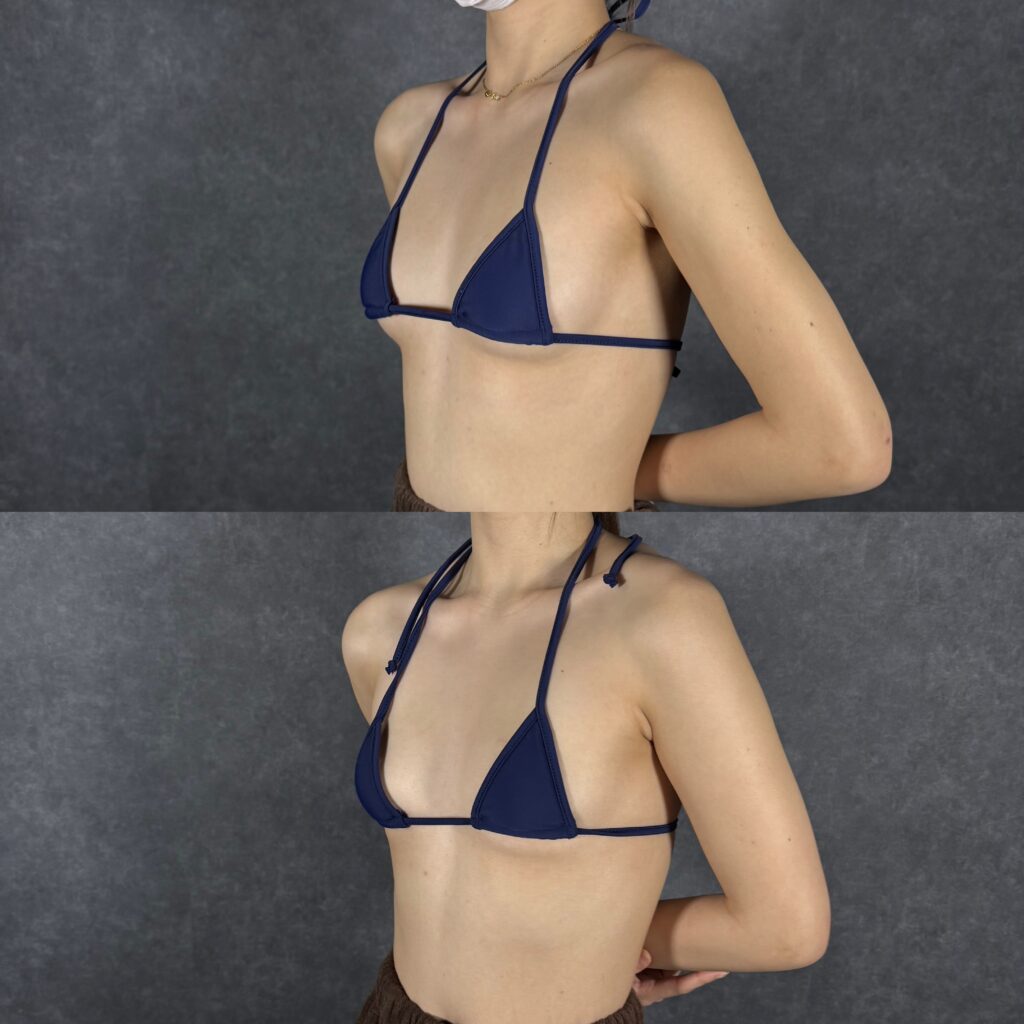
Fat grafting breast augmentation is a good procedure for patients who want a natural and soft breast enhancement.
However, it is not magic.
For patients who are:
- Very slim
- Smokers
- Poorly nourished
- Likely to lose weight after surgery
- Limited in skin stretch
fat retention may be unstable, and the result may be less dramatic than expected.
If a patient wants to increase breast size using fat grafting alone, it is important not to expect completion in one session.
A safer approach is often:
Inject an appropriate amount
Evaluate how much fat remains
Consider a second session if needed
This approach helps balance naturalness, safety, and long-term satisfaction.
For Patients Who Want More Volume in One Surgery, Hybrid Breast Augmentation May Be Better
If fat grafting alone is unlikely to achieve the desired volume, hybrid breast augmentation may be more suitable.
Hybrid breast augmentation combines silicone implants with fat grafting.
The implant creates the foundation of volume, while fat grafting softens the implant contour and improves the cleavage, décolletage, midline, and outer breast line.
For slim patients who want:
- A more reliable increase in size
- More forward projection
- A natural appearance
- Less visible implant contour
- Better upper body balance
hybrid breast augmentation can be an excellent option.
At AVAN TOKYO, we do not insist on fat grafting alone.
We recommend the best method based on the patient’s goals and body condition.
What AVAN TOKYO Values
At AVAN TOKYO, we do not recommend fat grafting breast augmentation casually.
It is an attractive procedure, but only when the indication is appropriate.
During consultation, we evaluate:
- BMI
- Skin elasticity
- Soft tissue thickness
- Breast tissue volume
- Available donor fat
- Smoking status
- Diet and lifestyle
- Ability to maintain weight after surgery
- Desired breast size
- Whether one surgery is enough or multiple sessions may be needed
Based on these factors, we determine whether fat grafting, hybrid breast augmentation, or implant breast augmentation is the best option.
Correct Procedure Selection Is Essential for Natural Results
Many patients choose fat grafting because they want a natural result.
They may want:
- Natural breast enhancement
- A subtle result
- Breast augmentation using their own fat
- A softer feel without obvious implant appearance
These are reasonable goals.
However, to achieve a natural and satisfying result, patients must also understand the limitations of fat grafting.
If naturalness is the priority, we should avoid excessive injection.
If size is the priority, hybrid breast augmentation may be more appropriate.
If fat grafting alone is chosen, multiple sessions may be necessary.
Smoking cessation, nutrition, and weight stability are also essential.
Final Message
Very slim patients who smoke may not be ideal candidates for fat grafting breast augmentation.
Fat grafting breast augmentation is an attractive procedure that can reduce unwanted fat and enhance the breasts naturally.
However, not all injected fat remains, and fat retention varies greatly between patients.
Patients with low BMI, limited skin stretch, smoking habits, poor diet, or post-operative weight loss may find it difficult to achieve sufficient volume in one session.
Fat grafting is not a magical procedure that guarantees natural enlargement.
It is a procedure strongly influenced by body condition and lifestyle.
At AVAN TOKYO, we carefully explain the benefits, risks, uncertainty of fat retention, and possibility of multiple sessions before proposing the most appropriate breast enhancement plan.
If you are unsure whether fat grafting, hybrid breast augmentation, or implant breast augmentation is suitable for you, please feel free to consult us.
AVAN TOKYO GINZA
AVAN TOKYO GINZA LIPOSUCTION CLINIC
We provide fat grafting breast augmentation, hybrid breast augmentation, and arm liposuction to create natural breast lines and refined upper body design.
International patients welcome.
English / 中文 / Tiếng Việt
Consultations are available via DM / LINE / Website / Phone.