


Why Is It Hard to Raise Your Arm After Arm Liposuction? Dr. Moriwaki Explains the Link Between Range of Motion and Fibrosis2026.08.07
In the first few weeks after arm liposuction, many patients notice that they cannot raise their arm above the horizontal line, that tying their hair feels tight, or that slipping an arm through a sleeve is surprisingly difficult. This is rarely a complication. In most cases it is a physiological response caused by subcutaneous inflammation and fibrosis, and can be understood as a temporary reduction in arm liposuction range of motion. Once you understand the underlying anatomy and the timeline, it becomes much clearer how far you can push daily movement and how to structure rehabilitation. In this article, Dr. Moriwaki of AVAN TOKYO GINZA LIPOSUCTION CLINIC explains why arm liposuction range of motion changes after surgery and how to recover ROM safely, drawing on orthopedic and rehabilitation medicine.
Key Points of This Article
・The reduction in arm liposuction range of motion is a physiological response involving three layers of tissue reaction — edema, inflammation, and fibrosis — that together disrupt scapulohumeral rhythm.
・Tightness during arm elevation and hair-tying peaks between postoperative days 3 and 7, and ROM gradually recovers over the fibrosis phase from one to three months.
・Overstretching in an attempt to force ROM recovery can cause hematoma, bruising, and contour irregularities; staged rehabilitation is the safer route.
・Sharp pain, sudden whole-arm swelling, numbness or weakness combined with restricted motion may indicate hematoma or nerve involvement and require prompt contact with the surgeon.
・Compression garments, moisturization, and light isometric exercises are the mainstays for restoring ROM most efficiently.
Three-Layer Shoulder Anatomy and Arm Liposuction Range of Motion
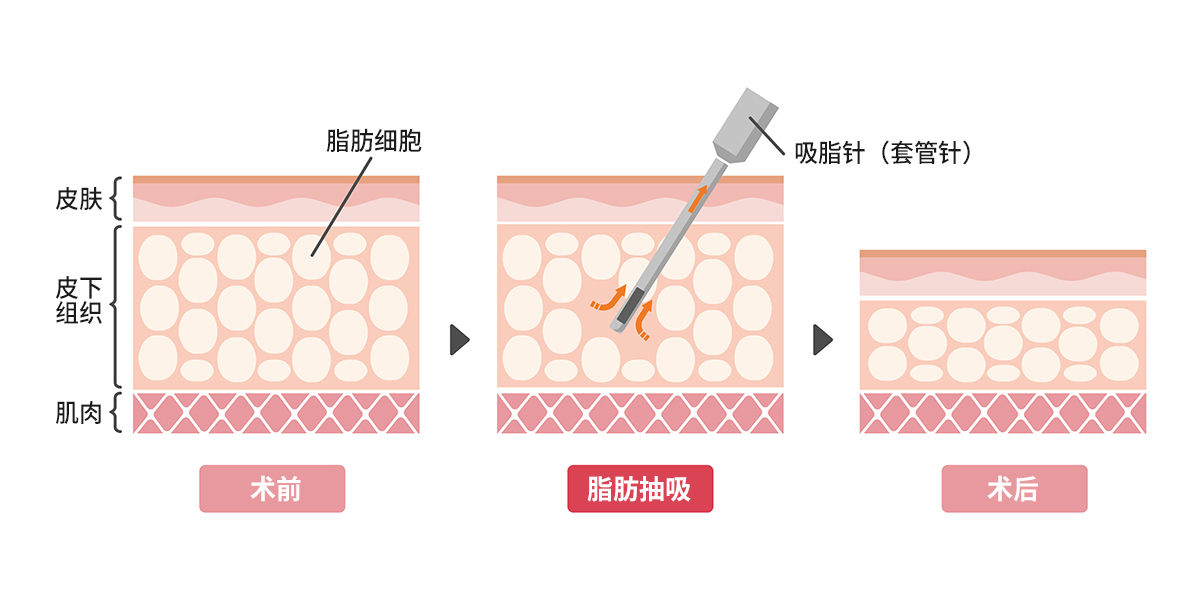
Shoulder elevation and external rotation rely on the coordinated motion of the glenohumeral, scapulothoracic, and clavicular joints, known collectively as scapulohumeral rhythm. Skin and subcutaneous fat wrap the outside of this system and glide together with tendons and fascia, allowing smooth arm elevation. In arm liposuction, cannulas mechanically dissect and remove tissue within this subcutaneous layer, so gliding between skin and fascia is temporarily reduced.
Subcutaneous fat behaves less like insulation and more like a bearing that allows skin to slide over deeper structures. When inflammatory edema and post-healing fibrosis are added on top, skin becomes temporarily adherent to fascia and bone, causing tightness during elevation and rotation. This is the anatomical basis for the early postoperative loss of ROM.
Changes in Range of Motion by Postoperative Phase
Immediately postop to 1 week: Inflammation phase
Inflammatory cytokines peak between 48 and 72 hours, and the entire subcutaneous layer swells. Raising the arm above 90 degrees, tying hair, and pulling a shirt over the head are the movements most likely to provoke tightness and dull pain. ROM in this window can drop to 40 to 60 percent of preoperative values, and forcing elevation tends to prolong bruising.
2 to 4 weeks: Entry into the fibrosis phase
As edema begins to resolve, fibroblasts become active and lay down collagen throughout the subcutaneous tissue. This temporarily binds skin to deeper layers, so patients often feel stiffness first thing in the morning or after long periods in one posture. ROM recovers to 60 to 80 percent, but daily variation is large and days that feel worse than the day before are common.
1 to 3 months: Fibrosis maturation
Collagen fibers realign, and a new gliding plane between skin and fascia is established. Combining gentle stretching with continued compression garment use during this phase brings arm liposuction range of motion back to preoperative levels or better, and the slender contour of the arm stabilizes.
The Medical Mechanism Behind Restricted Motion
Fibrosis is not simply muscle tightness. It is a temporary hardening of the entire connective tissue from just below the dermis down to the superficial fascia, occurring as part of wound healing. Microscopic scar tissue that forms along cannula tracks binds surrounding fat cells, skin, and fascia, creating a hammock-like tension. When you raise your arm, this hammock tightens first, and the movement feels restricted.
A defensive posture, in which patients keep the arm close to the body and avoid movement, can further disrupt scapular motor control and secondarily distort scapulohumeral rhythm. This is often the reason patients say pain is gone but the arm still will not lift. The Japan Society of Aesthetic Surgery also emphasizes that appropriate resumption of movement matters for both aesthetic results and functional recovery.
Warning Signs That Require Prompt Evaluation
Most postoperative ROM loss is physiological, but the following symptoms suggest hematoma, nerve injury, or infection. Strong axillary tension with pulsatile pain suggests hematoma. Numbness or weakness extending to the fingers suggests compression around the brachial plexus. Redness with fever suggests infection.
・Sharp, pulsatile pain accompanying restricted motion
・Sudden swelling of the entire arm, or asymmetric extreme hardness on one side
・Numbness reaching the fingers or reduced grip strength
・Fever above 38°C or purulent discharge from cannula sites
If any of these appear, contact your surgeon immediately, or if it is nighttime, go to an emergency department.
Safe Self-Care to Restore Range of Motion
Continued use of compression garments comes first. Appropriate pressure supports lymphatic flow and reshapes the gliding plane between skin and deeper tissue, accelerating recovery of arm liposuction range of motion. Rehabilitation should stay strictly within a pain-free range: begin elbow flexion and extension from day 3, forward shoulder elevation up to 90 degrees from week 1, and gradually expand elevation and external rotation from week 2.
Immediately after a warm bath, tissue is more pliable, so applying moisturizer and slowly drawing large circles with the arm is effective. Explosive loads such as yoga’s downward dog or lifting heavy bags should be avoided for four weeks. For a longer view of the aftercare journey, please also see our liposuction column archive.
What to Do Before and After Surgery to Protect ROM
Improving scapular flexibility before surgery softens the drop in ROM during the fibrosis phase. A five-minute daily routine of wall cat stretches and overhead towel lifts is recommended. Smoking impairs peripheral circulation and prolongs fibrosis, so a four-week window of no smoking before and after surgery is essential. Nutritionally, adequate protein, vitamin C, and zinc guide collagen maturation into a gentle, high-quality form. All of these directly support both aesthetic outcomes and early recovery of arm liposuction range of motion.
Frequently Asked Questions
Q. How long will it take before I can raise my arm normally?
Most patients regain motion sufficient for daily activities within 2 to 4 weeks. Full range of motion together with a return of suppleness typically arrives at 1 to 3 months, coinciding with fibrosis maturation. If significant restriction persists beyond one month, please be examined by your surgeon.
Q. Does aggressive fibrosis massage help me heal faster?
Excessive pressure reignites subcutaneous bleeding and prolongs fibrosis. Use pressure slightly lighter than “hurts so good” and glide slowly in the direction the skin naturally moves. Professional lymphatic drainage is helpful, but avoid deep frictional techniques.
Q. When can I return to desk work?
Light tasks such as typing and paperwork are possible from days 3 to 5. Long periods in the same posture worsen fibrosis-phase stiffness, so take short breaks every hour to rotate the shoulders and mobilize the scapulae.
Q. When can I restart weight training or yoga?
Light walking and stretching from week 1, and upper-body strength training or power yoga from weeks 4 to 6. Start at roughly 30 percent of your previous maximum load, and titrate up based on the swelling and pain you feel the next day.
Q. I have numbness in my fingertips. Is this part of restricted motion?
Sensory changes from transient subcutaneous edema usually resolve within days. Persistent numbness or loss of grip strength may indicate compression or injury of the brachial plexus or cutaneous nerves. Do not self-diagnose; report the symptom to your surgeon.
──────────────
【Supervising Physician】Shin Moriwaki, MD (Supervisor)
Member, Japan Society of Aesthetic Surgery (JSAS) / Member, American Academy of Aesthetic Medicine
ECFMG Certificate (US Medical Licensing Qualification)
──────────────
📍AVAN TOKYO GINZA LIPOSUCTION CLINIC
English / 中文 / Tiếng Việt supported
Reservations and consultations are accepted via
DM / LINE / Website / Phone.