


Facial Fat Transfer vs. Hyaluronic Acid2026.11.14
AVAN TOKYO · FACIAL INJECTION COLUMN
Choose facial injection treatment
by the area and your goals, as well as the material.
We explain why we often consider fat transfer first when creating a rounded forehead, and why our approach differs for the temples, under-eye area, cheeks, lips, and chin.
“Is fat transfer or hyaluronic acid filler better for facial hollows?” “Can the forehead and under-eye area be treated in the same way?” When considering facial injections, the choice involves more than the material alone.
Skin thickness, movement, and the amount of volume needed differ across the face. At AVAN TOKYO, we consider which areas you would like to change and the shape you hope to achieve, alongside swelling, lumps, and the possibility of future correction. This article explains the differences between facial fat transfer and hyaluronic acid filler and our approach to nine areas, with case photographs.
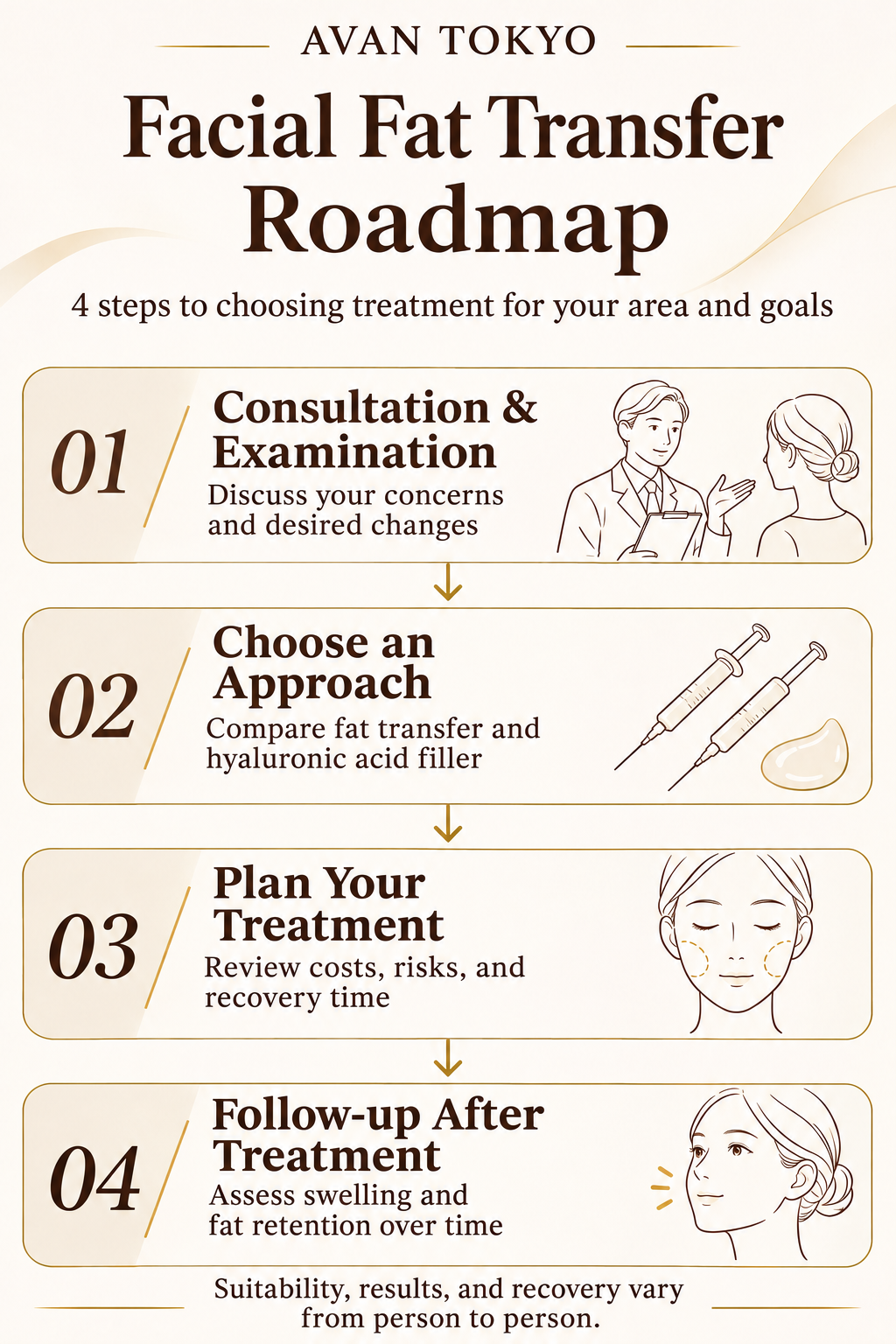
Facial Fat Transfer Roadmap
How do facial fat transfer and hyaluronic acid filler differ?
Fat transfer involves harvesting and processing your own fat, then grafting it into areas where hollowness or a lack of volume is a concern. Not all of the injected fat remains: some is absorbed. Fat that survives may provide long-term volume, but the amount retained and the final appearance vary between individuals.
Hyaluronic acid filler is used to fill hollows or refine contours by selecting the product’s properties, injection location, and amount. No fat harvesting is required. However, how long the effect lasts depends on the product and area, and repeat treatment may be considered as the results change over time.
| Consideration | Fat transfer | Hyaluronic acid filler |
|---|---|---|
| Material and procedure | Your own fat is harvested, processed, and injected | A filler product is selected and injected according to the treatment goal |
| Goals we consider at our clinic | Creating a rounded contour across a broad area such as the forehead, or restoring cheek volume | Filling localized hollows or adjusting the shape of areas such as the lips or chin |
| Changes over time | Some fat is absorbed; the amount retained varies between individuals | Duration varies according to the product, area, and other factors |
| Correction | Lumps or excessive volume may be difficult to correct | Dissolving the filler may be an option, but a return to the original appearance is not guaranteed |
| Physical burden | Swelling and pain at the fat-harvesting site must also be considered, in addition to the injected area | Swelling, bruising, and other effects can occur at the injection site |
Both treatments carry risks such as infection, lumps, and asymmetry. Serious complications from accidental injection into a blood vessel are not limited to hyaluronic acid filler. With either treatment, rare complications can include skin necrosis, visual impairment or blindness, and ischemic stroke. Using your own fat does not remove the need for careful attention to safety.
Choosing treatment for nine facial areas
The following explains how we approach treatment planning at our clinic. The choice is not determined by the name of the area alone. We assess your bone structure, skin, previous injection treatments, and goals during an examination.
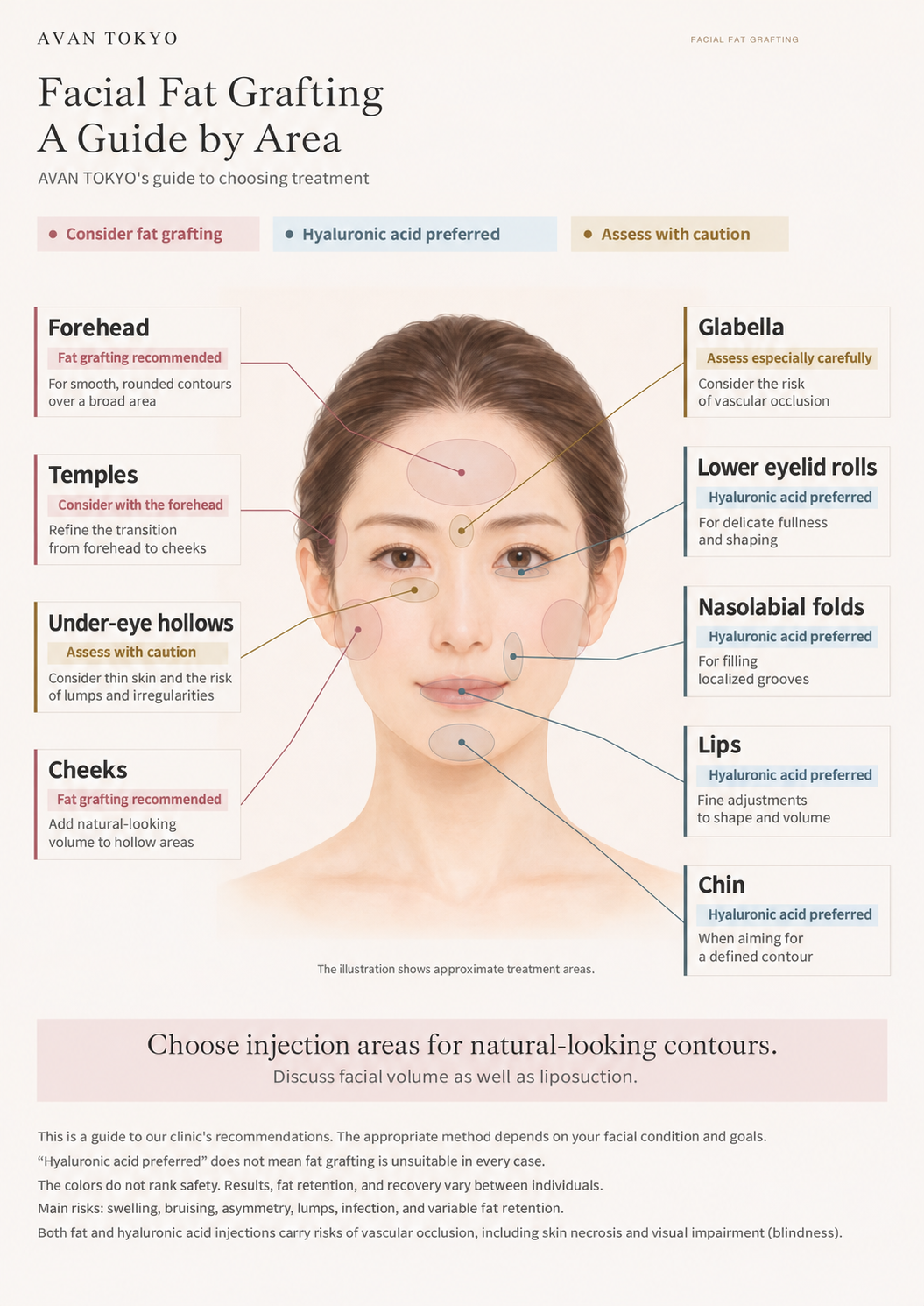
1. Forehead: considering fat transfer first for a broadly rounded contour
When the goal is to create a rounded contour across the forehead, we often consider fat transfer first. We assess not only the view from the front but also the curve in profile and its transition into the temples. More volume is not necessarily better: careful planning is important to avoid excessive fullness or irregularities.
2. Temples: a localized adjustment or treatment together with the forehead?
For a small area of the temple, we consider hyaluronic acid filler as an option. When the aim is to create a smoother transition from the forehead to the temples while performing forehead fat transfer, we consider fat transfer for the temples as well. Even within the same area, the choice depends on the extent of treatment needed and the overall plan. Fat retention can differ by area, so we cannot guarantee that fat in the temples will remain in the same way as in the forehead.
3. Under-eye area: carefully considering the difficulty of correcting lumps or irregularities
Small irregularities can be noticeable under the eyes, and lumps after fat transfer may be difficult to correct. We assess fat transfer cautiously in this area and also consider hyaluronic acid filler. However, hyaluronic acid filler can also cause swelling and irregularities. Because shadows may have causes other than hollowness, we assess whether injections alone are an appropriate approach.
4. Lower eyelid rolls (aegyo-sal): focusing on subtle changes in shape
In the lower eyelid rolls, even a small change in volume can affect facial expression and appearance. At our clinic, we do not generally recommend fat transfer for this purpose; we consider hyaluronic acid filler according to the desired shape. We distinguish this goal from treating under-eye hollows and also assess the appearance when you smile.
5. Between the eyebrows: prioritizing risk assessment with either material
The area between the eyebrows requires particular attention to serious complications involving blood vessels. We carefully assess suitability for both fat transfer and hyaluronic acid filler. Rather than assuming that your own fat is safe or that a dissolvable product is safe, we begin by considering whether an injection is appropriate at all.
6. Cheeks: weighing volume restoration against the risk of firmness
Both fat transfer and hyaluronic acid filler may be options for hollow cheeks. We assess whether a broad area needs volume or a localized adjustment is desired. Fat transfer can cause lumps or firmness associated with fibrosis, so we avoid unnecessary overfilling and prioritize balance with the existing facial contours.
7. Nasolabial folds: considering hyaluronic acid filler first
At our clinic, we often consider hyaluronic acid filler first for localized adjustment of the nasolabial folds. However, the depth of these folds is also influenced by the surrounding tissues and bone structure. Trying only to fill the line can create unnatural fullness, so we consider the whole face when planning the treatment area.
8. Lips: choosing with movement and detailed shaping in mind
The lips move frequently during speech and eating, and treatment may involve adjusting their contours and the balance between the upper and lower lips. We do not generally recommend fat transfer for the lips at our clinic; we consider hyaluronic acid filler. This does not mean that fat can never survive in the lips. It reflects our approach to the desired result and ease of adjustment.
9. Chin: considering a firmer filler when the goal is contour definition
When the goal is to adjust chin projection or contour, we often consider a firmer hyaluronic acid filler first. Fat can add volume, but it has limitations when a more defined shape is desired. We discuss what injections can reasonably achieve, taking bone structure and the bite into account as well.
Facial fat transfer case photographs
These photographs show individual examples at particular stages of recovery. Results, fat retention, and the resolution of swelling vary between individuals; the same outcome is not guaranteed. Posture, camera angle, lighting, and other conditions can affect appearance, so please consider differences in photographic conditions when comparing the images.
Case 1: fat transfer to the cheeks and temples
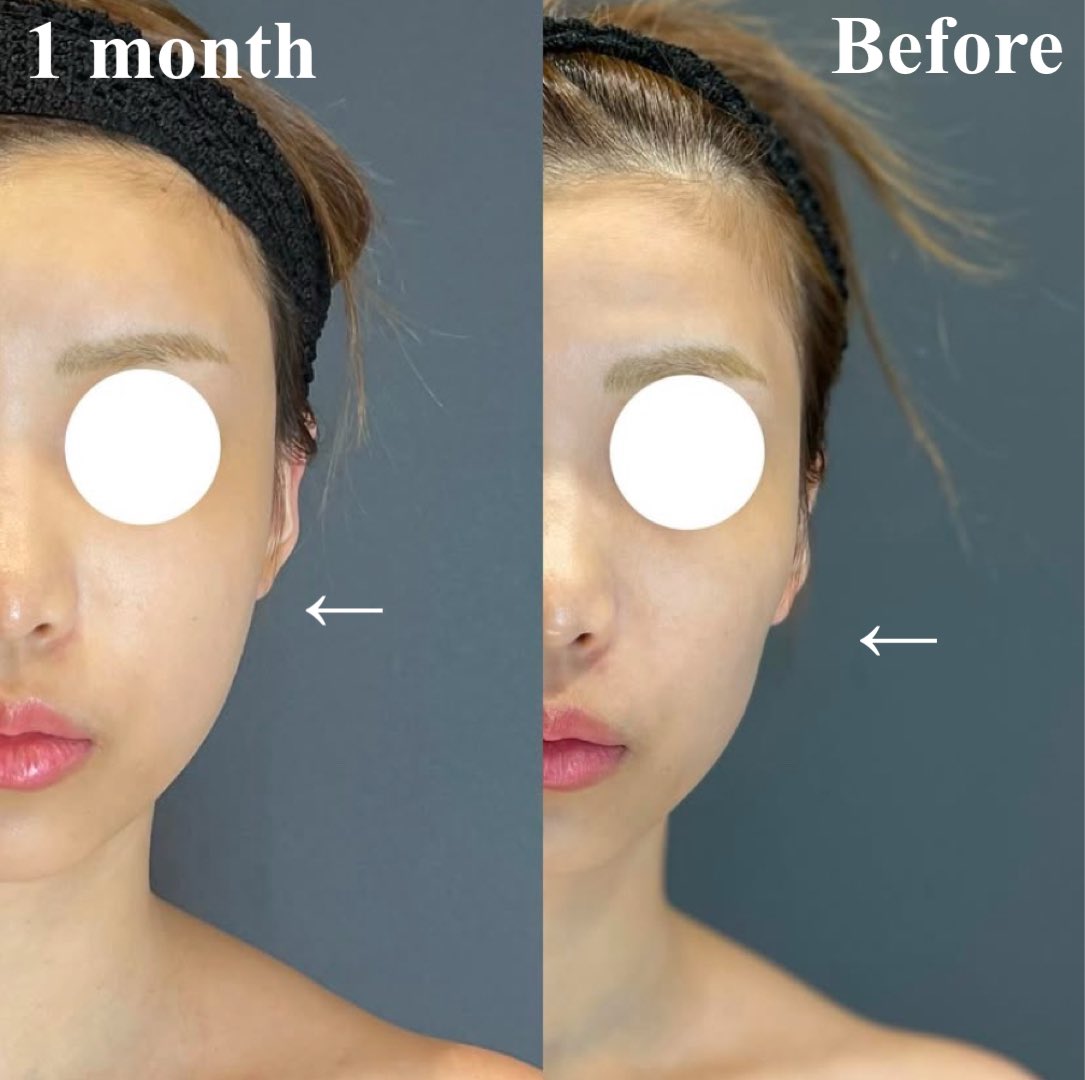
Assessing the cheeks and temples together allows us to consider their transition into the sides of the face as well as local fullness. At one month, recovery is still in progress, and this photograph alone cannot establish final fat retention.
- Treatment
- Your own fat is harvested, processed, and injected into the cheeks and temples. This is an elective, self-pay procedure.
- Number of procedures and follow-up
- One procedure, with no additional procedures combined. The follow-up period shown in the photograph is one month.
- Photograph timing
- Before surgery and one month after surgery.
- Illustrative cost at standard rates (JPY, tax included)
- Cheeks JPY 170,000 + temples JPY 170,000 + fat harvesting and processing fee JPY 120,000 + intravenous anesthesia JPY 55,000 = subtotal JPY 515,000. This is an example based on current standard rates when intravenous anesthesia at JPY 55,000 is selected. It does not indicate the amount this patient actually paid or the anesthesia used in this case. Applicable charges for tests, medication, compression garments, and other necessary items are additional, so this subtotal is not the final total. Intravenous anesthesia provided by an anesthesiology specialist costs JPY 110,000; general anesthesia costs JPY 220,000. Applicable items and the total cost will be explained during the consultation.
- Main risks and side effects
- Swelling, bruising, pain, infection, lumps, firmness, contour irregularities, asymmetry, excessive or insufficient volume, fat absorption, and contour irregularities or altered sensation at the harvesting site. Rarely, fat entering blood vessels can cause serious complications such as embolism, visual impairment or blindness, and ischemic stroke.
Case 2: fat transfer to the forehead and temples
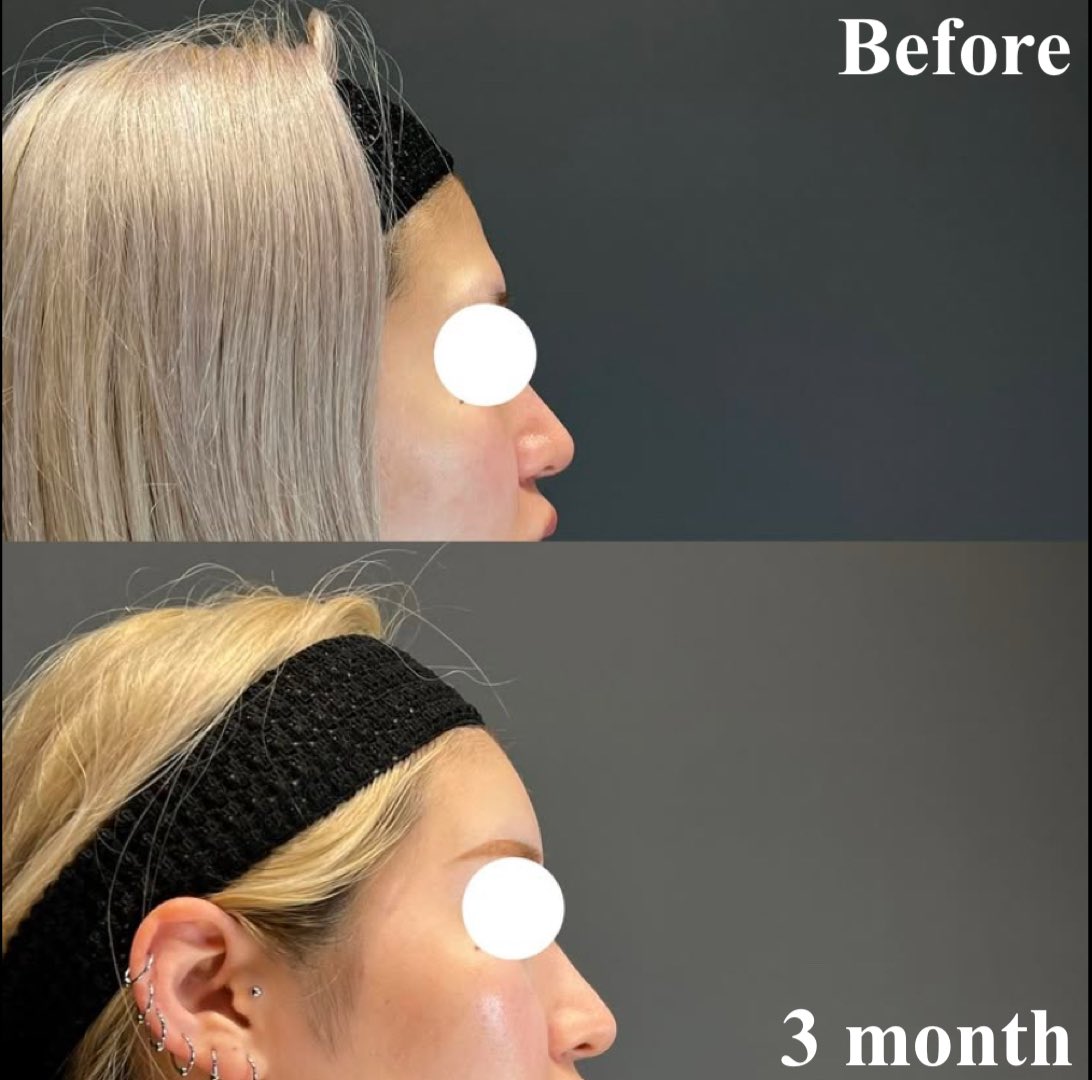
When planning treatment for the forehead and temples, we consider how these areas connect. Rather than simply rounding the forehead, we also assess the curve toward the sides and the overall facial appearance. The three-month photograph is a record of one point in time and does not mean that no further changes will occur.
- Treatment
- Your own fat is harvested, processed, and injected into the forehead and temples. This is an elective, self-pay procedure.
- Number of procedures and follow-up
- One procedure, with no additional procedures combined. The follow-up period shown in the photograph is three months.
- Photograph timing
- Before surgery and three months after surgery.
- Illustrative cost at standard rates (JPY, tax included)
- Forehead JPY 230,000 + temples JPY 170,000 + fat harvesting and processing fee JPY 120,000 + intravenous anesthesia JPY 55,000 = subtotal JPY 575,000. This is an example based on current standard rates when intravenous anesthesia at JPY 55,000 is selected. It does not indicate the amount this patient actually paid or the anesthesia used in this case. Applicable charges for tests, medication, compression garments, and other necessary items are additional, so this subtotal is not the final total. Intravenous anesthesia provided by an anesthesiology specialist costs JPY 110,000; general anesthesia costs JPY 220,000. Applicable items and the total cost will be explained during the consultation.
- Main risks and side effects
- Swelling, bruising, pain, infection, lumps, firmness, contour irregularities, asymmetry, excessive or insufficient volume, fat absorption, and contour irregularities or altered sensation at the harvesting site. Rarely, fat entering blood vessels can cause serious complications such as embolism, visual impairment or blindness, and ischemic stroke.
Fees are based on our official fee schedule (in Japanese), checked on November 14, 2026. All amounts are in Japanese yen (JPY) and include tax.
Recovery and what to discuss before treatment
Fat transfer causes swelling, bruising, and pain not only in the face but also at the fat-harvesting site. Before making plans for work or social occasions, please discuss the rest and follow-up visits you may need. The appearance while an area is swollen differs from its appearance once swelling has settled.
At your consultation, tell us about previous hyaluronic acid injections, fat transfer, surgery, and any medication you take. If you experience sudden changes in vision, severe pain, or a marked change in skin color after treatment, contact a medical facility immediately rather than waiting to see how symptoms develop.
Frequently asked questions
Q. Is one fat transfer procedure enough?
One procedure may bring you closer to your goal, but additional treatment may be considered after assessing fat absorption, asymmetry, and other changes. It is important to make decisions as recovery progresses rather than injecting excessive volume during the first procedure.
Q. Can hyaluronic acid filler always be reversed?
Dissolving treatment may be considered depending on the circumstances, but restoring the original appearance is not guaranteed. Dissolving treatment itself has risks, and it does not guarantee a favorable outcome if severe impairment of blood flow has occurred. Do not choose treatment solely on the possibility of correction.
Q. Is it better to use fat transfer for every area of the face?
There is no need to use the same method everywhere. Rounding the forehead, filling hollow cheeks, and shaping the lips or chin involve different goals. At our clinic, we consider each area separately, including the option of leaving areas untreated when there is little need for injection.
Discussing an approach that suits your overall facial balance
For facial injections, clarifying the treatment area, amount, and goal matters more than the name of the material alone. At AVAN TOKYO, we explain the advantages and limitations of both fat transfer and hyaluronic acid filler based on your goals and examination findings.