


Why Hybrid Augmentation After Fat Injection Gives Stable Results2026.11.14
“I had fat injection augmentation, but my breasts went back to how they were.” This is something I hear in consultations with some regularity.
Reversal after fat injection augmentation occurs when a portion of the injected fat is absorbed by the body.
This article explains why hybrid breast augmentation after fat injection tends to give stable results, and walks through a 6-month case for those considering this path.

The short answer
When hybrid breast augmentation is performed after fat injection augmentation has reversed, the breast tissue already has an established fat-integration environment, so the injected fat tends to integrate more stably than on the first attempt. Results can generally be evaluated at around 6 months, though individual variation applies.
Why Hybrid Breast Augmentation After Fat Injection Gives Stable Results
When hybrid breast augmentation (silicone implant + fat injection) is performed after fat injection augmentation has reversed, results tend to be more stable. This is something I observe consistently in surgery.
【Comparison of Breast Augmentation Methods】
| Fat injection only | Hybrid augmentation (first time) | Hybrid augmentation after fat injection | |
|---|---|---|---|
| Advantages | ・No foreign material ・Natural shape |
・Stable volume ・Shape is easier to design |
・Fat integrates more stably as a secondary injection ・Combines stability and volume |
| Disadvantages | ・Risk of reversal ・May require multiple sessions |
・Fat integration is first-time ・Implant texture may be felt |
・Fibrosis must be addressed ・Downtime tends to be longer |
| Best suited for | ・Prefer no foreign material ・Want natural gradual change |
・Want stable results in one procedure ・Have adequate subcutaneous fat |
・Fat injection has already reversed ・Want stable volume going forward |
Fat injection only
- Advantages
- ・No foreign material
・Natural shape - Disadvantages
- ・Risk of reversal
・May require multiple sessions - Best suited for
- ・Prefer no foreign material
・Want natural gradual change
Hybrid augmentation (first time)
- Advantages
- ・Stable volume
・Shape is easier to design - Disadvantages
- ・Fat integration is first-time
・Implant texture may be felt - Best suited for
- ・Want stable results in one procedure
・Have adequate subcutaneous fat
Hybrid augmentation after fat injection
- Advantages
- ・Fat integrates more stably as a secondary injection
・Combines stability and volume - Disadvantages
- ・Fibrosis must be addressed
・Downtime tends to be longer - Best suited for
- ・Fat injection has already reversed
・Want stable volume going forward
Reason 1: It acts as a secondary fat injection, so integration is more stable
A breast that has previously received fat injection already has an established environment where fat cells have integrated. Re-injecting fat into that environment is effectively a “secondary fat augmentation.”
This is why integration tends to be more stable than the first time. The breast tissue is thought to have adapted to become more receptive to fat.
Reason 2: The silicone implant anchors the base volume
The challenge with fat injection augmentation is volume fluctuation due to absorption. In hybrid augmentation, the silicone implant maintains base volume reliably.
Fat is injected primarily into areas the implant cannot fill well, such as the décolletage, cleavage, and outer breast contour. Separating the roles of implant and fat allows for a natural shape and stable volume.
Reason 3: A beautiful shape is achievable even with fibrosis
Some degree of fibrosis (tissue hardening) can develop inside the breast after fat injection augmentation.
Dissection during implant insertion may be slightly more difficult, but it is possible to achieve a well-shaped bust with careful technique.
For safety standards in aesthetic surgery, please refer to the Japan Society of Aesthetic Surgery (JSAS).
Case Study
Case: Hybrid augmentation following fat injection augmentation (female)
This patient consulted us after the volume from a previous fat injection augmentation had reversed. We performed hybrid breast augmentation (silicone implant + fat injection).
The comparison photo below shows the side-view change from before surgery (left) to 6 months after (right), where the improvement in breast volume and contour can be seen.
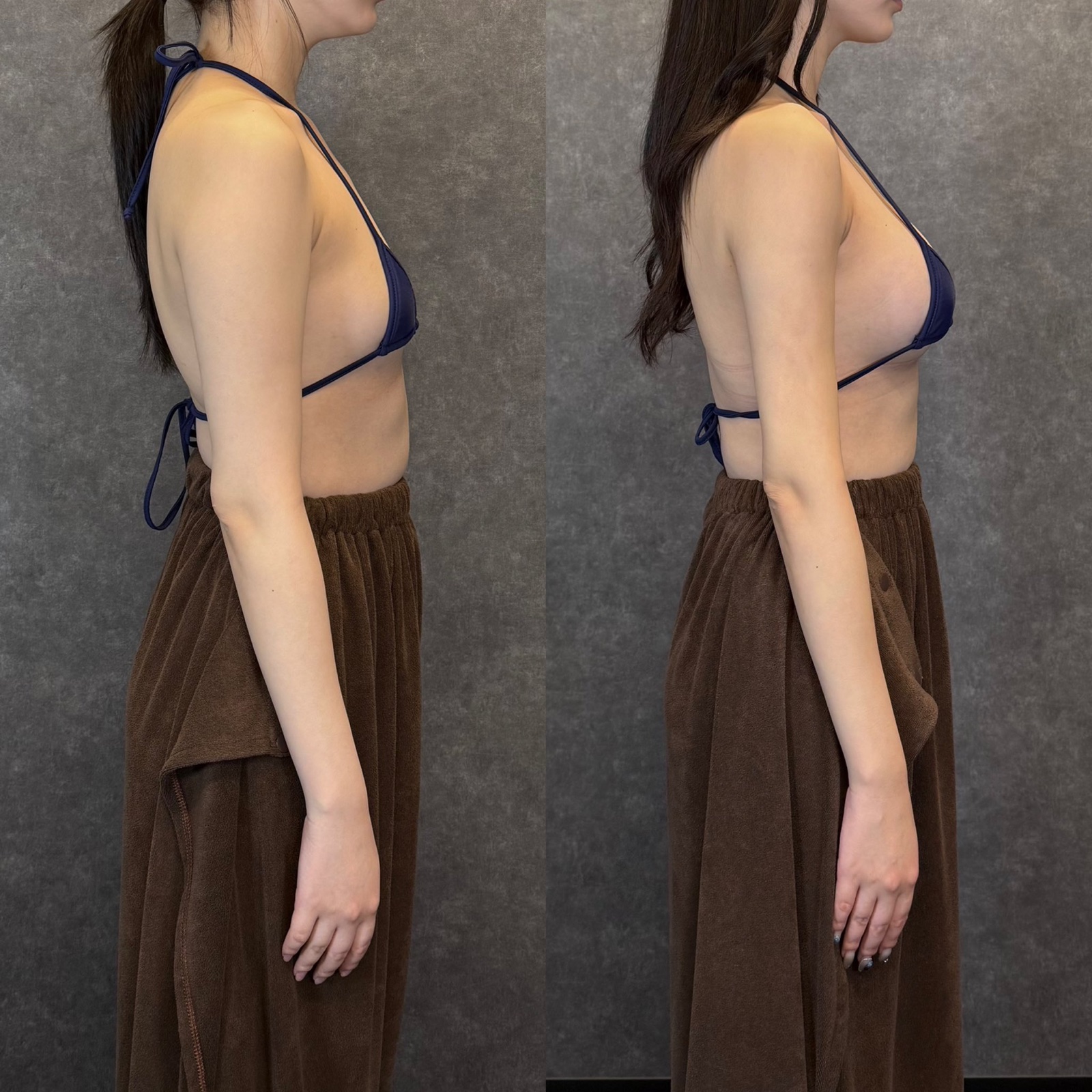
Hybrid breast augmentation (silicone implant + fat injection) | Before and 6 months after surgery
Video documentation of the pre-operative state and 6-month post-operative change is also available below.
Before
6 months after surgery (After)
| Procedure | Hybrid breast augmentation |
|---|---|
| Details | Silicone implant insertion + fat injection (secondary procedure after fat injection augmentation) |
| Photo timing | 6 months post-op |
| Cost | Please see the pricing page for details (final cost confirmed at consultation) |
| Key risks / side effects | Bruising, swelling, fibrosis, capsular contracture, asymmetry, fat necrosis, infection, etc. |
Results vary by individual. This photo represents one example.
Why Does Fat Injection Augmentation Reverse?
Because a portion of the injected fat is absorbed by the body
In fat injection augmentation, harvested and processed fat is injected into the breast. For injected fat cells to survive, blood supply must be re-established. Fat that fails to integrate is absorbed by the body.
Absorption typically progresses within the first several months after surgery. This means breasts may appear smaller a few months post-op than immediately after.
This is a characteristic of fat augmentation and is not abnormal.
How Long Is the Downtime for Hybrid Augmentation?
Days 2–3 are the most difficult; most patients improve within 10 days
Hybrid augmentation downtime tends to be longer than a single procedure because liposuction and breast augmentation are performed simultaneously. Pain peaks at days 2–3 post-op.
Bruising and swelling resolve over 2–3 weeks. Breast fibrosis (firmness and tension) peaks around 1 month post-op and tends to soften naturally within about 3 months. Individual variation applies.
When Can I Return to Normal Daily Activities?
Wear the compression garment 24 hours a day for the first week
The compression garment is worn 24 hours a day for the first week post-op. We also recommend continuing to wear it at home and during sleep until bruising and swelling have resolved.
Showering is possible from the day after surgery.
Bathing in a tub and vigorous exercise (gym, running) are permitted from 2 weeks post-op. Some patients return to desk work the next day, but pain varies individually.
What Risks and Complications Are Possible?
Bruising and swelling, plus the risk of capsular contracture
A key risk of hybrid augmentation is capsular contracture — the membrane that forms around the implant becoming thick and hard. The incidence is low, but the breast may become firmer or change shape in some cases.
In hybrid augmentation after fat injection, fibrosed tissue may also be a factor. It is important to thoroughly evaluate the breast condition before surgery.
Other risks include fat necrosis, lumps, infection, and asymmetry.
Summary | If Fat Injection Augmentation Has Reversed
When fat injection augmentation has reversed, hybrid breast augmentation after fat injection can be a stable option.
Because an established fat-integration environment already exists, the secondary injection tends to integrate more reliably.
Even when fibrosis has developed, careful dissection and injection planning can achieve a well-shaped result. With the implant anchoring base volume, there is less concern about reversal.
Please schedule a consultation to discuss your breast condition and the approach best suited to you. Browse our related breast augmentation and liposuction articles here.
Frequently Asked Questions
- How long after fat injection augmentation can I receive hybrid augmentation?
-
It is generally advisable to wait until the tissues have stabilized from the previous procedure — typically 6 months to 1 year or more — though this varies by individual.
Please consult us so we can assess your breast tissue condition.
- Will the amount of fat injected in the second procedure differ from the first?
-
The volume of fat injection in hybrid augmentation is planned according to the implant size and breast condition. It will not necessarily match the first injection volume; we will advise you at consultation.
- When does the post-operative firmness (fibrosis) ease?
-
Fibrosis typically peaks around 1 month post-op. Many patients find it softens within 3 months, though individual variation applies. Please follow your surgeon’s guidance on massage.
- When can I return to desk work after surgery?
-
Some patients return to desk work the day after surgery, but pain levels vary individually. The first 2–3 days tend to be the most difficult, so having a few days of buffer is reassuring.
- What if I have lumps from the previous fat injection?
-
We will evaluate any lumps at consultation and perform pre-operative ultrasound if needed. Depending on the nature of the lump, additional testing may be required.
- When will my breasts look most natural?
-
The implant and injected fat begin to integrate around 3 months post-op. Results tend to stabilize after 6 months, though individual variation applies.
- Which body areas will fat be harvested from?
-
Donor sites are decided in consultation with your surgeon based on your body type and harvest volume needed. Common sites include the upper arms, thighs, abdomen, and back, with individual variation.
【Supervised by】Shin Moriwaki, M.D. (Supervising Physician)
Credentials: VASER Lipo Certified / ECFMG Certificate
Memberships: Japan Society of Aesthetic Surgery (JSAS)
Japanese Society of Regenerative Medicine
American Academy of Aesthetic Medicine📍AVAN TOKYO GINZA LIPOSUCTION CLINIC
Consultations in Japanese and English
Appointments and inquiries accepted via
DM / LINE / Website / Phone
This article is based on a post by Dr. Moriwaki on X (@doctor_shin_). View the original post
For prices, case photos and FAQs, see the hybrid breast augmentation page.
Book a consultation
1 min walk from Exit 6, Ginza-itchome Station / Open 10:00–19:00
About the supervising physician

Director, AVAN TOKYO Ginza Liposuction Clinic
Graduated from Tokushima University School of Medicine.
Worked at Tokushima University Hospital, Tokyo Chuo Cosmetic Surgery and Gracia Clinic before taking up the current position.
Over 5,000 liposuction procedures performed (including previous positions).
Certifications
・VASER Lipo certified physician
・ECFMG Certificate
Memberships
・Member, Japan Society of Aesthetic Surgery (JSAS)
・Full member, Japanese Society for Regenerative Medicine
・Member, American Academy of Aesthetic Medicine
Related articles
- Why Some People Develop More Severe Bruising
- Hybrid Breast Augmentation Is a Strong Option If You Do Not Strongly Dislike Implants
- Why Can the Breasts Feel Firm After Fat Transfer? Understanding Intramuscular Fat Grafting to the Pectoralis Major