


When Can You Resume Laser Hair Removal After Liposuction? Dr. Moriwaki Explains Photothermal Stimulation and Skin Sensitivity During the Fibrosis Phase2026.08.17
We frequently receive questions from patients undergoing ongoing laser hair removal about when they can safely book their next session after liposuction. Post-liposuction laser hair removal is not simply a matter of waiting for wounds to close — you must also account for post-operative changes in the subcutaneous fat layer such as inflammation, edema, and fibrosis, and how these interact with the photothermal stimulation of laser energy. In this column, our supervising physician explains the medical mechanism of laser photothermolysis, the time-dependent variability of skin sensitivity, and site-specific guidelines for when post-liposuction laser hair removal can be safely resumed.
Key Points of This Article
・Post-liposuction laser hair removal is generally safe to resume 3 to 6 months after surgery.
・The skin immediately after surgery has a high risk of pigmentation, and laser photothermal energy can easily trigger post-inflammatory hyperpigmentation (PIH).
・During the fibrosis phase (1 to 3 months post-op), skin sensitivity is elevated and pain may be stronger than usual.
・YAG lasers penetrate more deeply than Alexandrite lasers, so device selection should be tailored to the site and skin condition.
・Recommended resumption timing differs by area (arms, thighs, abdomen, etc.).
Why Post-Liposuction Laser Hair Removal Cannot Be Resumed Immediately
The lasers used in medical hair removal (Alexandrite, Diode, YAG) selectively target melanin via photothermolysis to destroy the stem cells of the hair follicle. Skin after liposuction is vulnerable to photothermal stimulation for three reasons.
1. Residual Subcutaneous Inflammation
After liposuction, mechanical trauma from cannulas and rebound vasodilation following the vasoconstrictive effect of lidocaine and epinephrine in tumescent solution result in subclinical inflammation of the subcutaneous tissue that can persist for 2 to 3 months. Laser energy applied during this period can accumulate heat under the skin and prolong inflammation.
2. Increased Melanocyte Activity
Inflammatory cytokines (IL-1, TNF-α) stimulate melanocytes after surgery, temporarily increasing melanin production. Adding photothermal stimulation on top of this predisposes the skin to post-inflammatory hyperpigmentation (PIH) — the same principle as avoiding lasers immediately after sun exposure.
3. Nerve Regeneration Hypersensitivity
Sensory nerve fibers (Aδ and C fibers) beneath the epidermis are in a regeneration phase after liposuction, making pain perception more acute than usual. Many patients report that the same laser output feels significantly more painful than before surgery.
The Fibrosis Phase and Skin Sensitivity
Fibrosis is a normal wound-healing process that occurs 2 weeks to 3 months after liposuction. Fibroblasts in the dermis become activated, and TGF-β and collagen production are elevated. The skin barrier is temporarily compromised, making it more sensitive to external stimuli. Because hair removal lasers deliver heat to the upper dermis, applying them during the fibrosis phase theoretically increases risks such as strong thermal sensation, prolonged redness, and rarely a keloid-like over-reaction.
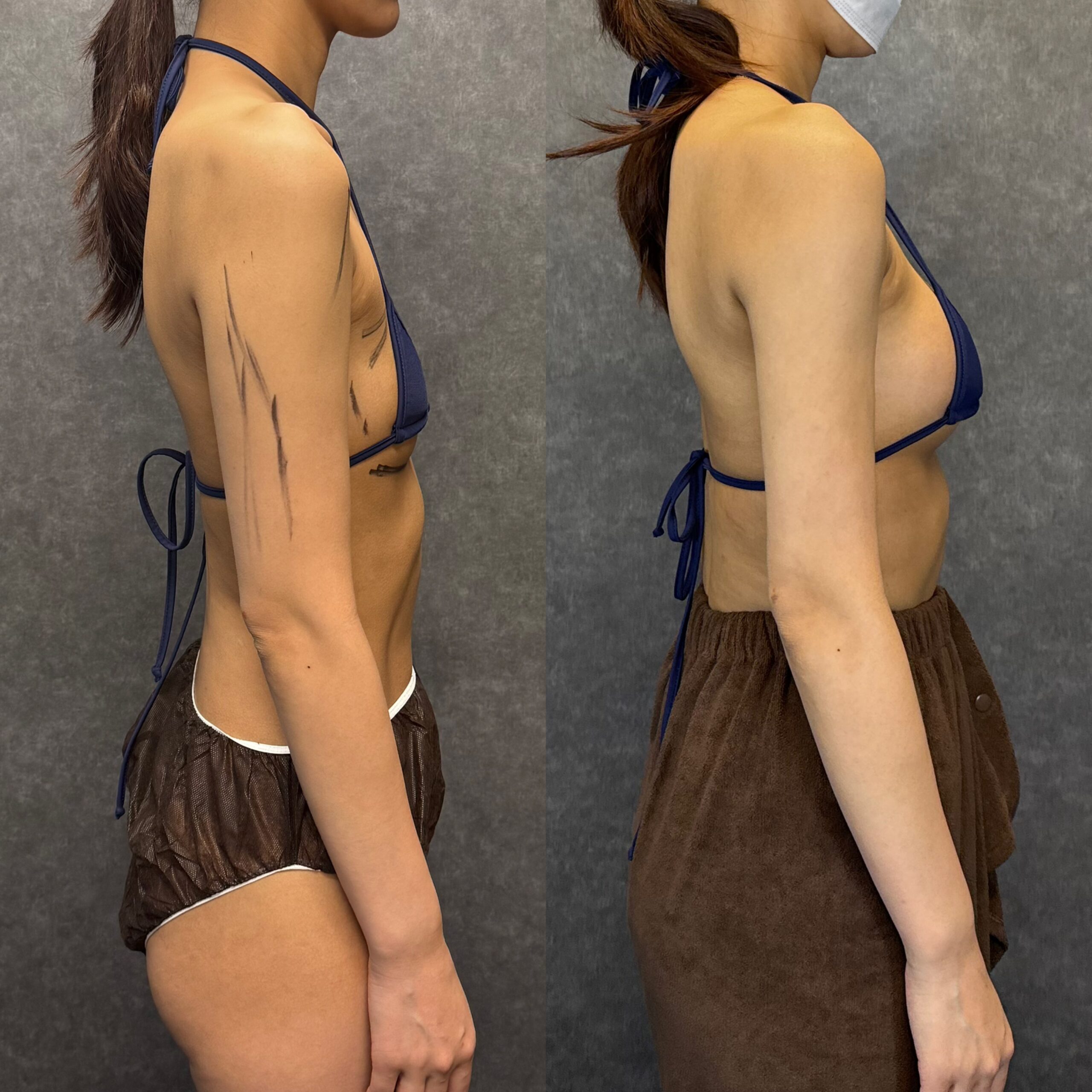
Site-Specific Resumption Guidelines for Post-Liposuction Laser Hair Removal
Submental and Jawline
Can typically be resumed 2 to 3 months after surgery. The face heals quickly due to rich blood flow but is also prone to pigmentation, so output must be adjusted carefully.
Upper Arms
Around 3 to 4 months post-op. The upper arms are an area where fibrosis persists for a long time, and skin sensitivity takes time to normalize.
Abdomen and Waist
4 to 6 months post-op is recommended. Large-volume liposuction here takes time for edema to resolve, and abdominal skin also carries elevated pigmentation risk.
Thighs and Knees
Can be considered from 3 to 4 months post-op. The area around the knee joint tends to have fibrosis adhering to the skin, prolonging sensitivity.
Calves
4 to 6 months post-op. The lower legs are slow to clear gravitational edema and also prone to lingering pigmentation.
Differences Between Laser Types
Alexandrite Laser (755nm)
High affinity for melanin and strong hair-removal efficacy, but also a wavelength with a higher pigmentation risk. Must be used cautiously on skin with residual tan or pigmentation after liposuction.
Diode Laser (800–810nm)
A balanced wavelength that is somewhat more forgiving on sensitive post-op skin. It is safer to start at low output and gradually increase.
YAG Laser (1064nm)
Deep penetration and relatively safe for darker skin, but painful and not recommended for sensitive skin in the fibrosis phase.
Precautions for Post-Liposuction Laser Hair Removal
・Try to leave your schedule clear of laser hair removal appointments from 1 month before to 3 months after surgery.
・When resuming hair removal, always inform the clinic or salon that you have undergone liposuction.
・During the fibrosis phase, it is safer to reduce output and start with a test shot.
・Home light-based devices (IPL and home hair-removal units) should also be avoided during the same period. Their energy reaches the upper dermis and can be as stimulating as clinical devices.
・If post-inflammatory hyperpigmentation appears, prioritize pigmentation care such as hydroquinone or oral tranexamic acid.
Please also refer to the Japan Society of Aesthetic Surgery for information on cosmetic surgery safety standards. For more detailed post-operative care and combined treatments, see our column archive on liposuction.
Frequently Asked Questions
Q. Is it OK to resume laser hair removal 1 month after surgery?
A. Not recommended. One month post-op is the peak of fibrosis and the time when skin sensitivity is highest. Because of the risks of post-inflammatory hyperpigmentation and strong thermal sensation, we recommend waiting at least 3 months.
Q. Why does the timing differ between the face and the abdomen?
A. Blood flow, residual edema, and the thickness of the subcutaneous fat layer differ by site. The face has abundant blood flow and recovers quickly, while the abdomen takes longer for tissue remodeling after large-volume liposuction.
Q. Is IPL at a beauty salon safe to receive right away?
A. IPL also damages hair follicles via photothermal effects, so the same precautions apply. Because IPL is broad-spectrum, pigmentation risk can even be higher in some cases.
Q. Should I finish my laser hair removal before liposuction?
A. If possible, we recommend completing your most recent session up to 1 month before surgery. Because post-op resumption is delayed, planning ahead makes downtime more comfortable.
Q. Should home hair-removal devices also be avoided?
A. Yes, avoid them during the same period. Even home devices deliver photothermal energy to the upper dermis, which can be excessive stimulation for skin in the fibrosis phase.
──────────────
【Supervising Physician】Shin Moriwaki, M.D.
Member of Japan Society of Aesthetic Surgery (JSAS) / Member of American Academy of Aesthetic Medicine
ECFMG Certificate
──────────────
📍AVAN TOKYO GINZA LIPOSUCTION CLINIC
English / 中文 / Tiếng Việt supported
Bookings and consultations available via
DM / LINE / Website / Phone.