


Fat Grafting After Silicone Implants: How to Choose Subcutaneous and Pectoralis Major Layers2026.11.03
After a silicone implant augmentation, more and more patients come to us wanting to add fat grafting to make the cleavage and décolletage look more natural, or to add a little more fullness to the upper chest. In this “secondary hybrid augmentation,” the single factor that most affects the result is the design: which layer you inject the fat into. In this article, I (Dr. Moriwaki) explain the two layers I focus on most as the operating surgeon — the subcutaneous layer and the pectoralis major — including why I choose them and how to use them differently, written for patients considering fat grafting after silicone implants.

The short answer
In fat grafting after silicone implants, the basic design is to thinly cover the implant through the subcutaneous layer to soften the artificial look, and to use injection into the pectoralis major, where take rate is highest, for size-up. Dividing volume and role by layer is what determines the result.
Fat Grafting After Silicone Implants Is Decided by the Subcutaneous and Pectoralis Major Layers
To put the conclusion first: when adding fat to a breast that already has a silicone implant, the two layers I pay the most attention to are the subcutaneous layer and the pectoralis major. These are the two layers in which fat is most likely to survive even after an implant is in place, and each has a different role. The subcutaneous layer, like a thin fabric, covers the entire implant and softens the artificial-looking outline that can appear at the cleavage and décolletage. Injection into the pectoralis major uses the layer where fat takes most reliably, and is chosen when we want one more step of size-up on top of the implant.
[Comparison: role of each layer in post-implant fat grafting]
| Subcutaneous injection | Pectoralis major injection | Subglandular / peri-implant | |
|---|---|---|---|
| Advantages | ・Thinly coats the entire implant ・Softens artificial look at cleavage and décolletage ・May help prevent rippling |
・Highest take rate layer ・Clear size-up effect ・Fullness from deeper layers |
・Smooths the border next to the implant ・Hides the edge of the shell |
| Disadvantages | ・Thin layer, hard to inject large volumes ・Possible superficial palpable nodules |
・Needs careful technique with muscle fibers ・Volume per session is limited |
・Injectable volume depends on capsule firmness ・Hard to achieve size-up by itself |
| Suited for | ・Patients bothered by the visible implant outline ・Flat décolletage ・Rippling prevention |
・Those wanting about one more cup ・Flat chest wall needing more coverage |
・Those wanting a softer transition at the implant edge |
Reason 1: the subcutaneous layer acts as a “cover” that softens the artificial look
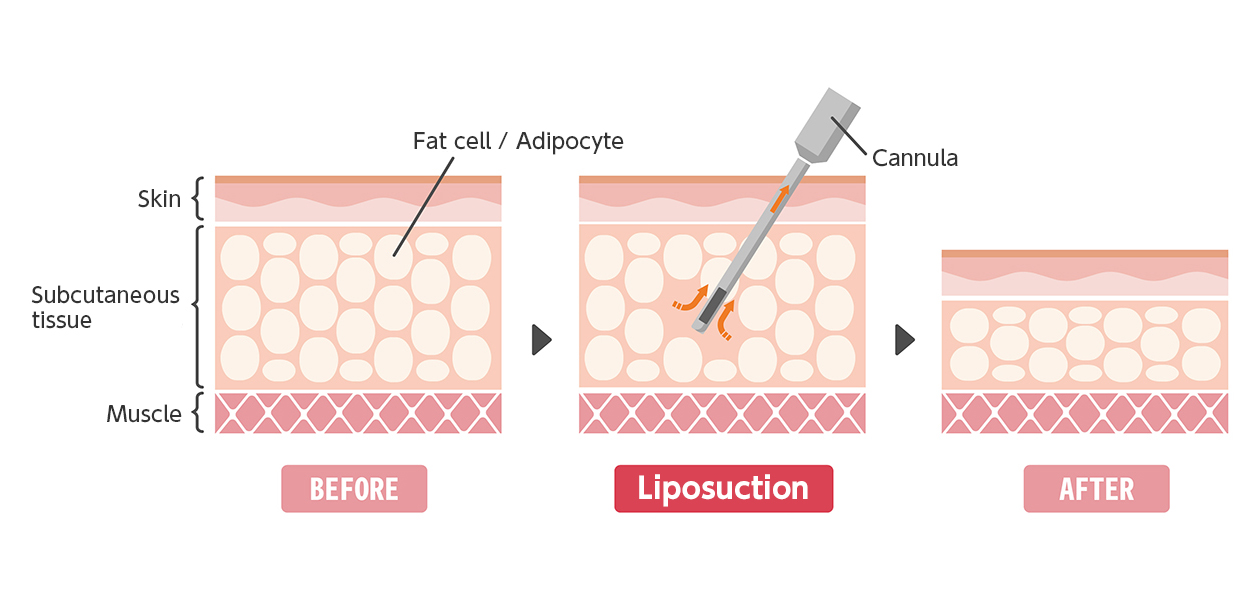
In silicone implant augmentation, especially in slim patients or those with thin subcutaneous fat, the edge of the implant can show faintly through the skin. A cleavage that looks too sharply split, or a step at the décolletage, are not rare complaints. Injecting fat into the subcutaneous layer is intended to spread a very thin “fabric” of fat over the implant and soften the artificial contour. The subcutaneous layer has rich blood supply and fat tends to take well, so even small volumes can meaningfully improve how the breast looks.
Reason 2: the pectoralis major is the layer where fat survives best
Inside the pectoralis major, blood supply is rich and fat can be evenly dispersed between muscle fibers, making it one of the layers where grafted fat most reliably survives. Even when a silicone implant is already in the subglandular or subfascial space, injection into the pectoralis major avoids interference with the implant and is well suited for size-up. It fits patients who want to add about one more cup of volume, or add projection from the infraclavicular region through the upper chest.
Reason 3: subglandular and peri-implant layers are “supporting” layers
The subglandular layer and the area around the implant are used to inject small, supportive volumes to disguise the implant edge. How much can be safely injected depends on the firmness and thickness of the capsule, and it is difficult to achieve size-up with these layers alone, so we always design them together with the subcutaneous and pectoralis major injections.
Case from our clinic
A case where the arm and chest lines were adjusted together (female patient, prior silicone implants at another clinic)
She had received silicone implant augmentation at another clinic, and came in saying “I have cleavage, but when I close my arms the upper chest and décolletage still look empty,” and “I want to look slimmer in the upper body overall while adding a bit more to the chest.”
At consultation, we checked the implant position, capsule firmness, and subcutaneous fat thickness with a pinch test and inspection, and planned a circumferential (anterior, posterior-“wing,” and posterior) upper arm liposuction, using the best-quality portion of the harvested fat for the breast. Injection was spread very thinly in the subcutaneous layer to cover the implant, and layered into the pectoralis major mainly along the upper chest and décolletage side, with per-breast volume decided individually from skeleton and subcutaneous thickness (specific volumes are judged case by case).
Postoperatively she wore the compression garment for 24 hours continuously, then throughout the day for one week. Pain peaked on days 2–3, swelling and bruising settled over 2–3 weeks, and the firmness (induration/”koshuku”) peaked around 1 month and softened over about 3 months. At 6 months, when she closes her arms the subcutaneous fat no longer bulges, and the bust and arm lines connect to look slimmer overall.
Before
6 months after surgery (After)
| Procedure | Circumferential upper arm liposuction + fat grafting breast augmentation after another clinic’s silicone implants (secondary hybrid augmentation) |
|---|---|
| Details | Fat harvested from the anterior, “wing,” and posterior upper arm was injected in separate layers into the subcutaneous layer and within the pectoralis major |
| Photo timing | 6 months post-op |
| Cost | Please see the price page (final figure is confirmed at consultation) |
| Main risks / side effects | Bruising, swelling, firmness (induration), asymmetry, temporary hardness or nodules, infection, rare fat necrosis, donor-site irregularity; on the upper arm, temporary hand numbness is also possible |
Results vary individually and the photos show one example.
Can fat grafting after silicone implants achieve two cup sizes in one session?
Realistically 1 to 1.5 cups; multiple sessions become an option for two or more
Realistically, a single fat grafting session can be expected to add about 1 to 1.5 cup sizes. Even when a silicone implant is already in place, there is an upper limit on how much fat can be safely injected, so we cannot promise “two cups or more for sure.” If you clearly want more than two cups, options include planning multiple fat grafting sessions, or choosing hybrid augmentation with a larger implant from the start. Stem cells, PRP and exosomes may “possibly” help as adjuncts, but at present there is no solid evidence that they guarantee a specific size increase.
What are the possible risks of subcutaneous and pectoralis major injection?
Watch for nodules, asymmetry, and donor-site irregularity
With injection into any layer, some fat may fail to survive and form calcified nodules, and asymmetry or temporary firmness can remain. The subcutaneous layer has rich blood supply, but injecting too shallowly makes superficial nodules more palpable, so depth and per-pass volume must be finely controlled. In the pectoralis major, overly concentrated volumes raise local tissue pressure and can rarely cause fat necrosis, so dispersing small amounts from multiple directions is essential. Infection, hematoma, and donor-site irregularity or asymmetry are also possible, so we use preoperative ultrasound evaluation and careful postoperative compression and follow-up to catch any issue early.
Why we often combine with upper arm liposuction
Think about the whole upper-body silhouette
For patients who want a slim and delicate upper body, I often propose combining fat grafting with liposuction of the upper arms, axillary breast tissue, and bra-line fat. When the subcutaneous fat does not bulge as the arms are closed, the bust line stands out more and the overall look of fat grafting after silicone implants becomes more beautiful. There is also a surgical advantage: the harvested fat is directly usable in the breast, and donor volume and recipient volume are easier to plan together.
Downtime and how to spend the recovery
Compression for 1 week, bath from 2 weeks, exercise from 2 weeks
At our clinic the body compression garment is worn continuously for the first 24 hours, then throughout the day for one week, and after that we recommend wearing it as much as possible at home and while sleeping until swelling and bruising subside. Showers can be taken from the day after surgery. Baths, saunas, pools, the sea, hot springs, and strenuous exercise (gym, running) can all be resumed from 2 weeks after surgery as a guide. Pain peaks on days 2–3 and settles around 10 days for most people; swelling and bruising settle in 2–3 weeks; firmness peaks around 1 month and usually softens over about 3 months. The breast should not be strongly compressed during the early take period, so we individually advise which sports bra to wear at the consultation. Avoid alcohol for 1 week after surgery, and avoid smoking for at least 1 week after surgery; for the best result we recommend not smoking from 1.5 to 6 months.
Finding the layer design that fits you starts with an examination
Fat grafting after silicone implants is a procedure where “which layer, how much, and from which direction” greatly changes both the appearance and the take rate. The subcutaneous layer softens the artificial look; the pectoralis major contributes to size-up by using its high take rate. How these two layers are combined depends on individual factors such as the current implant position, capsule firmness, chest wall shape, and subcutaneous fat thickness.
At our clinic, we plan a reasonable injection volume and layer distribution with the whole upper-body design in mind, including circumferential upper arm, axillary breast, and bra-line liposuction. Please start by discussing the state of your implants and the result you want at the consultation. See our related columns here. For general safety standards in aesthetic surgery, please also refer to the Japan Society of Aesthetic Surgery (JSAS).
FAQ
- Can fat grafting be done after silicone implants placed at another clinic?
-
In most cases, yes. However, the safe injectable layers and volumes change depending on implant position (subglandular, subfascial, submuscular), capsule condition, and medical history. We check the capsule and breast tissue with ultrasound preoperatively and judge each injectable layer individually.
- Isn’t the total volume too much if you inject into both the subcutaneous layer and the pectoralis major?
-
The two roles are different: the subcutaneous layer is a thin coating, while the pectoralis major is used for size-up with the highest take rate. Total volume is designed individually from skeleton, subcutaneous fat thickness, and implant size, and the safety principle is never to force too much in a single session.
- Can you guarantee two cup sizes in one session?
-
A single fat grafting session realistically adds about 1 to 1.5 cup sizes, and we cannot definitively say “two or more cups for sure.” If you want two or more cups, multiple fat grafting sessions or hybrid augmentation with a larger implant are the options.
- Do stem cells, PRP, or exosomes improve take rate?
-
The possibility of them acting as adjuncts is suggested in the literature, but at present there is no solid evidence that take rate reliably improves or that a specific size (such as two cups) is guaranteed. Please weigh the added cost carefully in consultation before deciding.
- What should I avoid during the recovery period?
-
Baths, saunas, pools, and strenuous exercise can all be resumed from 2 weeks after surgery as a guide. Avoid alcohol for 1 week, and avoid smoking for at least 1 week after surgery; we recommend not smoking from 1.5 to 6 months for a better result. Postures and bras that strongly compress the breasts should also be avoided during the early take period.
──────────────
[Supervising physician] Shin Moriwaki, M.D.
Member, Japan Society of Aesthetic Surgery (JSAS) / Member, American Academy of Aesthetic Medicine
ECFMG Certificate
Free consultation available
1 min walk from Exit 6, Ginza-itchome Station / Open 10:00–19:00
About the supervising physician
Director, AVAN TOKYO Ginza Liposuction Clinic
Graduated from Tokushima University School of Medicine. Worked at Tokushima University Hospital, Tokyo Chuo Cosmetic Surgery and Gracia Clinic before taking up the current position. Over 5,000 liposuction procedures performed (including previous positions).
Member, Japan Society of Aesthetic Surgery (JSAS) / Member, American Academy of Aesthetic Medicine / ECFMG Certificate