


Regular Shoulder Botox in Tokyo | AVAN TOKYO’s 5 Principles2026.11.16
Treatment approach: Clinic Director Dr. Shin Moriwaki | November 16, 2026
“I would like to have regular shoulder Botox treatments in Tokyo. If I am going to continue, I want a doctor who pays close attention to both the assessment and the injection technique.” If this sounds like you, this article explains the principles behind shoulder Botox treatment at AVAN TOKYO in Ginza.
The key to shoulder Botox is identifying what causes the shoulder prominence and planning treatment around the neck and shoulders as a whole, as well as the response to previous treatment.
At AVAN TOKYO, we emphasize ultrasound assessment, injections tailored to muscle movement and thickness, the contour from the neck to the shoulders, careful selection of the product, dose and treatment interval, and reassessment before repeat treatment. When shoulder blade position or posture plays a significant role, we also explain which features may be difficult to change with injections alone.
This article has been adapted from the clinical perspectives shared on X by our clinic director, Dr. Shin Moriwaki. Results and how long they last vary from person to person.
Ask about shoulder Botox on LINE
What is shoulder Botox? Understanding muscle, bone structure and posture
Shoulder Botox involves injecting a botulinum toxin product, primarily into the trapezius muscle, to temporarily reduce muscle activity and help improve shoulder prominence caused by the muscle. “Botox” is a trademark for a specific product; in this article, we use “shoulder Botox” as the commonly recognized name for this treatment.
However, the trapezius is not the only factor that determines shoulder contour. Subcutaneous fat, shoulder blade position, bone structure, posture, and surrounding muscles such as the levator scapulae also play a role. Botulinum toxin injections do not remove fat or reduce the bone itself, so the changes you expect may not be achievable, depending on the cause.
If you have had several treatments but still notice shoulder prominence, it is particularly important to identify what is creating the contour before deciding to add more injections or increase the dose in the same area.
5 principles behind shoulder Botox at AVAN TOKYO in Ginza, Tokyo
1. Using ultrasound to assess the relationship between muscles and bone
Even when shoulder prominence looks similar from the outside, the thickness of the fat and muscle, and their relationship to the shoulder blade, vary between individuals. At AVAN TOKYO, we examine posture and differences between the two sides, and use ultrasound to assess subcutaneous tissue, muscle thickness and their position relative to the bone surface.
By adding imaging to visual examination and palpation, we assess where the muscle is thicker and where injections may be able to produce a change. Ultrasound does not guarantee effectiveness or safety, but it provides additional information for treatment planning. Studies have also reported the use of ultrasound to assess trapezius thickness and injection sites.[1]
An ultrasound assessment. This video demonstrates how we examine the relationship between muscle and bone; it does not demonstrate a treatment result.
If a prominent area feels hard, we also assess the bone and the position of the shoulder blade. The levator scapulae is a muscle involved in raising the shoulder blade. During the examination, we consider whether shoulder blade position, surrounding muscles and posture, as well as the trapezius, may be contributing to the contour.
Assessing shoulder prominence. How hard an area feels, or the number of previous treatments, is not enough on its own to determine the cause.
We may consider treatment of the levator scapulae when appropriate, but this approach is not suitable for everyone. Injections into deeper muscles require attention to surrounding structures, and evidence for their cosmetic benefits remains limited. We explain the potential changes and risks, and discuss a plan that may also address posture and strain from everyday activities.
2. Planning injections around muscle contraction, relaxation and thickness
The shape and prominence of the muscles change when you shrug your shoulders and when you relax them. Dr. Moriwaki places importance on checking muscle movement, thickness and differences between the two sides before deciding where to inject.
Assessing muscle movement to plan the injection area. Injection sites and doses vary according to the examination.
We distribute the dose across multiple sites according to the area of muscle being treated, rather than concentrating it in one location. Because the shoulder muscles also help move the arms and shoulder blades, we consider the function you need for work, exercise, childcare and other daily activities, as well as appearance.
3. Considering the continuous line from the neck to the shoulders
Our aim is to consider the balance of the contour from the neck through the shoulders and into the back, rather than simply reducing one part of the shoulder. We assess the front, sides and back, looking at fullness at the base of the neck, the slope of the shoulders and differences between the two sides when planning the treatment area.
Concern about the appearance of the neck does not necessarily mean that additional neck injections are needed. We consider the potential strain caused by excessively weakening certain muscles and decide which areas, if any, need treatment. We discuss realistic expectations and limitations rather than assuming that adding neck injections will always make the neck look slimmer.
4. Considering the dose, interval and product when planning regular treatment
More shoulder Botox is not necessarily better. Higher doses may cause troublesome shoulder or neck fatigue, heaviness or difficulty generating strength. We consider muscle size, treatment history, the response to the previous treatment and the impact on daily life when determining the dose.
For ongoing treatment, we generally use an interval of at least 3 months as a guide, then assess the remaining effect and recovery of muscle strength before deciding on the next session. There is no dosing regimen approved in Japan for cosmetic treatment of the shoulders, so the same dose and schedule cannot be applied to everyone.
With repeated treatment, reduced responsiveness may occasionally occur due to neutralizing antibodies or other factors. Antibodies, however, are not the only possible reason for a weaker effect. We also review the product’s characteristics and previous injections, rather than simply increasing the dose or adding injections at short intervals.[2] Please tell us, as far as you know, the product names, dates and doses of any botulinum toxin injections you have received at other clinics or in other areas, such as the face or underarms.
5. Using the previous response to guide the next treatment
Ongoing treatment does not mean repeating exactly the same injections every time. We review which areas have changed, where prominence remains, and whether you experienced shoulder heaviness or any effect on everyday movements.
If the muscle has become thinner, options include reducing the dose, extending the interval or not performing another treatment at that time. If the change has been limited, we reassess the cause and whether treatment is appropriate, rather than immediately assuming that the dose was insufficient. We want people looking for a doctor they can consult over the long term to understand this approach to care.
Cases combining arm liposuction with shoulder Botox
Upper arm fat and shoulder muscle are different tissues. When considering a combination of liposuction and shoulder Botox, we assess whether each treatment is appropriate. The following cases involve combined procedures; the overall changes in the photographs should not be interpreted as the effects of shoulder Botox alone.
Case 1: Circumferential upper arm and upper and lower scapular area liposuction with trapezius injections
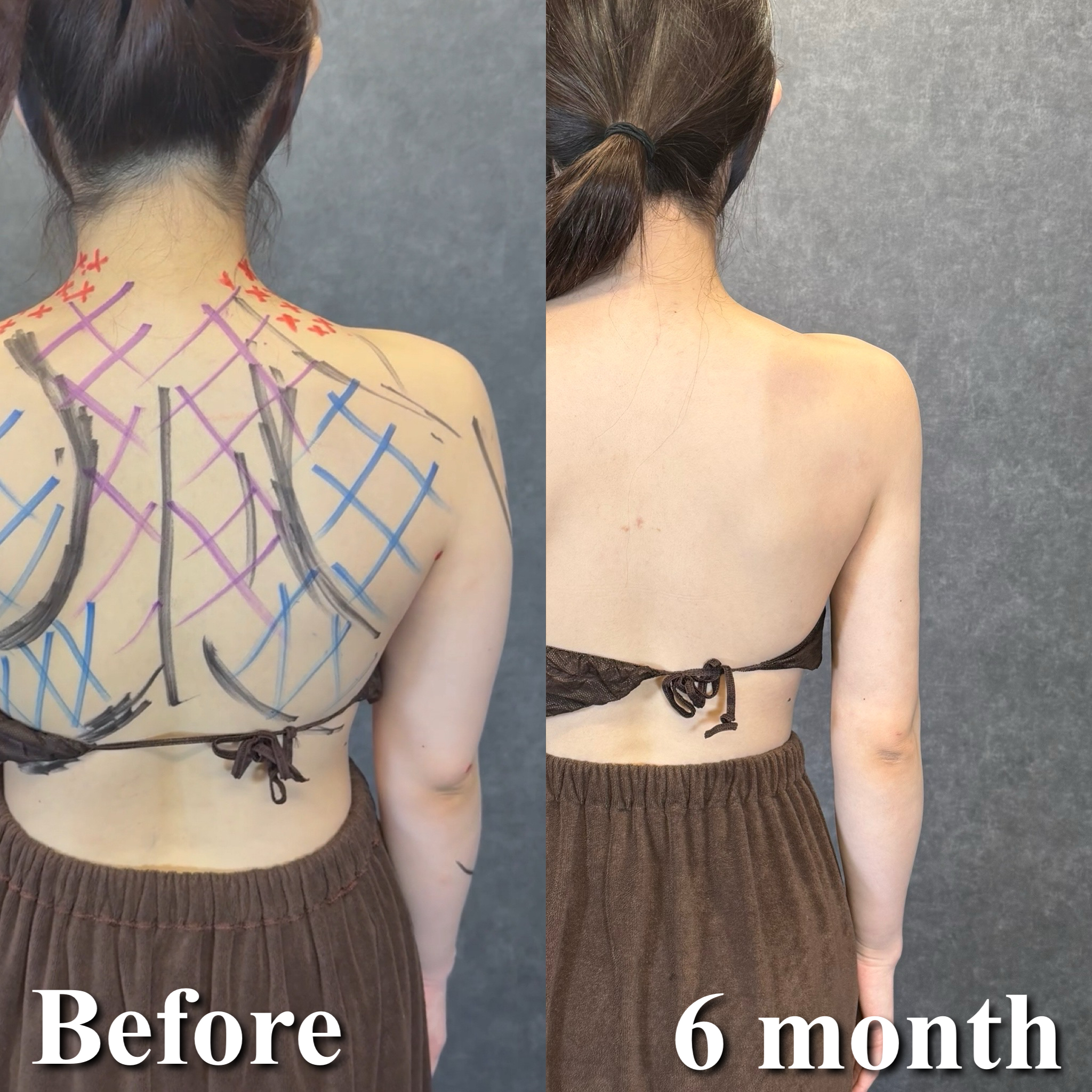
Left: before treatment / Right: 6 months after treatment. This patient underwent circumferential upper arm liposuction and liposuction above and below the shoulder blades, combined with a single trapezius injection session using a total of 200 units of botulinum toxin. Fat and muscle were assessed separately when planning the combined treatment.
Indicative standard price for the same treatment areas, including tax: ¥1,138,000–1,158,000. This comprises circumferential upper arm liposuction at ¥650,000, liposuction above and below the shoulder blades at ¥448,000, and 200 units of botulinum toxin at ¥40,000–60,000 (the price range for the products currently offered). Including anesthesia at ¥55,000–220,000, preoperative blood testing at ¥13,000, and an arm compression garment at ¥13,000, the estimated total is ¥1,219,000–1,404,000. Ultrasound-guided injection, if performed, costs an additional ¥10,000; a back compression garment, medications and other applicable items are charged separately. Some charges may not apply if you bring suitable blood test results or a compression garment.
Main risks include swelling, bruising, pain, tissue tightness or contracture, contour irregularities, asymmetry, infection and thrombosis associated with liposuction, as well as bruising, muscle weakness and shoulder or neck fatigue associated with injections. These photographs show one individual case and do not guarantee similar changes.
Case 2: Circumferential upper arm and forearm liposuction with trapezius injections
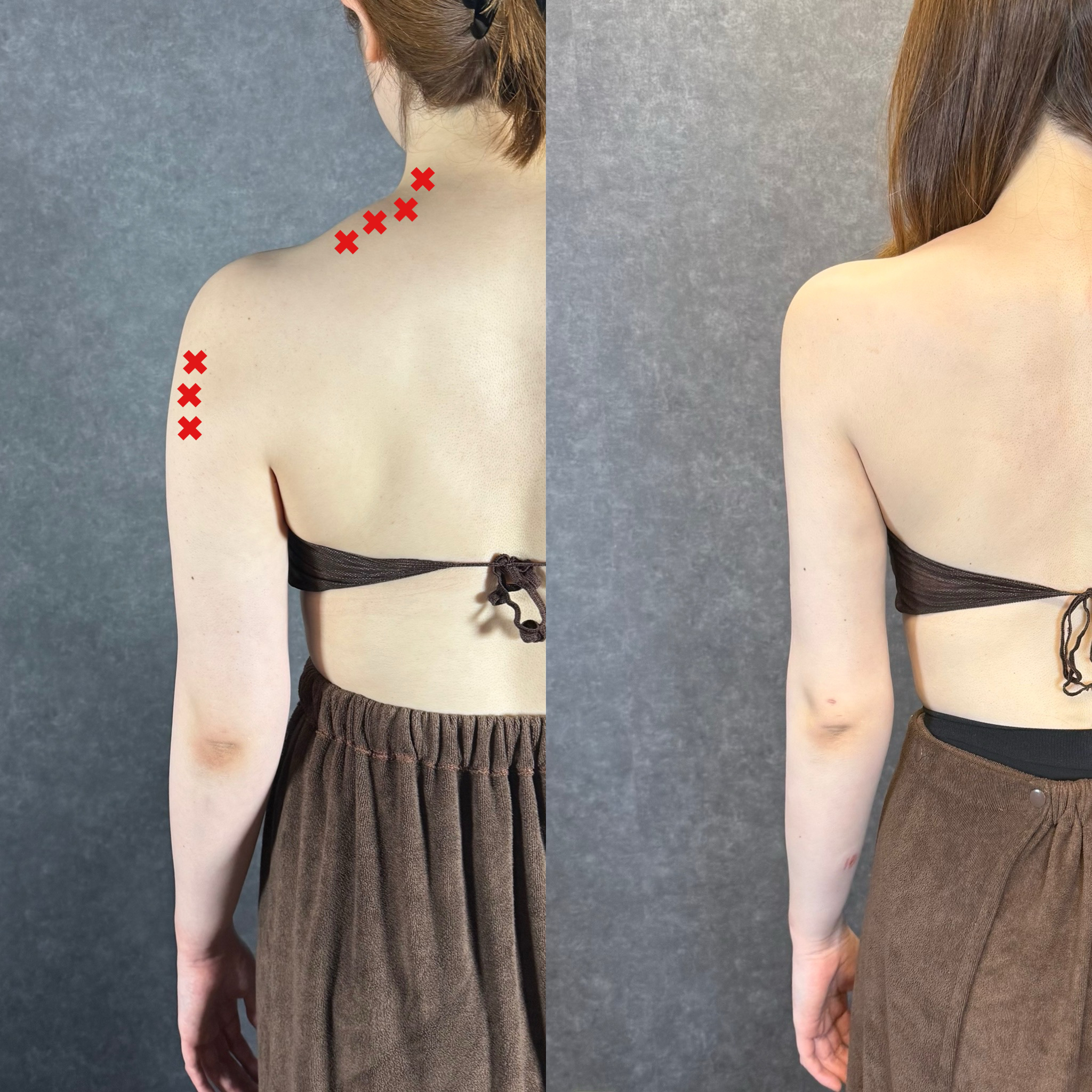
Left: before treatment / Right: 6 months after treatment. This patient underwent circumferential upper arm and forearm liposuction combined with a single trapezius injection session using a total of 200 units of Botulax. The 200-unit dose was used in this individual case and is not a recommendation for every patient.
Indicative standard price for the same procedures, including tax: ¥1,068,000. This comprises circumferential upper arm liposuction at ¥650,000, forearm liposuction at ¥378,000, and 200 units of Botulax at ¥40,000. Including anesthesia at ¥55,000–220,000, preoperative blood testing at ¥13,000, and an arm compression garment at ¥13,000, the estimated total is ¥1,149,000–1,314,000. Ultrasound-guided injection, if performed, costs an additional ¥10,000; medications and other applicable items are charged separately. Some charges may not apply if you bring suitable blood test results or a compression garment.
Main risks include swelling, bruising, pain, tissue tightness or contracture, contour irregularities, asymmetry, infection and thrombosis associated with liposuction, as well as bruising, muscle weakness and shoulder or neck fatigue associated with injections. Recovery and results vary between individuals.
The case prices are examples calculated using standard fees at the time of publication, not the actual amounts paid by the patients photographed. They assume a BMI below 25 and no additional options. Liposuction fees are multiplied by 1.5 for a BMI of 25–29 and by 2 for a BMI of 30 or above. We provide an estimate at the consultation that reflects the actual treatment areas, anesthesia method and any additional charges.
View upper arm liposuction procedures and prices / Explore estimated total liposuction costs
Shoulder Botox prices: Examples using 200 units
Shoulder Botox is a self-pay treatment that is not covered by Japan’s public health insurance. All prices below are in Japanese yen (JPY) and include tax.
| Item | Price including tax |
|---|---|
| Botulax | ¥200 per unit |
| Coretox | ¥300 per unit |
| Ultrasound-guided injection | Additional ¥10,000 |
Cost examples: A total of 200 units with ultrasound-guided injection
- Botulax: ¥40,000 + ¥10,000 = ¥50,000 including tax
- Coretox: ¥60,000 + ¥10,000 = ¥70,000 including tax
These are pricing examples, not recommendations to use 200 units. Units cannot be directly compared or converted between different products, and the same number of units does not imply the same effect. We will explain the appropriate product, dose and cost at your consultation. Liposuction is not included in these prices.
View our shoulder Botox treatment guide
Frequently asked questions about shoulder Botox
Q. What should I look for when choosing a clinic for regular shoulder Botox in Tokyo?
In addition to the dose and price, consider whether the doctor examines the cause of the prominence, checks muscle strength and the impact on daily life, and uses the previous response to guide the next treatment. Discuss ongoing care with a doctor who explains the limitations and side effects as well as the potential benefits.
Q. How often should I return for treatment?
We generally use an interval of at least 3 months as a guide and make the decision after assessing the treatment effect and recovery of muscle strength. If the changes are still present, we may extend the interval. The decision is based on your condition at the time, rather than on following a fixed injection schedule.
Q. How many units do I need? Should I choose 200 units?
The appropriate dose depends on muscle thickness, differences between the two sides, the product and your treatment history. The 200 units shown in the cases and pricing examples are not a universal guideline. We assess the dose at the consultation, including its potential effect on shoulder movement and function.
Q. If I have had 3 treatments without improvement, does that mean further change is impossible?
The number of treatments alone cannot answer this question. Muscles other than the trapezius, fat, bone structure or posture may be contributing. Details of previous products, doses and treatment dates, along with photographs of your progress, can help with reassessment.
Q. If my neck looks thick, should I have injections in my neck too?
There can be several reasons for neck thickness or fullness at the base of the neck. We assess the connection between the neck and shoulders, muscle function and bone structure without assuming that additional injections are needed. Some features may be difficult to improve with injections.
Q. When should I arrange a consultation before a wedding or photo shoot?
Visible changes are assessed over several weeks to months, so please consult us well ahead of an important event rather than immediately beforehand. Particularly for a first treatment or a combination with liposuction, we discuss a schedule that allows time to monitor your recovery and response.
Side effects and circumstances in which treatment may not be suitable
Main side effects include pain, swelling or bruising at the injection sites, asymmetry, shoulder or neck heaviness or fatigue, and muscle weakness. The cosmetic change you expect may not be achieved. Rarely, the product’s effects may extend to nearby or more distant muscles, potentially causing swallowing difficulties or effects on breathing. If you experience shortness of breath, difficulty swallowing or marked weakness, contact a medical provider and seek care promptly.[3]
Treatment may not be suitable if you are pregnant, may be pregnant, are breastfeeding, have a neuromuscular condition or have a history of allergy to an ingredient in the product, among other circumstances. Please tell us about your medical conditions, medications, pregnancy plans and any injections received at other clinics.
Products not approved in Japan and off-label treatment
Botulax and Coretox, the products used at our clinic, are not approved in Japan. Botulinum toxin injections to improve the contour of the shoulders or neck are also an off-label use, even when a product approved in Japan is used.
We obtain Botulax and Coretox through medical product suppliers.
Other botulinum toxin products are approved in Japan for different indications, but this does not mean they are approved for cosmetic shoulder treatment. In South Korea, both products are approved by the Ministry of Food and Drug Safety (MFDS) for indications including the temporary improvement of glabellar lines; cosmetic shoulder treatment is not among their approved indications. The Korean product information for both includes warnings about the possible spread of toxin effects beyond the injection site, muscle weakness, difficulty swallowing and difficulty breathing.[4][5] Approval overseas does not guarantee the effectiveness or safety of this treatment. Treatment using these products, which are not approved in Japan, is not covered by Japan’s Relief System for Adverse Drug Reactions.
Treatment approach: Clinic Director Dr. Shin Moriwaki
This article organizes the principles of assessment and treatment planning described in Dr. Moriwaki’s X posts about shoulder Botox. Individual cases and doses shared on social media are not presented as treatment recommendations that apply to everyone.
Read Dr. Shin Moriwaki’s profile
Considering ongoing shoulder Botox care in Ginza, Tokyo?
“I have had shoulder Botox, but the prominence still bothers me.” “Next time, I would like to discuss the injection approach as well.” At AVAN TOKYO, we review your current neck and shoulder condition and previous progress, then discuss a treatment plan—including whether further treatment is appropriate.
AVAN TOKYO Ginza Liposuction Clinic
DEAR GINZA 3F, 1-6-8 Ginza, Chuo-ku, Tokyo
1-minute walk from Exit 6 of Ginza-itchome Station on the Tokyo Metro Yurakucho Line
Hours: 10:00–19:00 / Closure days vary
Phone: 03-5915-4731
References
- Wang L, et al. Ultrasonographic Analysis of Trapezius Muscle for Efficient Botulinum Toxin Type A Injection. Aesthetic Plast Surg. 2023.
- Jankovic J, et al. Neutralizing Antibody Formation with OnabotulinumtoxinA Treatment from Global Registration Studies across Multiple Indications: A Meta-Analysis. Toxins. 2023.
- PMDA: BOTOX for Injection 50 Units / 100 Units, electronic prescribing information (revised June 2026; in Japanese)
- South Korean MFDS: Botulax product information (in Korean)
- South Korean MFDS: Coretox product information (in Korean)
These references were used to verify general medical information. The products, participants and methods used in the studies are not identical to every treatment performed at our clinic, and the published study results are not a guarantee of individual outcomes.