


Supraclavicular (Shoulder SC) Liposuction with Arm Contouring: A Case Study2026.09.06
Supraclavicular liposuction — what we internally call “shoulder SC” — is a design procedure that only makes sense when paired with upper-arm liposuction. If the arms alone are slimmed but a layer of fat remains above the clavicle and over the deltoid, the back view, the shoulder width and the neck line still look flat and undefined. Based on one of our combined arm-and-supraclavicular cases, Dr. Moriwaki explains why these two areas must be treated together, and the design and intraoperative decisions that shape the outcome.
Key Takeaways
・Supraclavicular liposuction thins the superficial fat above the clavicle and over the deltoid to create the “shadow” that defines the collarbone and shoulder.
・Arm liposuction alone cannot complete an upper-body linear silhouette; treating the supraclavicular region at the same time unites neck, shoulder and arm into a continuous line.
・More volume is not always better — cases with as little as ~200ml of total aspirate can transform the clavicle-to-shoulder impression.
・Incisions can be consolidated to two hidden ports behind the axilla, staying invisible under sleeveless tops and swimwear.
・A bolero-type compression garment is worn for several weeks; the final result matures over 3–6 months after the fibrotic phase.
What Is Supraclavicular Liposuction? Creating the “Shadow” Above the Clavicle and Deltoid
In our clinic, “SC” stands for supraclavicular — the thin superficial fat pad running from just above the clavicle to the origin of the deltoid. The layer itself is only a few millimeters to about a centimeter thick, but if fat is “riding” on it, the collarbone sinks visually, the junction between neck and shoulder blurs, and the overall impression becomes “short neck, wide shoulders.” Supraclavicular liposuction is a design procedure that thins this layer just enough to cast a natural shadow along the collarbone and shoulder. The goal is not fat reduction per se but revealing the skeletal contour through light and shadow.
Why Arm Liposuction Alone Cannot Complete the Upper-Body Line
The upper arm has to be designed as a continuum across the triceps side (the classic “bat-wing” area), the lateral aspect and the base of the shoulder (immediately below the deltoid). If any of these zones is treated in isolation, a visible step remains. Especially from the base of the shoulder to the outer arm, fat thickness changes gradually — this is a continuous field, and the principle is to suction it as a “surface” rather than along a boundary. Therefore, if the goal is a truly refined arm, the treatment inevitably extends into the supraclavicular region above. Leaving this area untouched slims the arm but leaves the shoulder full, so the upper body still reads as a rectangular silhouette from both front and back.
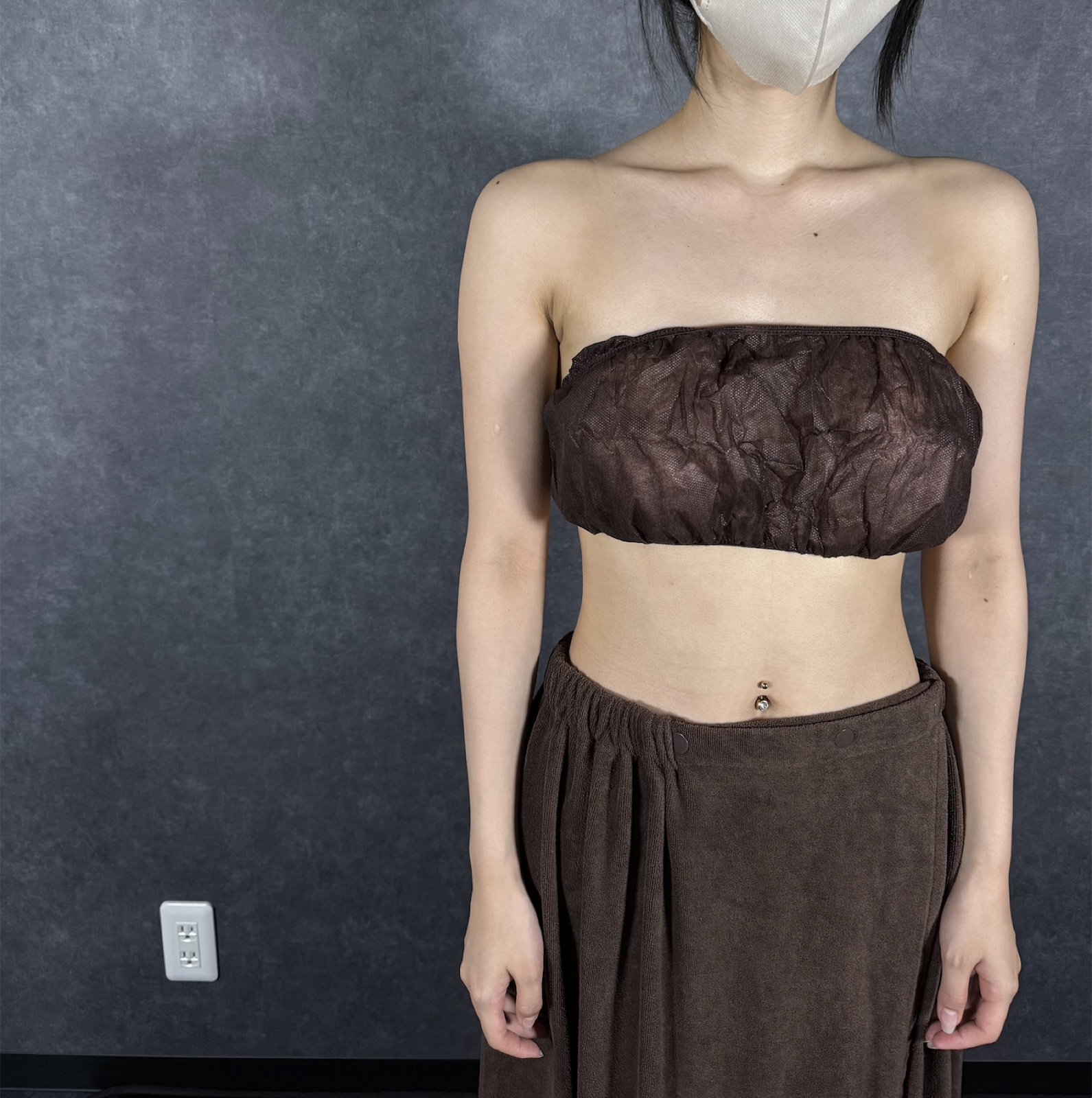
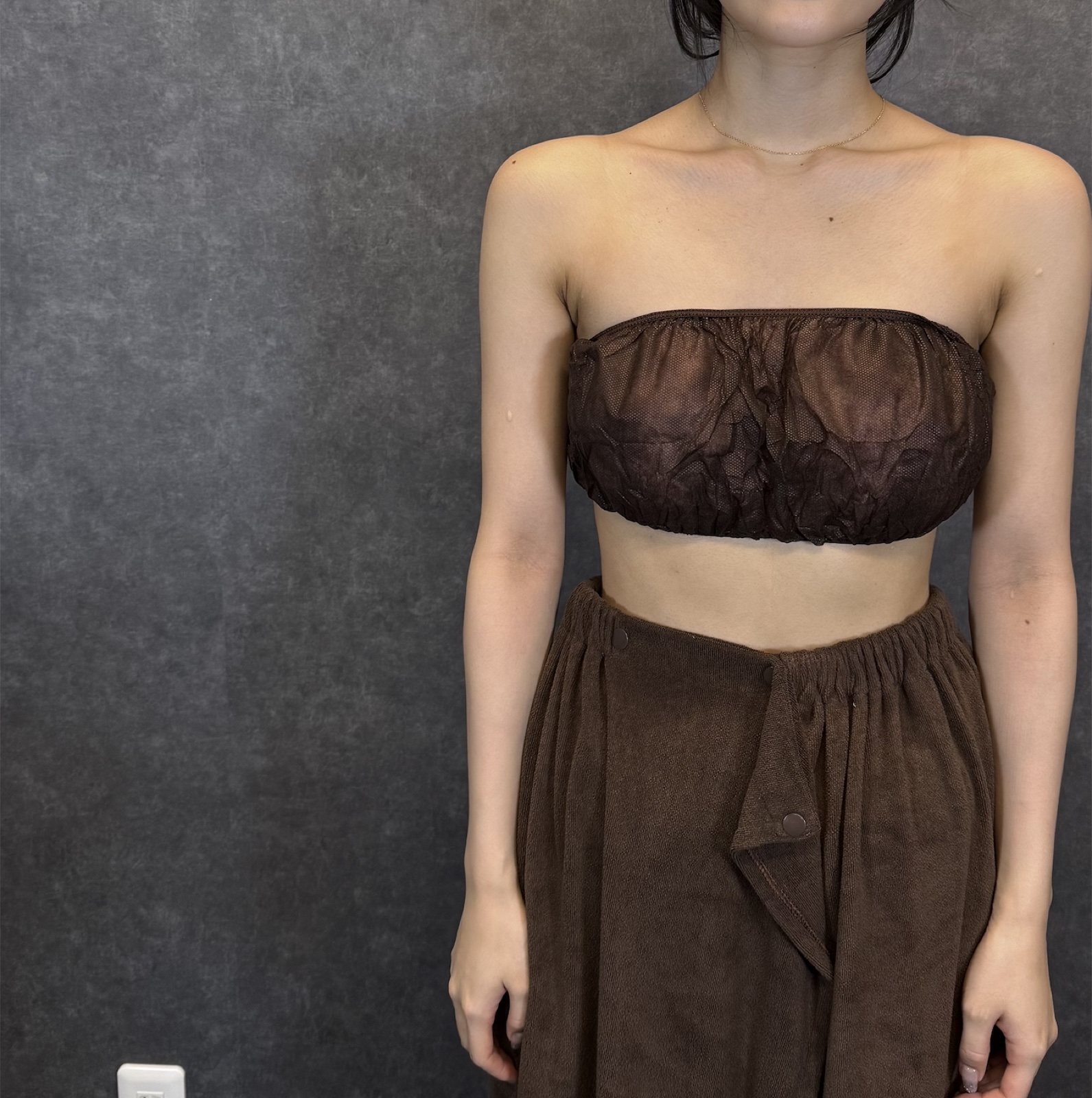
Case Overview: Woman in Her 30s, Combined Arm and Supraclavicular Liposuction
This case involved a woman in her 30s who underwent simultaneous liposuction of the upper arms and the supraclavicular region. She was not overweight; her concern was fat “riding” around the collarbone that made her neck look short and her shoulders look wide in sleeveless tops and back views. Total aspirate was approximately 200ml — a small figure by absolute measure. The aim was not weight loss but restoring a straight visual line from the clavicle through the shoulder to the arm. In this region, design precision takes priority over volume. Anesthesia combined intravenous sedation with nitrous oxide, so postoperative recovery from anesthesia was minimized.
Design Rationale: Sculpting the Back-View and Clavicle Line Through “Shadow”
Preoperative marking is always done in the standing position. In seated or supine positions, gravity redistributes fat and the drawing no longer matches the silhouette others actually see. In this case, we marked in the following order: ① a V-line along the upper margin of the clavicle, ② a continuous line from the supraclavicular zone into the outer upper arm using the deltoid origin (the shoulder curve) as the boundary, and ③ the bat-wing (posteromedial) area last. The design goal is not “how much can I take out” but revealing the clavicle and shoulder contour through light and shadow. To make the collarbone show, one does not touch the bone itself — one uniformly thins the superficial fat layer resting on top of it.
Intraoperative Findings: Cannula Path and Control of the Subcutaneous Plane
The superficial supraclavicular layer sits under thin skin, and deep to it run the clavicle, major vessels and the brachial plexus. Accordingly, the cannula is passed parallel to the bony surface directly above the clavicle, in a fan pattern confined to the superficial subcutaneous plane. Not applying downward pressure, choosing a small-caliber cannula (2–3mm range), and drawing the tissue thin and uniform are essential safety principles for this area. On the arm side, we worked in stratified layers (superficial and mid) from the bat-wing region, through the lateral aspect, and into the sub-deltoid zone, treating them continuously so no boundary was left. Rather than fixing the cannula in one direction, we crossed the tissue from multiple approach angles to prevent linear “grooves.”
Scar Design: Consolidating Access into “Invisible” Ports Behind the Axilla
In this case, all access was through two ports behind the axilla. Ports placed here sit between the trunk and the arm when the arm is at rest and are effectively hidden from external view even in sleeveless tops or swimwear. A single cannula introduced through this position can be angled in a fan pattern to reach the arm, the supraclavicular region and the sub-deltoid area through only one or two ports. Minimizing the number of incisions matters not only cosmetically but also because it reduces the total scar and pigmentation load — an especially important consideration for patients prone to keloids or postinflammatory pigmentation.
The Role of the Bolero Compression Garment and How Long to Wear It
A bolero-type compression garment covering the shoulders and both upper arms is worn postoperatively. Compression serves three purposes: ① closing dead space in the subcutaneous plane to prevent seroma, ② allowing skin to reattach along the new subcutaneous topography created by liposuction, and ③ smoothing edema and the irregularities that appear during the fibrotic phase. Duration is individual, but a common guide at our clinic is all-day wear for the first 1–3 weeks and night-only wear for several more weeks. Excessive tightness can trigger contact dermatitis or nerve compression, so garment fit and wear time are guided individually.
Treatment, Cost and Risks for This Case
・Procedure performed: liposuction of the upper arms (bat-wing and lateral) plus the supraclavicular / sub-deltoid region. Anesthesia was intravenous sedation with nitrous oxide, and a bolero-type compression garment was fitted.
・Cost: please refer to our pricing page. The fee varies with BMI, combined sites and devices used. The final quote is confirmed at consultation.
・Main risks / side effects: bruising, swelling, numbness, tenderness, fibrotic hardness and irregularity (1–3 months postoperatively), asymmetry, and less commonly infection, seroma, skin laxity, pigmentation, and — very rarely — nerve injury.
・Results vary between individuals. The photographs shown are one example; the same technique can produce different outcomes depending on constitution, skin elasticity and adherence to aftercare.
Postoperative Course and Complications
Swelling and bruising peak in the first week and superficial swelling begins to settle over 2–4 weeks. Between 1 and 3 months, patients enter the fibrotic (“contracture”) phase, when hardness and tightness are common; avoiding excessive exercise and vigorous massage while preserving range of motion during this window largely determines the final result. Final settling typically occurs 3–6 months postoperatively. Rare complications include infection, seroma, localized numbness and skin laxity — any abnormal signs should be evaluated promptly by the operating surgeon. General safety standards in cosmetic surgery can also be reviewed through the Japan Society of Aesthetic Surgery (JSAS).
For more detailed articles on techniques and combined procedures, please see our liposuction column index.
Frequently Asked Questions
Q. Can supraclavicular liposuction be done alone, without the upper arm?
It can, but in most cases treating the outer upper arm and the area just below the deltoid in continuity with the supraclavicular region produces a more natural, borderless result. At consultation we assess shoulder, arm and clavicle in a standing position to decide whether a single-site or combined procedure is right for you.
Q. Only 200ml was removed — is that really enough to make a difference?
The supraclavicular region is a thin, superficial fat layer, so even tens of milliliters change how the collarbone shows and how long the neck appears. In this region, design precision matters more than raw volume.
Q. How long until the scars become invisible?
The incisions behind the axilla are a few millimeters and mature into faint pale dots over 3–6 months. Patients with a keloid tendency or a predisposition to pigmentation require individualized aftercare.
Q. How long do I have to wear the bolero compression garment?
As a general guide, all-day wear for 1–3 weeks postoperatively, then night-only wear for several more weeks. We adjust based on skin fit and how the fibrotic (contracture) phase evolves. Excessive tightness can cause contact dermatitis or nerve compression, so we individualize sizing and duration.
Q. When can I return to work?
For desk-based work, most patients return within a few days to a week. Overhead arm work or heavy upper-body labor should be avoided for 2–4 weeks. There is individual variation, so we decide based on follow-up.
──────────────
Supervising Physician: Dr. Shin Moriwaki
Member, Japan Society of Aesthetic Surgery (JSAS) / Member, American Academy of Aesthetic Medicine
ECFMG Certificate
──────────────
📍AVAN TOKYO Ginza Liposuction Clinic
AVAN TOKYO GINZA LIPOSUCTION CLINIC
English / 中文 / Tiếng Việt available
For appointments and consultations, please reach us via
DM / LINE / Website / Phone.