


Fat Breast Augmentation Retention Rate for Slim Body Types | Why 2+ Sessions Are Recommended2026.11.23
“No silicone implants — ever. But I want a real bust size increase.” This is one of the most common requests I receive.
Fat transfer breast augmentation is the primary option when implants are out of the question. For slim patients, though, predicting “how much can be harvested” and “how much will survive” is especially challenging.
This article explains why slim body types tend to have lower fat breast augmentation retention rates and the rationale for recommending two or more sessions, based on a case from our clinic.

The short answer
Slim body types tend to have lower fat breast augmentation retention rates than average, and if aiming for two or more cup sizes, two or more sessions are a realistic option. The practical approach is to review results at six months after the first session before planning additional injections.
Why Two or More Sessions Are a Realistic Option for Improving Fat Breast Augmentation Retention Rate
If you want natural-looking volume without implants, fat transfer breast augmentation is a valid choice. However, achieving a guaranteed two-cup increase in a single session is difficult.
I generally recommend planning for two or more sessions from the start.
【Comparison of Breast Augmentation Methods】
| Fat Transfer — 1 Session | Fat Transfer — 2+ Sessions | Silicone Implant or Hybrid | |
|---|---|---|---|
| Benefits | ・No foreign material ・Shorter downtime |
・No foreign material ・Better retention from the 2nd session onward ・Fat more likely to settle in the bust with weight gain |
・Stable volume achievable in one session ・More predictable even for slim body types |
| Drawbacks | ・Difficult to predict how much fat will survive ・Limited harvest volume for slim patients |
・Requires multiple surgeries and downtime periods | ・Involves a foreign implant ・May feel or appear unnatural in some cases |
| Best for | ・Patients with adequate donor fat ・Those satisfied with modest improvement |
・Slim patients aiming for 2+ cup increase without implants | ・Slim patients wanting predictable volume in one session |
Fat Transfer — 1 Session
- Benefits
- ・No foreign material
・Shorter downtime - Drawbacks
- ・Difficult to predict how much fat will survive
・Limited harvest volume for slim patients - Best for
- ・Patients with adequate donor fat
・Those satisfied with modest improvement
Fat Transfer — 2+ Sessions
- Benefits
- ・No foreign material
・Better retention from the 2nd session onward
・Fat more likely to settle in the bust with weight gain - Drawbacks
- ・Requires multiple surgeries and downtime periods
- Best for
- ・Slim patients aiming for 2+ cup increase without implants
Silicone Implant or Hybrid
- Benefits
- ・Stable volume achievable in one session
・More predictable even for slim body types - Drawbacks
- ・Involves a foreign implant
・May feel or appear unnatural in some cases - Best for
- ・Slim patients wanting predictable volume in one session
Reason 1: Slim Patients Have Limited Fat Available for Harvesting
The amount of fat that can be harvested depends on the patient’s body composition. Those with a low BMI have less fat in areas like the arms and back, limiting the volume injected per session.
A large-scale study from Europe and North America tracking several thousand patients reported an average fat retention rate of 53%.
Japanese patients tend to be slimmer, meaning the fat breast augmentation retention rate may be even lower for many.
Reason 2: By the 2nd Session, the Breast Has Become More Receptive
After the first fat transfer, new blood vessels develop within the breast tissue (angiogenesis). These vessels support the survival of fat cells injected in a second session, improving retention.
Additionally, once more fat cells are established in the breast, the area tends to accumulate more fat with weight gain.
Our Case
Case with Improved Bust Line and Silhouette (Female, 20s)
Fat harvested from the full circumference of both arms and from the back was transferred to the breasts. The injection volume was 260 cc on the right and 250 cc on the left — a single session.
The patient maintained mindful eating habits throughout recovery, and at the six-month follow-up, the transferred fat had been well retained.
Before
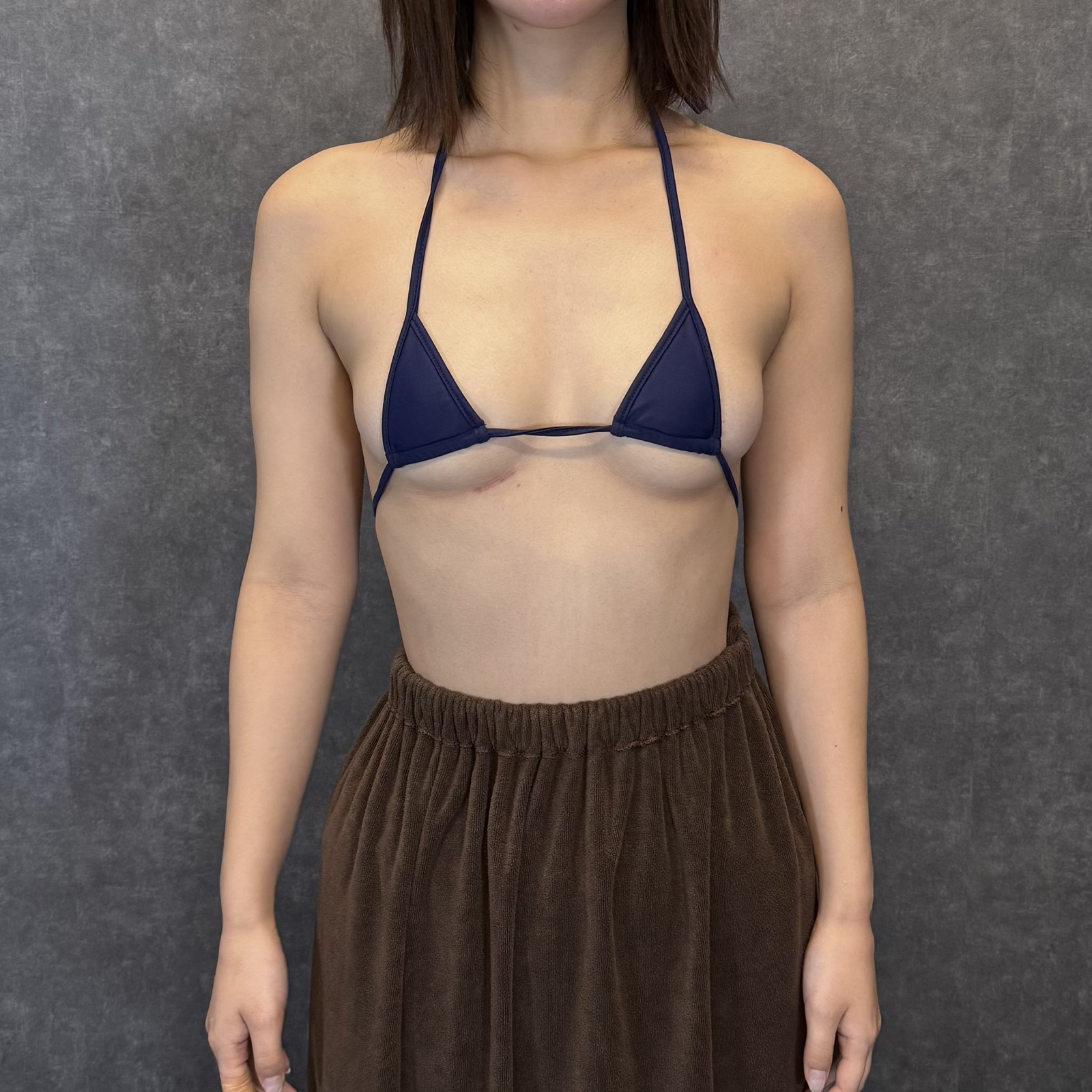
Full-circumference arm & back liposuction, fat transfer breast augmentation | Before
6 Months After
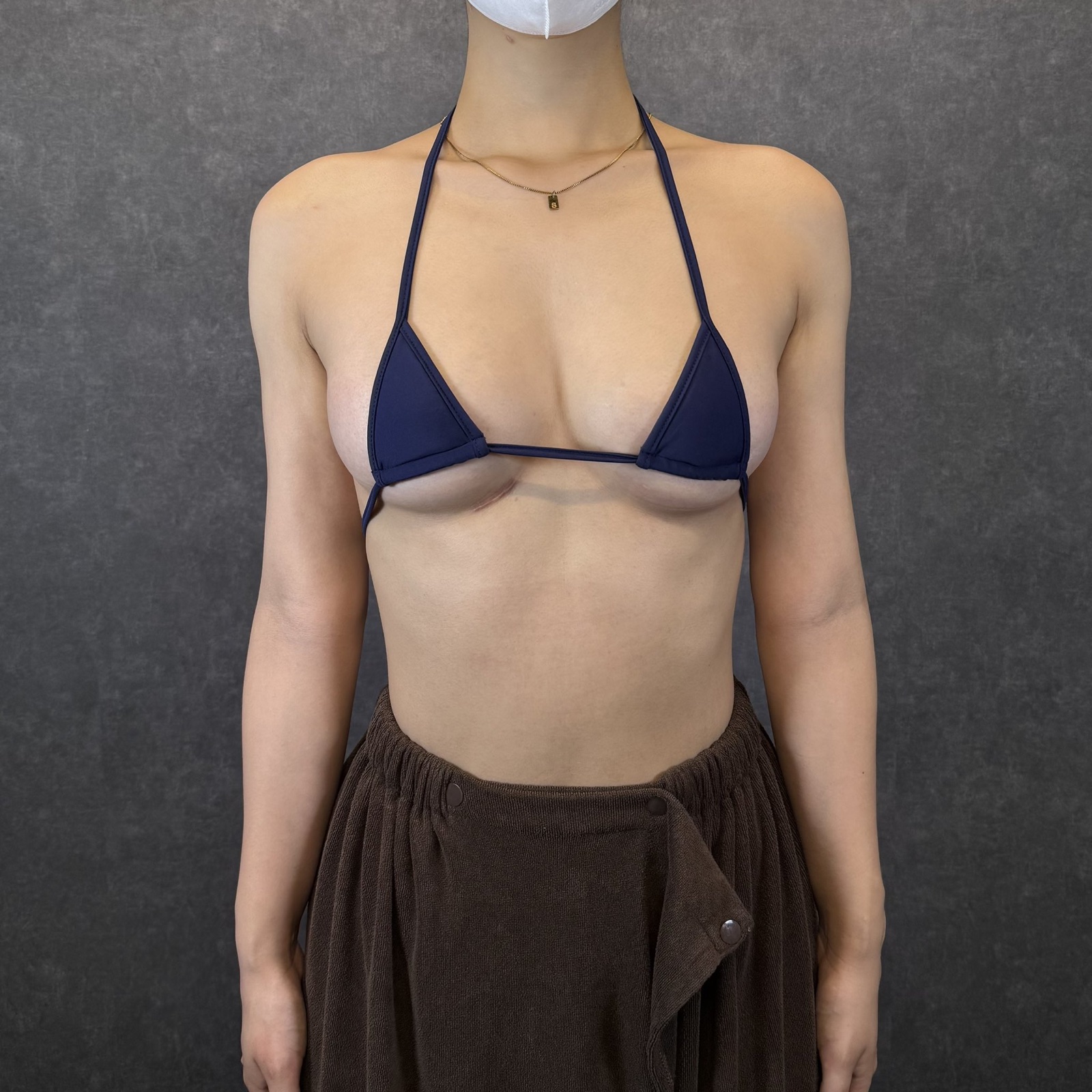
Full-circumference arm & back liposuction, fat transfer breast augmentation | 6 months post-op
From the front, the arms are noticeably slimmer and the bust has gained volume.
This approach — slimming the arms while redirecting their fat to the chest — allows the upper body to be reshaped as a connected unit in a single procedure.
Before
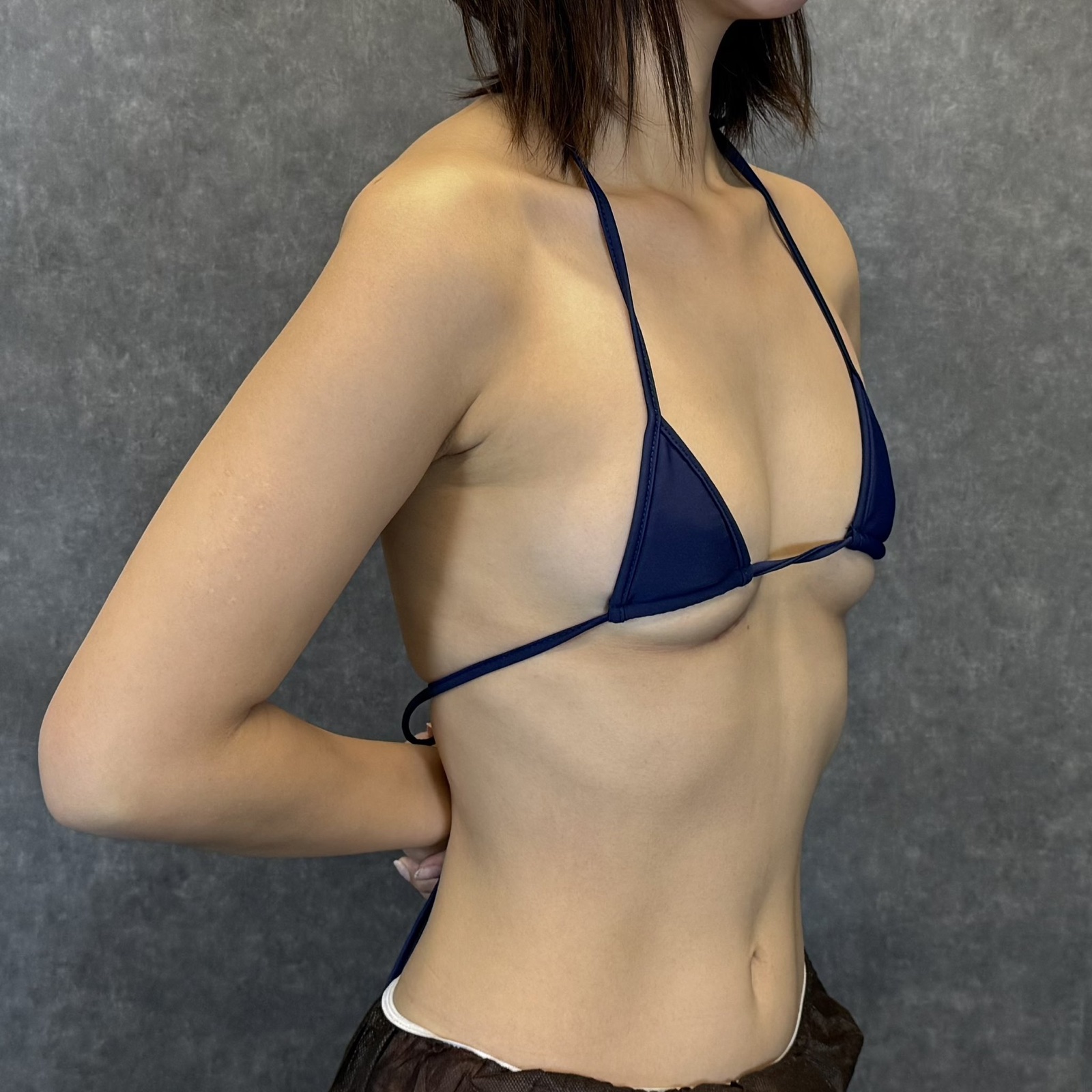
Full-circumference arm & back liposuction, fat transfer breast augmentation | Before (side view)
6 Months After
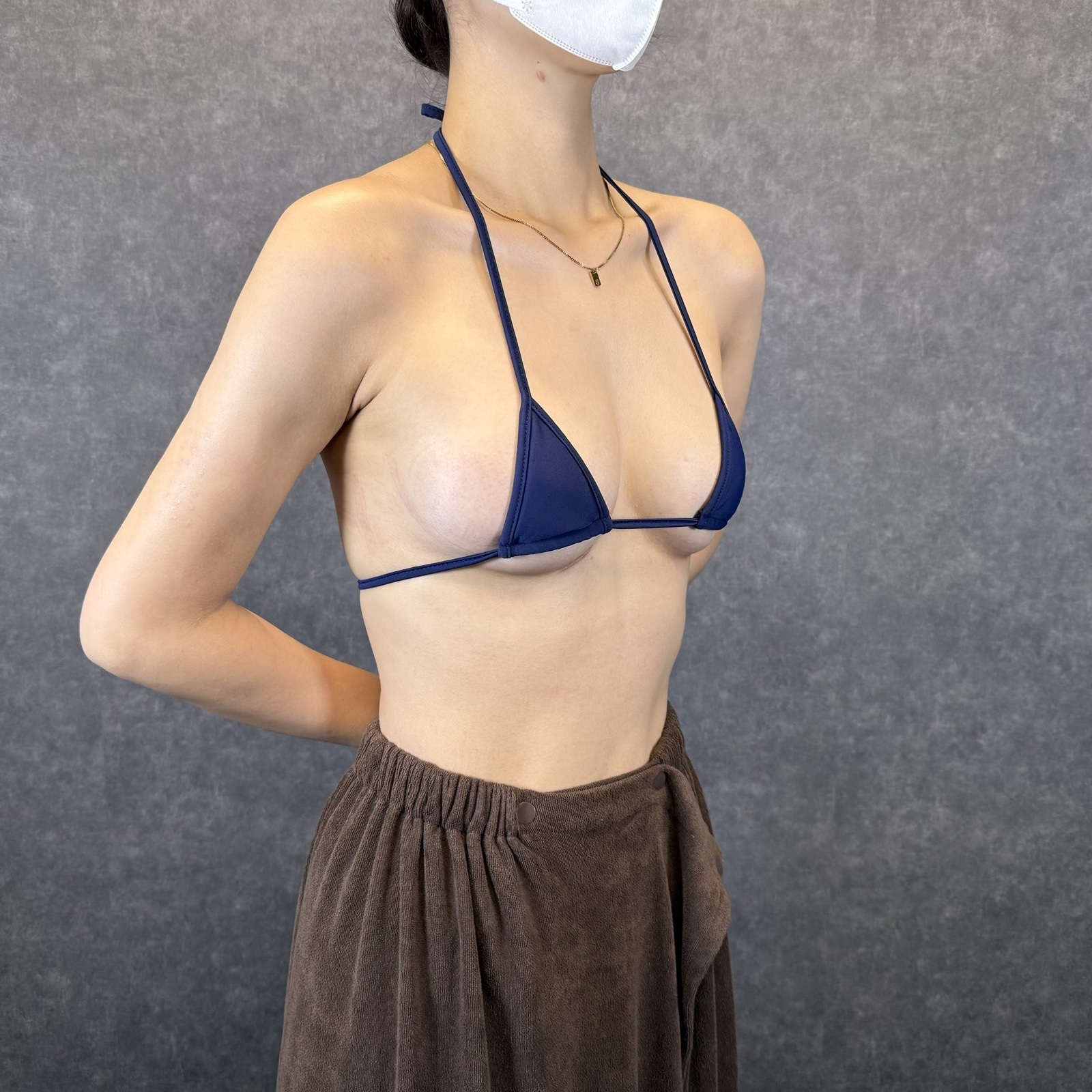
Full-circumference arm & back liposuction, fat transfer breast augmentation | 6 months post-op (side view)
From the side, the bust shows increased forward projection, and the lines from the back through the arms are visibly more defined.
| Procedure | Full-circumference arm liposuction, back liposuction, fat transfer breast augmentation |
|---|---|
| Details | Fat harvested from full-circumference arms and back, then injected into the breasts (right 260 cc, left 250 cc) |
| Photo timing | 6 months post-op |
| Cost | Please refer to our price page for details (final cost confirmed at consultation) |
| Main risks / side effects | Bruising, swelling, fibrosis (contracture), lumps, asymmetry, variable retention, infection, etc. |
Results vary by individual. Photos are representative examples only.
Which Body Types Have Lower Fat Breast Augmentation Retention Rates?
Low BMI and Slim Build Are Associated with More Difficult Fat Retention
The volume of fat that can survive in the breast is proportional to the existing breast tissue volume and softness.
Slim patients have less native breast tissue, so the breast has a lower capacity to accommodate transplanted fat at once.
Injecting too large a volume at once increases the risk of fat necrosis in areas that cannot be reached by blood flow. Injecting small amounts carefully in multiple layers is the foundation of improving retention rate.
What Changes with Two or More Sessions?
The First Session Builds the Foundation for the Next
After the first session, new blood vessels develop in the breast, improving the environment for the second injection. As more fat cells are established, the breast also becomes more responsive to weight gain.
The practical approach is to assess the results of the first session at six months before planning the second.
How Long Does Downtime Last?
Pain Peaks at Days 2–3; Swelling Settles in 2–3 Weeks
In the liposuction donor areas (arms and back), pain peaks around days 2–3 and settles within about 10 days. Bruising and swelling resolve over 2–3 weeks.
Fibrosis (a firm, tight sensation in the skin) peaks around one month post-op and usually softens over about three months. The breast side mainly experiences swelling, with less prominent fibrosis than the arm.
Bathing and vigorous exercise can be resumed two weeks after surgery.
Potential Risks and Prevention
Lumps, Asymmetry, and Variable Retention Are the Main Risks
The main risks of fat transfer breast augmentation include:
・Lumps: Fat that does not survive may calcify and remain as a palpable lump. Softer lumps often diminish over time.
・Variable retention: Even with the same injection volume, the amount that survives varies by individual. Rest, diet, and compression during recovery can influence the outcome.
・Asymmetry: Retention may differ between the two sides. If the difference is significant, additional injection is an option.
・Infection: Rare, but if pain or warmth increases after surgery, please contact us promptly.
For safety standards in aesthetic surgery, please refer to the Japan Society of Aesthetic Surgery.
Summary | Planning Realistically for a Slim Body Type
For slim patients aiming for two or more cup sizes without implants, the final result of a single fat transfer session depends on the product of injection volume and retention rate.
Data from Western studies puts the average retention rate at 53%, and the figure may be lower for slim Japanese patients.
Planning two or more sessions from the outset means the first session also prepares the breast environment for the next.
The practical approach is to review the first session results at six months, then plan additional injections as needed.
View our full column archive here. We encourage you to come in for a consultation to assess your donor fat, body type, and injection plan.
Frequently Asked Questions
- Can fat transfer breast augmentation be performed on slim patients?
-
Yes. However, the amount of harvestable fat is limited, so planning two or more sessions tends to produce more realistic and reliable results than aiming for major volume in a single session.
- How long should I wait between sessions?
-
As a general guideline, we recommend waiting at least six months after the first session to confirm how much fat has been retained before planning the second.
The exact timing depends on the individual and will be discussed at your follow-up appointment.
- Does all of the harvested fat survive in the breast?
-
No. The harvested fat is purified before injection, and only a portion of the injected fat survives. The relationship is: harvested volume > injected volume > retained volume.
- How will downtime affect my work and daily life?
-
Patients with desk jobs sometimes return to work the following day, though pain levels vary. We recommend avoiding arm-intensive tasks and heavy lifting for about two weeks after surgery.
- What should I do if I develop a lump in my breast after surgery?
-
Soft lumps often become smaller over time. If a lump feels firm or causes pain, please come in for a check-up as soon as possible.
- Is recovery different for the arm donor site versus the breast?
-
The arms (liposuction donor area) are more prone to fibrosis, which typically peaks around one month post-op. The breast side mainly experiences swelling, with less prominent fibrosis.
When both are treated simultaneously, we recommend resting for the first one to two weeks.
- Will my bust grow larger if I gain weight after the procedure?
-
The retained fat cells are living tissue, and they can enlarge with weight gain, increasing bust volume.
The more sessions you have, the more fat cells are established in the breast, and the stronger this effect tends to be. Individual results vary.
This article is based on a post by Dr. Moriwaki on X (@doctor_shin_). View the original post
For prices, case photos and FAQs, see the fat transfer breast augmentation page.
Book a consultation
1 min walk from Exit 6, Ginza-itchome Station / Open 10:00–19:00
About the supervising physician

Director, AVAN TOKYO Ginza Liposuction Clinic
Graduated from Tokushima University School of Medicine.
Worked at Tokushima University Hospital, Tokyo Chuo Cosmetic Surgery and Gracia Clinic before taking up the current position.
Over 5,000 liposuction procedures performed (including previous positions).
Certifications
・VASER Lipo certified physician
・ECFMG Certificate
Memberships
・Member, Japan Society of Aesthetic Surgery (JSAS)
・Full member, Japanese Society for Regenerative Medicine
・Member, American Academy of Aesthetic Medicine