


Protecting the Marginal Mandibular Nerve in Submental Liposuction | Dr. Moriwaki Explains Corner-of-the-Mouth Droop Risk and Safe Suction Planes2026.08.08
Submental liposuction, often chosen to sharpen the jawline, is a highly safe procedure with barely visible scars when performed in the correct plane. However, just beneath the inferior border of the mandible runs the marginal mandibular branch of the facial nerve, which controls the movements of expression muscles. Injury to this branch can cause long-term changes such as a drooped corner of the mouth or an asymmetric smile. In this column, submental liposuction marginal mandibular nerve anatomy and the strategy for choosing a safe suction plane to minimize corner-of-the-mouth droop are explained in detail by Dr. Shin Moriwaki, supervising physician at AVAN TOKYO.
Key Points of This Article
・Injury to the submental liposuction marginal mandibular nerve can cause changes such as corner-of-the-mouth droop or an asymmetric smile that are difficult to reverse.
・The marginal mandibular branch runs within 1 to 2 cm above or below the inferior border of the mandible, and often passes below the bone near the mandibular angle.
・Liposuction should be performed in the subcutaneous plane superficial to the platysma; avoiding deep drift is the top priority.
・The cannula opening should always face the skin, and never be pressed hard toward the mandible.
・Temporary difficulty moving the corner of the mouth after surgery is usually due to edematous compression; permanent nerve injury is extremely rare.
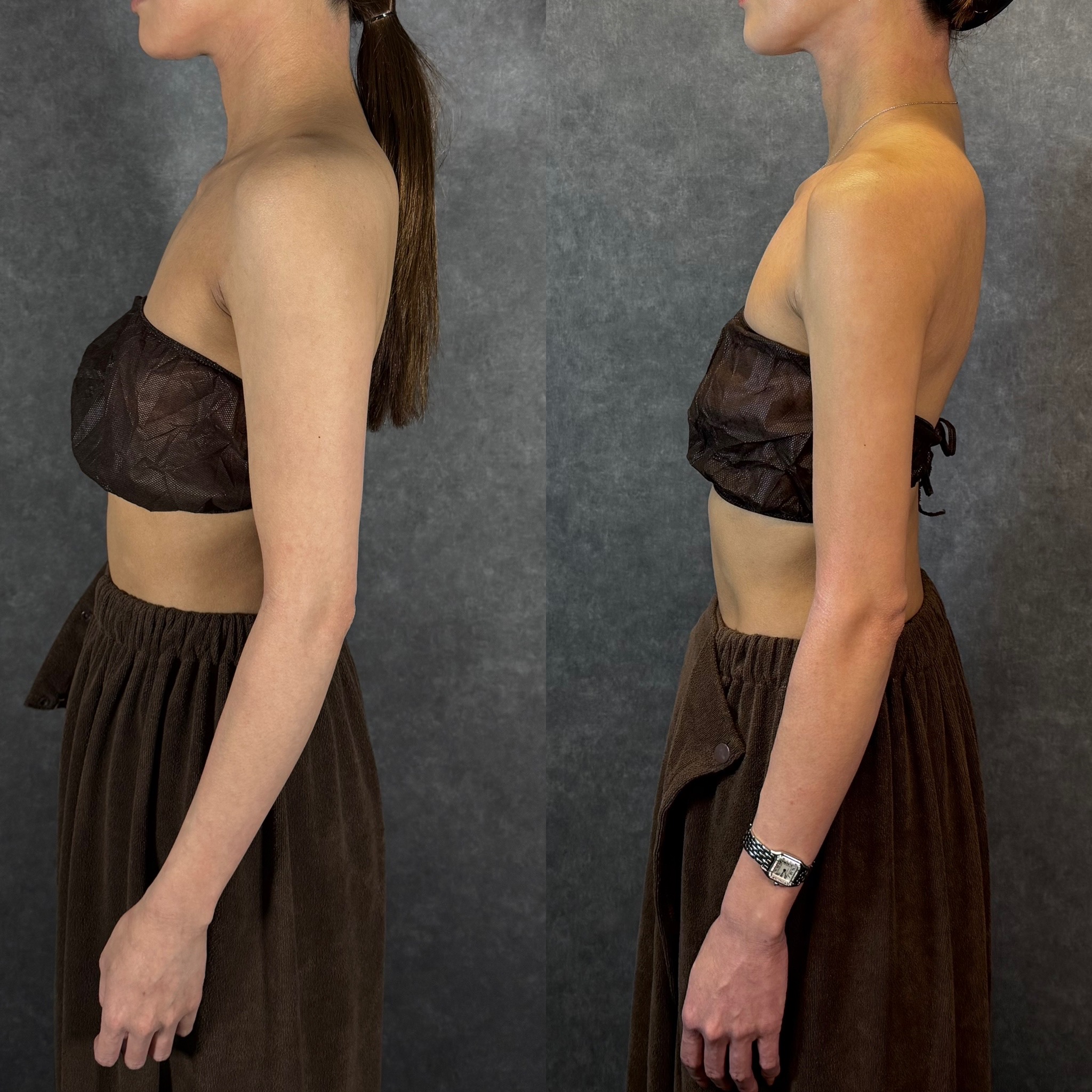
Anatomical Location of the Submental Liposuction Marginal Mandibular Nerve
After branching from the main trunk of the facial nerve within the parotid gland, the marginal mandibular branch temporarily descends below the inferior border of the mandible near the mandibular angle, enters the neck, then travels forward to supply the depressor anguli oris (DAO), depressor labii inferioris (DLI), and mentalis muscles. Existing anatomical studies show that near the mandibular angle the marginal mandibular branch can run up to 1 to 2 cm below the inferior mandibular border, gradually returning above the bone as it approaches the corner of the mouth. Keeping this three-dimensional picture in mind is the first step in protecting the nerve during submental liposuction.
Relationship with the platysma
The marginal mandibular branch runs deep to the platysma and below the SMAS (superficial musculoaponeurotic system). Conversely, if suction is carried out only in the subcutaneous plane superficial to the platysma, the nerve cannot in principle be directly injured. The essence of submental liposuction marginal mandibular nerve risk lies in unintended drift into the deep plane.
Safe Suction Plane: The Meaning of Staying in Superficial Fat (Subcutaneous)
Submental fat is broadly divided into a superficial layer (subcutaneous fat) and a deep layer (subplatysmal fat) beneath the platysma. Aesthetic submental liposuction should target only the superficial layer; deep fat suction lies close to the marginal mandibular branch, the digastric, the submandibular gland, and major vessels, and belongs to a domain that requires open, direct-view surgical technique. Reaching casually into the deep plane must be avoided, and staying within the correct layer through repeated palpation of skin thickness and fat depth is essential.
Cannula orientation and movement
The core of safe technique is always keeping the cannula opening facing the skin (the superficial side). Pressing the cannula with its opening turned toward the bone increases the risk of breaching the platysma and drifting into deep tissue. Near the mandibular angle, the operator should consciously limit the range of fan-shaped strokes in the 1 to 2 cm zone below the inferior mandibular border. Choosing a small-caliber cannula (around 2 mm) is also effective for both nerve protection and irregularity prevention.
How to Assess Suspected Corner-of-the-Mouth Droop or Asymmetry
Difficulty moving the corner of the mouth in the first week after surgery is usually a transient nerve compression by residual tumescent fluid or postoperative edema and typically improves within days to weeks. On the other hand, if lower-lip asymmetry when smiling (the affected side fails to drop or rise) persists beyond 3 months, nerve stretch injury (neuropraxia) or partial disruption should be suspected, and detailed evaluation is required. Do not leave it untreated on the assumption that time alone will resolve it; a consultation with your surgeon is important.
Electrophysiological evaluation and recovery timeline
For persistent nerve symptoms, nerve conduction studies and electromyography are used to grade the injury. Neuropraxia (conduction block only) usually recovers spontaneously within several weeks to 6 months, whereas axonotmesis (axonal injury) recovers slowly over 6 to 12 months. Complete transection is extremely rare in aesthetic submental liposuction, but if it occurs, plastic surgical nerve repair is considered. Rather than issuing a fixed prognosis, careful longitudinal follow-up is the appropriate stance.
Safety Measures Practiced at AVAN TOKYO
To minimize submental liposuction marginal mandibular nerve risk, AVAN TOKYO adheres to the following practices. First, we always mark the inferior mandibular border and the presumed course of the marginal mandibular branch with the patient standing preoperatively, and maintain that visualization intraoperatively. Second, we use only small-caliber 2 mm class cannulas, raising the resistance to drift into deep tissue. Third, we continually palpate fat thickness from outside the skin during surgery to repeatedly confirm that we have not entered the deep plane. Fourth, we treat the zone within 5 mm outside the mandibular angle as a no-suction area in principle. Safety is guaranteed by choice of technique and careful handwork.
For safety standards in cosmetic surgery, please also refer to the Japan Society of Aesthetic Surgery. For related facial and body procedures, please visit our liposuction column archive.
Frequently Asked Questions
Q. What is the probability of nerve injury during submental liposuction?
If suction is confined to the superficial plane, the reported frequency of permanent marginal mandibular branch injury is less than 0.1 to 1%, which is very rare. It varies considerably with operator experience, cannula caliber, and suction depth, so choosing a specialist familiar with regional anatomy is essential.
Q. My corner of the mouth feels hard to move after surgery. Is this nerve injury?
Discomfort at the corner of the mouth in the first 1 to 2 weeks is usually due to residual tumescent fluid or postoperative edema causing transient nerve compression. If there is no smile asymmetry lasting beyond 3 months, permanent nerve injury is unlikely. If you are worried, please see your treating physician.
Q. Can submental liposuction and platysmaplasty be performed at the same time?
Because platysmaplasty reaches the deep plane, it requires simultaneous exposure of deep structures including the marginal mandibular branch. It should be considered cautiously by an experienced surgeon after balancing indication and invasiveness.
Q. Are there tips to reduce postoperative swelling faster?
Sleep with the head elevated for the first 48 hours, limit salt and alcohol, and wear the prescribed elastic face band at the appropriate pressure. Aggressive massage or heat stimulation can actually prolong swelling.
Q. When does the final result of submental liposuction appear?
Large swelling subsides in 1 to 2 weeks, the contracture phase is passed at 3 months, and the final shape emerges around 6 months. Bone structure and skin elasticity vary by individual; for significant laxity, combination with skin tightening or lifting procedures may be considered.
──────────────
【Supervising Physician】Shin Moriwaki, MD (Supervisor)
Member, Japan Society of Aesthetic Surgery (JSAS) / Member, American Academy of Aesthetic Medicine
ECFMG Certificate (US Medical Licensing Qualification)
──────────────
📍AVAN TOKYO GINZA LIPOSUCTION CLINIC
English / 中文 / Tiếng Việt supported
Reservations and consultations are accepted via
DM / LINE / Website / Phone.