


Arm Liposuction × Hybrid Breast Augmentation for a More Defined Upper Body | 6-Month Result in a Slim Patient with BMI 17.72026.08.29
“I want slimmer arms.”
“I have a slim body, so I am worried that breast implants may look too obvious or unnatural.”
“I want both a sharper arm line and a natural-looking breast shape with more volume.”
These are common concerns we hear at AVAN TOKYO.
When improving the appearance of the upper body, I do not believe that simply reducing arm fat or increasing breast size is enough.
What matters is the overall balance between:
● the shoulders
● the upper arms
● the axillary area
● the décolletage
● the cleavage
● the upper breast
● the lower breast
● the waist and torso
At AVAN TOKYO, liposuction and breast augmentation are not treated as completely separate procedures.
Instead, we consider them part of a single concept:
upper body contouring.
In this article, I will explain our approach using a patient who underwent:
360-degree upper arm liposuction, axillary fat liposuction, and hybrid breast augmentation.
The patient was 161 cm tall, weighed 46 kg, and had a BMI of 17.7.
Case Overview
The patient had a slim body type:
Height: 161 cm
Weight: 46 kg
BMI: 17.7
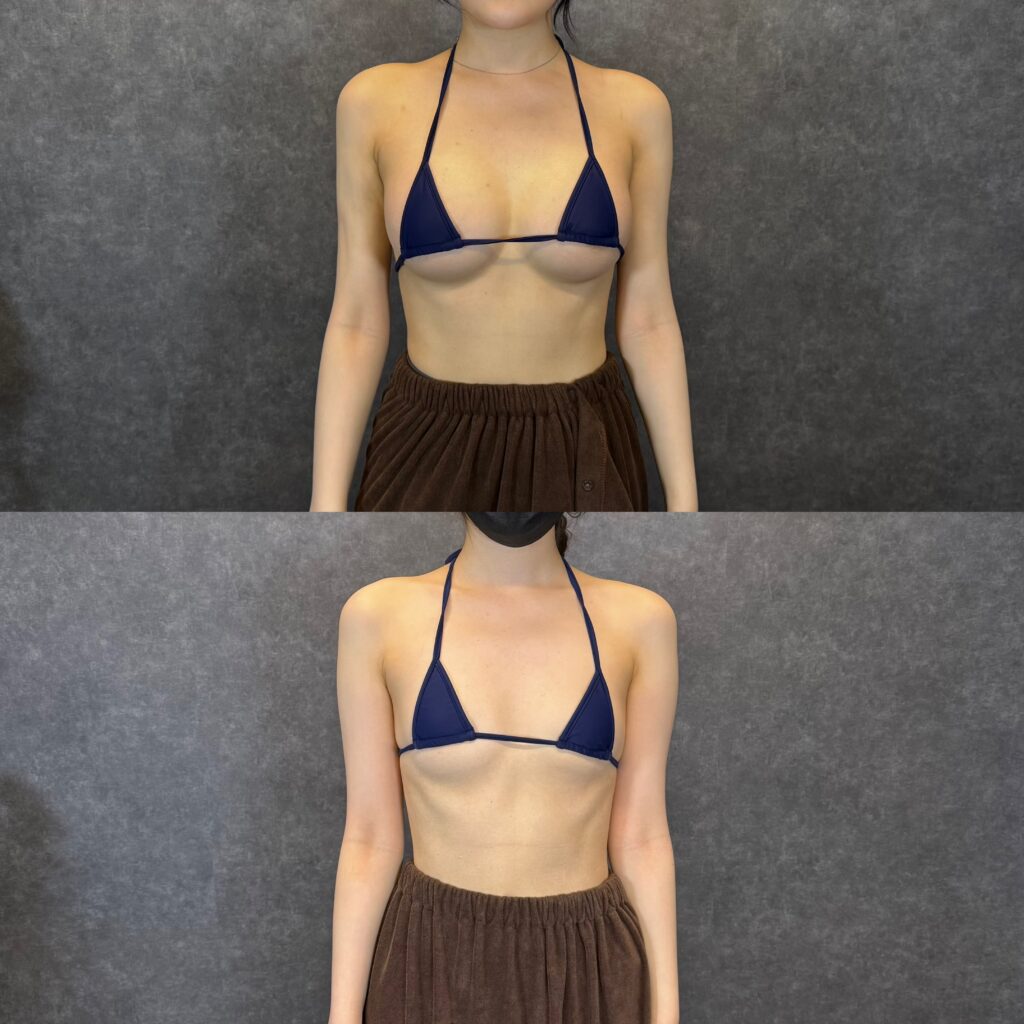
The procedures performed were:
● 360-degree upper arm liposuction
● axillary fat liposuction
● hybrid breast augmentation
Approximately 600 cc of purified fat was harvested from the upper arms and surrounding areas.
For breast augmentation, we used:
Motiva Mini 270 cc implants placed in the subglandular plane
combined with fat grafting of:
130 cc to the right breast
110 cc to the left breast
The goal was not simply to make the breasts larger.
The main design priorities were:
1. To create a sharper transition from the shoulders to the upper arms
2. To increase the visual contrast between slim arms and fuller breasts
3. To create a smooth contour from the décolletage to the lower breast
4. To use fat grafting to refine the cleavage and upper breast
5. To reduce the risk of the implants looking too obvious in a slim patient
Why Combine Arm Liposuction with Breast Augmentation?
Breast size alone does not determine how the upper body looks
When patients consider breast augmentation, one of the first questions is often:
“How many cc should I choose?”
Implant size is important, but the overall appearance of the upper body is not determined by breast volume alone.
I pay close attention to the visual transition from:
shoulder → upper arm → axilla → décolletage → breast
Even with the same 270 cc implant, the result can look very different depending on the amount of volume around the arms and axillary area.
By reducing excess volume around the upper arms and axilla, the breasts may appear more prominent in proportion to the rest of the upper body.
In other words, upper body contouring is not only about adding volume.
It also involves subtracting volume from the right areas.
This combination of reduction and enhancement can create a more defined silhouette.
Our Approach to 360-Degree Upper Arm Liposuction
One of the areas I focus on most during upper arm liposuction is the contour between the shoulder and the arm.
The goal is not simply to make the arm smaller.
We aim to create a sharper, cleaner transition from the shoulder into the upper arm.
This can be particularly important when wearing:
● sleeveless clothing
● dresses
● tank tops
● fitted tops
The appearance of the upper body is influenced by:
● the outer upper arm
● the posterior upper arm
● the anterior upper arm
● the shoulder area
● the axillary area
For this reason, AVAN TOKYO often evaluates the arm circumferentially rather than focusing only on one visible surface.
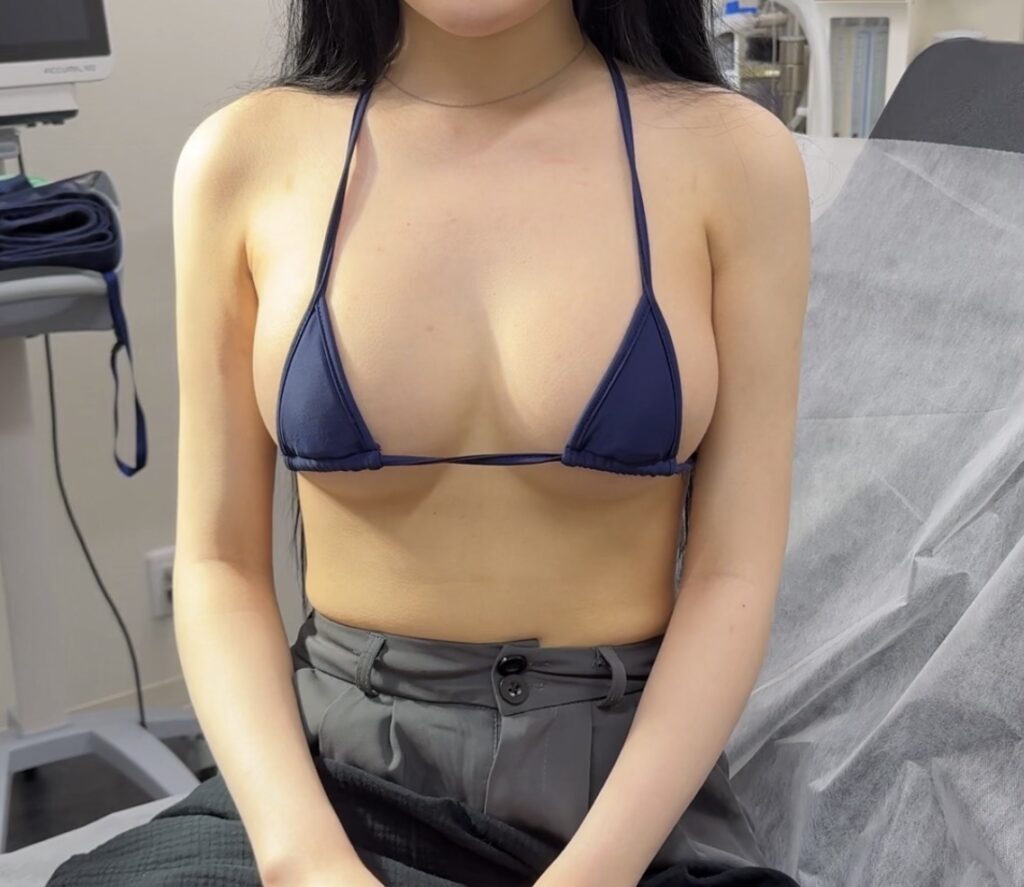
The objective is to create a balanced contour from multiple viewing angles.
Why Treat the Axillary Fat Area?
Even when the upper arms become slimmer, excess fullness in the axillary area can interrupt the transition between the arms and the breasts.
The area from:
upper arm → axilla → lateral breast
is visually continuous.
If excess volume remains in the axilla, the upper body may still appear bulky even after arm liposuction.
In this case, axillary fat liposuction was combined with 360-degree upper arm liposuction to create a cleaner transition toward the breast.
What Is Hybrid Breast Augmentation?
Hybrid breast augmentation combines:
breast implants + autologous fat grafting
Breast implants provide predictable structural volume.
Fat grafting allows more detailed contour refinement.
At AVAN TOKYO, the basic concept is:
the implant creates the main breast volume, while fat grafting helps refine the surrounding contour.
This is particularly useful when adjusting:
● the décolletage
● the cleavage
● the upper breast
● the transition around the implant
● minor asymmetries
Why Add Fat Grafting Instead of Using Implants Alone?
This can be especially important in patients with a low BMI.
Slim patients often have thinner soft tissue coverage over the breast.
If an implant is placed without sufficient tissue coverage, there may be a higher chance of visible or palpable implant edges.
In some patients, implants alone may also create:
● a more abrupt upper breast contour
● visible implant borders
● a breast that projects forward without enough surrounding softness
● insufficient medial fullness or cleavage
For this reason, this patient received a Motiva Mini 270 cc implant combined with fat grafting.
Fat grafting was used to refine the contour and improve the transition around the implant.
Why the Décolletage and Cleavage Matter So Much
When I perform hybrid breast augmentation, I pay particular attention to two areas:
the décolletage and the cleavage.
A breast can have adequate volume in the lower pole but still appear unnatural if the transition from the chest wall into the upper breast is too abrupt.
This issue can be more noticeable in slim patients.
The transition from:
collarbone → upper chest → upper breast → lower breast
should appear smooth.
The implant mainly provides breast volume.
Fat grafting is used to refine the contour.
This is one of the reasons hybrid breast augmentation can be useful for selected patients.
Can We Achieve Both Natural Appearance and Volume?
Many patients say:
“I want my breasts to look natural, but I also want a noticeable increase in size.”
These goals are not necessarily contradictory.
The key is not simply choosing a smaller implant.
Implant selection should take into account:
● chest width
● breast width
● existing breast tissue
● skin elasticity
● soft tissue thickness
● desired projection
● décolletage volume
● overall body proportions
For this patient, a Motiva Mini 270 cc implant was selected based on her slim body type and chest proportions.
The implant was then combined with fat grafting to refine the contour.
Why Fat Grafting Is Not Only About the Number of cc Injected
Patients often ask:
“How many cc of fat do I need to increase one cup size?”
Fat grafting cannot be evaluated by injection volume alone.
Not all transferred fat remains permanently.
Some of the injected fat may be reabsorbed during the healing process.
Therefore, successful fat grafting depends on multiple factors, including:
● fat harvesting technique
● fat processing
● injection technique
● injection plane
● tissue blood supply
● smoking status
● postoperative recovery
● individual biological differences
At AVAN TOKYO, we do not simply inject a large amount of fat into one area.
The fat is distributed carefully in small amounts while evaluating the three-dimensional breast contour.
Postoperative Care Also Matters
Hybrid breast augmentation does not end on the day of surgery.
The recovery period is also important, particularly when fat grafting is involved.
We generally advise patients to avoid extreme dieting and rapid weight loss during the postoperative period.
Adequate calorie intake, protein intake, and a balanced diet support normal wound healing and recovery.
However, it is important to understand that no specific food can guarantee higher fat survival.
Fat retention is influenced by many factors, including:
● individual tissue quality
● surgical technique
● blood supply
● fat processing
● injection method
● smoking
● postoperative behavior
For this reason, we consider postoperative management an important part of the overall treatment process.
Why the Result Can Continue to Change Between 3 and 6 Months
The appearance immediately after breast augmentation is not the final result.
During the early recovery period, patients may experience:
● swelling
● firmness
● tightness
● temporary asymmetry
Over time:
● swelling decreases
● tissues soften
● the implants settle
● the transferred fat stabilizes
● breast movement becomes more natural
For this reason, we evaluate not only the early postoperative appearance but also the longer-term result.
This patient was followed through the 6-month postoperative period.
Long-term evaluation is especially important in breast augmentation because the breast contour continues to evolve during recovery.
Who May Be a Good Candidate for Arm Liposuction × Hybrid Breast Augmentation?
This combination may be worth considering for patients who:
● want slimmer upper arms
● want a more defined shoulder-to-arm line
● are concerned about axillary fat
● want more upper body contrast
● have a low BMI but still want breast augmentation
● are concerned that implants may look too obvious
● want more décolletage and cleavage definition
● want both breast volume and a natural contour
● are unsure whether fat grafting alone will provide enough volume
However, hybrid breast augmentation is not necessary for everyone.
Depending on the patient, one of the following may be more appropriate:
● fat grafting alone
● breast implants alone
● upper arm liposuction alone
The treatment plan should be individualized.
Can Slim Patients with BMI 17 Still Have Fat Grafting?
In some cases, yes.
This patient had a BMI of 17.7.
Even in slim patients, usable fat may still be available in areas such as:
● upper arms
● axilla
● back
● abdomen
● waist
● thighs
However, BMI alone does not determine whether a patient is a good candidate for fat grafting.
Two patients with the same BMI may have very different fat distributions.
The amount and quality of available fat must be evaluated during consultation.
AVAN TOKYO’s Concept of Upper Body Contouring
I consider the combination of:
upper arm liposuction + breast augmentation
to be one of the most effective options for creating a major change in upper body proportions in appropriately selected patients.
However, the goal is not to perform more procedures.
The key question is:
Where should volume be reduced, and where should volume be added to improve overall balance?
In this case:
● the upper arms and axillary area were reduced
● the breasts were enhanced
● fat grafting was used to refine the décolletage, cleavage, and surrounding contour
The goal was to create:
sharper arms and a smooth breast contour with both natural appearance and volume.
This is the core concept behind our approach to upper body contouring at AVAN TOKYO.
Frequently Asked Questions
Can upper arm liposuction and breast augmentation be performed at the same time?
In some patients, yes.
Whether combined surgery is appropriate depends on:
● overall health
● the extent of liposuction
● expected blood loss
● operative time
● anesthesia considerations
When appropriate, fat harvested during liposuction may also be used for breast fat grafting.
Can fat from the upper arms be transferred to the breasts?
Yes, when sufficient usable fat is available.
In this patient, fat harvested from the upper arms and surrounding areas was processed and used for breast fat grafting.
Can patients with BMI 17 undergo hybrid breast augmentation?
Possibly.
The decision depends more on fat distribution and tissue thickness than on BMI alone.
Some slim patients still have enough usable fat for grafting.
Does hybrid breast augmentation look more natural than implants alone?
Not necessarily in every patient.
However, in patients with thin soft tissue coverage, fat grafting may help soften the transition around the implant and refine the décolletage and cleavage.
Does all injected fat survive permanently?
No.
Some transferred fat is typically reabsorbed after surgery.
The final retained volume varies between patients.
Who may be suitable for Motiva Mini implants?
Implant selection depends on:
● chest width
● breast width
● skin and soft tissue thickness
● existing breast volume
● desired projection
● overall body proportions
At AVAN TOKYO, implant size is not selected based only on cc volume.
The entire upper body is evaluated.
At AVAN TOKYO, We Evaluate the Entire Upper Body
When a patient comes to AVAN TOKYO for arm liposuction or breast augmentation, we do not evaluate only the breasts.
We assess:
● shoulders
● upper arms
● axilla
● chest wall
● décolletage
● breasts
● waist
● overall body proportions
This is because breast aesthetics are strongly influenced by surrounding anatomy.
A beautiful breast contour is not created by breast volume alone.
It is created by the relationship between the breasts and the rest of the upper body.
At AVAN TOKYO, we focus on combining liposuction, fat grafting, and breast implants when appropriate to create a balanced upper body silhouette.
Case Details
Height: 161 cm
Weight: 46 kg
BMI: 17.7
Procedures:
● 360-degree upper arm liposuction
● axillary fat liposuction
● hybrid breast augmentation
● purified fat harvested: approximately 600 cc
● Motiva Mini implant: 270 cc
● implant plane: subglandular
● fat grafting: 130 cc right / 110 cc left
● follow-up shown: 6 months
Results and recovery vary between individuals.
Possible Risks and Complications
Liposuction
Possible risks include:
● swelling
● bruising
● pain
● edema
● temporary firmness
● contour irregularity
● asymmetry
● skin retraction
● pigmentation changes
● infection
● hematoma
● seroma
Fat Grafting to the Breasts
Possible risks include:
● swelling
● bruising
● infection
● fat necrosis
● lumps
● calcification
● asymmetry
● partial fat absorption
Breast Implant Surgery
Possible risks include:
● swelling
● bruising
● infection
● hematoma
● asymmetry
● scarring
● sensory changes
● capsular contracture
● implant malposition
● rippling
● implant rupture
● need for revision surgery
Breast implants also carry implant-specific risks, including rare implant-associated conditions.
Patients considering surgery should receive a full explanation of both the expected benefits and potential risks before treatment.
Author and Medical Supervisor
AVAN TOKYO GINZA LIPOSUCTION CLINIC
Dr. Moriwaki focuses on:
● liposuction
● fat grafting breast augmentation
● breast implant surgery
● hybrid breast augmentation
● upper body contouring
with an emphasis on overall body balance and three-dimensional contour design.
This article is intended to provide general medical information about cosmetic surgery and to explain treatment concepts used at AVAN TOKYO.
Individual treatment plans, eligibility, risks, and expected outcomes vary from patient to patient.