


What Determines Fat Retention After Fat Transfer Breast Augmentation?2026.09.18
Case Study of a 20-Year-Old Woman Undergoing 360° Arm Liposuction and Breast Fat Grafting
One of the most common questions we receive about fat transfer breast augmentation is:
“Will my breasts become larger if more fat is injected?”
The answer is not necessarily.
When it comes to breast augmentation with fat grafting, the amount of fat injected is only one part of the equation.
Another important factor is how much capacity the breast tissue and skin have to accommodate the transferred fat.
In our clinical experience, patients who already have some breast volume and whose breast skin and soft tissue are flexible and easily expandable may provide a more favorable environment for distributing the transferred fat.
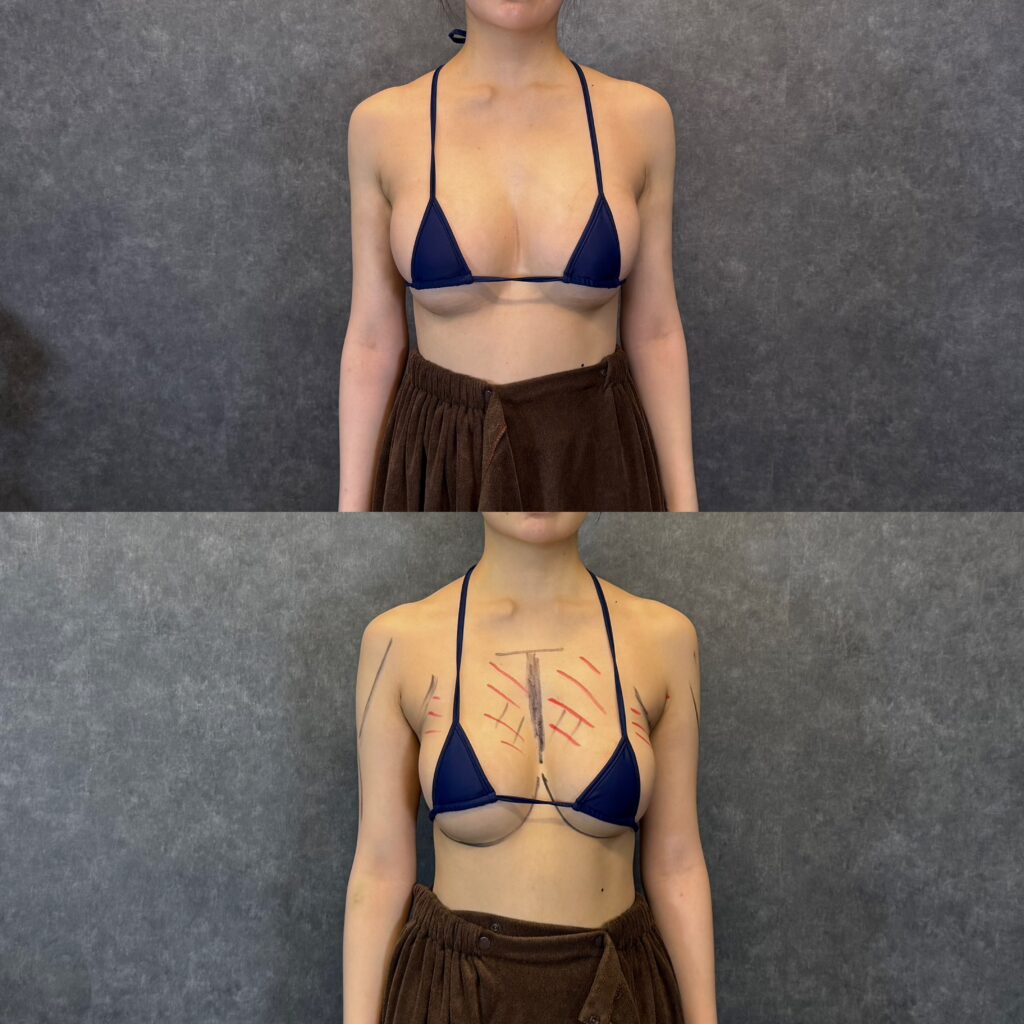
In this case, we performed 360° upper-arm liposuction, accessory breast fat removal, axillary fat removal, and fat transfer breast augmentation in a 20-year-old woman who was 162 cm tall and weighed 47 kg.
Case Overview
Age: 20 years
Height: 162 cm
Weight: 47 kg
BMI: approximately 17.9
Procedures performed:
● 360° upper-arm liposuction
● Accessory breast fat removal
● Axillary fat removal
● Fat transfer breast augmentation
A total of 420 cc of purified fat was harvested from the upper arms, accessory breast area, and axillary region.
The harvested fat was then processed and carefully transferred to the breasts according to the patient’s breast shape, tissue characteristics, asymmetry, and skin flexibility.
This approach allows us not only to reduce unwanted fat around the arms and underarms, but also to use that tissue to create additional breast volume.
In other words, we can approach the entire upper body as one continuous silhouette rather than treating the arms and breasts as completely separate areas.
Is Injecting More Fat Always Better for Breast Augmentation?
Not necessarily.
Patients often focus on numbers such as:
“200 cc was injected.”
or
“300 cc was injected.”
However, at AVAN TOKYO, we do not evaluate fat transfer breast augmentation based solely on the total injection volume.
For transferred fat to survive, it must receive sufficient nutrients and blood supply from the surrounding tissue.
If too much fat is concentrated within a limited space, some of the transferred fat may be positioned too far from well-vascularized tissue.
Therefore:
More injected fat does not automatically mean more retained breast volume.
What matters is determining how much fat the patient’s breast tissue can appropriately accommodate and how that fat should be distributed.
Why Breast Skin Flexibility Matters in Fat Transfer Breast Augmentation
Before fat grafting, we evaluate several characteristics of the breast, including:
● Skin flexibility
● Soft-tissue thickness
● Breast tissue expandability
● Existing breast volume
● Breast asymmetry
● Chest-wall anatomy
● The patient’s desired breast shape
Patients with relatively soft, flexible breast tissue may have more available space for the transferred fat to be distributed throughout the breast.
This can be advantageous when performing multi-layer fat grafting.
Conversely, when the breast skin and surrounding tissues are very tight, attempting to inject excessive volumes at one time can increase tissue pressure.
For this reason, we believe that one of the keys to fat transfer breast augmentation is:
not simply deciding how much fat we want to inject, but determining how much fat the individual breast can reasonably accommodate.
Breast flexibility is therefore one factor we consider when determining the appropriate injection volume and technique.
Where the Fat Is Injected Also Matters
In fat transfer breast augmentation, the final result is influenced not only by how much fat is injected, but also by where and how the fat is distributed.
At AVAN TOKYO, the injection design is customized according to the patient’s anatomy and aesthetic goals.
For example, we evaluate whether the patient requires:
● More upper-pole fullness
● Improvement of upper-breast hollowness
● A smoother transition from the décolletage to the breast
● Additional lower-pole volume
● Correction of asymmetry
Rather than simply injecting the same amount of fat uniformly throughout the entire breast, we design the distribution according to the desired breast contour.
In cases where the upper breast appears hollow, for example, fat can be strategically distributed to create a smoother transition from the upper chest toward the lower breast.
One of the advantages of breast augmentation with fat transfer is that it can be used not only to increase breast volume, but also to refine the overall breast contour.
Why Upper-Arm Liposuction and Fat Transfer Breast Augmentation Work Well Together
Combining upper-arm liposuction with fat transfer breast augmentation can be particularly effective for improving the overall proportions of the upper body.
In this case, we treated:
360° upper arms + accessory breast fat + axillary fat
as a continuous anatomical area.
If only the upper arms are made slimmer while excess fat remains around the underarms and lateral breast area, the upper body may still appear heavy when viewed from the front or at an oblique angle.
For this reason, we evaluate the entire transition from:
upper arm → axilla → accessory breast area → breast
as one continuous silhouette.
Removing excess fat from the arms and underarms while adding appropriate volume to the breasts can create a stronger visual contrast between the slimmer arms and the breast contour.
The goal is not simply:
“smaller arms”
or
“larger breasts.”
The goal is to create a more balanced upper-body contour.
Can Slim Patients Have Fat Transfer Breast Augmentation?
Yes, some slim patients may still be candidates for fat transfer breast augmentation.
This patient was 162 cm tall and weighed 47 kg, with a BMI of approximately 17.9.
A common question we receive is:
“Am I too thin for fat transfer breast augmentation?”
Body weight or BMI alone does not determine candidacy.
What matters is whether sufficient subcutaneous fat can be safely harvested from areas such as:
● Upper arms
● Axillary area
● Abdomen
● Waist
● Back
● Thighs
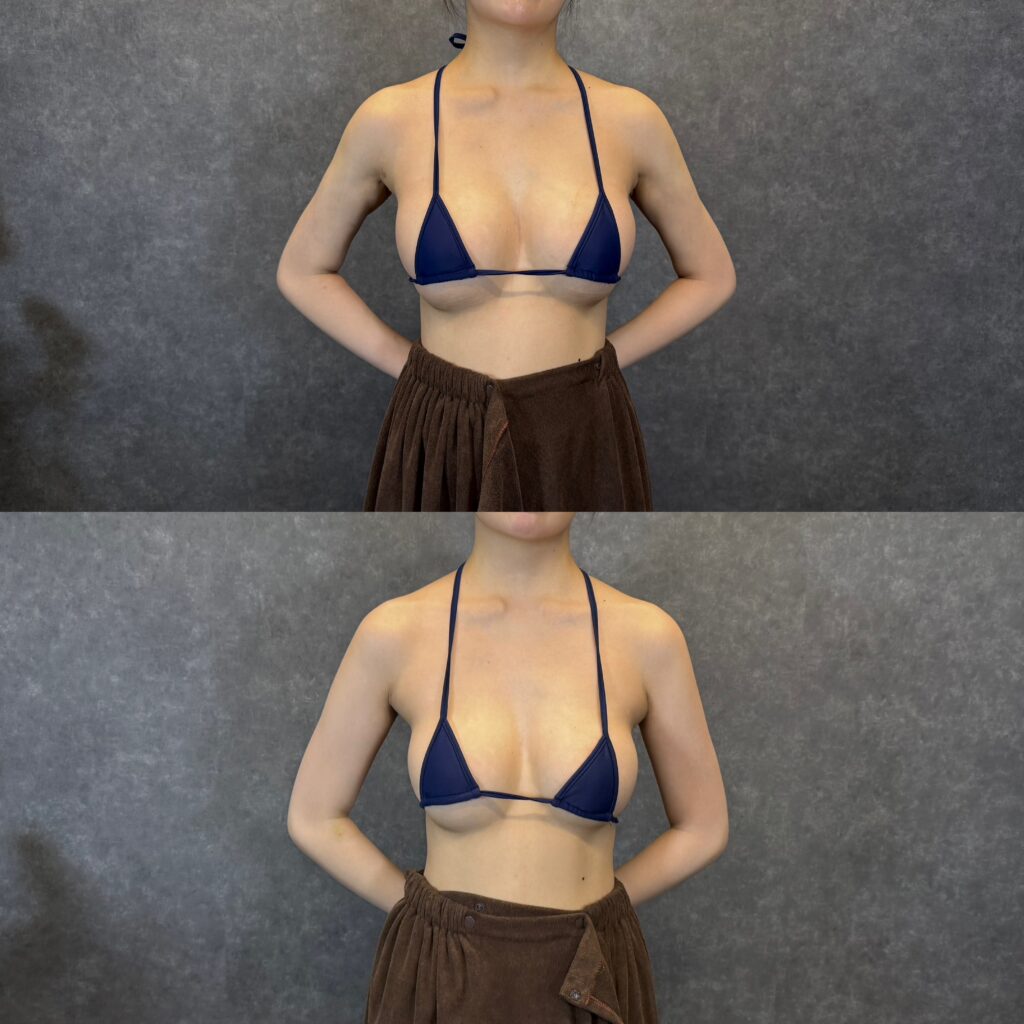
In this case, we were able to obtain 420 cc of purified fat from the upper arms, accessory breast area, and axillary region.
However, very slim patients naturally have a limited amount of available donor fat.
For these patients, it is important to balance:
the amount of fat that can realistically be harvested
with
the degree of breast enlargement they would like to achieve.
If a patient desires a more substantial increase in breast volume, silicone breast implants or hybrid breast augmentation, which combines implants with fat grafting, may be a more appropriate option.
How Many Cup Sizes Can Fat Transfer Breast Augmentation Add?
There is no guaranteed number of cup sizes that can be achieved with fat transfer breast augmentation.
Not all injected fat remains permanently.
After surgery, part of the transferred fat is absorbed by the body, while the portion that successfully establishes a blood supply may remain as living tissue.
At AVAN TOKYO, we commonly aim for approximately 1 to 1.5 cup sizes of enhancement per fat transfer procedure, although the final result varies considerably between patients.
Factors that may influence the outcome include:
● The amount of harvestable fat
● Breast skin and tissue flexibility
● Available space within the breast
● The volume of fat that can be appropriately injected
● Individual fat retention
● Baseline breast anatomy
For this reason, breast fat grafting should not be evaluated simply by asking:
“How many cc were injected?”
Instead, the goal is to determine the appropriate volume and distribution for the individual patient’s anatomy.
What Helps Transferred Fat Survive?
Fat grafting is not simply the process of moving fat from one area to another.
The transferred fat needs to establish sufficient blood supply from the surrounding tissue.
For this reason, injection technique is important.
Rather than placing a large amount of fat into a single pocket, the fat is carefully distributed in small amounts across appropriate tissue planes.
This approach increases the surface area of contact between the transferred fat and the surrounding vascularized tissue.
However, it is important to understand that fat retention varies between individuals.
Skin flexibility is only one of several factors involved.
It would therefore be inaccurate to say that soft breast skin always guarantees superior fat retention.
Instead, breast tissue flexibility should be considered as part of a broader assessment that includes anatomy, available donor fat, vascularity, injection technique, and postoperative healing.
AVAN TOKYO’s Approach to Fat Transfer Breast Augmentation
At AVAN TOKYO, we do not consider fat transfer breast augmentation simply as a procedure for moving fat from one part of the body to another.
Our focus is:
Where should volume be reduced, and where should volume be added to create the most balanced overall silhouette?
Combining:
360° upper-arm liposuction
● accessory breast fat removal
● axillary fat removal
● fat transfer breast augmentation
allows us to approach the entire upper body as a single aesthetic unit.
The arms and underarm region can be refined while the harvested fat is strategically used to enhance breast contour.
This is particularly important in slim patients.
For patients with limited subcutaneous fat, aggressive fat removal is not necessarily the goal.
Instead, we aim to preserve the tissue required for a smooth body contour while selectively harvesting usable fat and determining how it can be most effectively utilized.
At AVAN TOKYO, liposuction and breast augmentation are therefore planned together with a focus on comprehensive upper-body contour design.
Frequently Asked Questions About Fat Transfer Breast Augmentation
Q. Does injecting more fat create larger breasts?
Not necessarily. Every breast has a limited capacity to accommodate transferred fat at one time. Excessive injection does not automatically result in greater permanent breast volume. The amount and distribution of fat should be tailored to each patient’s breast anatomy and tissue characteristics.
Q. Does soft breast skin improve fat retention?
Flexible breast skin and soft tissue may provide more space for the transferred fat to be distributed. However, fat retention depends on multiple factors, including vascularity, injection technique, individual anatomy, and healing. Skin flexibility alone does not determine the final retention rate.
Q. Can thin patients undergo fat transfer breast augmentation?
Yes, depending on the amount and distribution of available body fat. This patient was 162 cm and 47 kg with a BMI of approximately 17.9, yet 420 cc of purified fat was harvested from the upper arms, accessory breast area, and axillary region. Candidacy should therefore be determined through physical examination rather than BMI alone.
Q. Can fat from the upper arms be transferred to the breasts?
Yes. Fat harvested from the upper arms and surrounding areas can be processed and used for breast fat grafting when appropriate. Combining upper-arm liposuction with breast fat transfer can simultaneously refine the arms and enhance the breast contour.
Q. Which is better: fat transfer breast augmentation or hybrid breast augmentation?
The appropriate option depends on the patient’s anatomy and goals. Patients seeking a natural, moderate increase in breast volume and who have sufficient donor fat may be candidates for fat transfer alone. Patients who are very slim or want a larger increase in breast size may benefit from hybrid breast augmentation, which combines a silicone implant with fat grafting.
Summary: Successful Fat Transfer Breast Augmentation Is Not Just About How Many CCs Are Injected