


Axillary Fat Liposuction for a Slimmer Back | Full Upper Arm 6-Month Case2026.11.17
“I hate the way my underarm fat looks from behind” — this is one of the most common concerns I hear.
Axillary fat is one of the areas that is particularly resistant to diet and exercise.
This article explains the indications, risks, and recovery timeline for axillary fat liposuction, using a case from our clinic.

The short answer
Axillary fat is one of the causes that makes the back look wider, and it is a relatively straightforward area to treat with liposuction. Combining it with full upper arm liposuction creates a cleaner line from the back view, though results vary by individual.
Why Axillary Fat Liposuction Changes the Back View
When you lower your arms to your sides, axillary fat appears as a bulge in the underarm area when viewed from behind.
It makes the back look wider, which is especially noticeable in backless dresses, swimwear, and sleeveless tops.
If you want a sharp, straight line from shoulder to elbow, it is important to address not only the upper arm fat but the axillary fat as well.
【Comparison of approaches for upper arm and underarm slimming】
| Liposuction (axilla + upper arm) | Diet and exercise | Radiofrequency (RF) devices | |
|---|---|---|---|
| Advantages | ・Reduces the number of fat cells ・Targets a specific area ・Low rebound risk |
・Supports overall health ・No cost |
・Minimal downtime ・Non-invasive |
| Disadvantages | ・Compression garment required post-op ・Requires a recovery period ・Has a cost |
・Localised areas like the axilla are hard to target ・Takes time |
・Does not reduce fat cell count ・High individual variability in effect |
| Best for | ・Those bothered by axillary fat ・Those with occasions to show their back |
・Those wanting to change overall body shape ・Those who prefer to avoid surgery |
・Those seeking non-invasive care ・Those wanting to complement liposuction |
Liposuction (axilla + upper arm)
- Advantages
- ・Reduces the number of fat cells
・Targets a specific area
・Low rebound risk - Disadvantages
- ・Compression garment required post-op
・Requires a recovery period
・Has a cost - Best for
- ・Those bothered by axillary fat
・Those with occasions to show their back
Diet and exercise
- Advantages
- ・Supports overall health
・No cost - Disadvantages
- ・Localised areas like the axilla are hard to target
・Takes time - Best for
- ・Those wanting to change overall body shape
・Those who prefer to avoid surgery
Radiofrequency (RF) devices
- Advantages
- ・Minimal downtime
・Non-invasive - Disadvantages
- ・Does not reduce fat cell count
・High individual variability in effect - Best for
- ・Those seeking non-invasive care
・Those wanting to complement liposuction
Reason 1: Axillary fat directly affects the back view
Axillary fat sits in the subcutaneous layer of the underarm. When you lower your arm, it appears as an overhang on the back. A larger volume makes the back look wider and can make the upper arm appear thicker as well.
It is especially noticeable in backless wedding dresses, camisoles, and swimwear. For anyone with occasions to show their back, addressing this area can make a significant difference.
Reason 2: Combining with full upper arm creates one continuous line
Even after removing upper arm fat, residual axillary fat can leave the impression of a bulge when viewed from behind.
Performing axillary fat liposuction together with full upper arm liposuction creates a single flowing line from the shoulder to the elbow.
This is one of the reasons behind the “straight, sharp arm” look common among Korean pop idols.
Reason 3: Limited removal volume means less physical burden
Axillary fat is a localised deposit; the volume removed is typically smaller than for the full thigh or abdomen, which often means a more limited overall physical burden.
That said, the axilla contains a concentration of nerves, blood vessels, and lymphatic vessels, making precise identification of the correct subcutaneous fat layer essential.
For safety standards in aesthetic surgery, please refer to the Japan Society of Aesthetic Surgery (JSAS).
Case Study at Our Clinic
Improved arm and back silhouette (Female patient)
We performed full upper arm and axillary fat liposuction, removing 800cc of pure fat in total. The patient continued with dietary management after surgery.
At the six-month follow-up, the underarm bulge visible from behind was gone and the line from the back to the arm had become straight and streamlined.
Before surgery (Before)
Full upper arm & axillary fat liposuction | Before surgery (preoperative marking)
The photos below show the back view (top: 6 months after surgery; bottom: before surgery). The reduction in axillary fat volume and the improved back silhouette are clearly visible.
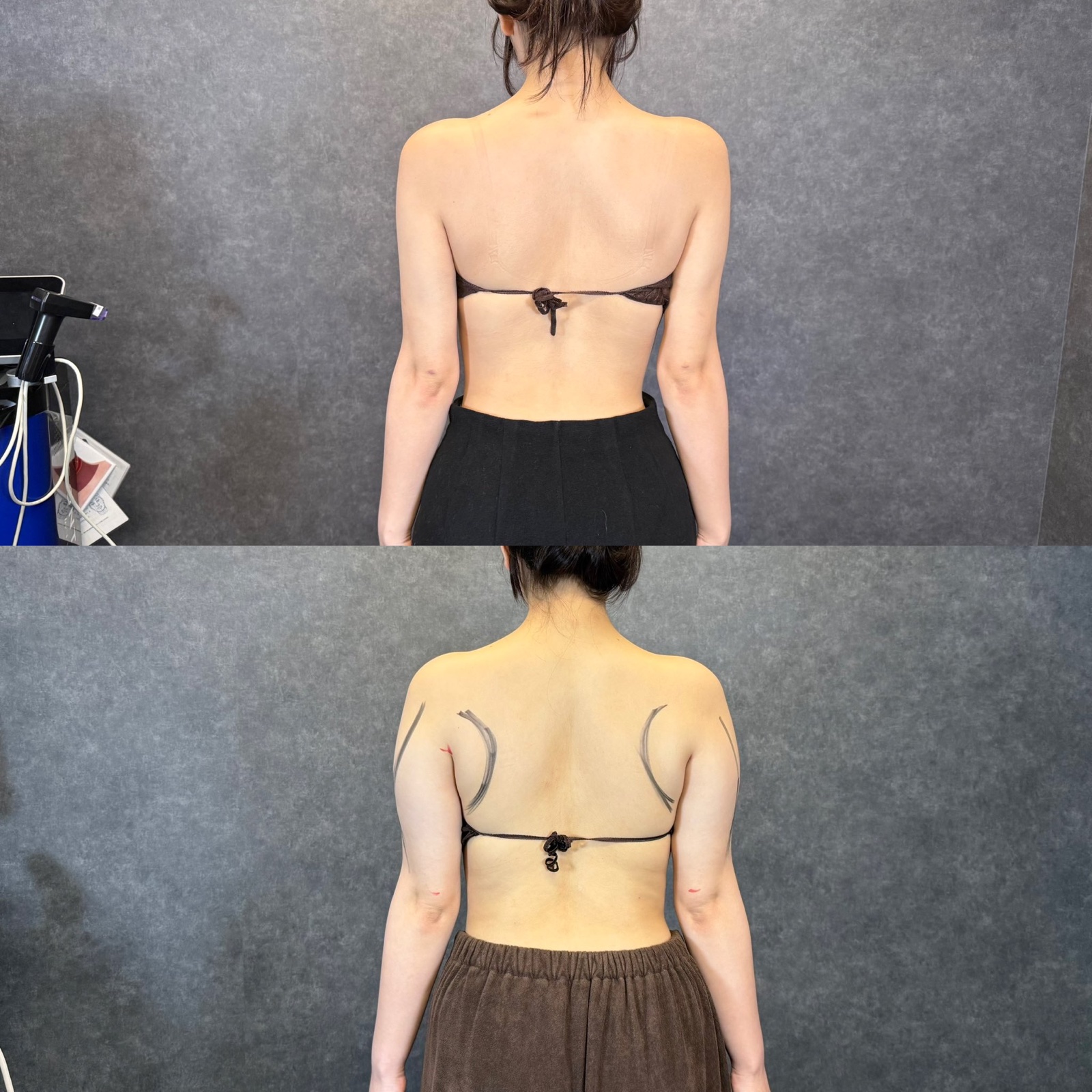
Full upper arm & axillary fat liposuction | 6 months after surgery (top) and before surgery (bottom)
The next photos show the arm from the side (top: 6 months after surgery; bottom: before surgery). The thickness of the arm from the axilla to the elbow has decreased uniformly.
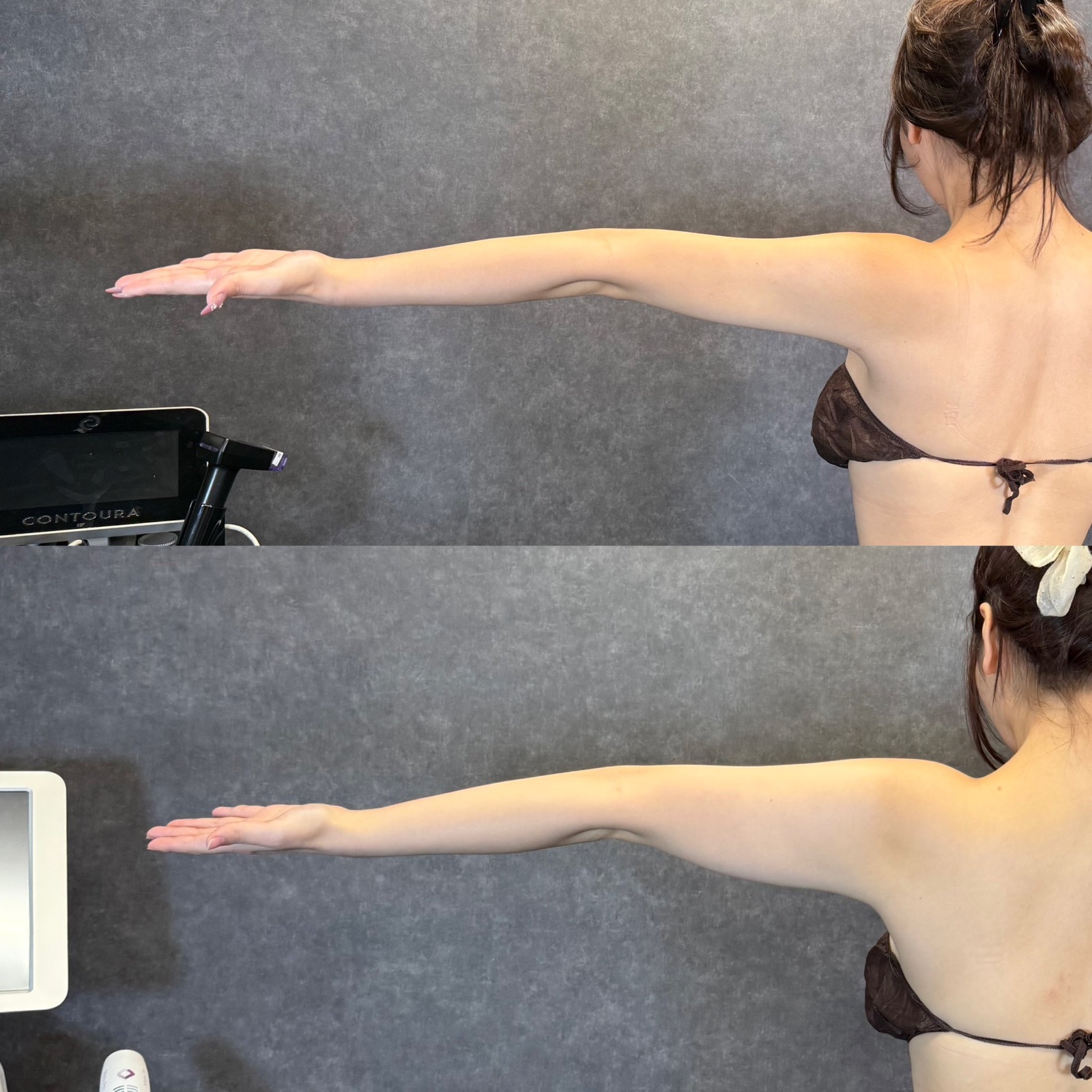
Full upper arm & axillary fat liposuction | 6 months after surgery (top) and before surgery (bottom)
| Procedure | Upper arm and axillary fat liposuction |
|---|---|
| Details | Full upper arm circumference and axillary subcutaneous fat liposuction (800cc pure fat) |
| Photo timing | 6 months post-op |
| Cost | Please refer to our price page for details (final amount confirmed at consultation) |
| Key risks / side effects | Bruising, swelling, fibrosis, asymmetry, temporary numbness, infection, etc. |
Results vary by individual, and this photo represents a single case.
Can massage reduce axillary fat?
Massage may ease puffiness but cannot reduce fat cells
Massage can promote lymphatic flow and help reduce puffiness. However, it cannot reduce the number of subcutaneous fat cells themselves.
Overall weight loss may cause some change in axillary fat, but selectively eliminating fat from just the underarm area through diet or exercise alone is very difficult in practice.
How long is the recovery?
Pain peaks at days 2–3; fibrosis peaks around one month
Pain typically peaks two to three days after surgery and settles within about ten days. Swelling and bruising gradually subside over two to three weeks.
The compression garment should be worn 24 hours a day for the first week post-op, then continued as much as possible until the swelling resolves.
Because the underarm is used frequently in daily movement, you may feel some restriction when raising your arm immediately after surgery.
Showering is usually possible from the following day; baths and strenuous exercise are cleared two weeks post-op. Those in desk-based work sometimes return the next day, but pain levels vary.
Fibrosis (post-surgical hardening) typically peaks around one month after surgery, when you may notice some firmness or unevenness around the arm and axilla.
This is a normal part of the healing process and usually softens over approximately three months.
What are the possible risks and how are they managed?
Careful attention to axillary nerves and lymphatics is essential
Axillary fat liposuction is performed very close to the nerves, blood vessels, and lymphatic vessels concentrated in the underarm.
Staying within the correct subcutaneous fat layer minimises complications, but temporary numbness or altered sensation may occur after surgery. This typically resolves within weeks to months.
Lymphatic flow may also be temporarily disrupted, causing swelling along the inner arm or the back of the hand. Wearing the compression garment and gently moving the arm regularly can help reduce this swelling.
Infection and haematoma are rare but warrant regular post-op check-ups to monitor recovery.
Is skin laxity a concern after surgery?
Outcomes vary with age, skin elasticity, and removal volume
Because the volume removed from the axilla is relatively small, patients with good skin elasticity tend to experience minimal laxity.
However, some degree of looseness may remain after surgery depending on age, BMI, and how much the skin has been stretched.
In the case shown here, continuing with dietary management post-operatively contributed to a result with minimal sagging.
For patients with specific skin quality concerns, combining radiofrequency RF devices may be considered (individual results vary).
Summary | A slimmer back starts with the axilla
Axillary fat is resistant to diet alone and is a key factor in making the back look wide.
Axillary fat liposuction is a relatively low-risk procedure, and combining it with full upper arm liposuction creates a cohesive line from the back view.
Recovery involves peak pain at days 2–3 post-op, with fibrosis peaking around one month. The area gradually softens over three months, and the final result is typically stable at six months.
If you are bothered by your back view or want to feel confident in dresses or swimwear, please book a consultation to discuss your condition and the right approach for you. View more liposuction articles here
Frequently Asked Questions
- Can I have only the axillary fat removed?
-
Yes, liposuction targeting only the axillary area is possible. However, treating the upper arm and axilla together as a continuous line often produces a more cohesive result from behind.
We discuss your goals and body shape at consultation before recommending an approach.
- Can upper arm and axillary liposuction be done on the same day?
-
Yes, at our clinic we perform full upper arm and axillary fat liposuction on the same day. Because the areas are adjacent, combining them means you only go through one recovery period.
- When can I move my arm normally after surgery?
-
You may feel some restriction when raising your arm for a few days post-op. Most patients resume normal daily arm movements within 1–2 weeks.
Strenuous exercise is typically cleared two weeks after surgery. Individual variation exists, so please confirm at your follow-up visit.
- Where are the incisions made?
-
Entry points (incisions) are a few millimeters in size and placed in discreet locations such as the underarm or near the elbow. Marks fade over time but do not disappear completely.
Protecting the area from sun exposure and friction helps them become less visible.
- Will the results rebound?
-
Liposuction directly reduces the number of fat cells, so the treated area is unlikely to rebound as long as significant weight gain does not occur afterward. However, remaining fat cells can enlarge with weight gain.
- Can accessory breast tissue be removed at the same time?
-
Yes, accessory breast tissue (the fullness in the front axillary fold) can be suctioned together with the axillary fat.
Treating the axilla, accessory breast, and full upper arm in one session allows the surgeon to design the front, side, and back views together. The plan depends on the degree and condition assessed at consultation.
- Where can I check my progress after surgery?
-
Regular follow-up visits are scheduled after surgery to assess your recovery and adjust compression. The surgeon evaluates swelling, fibrosis, and scar status and advises accordingly.
Please contact us promptly if you notice any concerning symptoms.
This article is based on a post by Dr. Moriwaki on X (@doctor_shin_). View the original post
For prices, case photos and FAQs, see the upper arm liposuction page.
Book a consultation
1 min walk from Exit 6, Ginza-itchome Station / Open 10:00–19:00
About the supervising physician

Director, AVAN TOKYO Ginza Liposuction Clinic
Graduated from Tokushima University School of Medicine.
Worked at Tokushima University Hospital, Tokyo Chuo Cosmetic Surgery and Gracia Clinic before taking up the current position.
Over 5,000 liposuction procedures performed (including previous positions).
Certifications
・VASER Lipo certified physician
・ECFMG Certificate
Memberships
・Member, Japan Society of Aesthetic Surgery (JSAS)
・Full member, Japanese Society for Regenerative Medicine
・Member, American Academy of Aesthetic Medicine
Related articles
- Supraclavicular (Shoulder SC) Liposuction with Arm Contouring: A Case Study
- Arm, Axillary Fat & Accessory Breast Liposuction
Continuous Back-View Design - Circumferential Upper Arm Liposuction: Why Six Ports at the Front Axilla, Elbow and Posterior Axilla