


Should Thigh Liposuction Include the Buttocks? A 6-Month Case2026.11.07
“If I want slimmer thighs, should fat also be removed from my buttocks?” People considering lower-body liposuction may be concerned about the outward fullness extending from the buttocks to the outer thighs.
The answer depends on the shape of the buttocks and the distribution of fat. Selectively reducing excess fat along the outer contour may improve its transition into the thighs. However, routinely suctioning the buttocks or the area beneath them can contribute to sagging or unevenness. This case of a 25-year-old woman illustrates how we consider both the areas to treat and the areas to preserve.
Operating surgeon and case provider
Director, AVAN TOKYO Ginza Liposuction Clinic About Dr. Shin Moriwaki
The key point
Buttock liposuction is not a routine addition for everyone having thigh liposuction. Assessment distinguishes subcutaneous fat from skeletal structure, muscle and loose skin. In this case, the surgical plan addressed outer fullness while preserving the area immediately beneath the buttocks. Deciding where to preserve fat matters as much as deciding how much to remove.
What creates fullness around the outer buttocks?
Identify the location of the fullness
From behind, the waist, outer buttocks and upper thighs form one continuous contour. The location of unwanted fullness differs between individuals. Rather than deciding the treatment area from the thighs alone, assessment should consider the transition from the waist through the buttocks to the outer thighs while standing.
Liposuction targets subcutaneous fat. It does not narrow the pelvic or femoral bones or reduce the muscles themselves. Further suction in an area with little fat may not produce the desired change in width. If skin elasticity is poor, reducing fat may make laxity more noticeable. [1] [2]
A “wave” body-type label does not determine suitability
The original X post uses the Japanese styling term “wave body type” to describe lower-body fullness. This label alone cannot establish fat thickness or skin quality. Individual assessment includes palpation, fat distribution, asymmetry, skin laxity, previous liposuction and the curves the person wishes to retain.
When to consider buttock liposuction—and when to be cautious
| Finding | How it may affect the plan |
|---|---|
| Subcutaneous fullness from the outer buttocks into the outer thighs | Limited treatment of the outer contour may be considered in relation to the thighs. |
| Width is mainly due to bone structure or muscle | Explain the limits of liposuction and avoid excessive additional suction. |
| Flat buttocks, thin fat layers or existing sagging | Preserving volume or avoiding suction may be appropriate because flattening or sagging could worsen. |
| Unevenness, firmness or asymmetry after surgery elsewhere | Assess the remaining fat and tissue condition. Additional liposuction alone may not resolve the problem. |
Refining the outer contour is different from reducing the entire buttock
In the preoperative video, the surgeon explains a plan to adjust the outer fullness while preserving the area immediately below the buttocks. The aim is to improve the transition into the thighs while retaining necessary shape.
The American Society of Plastic Surgeons (ASPS) patient handbook also cautions that liposuction of the buttocks themselves, particularly the lower half, can lead to contour irregularity or a sagging appearance. This supports careful selection of the treatment area and suitable candidates; it does not mean that buttock liposuction is never an option. [1]
A 25-year-old woman’s case: before and 6 months after surgery
This patient had previously undergone liposuction at another clinic. The treatment described here combined liposuction of the upper arms, back and lower body with hybrid breast augmentation. This article focuses on the posterior contour from the buttocks to the thighs.
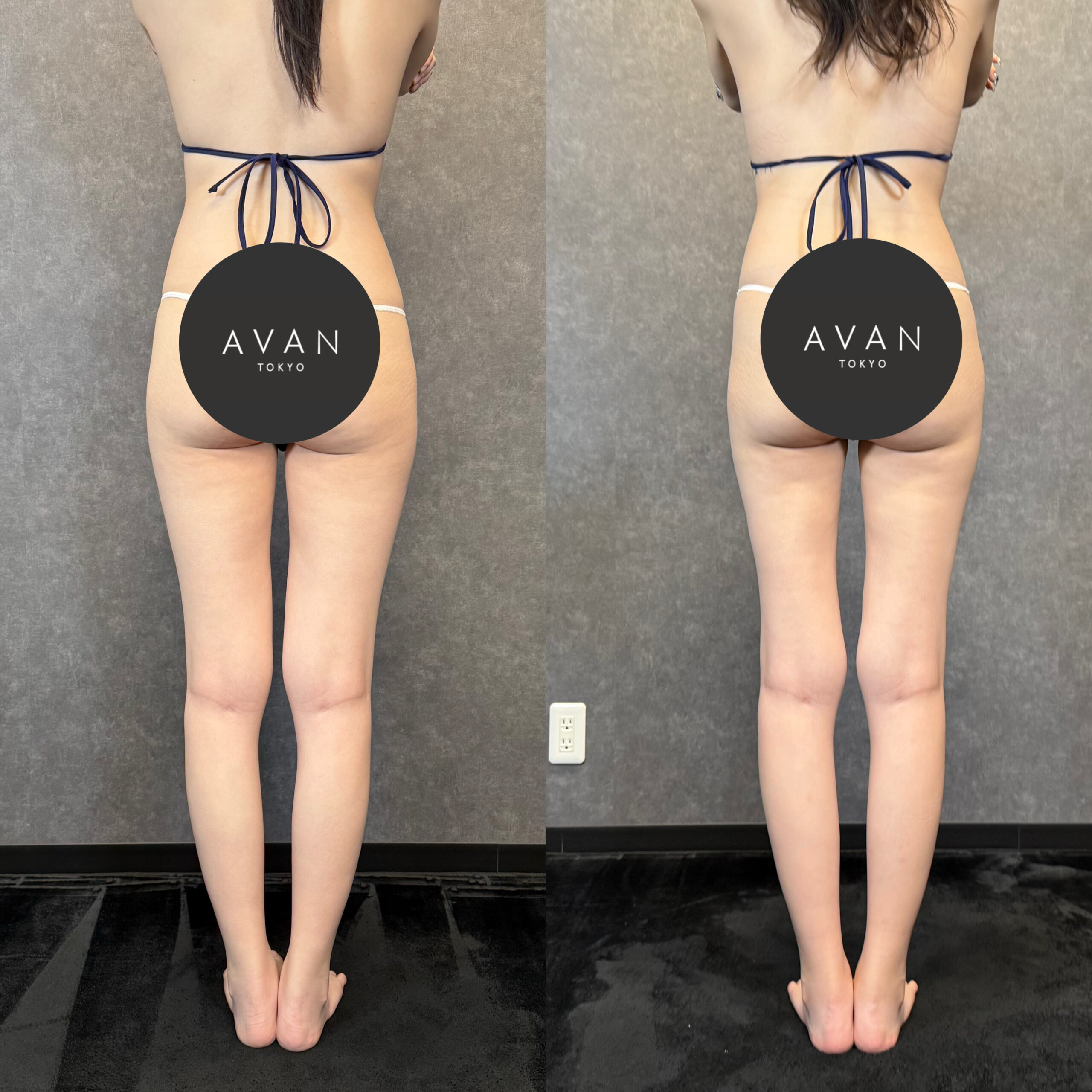
The photograph shows less outward fullness from the outer buttocks into the outer thighs and an apparently smoother transition. Photographs alone cannot establish the change in circumference or how much fat was removed from each specific area.
How to interpret the photograph
Posture, foot position, underwear, lighting and camera distance can affect appearance. Skin and contours hidden by the logos cannot be assessed in this photograph. Six months is one follow-up point; it does not guarantee that the appearance will remain unchanged or that another person will obtain the same result.
Surgical planning and recovery through 3 months on video
The clinic’s YouTube video follows the same patient through preoperative marking, surgery and recovery up to 3 months. This is a different follow-up point from the 6-month photograph. The video includes surgical footage and is in Japanese.
Watch the case video on YouTube (Japanese)
| Stage and video timestamp | What the recording shows |
|---|---|
| Before surgery Around 0:58 | Marking to address outer fullness while preserving the area immediately beneath the buttocks. |
| Early recovery From around 2:00 | Bruising and difficulty with movement and walking. Upper-body liposuction and breast augmentation were also performed, so this does not represent recovery from thigh liposuction alone. |
| About 1 month From around 5:59 | Firmness and tightness are assessed, with observation while postoperative tissue changes settle. |
| About 3 months From around 7:45 | Contour and scars are reviewed, including advice to continue observing residual redness. |
| 6 months | The comparison photograph in this article documents the posterior contour at a later stage than the video. |
Recovery varies with the treatment area, prior operations, health and accompanying procedures. A final result cannot be promised by 3 months, nor can a fixed return-to-work date be guaranteed. Discuss work and travel plans during consultation. [2] [3]
Reference fees, risks and postoperative care
Reference prices from the official fee schedule
The following tax-inclusive prices in Japanese yen were checked against the official fee schedule (Japanese) on November 7, 2026. They are reference prices, not the patient’s actual total payment. Discounted “monitor” rates are subject to screening and conditions such as participation in case photography.
| Related procedure | Standard price, tax included | Monitor price, tax included |
|---|---|---|
| Circumferential thighs | JPY 998,000 | JPY 798,000 |
| Buttocks | JPY 348,000 | JPY 278,000 |
| Circumferential upper arms | JPY 650,000 | JPY 498,000 |
| Back: above and below the shoulder blades | JPY 448,000 | JPY 368,000 |
| Hybrid breast augmentation | JPY 1,480,000 | JPY 998,000 |
Intravenous anesthesia is JPY 55,000, or JPY 110,000 when provided by a specialist anesthesiologist; general anesthesia is JPY 220,000. Blood tests and compression garments may also be charged separately. Pricing depends on fat-harvesting sites, suction areas and procedure combinations, so adding the items above does not establish this patient’s bill or your own quote. An itemized estimate and total are provided after assessment.
Main liposuction risks
Possible effects and complications include swelling, bruising, pain, edema, firmness, tightness, numbness or altered sensation, scars, pigmentation changes, asymmetry, contour irregularities, loose skin, under- or over-removal, infection, bleeding, hematoma, seroma and skin injury. Revision surgery may be necessary. Rare serious complications include deep vein thrombosis, pulmonary embolism, fat embolism, fluid imbalance and anesthesia-related complications. [2]
Risks of the accompanying hybrid breast augmentation
Implant-related risks include capsular contracture, displacement, rupture, altered sensation and further surgery. Fat grafting may lead to resorption, fat necrosis, lumps, cysts and calcification. Rare implant-associated malignancies have also been reported, and continued follow-up is necessary. The lower-body photograph cannot be used to evaluate the outcome or safety of the breast augmentation. [4] [5]
Match postoperative care to your treatment and recovery
Follow your surgeon’s instructions on compression garments, bathing, exercise and massage. After extensive procedures, arrange rest and help with daily activities; confirm when to start walking and how to increase activity. Do not push yourself to recover at the same pace as a person in a photograph or video. [3]
Contact the treating clinic if pain, redness or swelling worsens, or if you develop a fever. Sudden shortness of breath, chest pain or fainting requires urgent medical assessment; do not assume it is normal recovery.
Thigh and buttock liposuction: frequently asked questions
- Should thigh liposuction always include the buttocks?
No. It may be considered when subcutaneous fat causes fullness between the outer buttocks and thighs. Buttock shape, sagging and fat thickness should be assessed, and areas to preserve should also be identified.
- Does a ‘wave’ body type mean I am suitable for buttock liposuction?
No. This styling label alone cannot determine suitability. Assessment includes fat distribution, skin quality, skeletal and muscular influences, and previous procedures.
- Can buttock liposuction cause sagging?
Yes. Depending on the area treated, the amount removed and skin quality, sagging or unevenness may become more noticeable. In this case, the video explains a plan to preserve the area immediately beneath the buttocks.
- Was all 1,750 cc removed from the buttocks?
No. The 1,750 cc figure is the pure fat removed from the lower body in this case. It is neither the buttock-only volume nor an amount recommended for everyone.
- Can a slim person have thigh or buttock liposuction?
It may be considered if a localized area has sufficient treatable subcutaneous fat, but BMI alone does not establish suitability. This patient’s BMI of about 18.44 and removal volume are not personal treatment targets for others.
- Can I consult you after previous liposuction elsewhere?
Yes. Assessment includes the previous treatment area and timing, remaining fat, firmness, contour irregularities and skin condition. Further liposuction alone may not address the concern, and avoiding another procedure may be advised.
- What is assessed at 3 and 6 months?
Follow-up assesses changes in swelling and firmness, contour, symmetry, skin and scars. The video in this article covers up to 3 months; the comparison photograph is at 6 months. Recovery and the timing of the final appearance vary.
Sources and related information
Case details are based on the operating surgeon’s X post, the clinic’s YouTube explanation and follow-up, and the supplied 6-month photograph. General information on suitability and risks draws on the following professional societies’ patient resources.
- American Society of Plastic Surgeons (ASPS). Liposuction Handbook (PDF): buttock liposuction and precautions.
- International Society of Aesthetic Plastic Surgery (ISAPS). Liposuction: suitability, skin elasticity, recovery and risks.
- ASPS. Liposuction Recovery: postoperative care and recovery.
- ASPS. Breast Augmentation Risks and Safety.
- ASPS. Fat Transfer Breast Augmentation Risks and Safety.
Original case sources: Dr. Moriwaki’s X post, November 7, 2026 (Japanese) / YouTube case follow-up (Japanese)
- Thigh liposuction treatment information (Japanese)
- Hybrid breast augmentation (Japanese)
- Related article: diet after fat-transfer breast augmentation and a 6-month case (Japanese)
- Official fee schedule (Japanese)
Consider the thighs and buttocks as one continuous contour
At AVAN TOKYO, assessment considers the fullness you wish to reduce and the curves you wish to preserve. We explain what surgery may change and its limitations. If you have had previous liposuction, discuss your surgical history and desired shape during consultation.
Request a consultationAbout Dr. Shin Moriwaki