


Why Shoulder Botox Sometimes Fails — A Medical Analysis Based on the Scapula and Muscle Anatomy2025.12.03
— Improving the shoulder line correctly, based on the position of the shoulder blades and muscle structure —
“I had shoulder Botox, but my shoulders didn’t come down.” “My neck doesn’t look any longer.” “My silhouette hasn’t changed.” We receive consultations like these quite often. In fact, one of the main reasons shoulder Botox ends up being wasted is that the true cause of the shoulder prominence is not the “trapezius” muscle.
The short answer: How well shoulder Botox works depends on what is causing the shoulder prominence.
Standard shoulder Botox is suited to the type in which the shoulders bulge upward because of the trapezius.
In the type where the shoulder blades protrude upward, the main cause is often deeper muscles such as the supraspinatus; in the type where the shoulders look wide from side to side, it is often subcutaneous fat.
It is important to choose supraspinatus Botox or circumferential upper arm liposuction according to the cause.
Standard shoulder Botox works for the “trapezius hypertrophy” type of shoulder
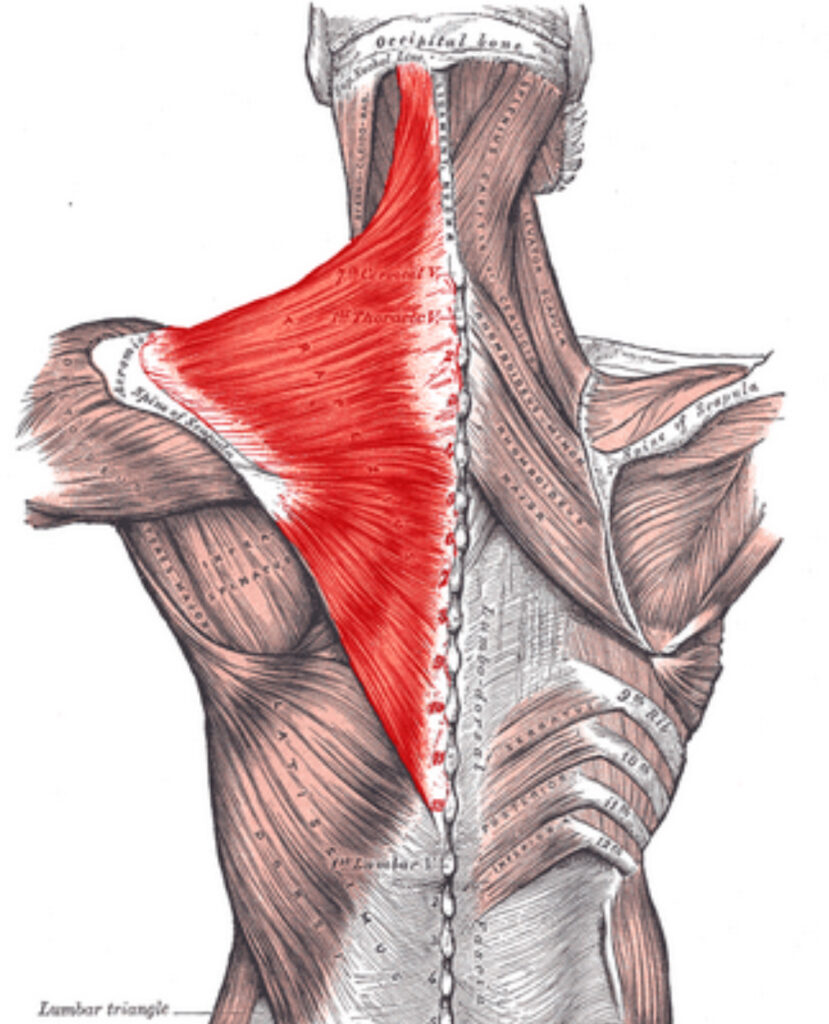
Standard shoulder Botox is injected into the trapezius muscle.
The trapezius is the muscle mainly responsible for “shrugged-looking shoulders” and for “making the neck look short,” so it can be expected to help with
- the type in which the shoulders bulge upward in a rounded shape
- the type in which the border between the neck and shoulders fades into a gentle slope
in particular.
In this type, weakening the tension of the trapezius with Botox can be expected to bring changes such as:
- The shoulders sit lower
- The neck looks longer
- The décolletage line looks more feminine
These are the kinds of changes that can be expected.
For the “upward-protruding shoulder blade” type, treating the trapezius alone is not enough
On the other hand, in the type where the shoulder blades themselves are raised upward, injecting Botox into the trapezius alone may not change the appearance much.
In this type, the actual main cause is often
- the supraspinatus muscle
- the “deep muscle group that pulls the shoulder blade upward”
and so relaxing only the superficial trapezius leaves the skeletal prominence in place.
The option of ultrasound-guided “supraspinatus Botox”
At our clinic, we first assess the cause of the shoulder line, using ultrasound (echo) as needed, and then:
- If the trapezius is the cause → trapezius Botox
- If the supraspinatus is the cause → ultrasound-guided Botox into the supraspinatus
- If both are involved → simultaneous trapezius + supraspinatus Botox
In this way, we inject precisely into the anatomically correct muscle.
The supraspinatus lies deep, and blind injection into this area carries a higher risk of nerve and blood vessel injury, so ultrasound-guided injection is also important from a safety standpoint.
“Sideways” shoulder width is often caused by fat
Another important type is the one where “the shoulders look wide from side to side.”
In this case, the main cause is often not muscle but
- the base of the upper arm
- the flesh around the armpit
- subcutaneous fat on the back of the upper arm
instead.
Even if shoulder Botox is performed for this type, the silhouette is unlikely to change much.
The appropriate choice is a “physical reduction in width” through circumferential upper arm liposuction.
Improving the shoulder line requires a “cause-specific approach”
Shoulder prominence can be broadly classified into the following three types.

If a treatment is chosen based on a misjudged cause, the expected results are hard to achieve no matter how expensive the procedure.
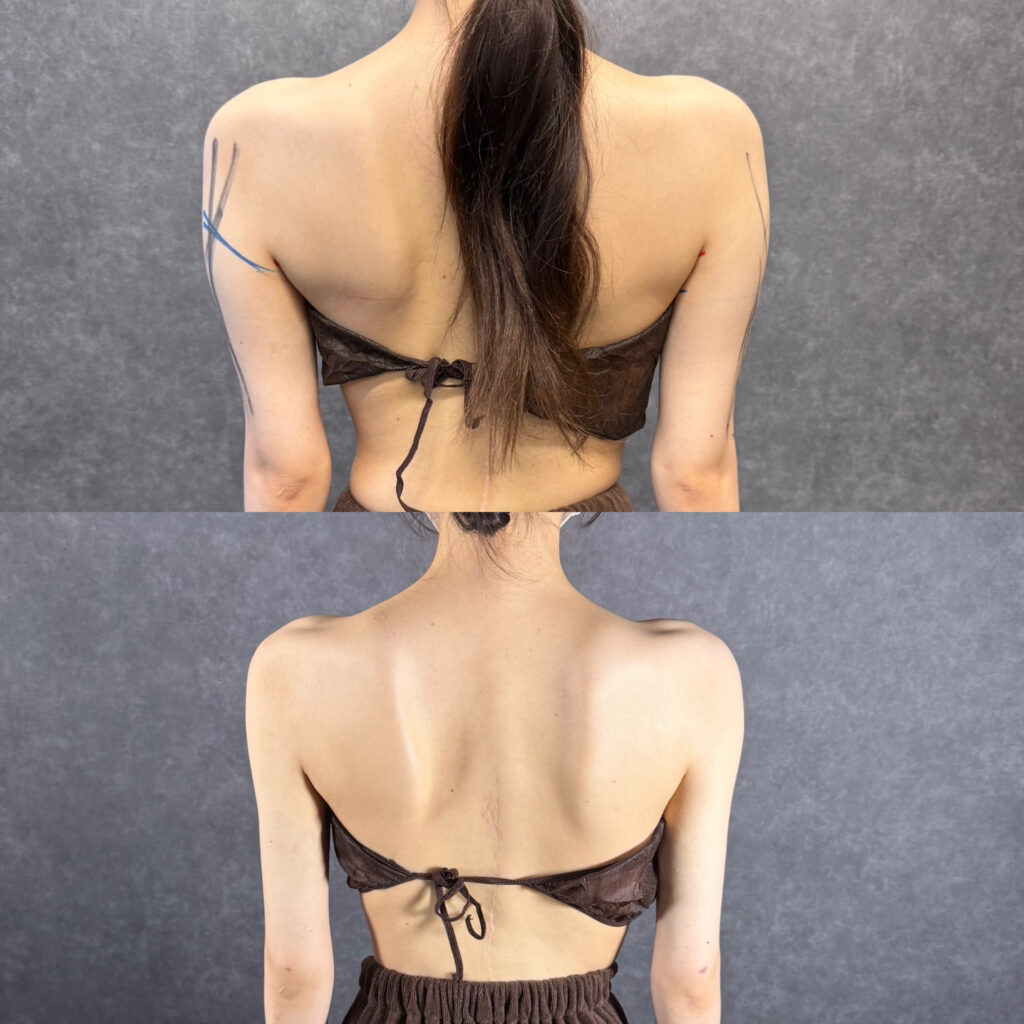
Why circumferential upper arm liposuction + trapezius Botox work well together
- Width → physically slimmed with liposuction
- Upward bulk → shoulders lowered with Botox
By performing these two at the same time,
- the “height” of the shoulders
- the “width” of the shoulders
- the “continuous line” from the neck to the shoulders to the upper arms
can all be refined together, so you can aim for a shoulder and upper-body line that looks good in photos, videos and selfies.
Case photos
Fees: Please see our price list. The final amount is confirmed at your consultation. For the main risks, see here. Results and recovery vary from person to person.
Main risks and side effects
| Treatment | Main risks and side effects |
|---|---|
| Shoulder Botox (trapezius, supraspinatus) | It takes about 3 days to 1 week for the effect to appear. The effect is not permanent and generally lasts about 3–6 months. Temporary muscle weakness or discomfort in the shoulders or neck (usually improves within a few days to a few weeks); bruising at the injection site |
| Liposuction (circumferential upper arm) | Swelling, puffiness and bruising; contracture (a tight feeling, unevenness, firmness); rarely, infection or pigmentation |
On the day of shoulder Botox, please avoid strenuous exercise, long baths and alcohol, and avoid massaging the treated area for about one week.
If liposuction is performed under intravenous sedation or general anesthesia, a preoperative blood test is required.
Frequently Asked Questions
- Why don’t my shoulders come down even after shoulder Botox?
- One possibility is that the trapezius is not the cause of the shoulder prominence. In the type where the shoulder blades protrude upward, the main cause is often deeper muscles such as the supraspinatus; in the type where the shoulders look wide from side to side, it is often subcutaneous fat at the base of the upper arm and around the armpit.
- What should I do if my shoulders look wide from side to side?
- If the main cause is subcutaneous fat, shoulder Botox is unlikely to change the silhouette much, so physically slimming the width with circumferential upper arm liposuction becomes an option.
Summary: Whether shoulder Botox is wasted depends on the “diagnosis”
Shoulder Botox is by no means a cure-all treatment. Only by accurately assessing
- the type of muscle
- the position of the shoulder blades
- the distribution of fat
does it become a cost-effective treatment.
At our clinic, we provide
- muscle assessment with ultrasound as needed
- diagnosis across three layers: skeleton, fat and muscle
- combination with liposuction or other treatments where necessary
Rather than simply “making the shoulders slimmer,” we design shoulders that look beautiful as part of the overall body line.
Consultations about the shoulder line and shoulder Botox are welcome
1 minute walk from Ginza-itchome Station Exit 6 / Reception 10:00–19:00
About the reviewing doctor
Dr. Shin Moriwaki
Director, AVAN TOKYO Ginza Liposuction Clinic
Graduate of Tokushima University School of Medicine.
After working at Tokushima University Hospital, Tokyo Chuo Cosmetic Surgery and Gracia Clinic, he took up his current position.
At least 3,000 cosmetic surgeries performed from January 2022 through November 2026, including previous positions.
Certifications
・VASER Lipo certified physician
・ECFMG Certificate
Memberships
・Member, Japan Society of Aesthetic Surgery (JSAS)
・Full member, Japanese Society for Regenerative Medicine
・Member, American Academy of Aesthetic Medicine