


Why Slim People Can Still Look Heavy — The Truth Behind “Shadow and Line” in Body Contour2026.05.24
You stand in front of the mirror, and although your weight is by no means high, something about your figure looks heavy and unrefined. Your BMI is below average, yet you still feel something is off about your body — many women feel exactly this way.
The short answer: A slim body can “look heavy” because size is perceived through the contrast of light and shadow, not through volume.
When shadows and lines are disrupted by uneven bulges of fat caused by fascial adhesions, by a fat distribution that is too flat, or by a mismatch between the lines of the skeleton and the fat, the body tends to look heavier even at the same weight.
In liposuction, it is important not only to reduce fat but also to design where shadows fall and which lines run through the body.
Looking “heavy despite being slim” is not an illusion
In fact, this phenomenon of looking “heavy despite being slim” is not a perceptual illusion; it can be explained anatomically and optically.
The size of the human body is perceived not through its “volume” but through “the contrast of light and shadow.” Even at the same weight and the same size, if the way shadows fall and the flow of the curves are disrupted, the body looks visually “heavier” and “bigger.”
Three structural factors that make a body “look heavy”
1. Uneven bulges of fat caused by fascial adhesions
Subcutaneous fat normally covers the fascia smoothly.
However, when the fascia develops adhesions because of long periods in the same posture, lack of exercise, changes in hormonal balance and so on, the flow of fat becomes partly blocked.
Fat then rises only in certain places, and the shadows there are emphasized. Tension at the front of the thighs, the base of the upper arms, and bulkiness above the hips are typical examples of exactly this.
2. A “too flat” fat distribution takes away three-dimensionality
This may come as a surprise, but a body in which fat is spread thinly and evenly can actually look “flat” and heavy.
The beauty of a body line comes from its “curves” and “contours.” When the contrast between light and dark surfaces is weak, “slimness as a three-dimensional form” is harder to convey, both in photos and in person.
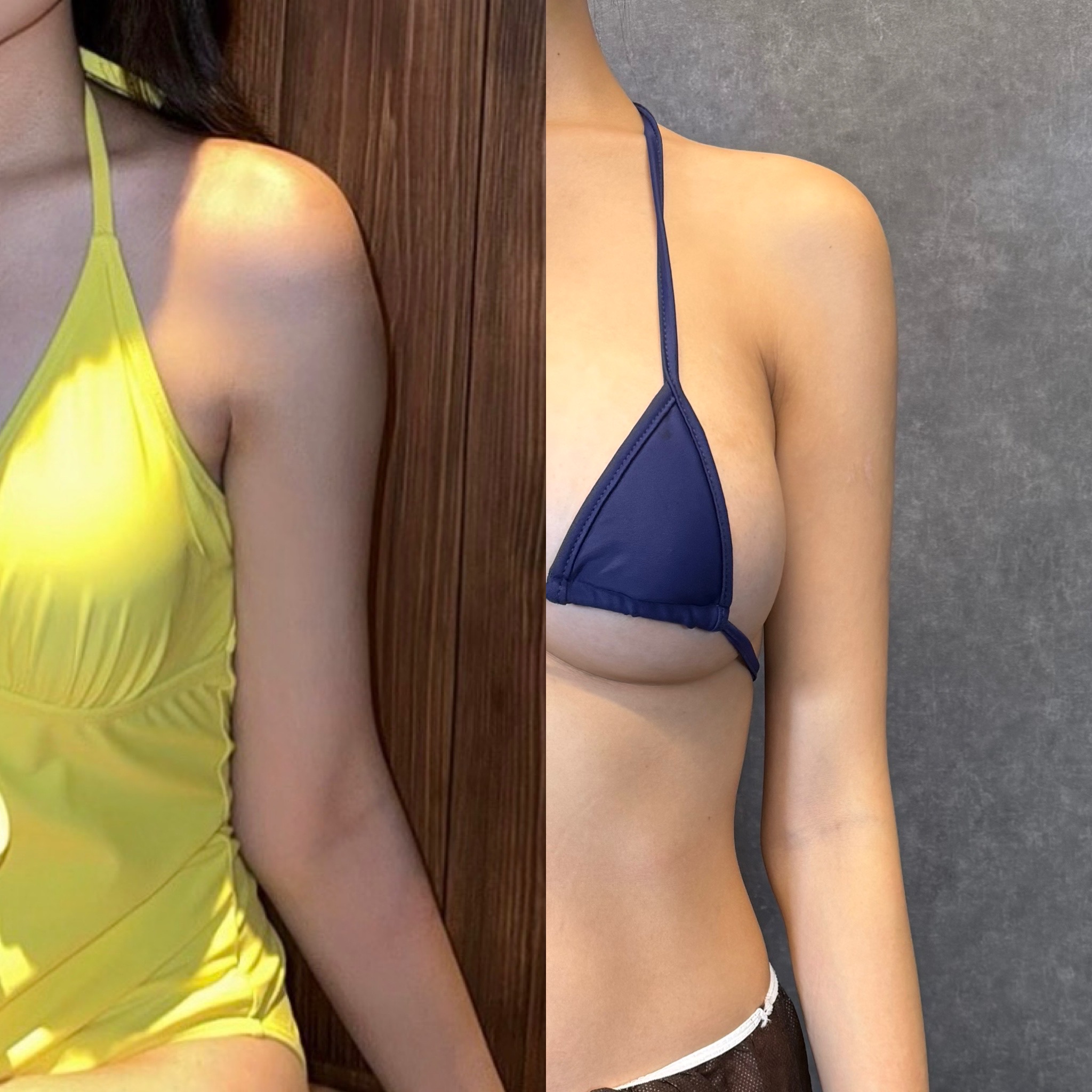
Fees: Please see our price list. The final amount is confirmed at your consultation. For the main risks, see here. Results and recovery vary from person to person.
3. A mismatch between the lines of the skeleton and the fat
The human body has “lines of flow” that follow the skeleton: from the collarbone to the shoulder, from the waist to the greater trochanter, from the knee to the ankle.
When fat sits neatly along these lines, the silhouette becomes a single flowing curve.
But when fat accumulates in positions that are out of line with the skeleton, the lines are broken up and the body looks as if blocks had been stacked together.
This is one of the major reasons a body can look “heavy despite being slim.”
A beautiful silhouette is determined by “the design of shadows”
What matters is the idea that a body line is determined not only by the amount of fat but by “the design of light and shadow.” The convex areas that catch the light, the concave areas where shadows fall, and the borders between them — only when these three elements are in balance do people perceive a body as “beautiful.”
For example, the curve of the waist is emphasized when a shadow falls in the hollow from the lower edge of the ribs to the iliac crest.
A lift in the lower back alone makes the hips look higher, and a vertical line on the inner thigh alone makes the legs look longer.
Simply “reducing” fat does not create these shadows and lines.
Liposuction is not “surgery to reduce fat”
If you have read this far, you may have noticed. The essence of liposuction is not simply reducing fat but “re-sculpting shadows and lines.”
The doctor reads the patient’s skeleton, skin thickness and fascial condition, and then designs where to leave light and where to let shadows fall.
Even with the same volume of fat removed, the result can differ greatly depending on the design.
In fact, “a sculpted body with an appropriate amount of fat left” can sometimes look slimmer and more beautiful than “a body with the fat removed down to the bone.”
The “sculptural silhouette” AVAN TOKYO pursues
At our clinic, during the preoperative consultation we examine skeletal balance, fat distribution and the condition of the fascia three-dimensionally, and design “which shadows to create and which lines to run” for each individual.
Not competing for “thinness,” but creating “beauty as a three-dimensional form” — this is AVAN TOKYO’s consistent philosophy. The real reason a slim body can feel as if it looks heavy is by no means a lack of effort.
By refining the relationship between the skeleton and fat, and between light and shadow, we can aim for the beautiful silhouette you naturally have.
Main risks and side effects
| Treatment | Main risks and side effects |
|---|---|
| Liposuction | Swelling, puffiness and bruising; contracture (a tight feeling, unevenness, firmness); rarely, infection or pigmentation |
When performed under intravenous sedation or general anesthesia, a preoperative blood test is required.
Frequently Asked Questions
- Why do I look heavy even though my weight is low?
- Because the size of the human body is perceived not through volume but through the contrast of light and shadow. Even at the same weight and the same size, if the way shadows fall and the flow of the curves are disrupted, the body looks visually heavier and bigger.
- Will I look slimmer if a lot of fat is removed?
- Simply reducing fat does not create the shadows and lines that emphasize features such as the waist curve. By designing where to leave light and where to let shadows fall, and leaving an appropriate amount of fat, the body can sometimes look slimmer and more beautiful.
Consultations about your body line are welcome
1 minute walk from Ginza-itchome Station Exit 6 / Reception 10:00–19:00
About the reviewing doctor
Dr. Shin Moriwaki
Director, AVAN TOKYO Ginza Liposuction Clinic
Graduate of Tokushima University School of Medicine.
After working at Tokushima University Hospital, Tokyo Chuo Cosmetic Surgery and Gracia Clinic, he took up his current position.
At least 3,000 cosmetic surgeries performed from January 2022 through November 2026, including previous positions.
Certifications
・VASER Lipo certified physician
・ECFMG Certificate
Memberships
・Member, Japan Society of Aesthetic Surgery (JSAS)
・Full member, Japanese Society for Regenerative Medicine
・Member, American Academy of Aesthetic Medicine