


Post-Hair-Transplant Hair Loss Care: Why ‘Native Hair’ Keeps Thinning Even When Grafts Survive — Dr. Moriwaki on Scalp Environment Maintenance with Stem Cell Conditioned Media2026.08.13
Hair transplantation is a powerful way to physically restore lost density, but many patients tell us a few years after surgery, “I had it done, and yet I’m thinning again.” In most cases, it isn’t the transplanted grafts that fell out — it is the surrounding native hair that quietly continued its AGA progression.
Effective post transplant hair loss care must be designed not around the survival of the grafts themselves, but around how to protect the native follicles that remain in between them. This article organizes a post-surgical scalp environment strategy that includes stem cell conditioned media scalp treatment, from the medical perspective of Dr. Moriwaki.
Key points of this article
・Transplanted grafts come from the occipital donor area and are DHT-resistant, while surrounding native hair continues its AGA progression.
・Distinguish transient shock loss (1–3 months post-op) from true long-term progressive thinning that unfolds over years.
・The pillars of post transplant hair loss care are oral finasteride/dutasteride, topical minoxidil, and scalp environment maintenance — a three-layer design.
・Stem cell conditioned media scalp treatment can support the graft take environment and the microenvironment of existing follicles in parallel.
・Effect assessment at 6–12 months post-op should separately track “graft density” and “recession at the border zone.”
Why post transplant hair loss care is fundamentally required
Grafts and native hair are biologically different
The follicles moved during hair transplantation are harvested from the lower occipital donor zone. These follicles are inherently less sensitive to dihydrotestosterone (DHT) produced by 5α-reductase — a property known as donor dominance. This is why occipital hair survives longest even in men with AGA, and why grafts persist for years after transplantation.
By contrast, the native hair that remained in the frontal and vertex areas retains its high DHT sensitivity. A transplant merely relocates follicles; it does not change the underlying AGA constitution. As a result, native follicles between the grafts quietly continue to shorten their growth cycle and miniaturize. Density looks restored right after surgery, but the border zone often recedes again years later for exactly this reason.
Separate shock loss from long-term progression
A transient increase in shedding 2–8 weeks post-op is called shock loss. It reflects micro-trauma and cycle synchronization, resolves within a few months in most cases, and is not a sign of failure. In contrast, gradual thinning of native hair over the following 1–5 years is not shock loss but the natural course of AGA. Confusing the two leads to a flawed post transplant hair loss care design.
What scalp environment maintenance can and cannot protect
Oral and topical drugs form the base for protecting native hair
The core of post transplant hair loss care is continued oral finasteride or dutasteride, which inhibit 5α-reductase and lower intrascalp DHT to slow miniaturization of existing follicles. Topical minoxidil supports diameter recovery through vasodilation and prolongation of the anagen phase. Together they form the minimum defense against AGA progression that transplantation alone cannot prevent. For overall AGA management guidelines, please also refer to the Japanese Dermatological Association.
The follicular microenvironment stem cell conditioned media can address
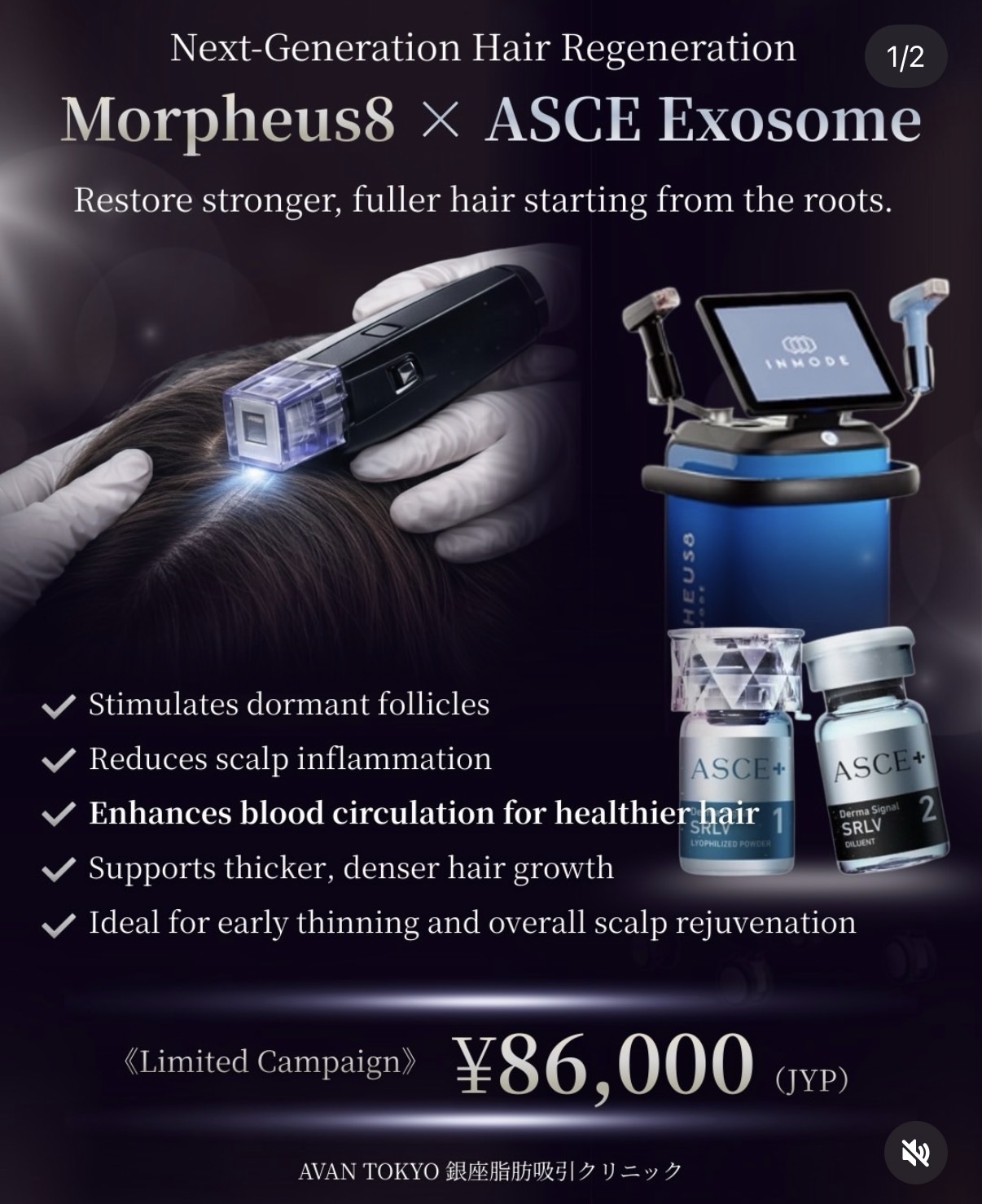
While drugs act on DHT and blood flow, stem cell conditioned media delivers a bundle of growth factors (VEGF, IGF-1, HGF, FGF, etc.) and cytokines that make up the hair follicle stem cell niche, aiming to correct chronic micro-inflammation and to lift the wound-healing environment. During post-surgical healing, subcutaneous microvasculature and collagen are being remodeled — a window in which scalp environment maintenance can be meaningful for both grafts and native follicles.
That said, conditioned media is not an injection that “grows additional transplanted hairs,” nor can it fully reverse miniaturization that has already progressed. Honest boundaries around indications and limits are essential.
When to begin scalp regenerative treatment after surgery
Wound healing and timeline
Until FUE or FUT wounds close (roughly 2–4 weeks post-op), scalp treatments involving needle penetration or RF are generally postponed. Once the epidermal barrier has recovered and crusts have fallen off — typically from 1–2 months post-op — conditioned media scalp injection or drug delivery can be considered in areas away from the surgical field. Coordination between the transplant surgeon and the regenerative medicine physician on treatment history and progress is a prerequisite.
Assessment and maintenance-phase design
The effect of post transplant hair loss care is assessed at 6–12 months post-op by evaluating “graft density” and “border recession” separately, combining standardized photography with microscope-based hair diameter measurement. If the border keeps receding, reconsider oral therapy, reset conditioned media dosing intervals, and adjust topical intensity. For related reading, please also see our hair regenerative medicine column index.
Summary
Post transplant hair loss care is designed not around graft survival, but around how to slow the AGA progression of the native hair that remains around the grafts. A pharmacologic base (oral + topical) with scalp environment maintenance via stem cell conditioned media forms a realistic three-layer strategy. To keep the aesthetic benefit of a transplant for the long term, treatment must be planned with the 1-, 3-, and 5-year picture in mind — not just the day of surgery.
Frequently Asked Questions
Q. If I have a hair transplant, do I no longer need AGA treatment?
No. A transplant restores the position and number of hairs moved, but it does not cure the underlying AGA constitution. Protecting the surrounding native hair generally requires continued post transplant hair loss care with oral and topical therapy.
Q. How long after surgery can I start stem cell conditioned media scalp treatment?
Most commonly, from about 1–2 months post-op once wounds have closed and crusts have shed, with introduction in areas away from the surgical field after consulting your transplant surgeon. Timing varies with technique and healing course.
Q. Will hair lost to shock loss grow back?
Transient shock loss at 2–8 weeks usually recovers over several months via a telogen phase. However, follicles already affected by AGA must be evaluated separately over a longer horizon.
Q. Will conditioned media make my transplanted hairs themselves thicker?
Graft caliber is largely set by the donor genetics of the follicle, so dramatic thickening from conditioned media cannot be promised. What it targets is the microenvironment of surrounding native follicles and the scalp environment during graft take.
──────────────
[Supervising physician] Dr. Shin Moriwaki
Member, Japan Society of Aesthetic Surgery (JSAS) / Member, American Academy of Aesthetic Medicine
ECFMG Certificate
──────────────
📍AVAN TOKYO Ginza Hair Regenerative Medicine
English / 中文 / Tiếng Việt supported
Inquiries via DM / LINE / Website / Phone.