


Can Patients with Atopic Dermatitis Undergo Liposuction? Skin Barrier Function and Wound Healing Risks — Dr. Moriwaki Explains2026.08.05
Patients with atopic dermatitis frequently ask us, “I want liposuction, but is my skin safe for it?” The conclusion is that atopic dermatitis liposuction can be performed safely provided the skin condition is stabilized in advance and the risks of infection, wound healing, and scarring are evaluated individually. That said, additional care is required both before and after surgery compared with patients who have unaffected skin. In this article, Dr. Moriwaki of AVAN TOKYO explains the topic through three medical lenses — skin barrier function, Staphylococcus aureus colonization, and wound healing — including the actual protocols we use in clinic.
Key Points of This Article
・Atopic dermatitis liposuction can be performed safely when the skin is in a stable phase.
・Patients with atopic dermatitis carry Staphylococcus aureus at very high rates, and post-operative infection risk has been reported to be higher than in unaffected skin.
・Two to four weeks of topical therapy and moisturization before surgery to restore the barrier is the single most important preparation.
・The timing of tapering topical steroids must be individualized to avoid a flare.
・A tendency toward hypertrophic scarring means that port placement design, post-op sun protection, and moisturization are essential.
The First Consideration in Atopic Dermatitis Liposuction: Skin Barrier Function
The essence of atopic dermatitis is not simply “rough skin” but a breakdown of skin barrier function. In the stratum corneum, filaggrin protein and intercellular lipids such as ceramides and free fatty acids work like “bricks and mortar” to prevent water loss and entry of external substances. In atopic patients, filaggrin gene mutations and reduced ceramide synthesis thin this “mortar,” and transepidermal water loss (TEWL) is known to reach two to five times that of normal skin.
Three ways a compromised barrier affects liposuction
First is irritation from antiseptics and local anesthetic tapes. Chlorhexidine and povidone-iodine sting even normal skin, but on a compromised barrier the sensation is stronger and contact dermatitis is more likely.
Second is rashes from post-op compression garments and tapes. Compression must be maintained for weeks after liposuction, and friction from synthetic fibers or trapped sweat easily triggers a flare, so material choice and how the garment is worn require thought.
Third is dryness and delayed healing at wound sites. Higher TEWL makes a moist environment harder to maintain and affects the speed of re-epithelialization. We advise our patients to moisturize more frequently after surgery than a person with normal skin would.
The Most Critical Concern in Atopic Dermatitis Liposuction: Staphylococcus aureus
Staphylococcus aureus is carried on the skin of only 5–30% of healthy individuals, but multiple dermatology studies have reported that it colonizes 80–90% of lesional skin and is present at high frequency on non-lesional areas in patients with atopic dermatitis. Staphylococcus aureus is also among the most commonly identified pathogens in post-liposuction infection, and this difference in colonization rate cannot be clinically ignored.
At AVAN TOKYO, for atopic patients undergoing liposuction, we build an individualized protocol that includes pre-operative skin condition assessment, careful surgical site cleansing, and — when indicated — an extended course of pre-operative antibiotic prophylaxis. However, because excessive prophylaxis promotes antimicrobial resistance, the principle is always a design tailored to the case.
Skin Conditioning in the 2–4 Weeks Before Surgery
The biggest difference in outcomes for this procedure comes not from the surgery itself but from the skin preparation beforehand. The more stable the barrier at the time of surgery, the lower the infection risk and the calmer the final scars.
Recommended concrete steps include:
・Continue the topical regimen prescribed by your dermatologist (topical steroid, tacrolimus ointment, delgocitinib, etc.) and bring flares under control first.
・Apply a moisturizer (heparinoid, petrolatum, ceramide-containing creams, etc.) two to three times daily to lower TEWL as much as possible.
・Avoid nylon towels and very hot baths to reduce mechanical irritation to the skin.
・Ensure adequate intake of nutrients that support wound healing, such as iron, zinc, and vitamins A, C, and D.
A common question is whether topical steroids can be used right up until surgery. Regular use on areas away from the incision sites does not meaningfully impair wound healing. Application directly on the surgical site is decided individually, balancing the risk of a flare against local immunosuppression.
Scarring and Hypertrophic Scar Risk in Atopic Patients
Atopic dermatitis is characterized by a Th2-dominant immune response, and the cytokine balance during wound healing differs from that of unaffected patients. As a result, the risk of hypertrophic scarring (raised, red scars) tends to be higher than in normal skin. This is different from true keloid diathesis, but post-op scar management is even more important than usual.
Design considerations for port placement
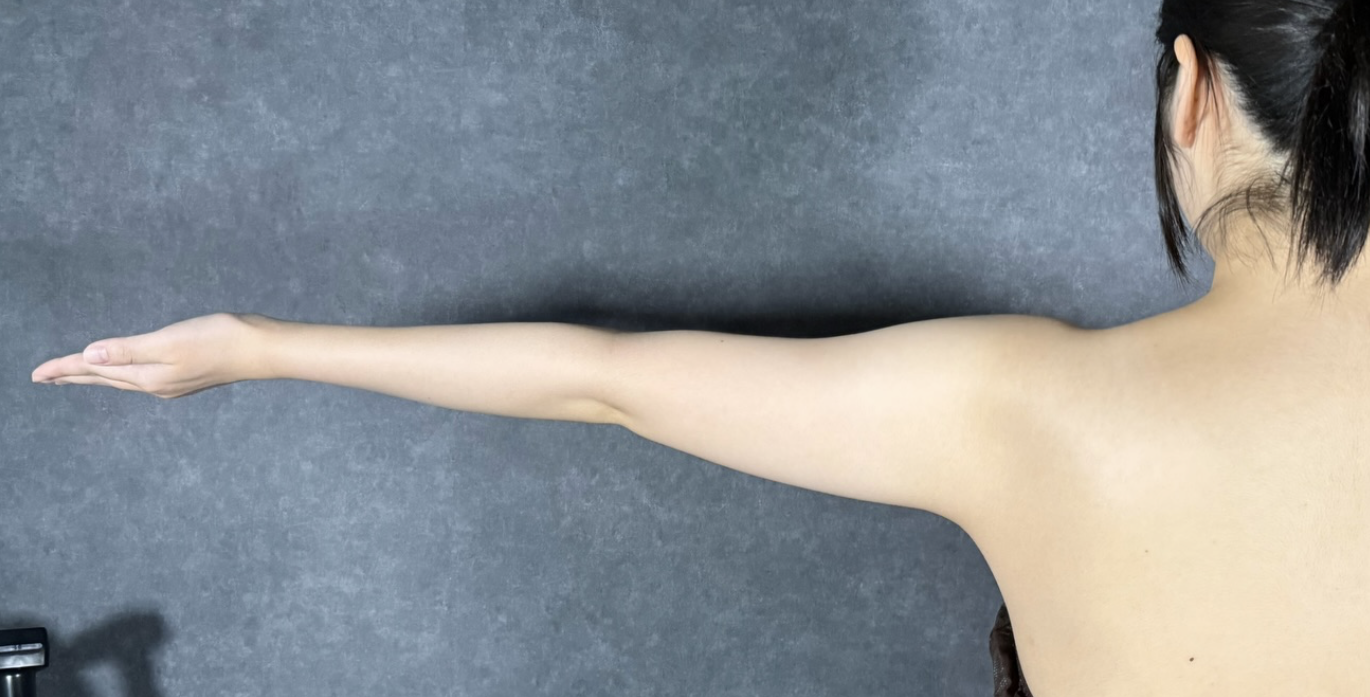
Liposuction ports are usually only 3–5 mm, but in atopic patients we further emphasize three points: hidden location, no tension, and minimum number of incisions. On the upper arm we place them within the natural skin folds of the axilla; on the abdomen we place them inside the underwear line — locations that avoid daily friction and tension after surgery.
For three months post-op we ask patients to continue UV protection and scar care with silicone gel sheeting or taping. Because post-inflammatory hyperpigmentation (PIH) tends to be more pronounced in atopic patients, UV protection must be even more thorough than in the general population.
Decisions Around Topical Steroids, Biologics, and JAK Inhibitors
Treatment options for atopic dermatitis have expanded rapidly. Beyond topical agents, biologics such as dupilumab (Dupixent®) and JAK inhibitors such as baricitinib and upadacitinib are now widely used. Each class requires a different approach before liposuction.
・Topical steroids and tacrolimus: Regular use away from the surgical site is not a problem.
・Dupilumab: Systemic immunosuppression is limited and continuation is generally acceptable — but confirm with the prescribing physician.
・JAK inhibitors: Because they may increase infection and thrombosis risk, a washout period should be considered.
・Long-term systemic steroids: Evaluate individually for delayed wound healing and increased infection risk.
In every case, do not decide to stop or continue medication on your own — close coordination between your dermatologist and your cosmetic surgeon is essential.
Should Atopic Patients Give Up on Liposuction?
The conclusion is that atopic dermatitis liposuction is not an absolute contraindication and can be performed safely with proper preparation. When you choose a period when the skin is stable, spend two to four weeks preparing the barrier, and carefully design your infection prevention and scar care, an outcome comparable to that of patients with normal skin is achievable.
However, when eczema is widely active or scratch marks are fresh, we recommend postponement. Rather than “I want it now,” please prioritize “I want it done at the time it will heal most beautifully.” Because individual variation is large, please start with a consultation so we can assess your skin.
For safety standards and pre-operative evaluation in cosmetic surgery, please also refer to the Japan Society of Aesthetic Surgery (JSAS). Our other case reports and risk articles can be found in the liposuction column archive.
Frequently Asked Questions
Q. My atopic dermatitis is only on my face — can I still have upper arm liposuction?
If the skin at the surgical site is normal, facial atopic dermatitis alone is not a reason to avoid liposuction. However, because systemic immune tendencies raise infection and inflammation risk somewhat, we assess overall condition carefully before surgery.
Q. How many days before surgery should I stop using topical steroids?
Regular-dose use on areas other than the surgical site does not need to be stopped. Application directly on the surgical site is typically adjusted around 48–72 hours before surgery, though this depends on the severity of symptoms. Do not stop on your own judgment.
Q. Is it true that scars are more noticeable in atopic patients?
There is a tendency toward hypertrophic scarring. However, port incisions are only 3–5 mm, and with careful placement design and diligent post-op sun protection, moisturization, and silicone gel sheeting, most cases fade over 6–12 months.
Q. What should I do if the compression garment causes a rash?
Please consult your dermatologist or our clinic first. We can respond with material changes, layering with cotton undergarments, or splitting the wearing time. Removing compression completely on your own will affect the result, so please consult us before making changes.
Q. Can I have liposuction while I am using Dupixent?
Because dupilumab does not have strong systemic immunosuppressive effects, patients can generally continue it and undergo liposuction. That said, we recommend coordinating dosing schedule and surgery date with the prescribing physician.
──────────────
【Supervising Physician】Shin Moriwaki, MD (Supervisor)
Member, Japan Society of Aesthetic Surgery (JSAS) / Member, American Academy of Aesthetic Medicine
ECFMG Certificate (US Medical Licensing Qualification)
──────────────
📍AVAN TOKYO GINZA LIPOSUCTION CLINIC
English / 中文 / Tiếng Việt supported
Reservations and consultations are accepted via
DM / LINE / Website / Phone.