Why Stem Cell Conditioned Media Is Suitable for Diffuse Hair Loss in Women2026.03.04
— A Condition That Cannot Be Explained by Hormones Alone
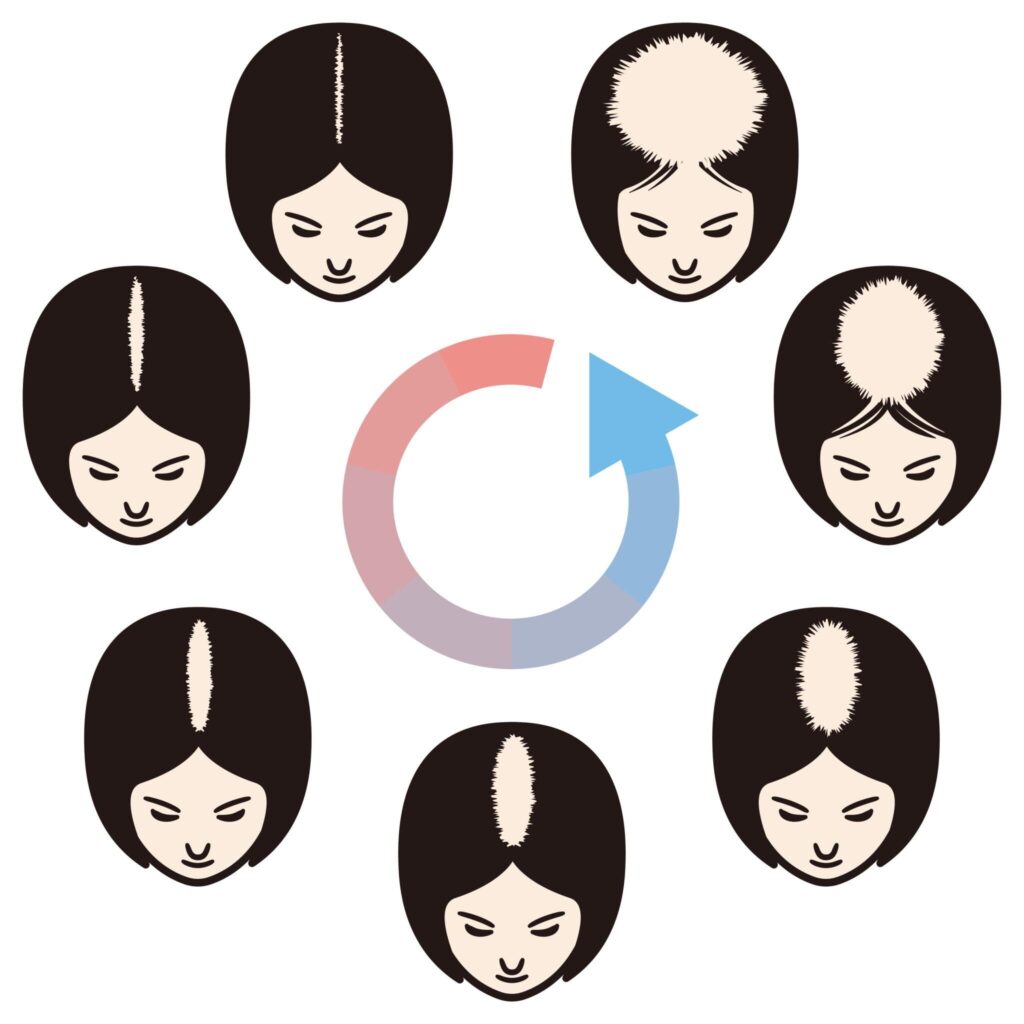
Female hair loss often appears differently from male pattern baldness.
Rather than a receding hairline, many women experience diffuse thinning across the entire scalp.
Common concerns include:
- A widening part line
- A thinner ponytail
- Loss of volume at the crown
- Visible scalp through the hair
In recent years, more women have been seeking treatment for these issues.
During consultations, we often hear the same phrase:
“My hormone test results were normal.”
This highlights one of the main challenges in treating female hair loss.
Female Hair Loss Cannot Be Explained by Hormones Alone
Male pattern baldness is primarily driven by
DHT (dihydrotestosterone).
However, female diffuse hair loss is usually influenced by multiple factors:
- Micro-inflammation around hair follicles
- Reduced activity of hair follicle stem cells
- Poor scalp circulation
- Postpartum hormonal changes
- Stress
- Nutritional factors
- Age-related follicle miniaturization
In many cases, it is better understood as:
A decline in the regenerative capacity of hair follicles.
Why Stem Cell Conditioned Media Has Gained Attention
Stem Cell Conditioned Media (SCCM) is essentially
a collection of regenerative signals secreted by stem cells.
It contains:
- Growth factors (FGF, VEGF, IGF)
- Anti-inflammatory cytokines
- Exosomes (cell-to-cell communication signals)
These factors may influence hair follicles in several ways:
✔ Activation of hair follicle stem cells
✔ Reduction of chronic micro-inflammation
✔ Stimulation of dermal papilla cells
✔ Promotion of new blood vessel formation
In simple terms, it works by
Regenerating the environment around hair follicles.
Why It Is Particularly Effective for Female Diffuse Hair Loss
In many women with diffuse thinning,
hair follicles are not permanently destroyed.
Instead:
- Hair shafts become thinner
- The growth phase becomes shorter
- The resting phase becomes longer
In other words,
The follicles are “dormant.”
Delivering regenerative signals to these follicles is therefore a rational treatment strategy.
AVAN TOKYO’s Approach: Delivery Matters
In regenerative medicine,
how the treatment is delivered
is often more important than what is used.
At AVAN TOKYO, we combine:
- Precise scalp injections
- Drug delivery techniques such as Morpheus8
- Treatment designs that consider scalp circulation
This allows the regenerative factors to reach
the layers where hair follicle stem cells reside.
Treatment Frequency
Typical protocol:
Initial phase
Every 2–4 weeks × 3–5 sessions
Maintenance phase
Every 2–3 months
Because the hair cycle is long,
visible improvement often appears after 3–6 months.
Conclusion: A New Era of Regenerative Treatment for Female Hair Loss
Female diffuse hair loss cannot be explained solely by hormones or aging.
The key question is:
How can we restore the regenerative capacity of hair follicles?
Stem Cell Conditioned Media targets:
- Hair follicle stem cells
- Dermal papilla cells
- The scalp environment
making it a next-generation regenerative treatment for hair loss.
At AVAN TOKYO, we integrate surgical knowledge, dermatology, and regenerative medicine to design treatments that create
a scalp environment where hair can grow again.