Postpartum Hair Loss and Stress-Related Hair Loss2026.03.07
What Can Stem Cell Conditioned Media Actually Change?

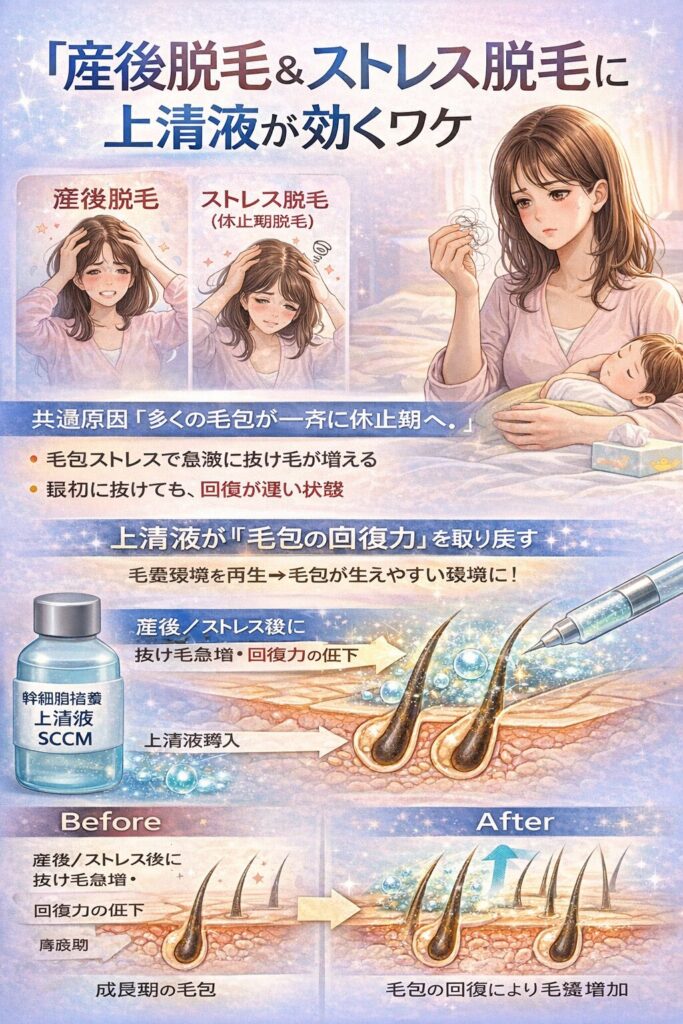
It is not uncommon for women to suddenly experience increased hair shedding after childbirth, or notice that their hair becomes thinner following periods of intense stress.
These conditions—postpartum hair loss and stress-related hair loss (Telogen Effluvium)—are forms of hair loss that many women may experience.
Although patients are often told that “hair will grow back over time,” many women visit clinics because of persistent concerns such as:
- Hair shedding that does not stop
- A widening hair part that does not recover
- Hair becoming thinner than before
So what role can Stem Cell Conditioned Media (SCCM) play in these conditions?
The Common Mechanism
Disruption of the Hair Cycle
Hair normally grows through a repeating cycle:
- Growth phase (Anagen)
- Regression phase (Catagen)
- Resting phase (Telogen)
However, after childbirth or severe stress, a large number of hair follicles can prematurely shift into the telogen phase simultaneously.
As a result, several months later patients may experience:
- Sudden excessive hair shedding
- Reduced hair volume
- Thinner hair shafts
The Real Problem Is Not the Shedding
But the Speed of Recovery
Many cases of telogen effluvium eventually recover naturally.
However, in clinical practice we often see:
- Recovery taking more than a year
- Hair density not returning to the previous level
- Hair remaining thinner than before
This delayed recovery is often related to factors such as:
- Micro-inflammation around hair follicles
- Reduced activity of hair follicle stem cells
- Poor scalp circulation
- Hormonal and nutritional imbalance
In other words,
the environment needed for follicles to function normally again is not fully restored.
What Stem Cell Conditioned Media Can Do
Stem Cell Conditioned Media is essentially a collection of regenerative signals secreted by stem cells.
It contains:
- Growth factors (FGF, VEGF, IGF)
- Anti-inflammatory cytokines
- Exosomes (cell-to-cell signaling molecules)
When delivered to the scalp, these factors may help:
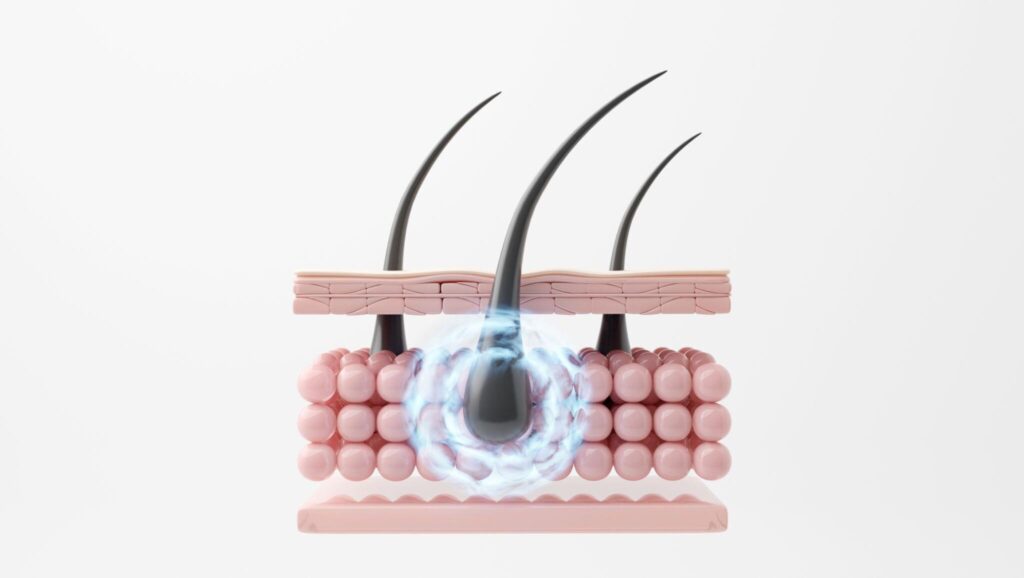
✔ Reactivate hair follicle stem cells
✔ Improve dermal papilla activity
✔ Reduce chronic inflammation
✔ Improve microcirculation around follicles
In simple terms,
it helps rebuild a scalp environment where hair can grow again.
Why Delivery Matters at AVAN TOKYO
In regenerative medicine,
how the treatment is delivered is often more important than the material itself.
At AVAN TOKYO, we combine:
- Precise scalp injections
- Drug delivery techniques such as Morpheus8
- Treatment designs that consider scalp blood flow
to ensure that regenerative signals reach the layer where follicular stem cells reside.
Treatment Frequency
Typical protocol:
Initial treatment
Every 2–4 weeks × 3–5 sessions
Maintenance phase
Every 2–3 months
Because of the hair growth cycle,
visible improvement is often noticed after 3–6 months.
A New Perspective on Postpartum and Stress-Related Hair Loss
While postpartum and stress-related hair loss often recover naturally, many patients want:
- Faster recovery
- Restoration of previous hair density
- Improvement of thinning hair
In such cases, regenerative medicine approaches that restore the scalp environment can be highly beneficial.
At AVAN TOKYO, we integrate knowledge from surgery, dermatology, and regenerative medicine to create
a scalp environment that allows hair to grow again.