


Does the Treatment Interval Change with Age? Dr. Moriwaki Reworks the Frequency and Timing of Stem Cell Conditioned Media Based on Follicular Recovery in Your 20s, 40s, and 60s2026.07.17
“Should I get stem cell conditioned media scalp treatment once a month, or is once every three months enough?” — a question we hear often in the clinic. The answer changes substantially with age and follicular status. Even with the same complaint of thinning, the follicular recovery capacity, hair-cycle length, and scalp environment differ in your 20s, 40s, and 60s, so the protocol for how frequently and how many times to inject stem cell conditioned media must be redesigned accordingly. In this article, Dr. Moriwaki organizes how to think about the dosing design of stem cell conditioned media by decade.
Key Points of This Article
・The interval for stem cell conditioned media is not one-size-fits-all; it should be redesigned around each decade’s follicular recovery capacity and hair-cycle length.
・In your 20s, follicles retain reserve and respond quickly, but the priority is defensive — holding back progression — while extending intervals early to avoid overtreatment.
・In your 40s, build a thicker induction phase and individualize maintenance. Objective indicators are the key to catching phases of weak response.
・In your 60s, the axis shifts from “growing more” to “preserving what remains,” prioritizing sustainability over frequency.
・What ultimately determines the interval is not age itself but three indicators: hair-cycle synchrony, scalp environment, and the presence of concomitant medication.
Why the Same Interval Cannot Fit Every Age Group
Collecting information on hair regeneration, you often encounter standard protocols like “once a month, six times as one cycle.” This is only an average guideline, not necessarily optimal for everyone. Follicular recovery capacity gradually declines with age, and the length of the hair cycle (anagen–catagen–telogen) also shifts. Younger follicles retain higher proliferative capacity, blood flow, and sensitivity to growth factors, so signals delivered by stem cell conditioned media tend to translate into visible change sooner. As age advances, both the time it takes for a response to appear and the duration of the effect become more variable.
Follicles in Your 20s: High Reserve, But Prioritize Defense
Follicles in your 20s have strong proliferative capacity and rich scalp blood flow. Response to topical or oral minoxidil is comparatively good, and patients often notice improvements in hair quality and firmness early when stem cell conditioned media is introduced. What matters most in 20s AGA, however, is holding progression back rather than pushing offense. When DHT-sensitive follicles begin shifting to telogen, the basic combination is oral finasteride or dutasteride to slow progression, while stem cell conditioned media conditions the scalp environment to prolong anagen.
Follicles in Your 40s: Slower Response and a Redrawn Maintenance Line
By your 40s, anagen per follicle shortens and the return from telogen to anagen also takes longer. When patients say “the effect feels weaker than before,” this stretched hair cycle is often the background. In your 40s, design a thicker induction phase and repeatedly deliver growth-factor signals to anagen follicles. Once in maintenance, the key is objective evaluation — combining photography, trichoscopy, and hair-caliber measurement — so weak-response periods are not overlooked.
Follicles in Your 60s: “Maintain and Preserve Quality” Over “Grow More”
From your 60s onward, regenerating already-lost follicles is difficult with stem cell conditioned media alone. The realistic goal shifts to “not losing more of what remains” and “preserving hair quality.” Increasing frequency does not produce proportional gains; sustainability — whether you can keep coming in, whether the scalp can tolerate the load — takes priority.
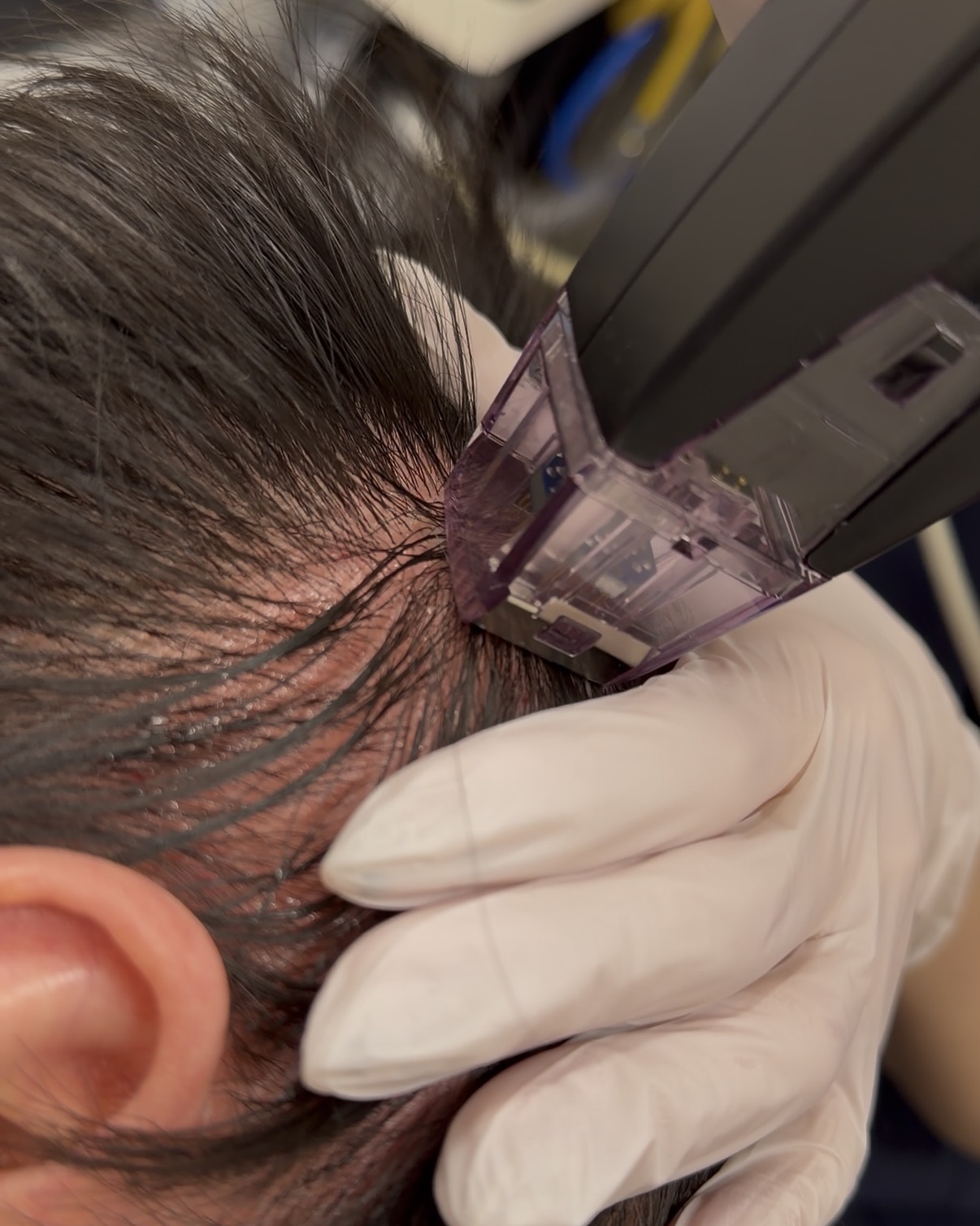
Designing Intervals by Decade
Your 20s: Monthly Induction, Then Stretch Maintenance to Every Three Months
In your 20s, the induction phase of 3–4 months is delivered once a month, concentrating stem cell conditioned media signaling on anagen follicles. If oral and topical therapies are working, maintenance intervals can often be extended to once every three months while preserving density. Young patients respond fast but are also prone to the psychology of “wanting to do more treatment,” so objective indicators help avoid unnecessary top-up sessions.
Your 40s: Thicker Induction, Individualized Maintenance
In your 40s, a typical design is a 5–6 session monthly induction, followed by maintenance at 2–3 month intervals. Be careful about the “rushed judgment during induction” trap in this decade. Effects usually begin appearing around 3 months and become visually apparent over 6 months; cutting things short midway forfeits responses that would have arrived. Maintenance intervals should be reviewed against measurement apps and microscope images, and shortened again when regression is detected — individualization is realistic.
Your 60s: Prioritize Sustainability Over Frequency
In your 60s, stable visits every 2–3 months over the long term often preserve the scalp environment better than intensive monthly sessions. Increasing frequency does not raise the ceiling of recovery capacity, and cost and travel burden more often prevent continuation. Designing “a protocol that can be continued for a decade or more” from the start matters most for this age group.
Three Indicators That Matter More Than Age When Setting Intervals
Hair-Cycle Synchrony
In postpartum shedding or shedding after acute stress, many follicles enter telogen simultaneously and return to anagen with lags. The best timing for stem cell conditioned media varies with this synchrony. Read the phase of the cycle before you read the age.
Scalp Environment (Inflammation, Seborrhea, Dryness)
If seborrheic dermatitis, scalp acne, or dry scalp remain, inflammatory cytokines in the background impair signal delivery to follicles. Treat the underlying dermatologic condition first, and design intervals only after the environment is stabilized.
Concomitant Therapy (Oral / Topical)
Whether finasteride, dutasteride, or minoxidil is used alongside changes the interval design of stem cell conditioned media. If progression is well controlled with oral therapy, intervals can be extended; when used as monotherapy, induction must be thicker. See our column archive at avan-tokyo.com/stem-cell/column/. For AGA guidelines, refer to the Japanese Dermatological Association.
Frequently Asked Questions
Q. Does stem cell conditioned media always require monthly sessions?
Not necessarily. In 20s maintenance or in your 60s, intervals of 2–3 months often preserve density. The right interval varies with age, hair-cycle status, and concomitant therapy. Monthly induction is a common baseline, but maintenance frequency should be individualized.
Q. If I do many sessions early in life, will hair grow back faster?
Higher frequency does not produce proportional growth. Follicular responses follow the anagen–catagen–telogen cycle; growth factors delivered to a telogen follicle do not activate it immediately. Overtreatment increases cost and cumulative physical stress to the scalp without matching gain.
Q. In your 40s, how long until effects are felt?
As a guideline, changes in hair quality and firmness begin around 3 months, and hair-volume changes become visually apparent over 6 months. Individual variation exists, but avoid judging mid-induction. Time-lapse photography and microscope records make later evaluation easier.
Q. Is there value in starting stem cell conditioned media in your 60s?
Yes. The goal reframes from “growing new hair” to “maintaining what remains and preserving hair quality.” Designing a sustainable interval and cost structure at the outset matters more than the yes/no decision itself.
Q. Is it OK to change intervals midway through treatment?
Yes. In fact, reviewing intervals with treatment response is the basic principle. Extend intervals when maintenance holds density; shorten them when regression appears. Adapting the design to the course is more medically natural than sticking rigidly to a fixed package.
──────────────
【監修】森脇 進 / Shin Moriwaki(監修医師)
日本美容外科学会(JSAS)会員 / American Academy of Aesthetic Medicine 会員
ECFMG Certificate
──────────────
📍AVAN TOKYO 銀座 毛髪再生医療
AVAN TOKYO Ginza Hair Regenerative Medicine
English / 中文 / Tiếng Việt available
Contact us via DM / LINE / Website / Phone.